• Login / Join
  • About
  • •
  • Contact
  • •
  • Advertising
bustler logo
bustler logo
  • News
  • Competitions
  • Events
  • Bustler is powered by Archinect
  • Sign up for Bustler's Email Newsletters

  • Follow these Bustler feeds:

  • Search

    Search in

  • Submit

    What are you submitting?

    News Pitch
    Competition
    Event
  • Login / Join
  • News|Competitions|Events
  • Search
    | Submit
    | Follow
  • Search in

    What are you submitting?

    News Pitch
    Competition
    Event

    Follow these Bustler feeds:

  • About|Contact|Advertising
  • Login / Join

AS+GG Designs Dancing Dragons Complex for Seoul's Yongsan District

By Bustler Editors|

Thursday, May 10, 2012
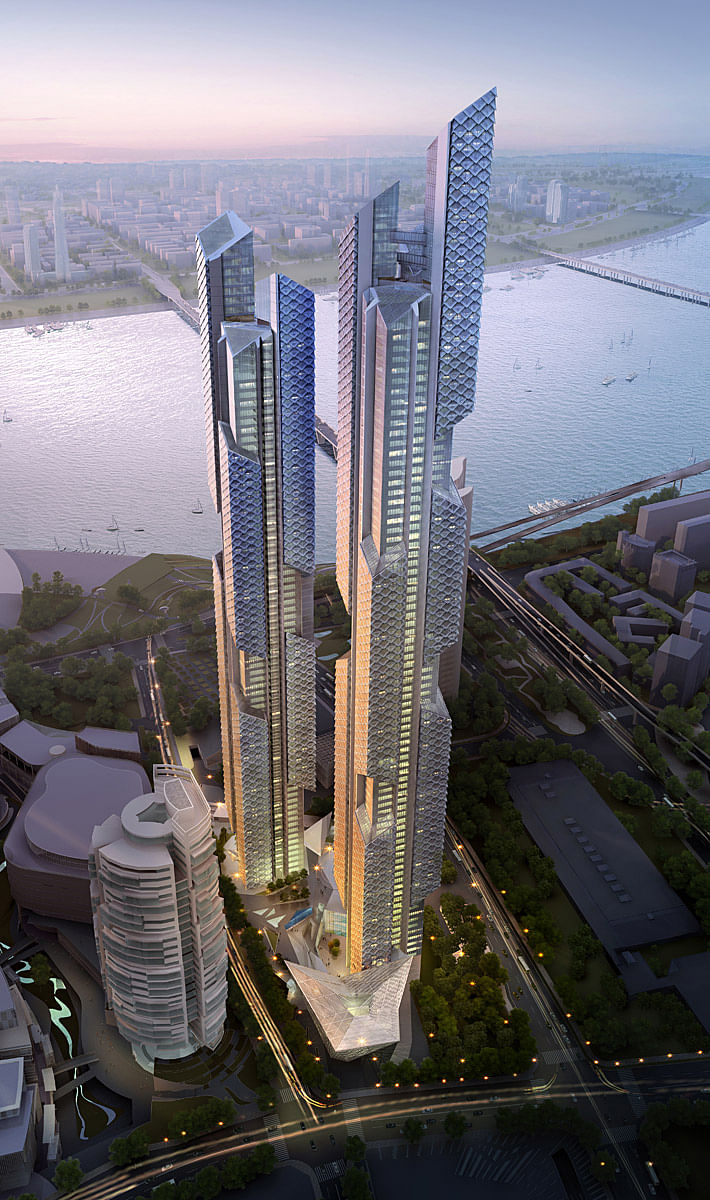
Aerial view of the AS+GG-designed Dancing Dragons Complex for the new Yongsan International Business District in Seoul, South Korea (Image: Adrian Smith + Gordon Gill Architecture)

Chicago-based firm Adrian Smith + Gordon Gill Architecture just released its design for Dancing Dragons, a pair of landmark supertall mixed-use towers for the new Yongsan International Business District in Seoul, South Korea. The buildings, which include residential, “officetel” and retail elements, consist of slender, sharply angled mini-towers cantilevered around a central core.

Project Description from the Architects:

The mini-towers feature a dramatic series of diagonal massing cuts that create living spaces that float beyond the structure.This recalls the eaves of traditional Korean temples—a design theme echoed both in the geometry of the building skin and the jutting canopies at the towers’ base. The theme is extended in the building skin, which suggests the scales of Korean mythical dragons, which seem to dance around the core—hence the project’s name. (Yongsan, the name of the overall development, means “Dragon Hill” in Korean.)

Dancing Dragons’ scale-like skin is also a performative element. Gaps between its overlapping panels feature operable 600-mm vents through which air can circulate, making the skin “breathable” like that of certain animals.
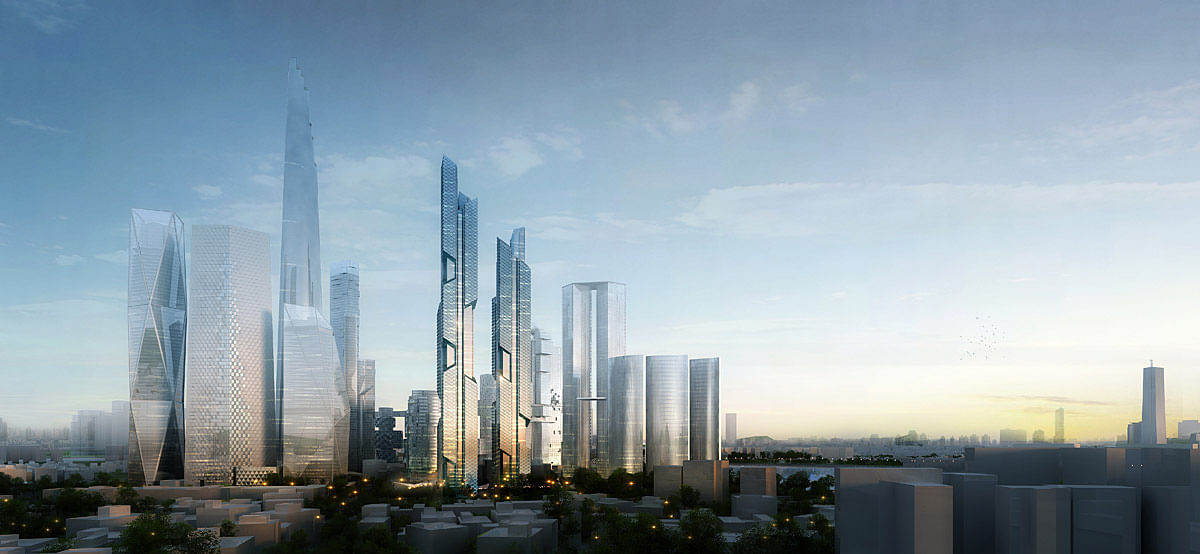
Overall view, north (Image: Adrian Smith + Gordon Gill Architecture)

Towers 1 and 2—about 450 meters and 390 meters tall, respectively—share an architectural language and, therefore, a close family resemblance, but are not identical. In the taller structure, the 88-level Tower 1, the massing cuts at the top and bottom of the mini-towers are V-shaped. In the 77-level Tower 2, the cuts move diagonally in a single unbroken line; they are also arranged in a radial pattern around the core that is perceptible as viewers move around the tower.
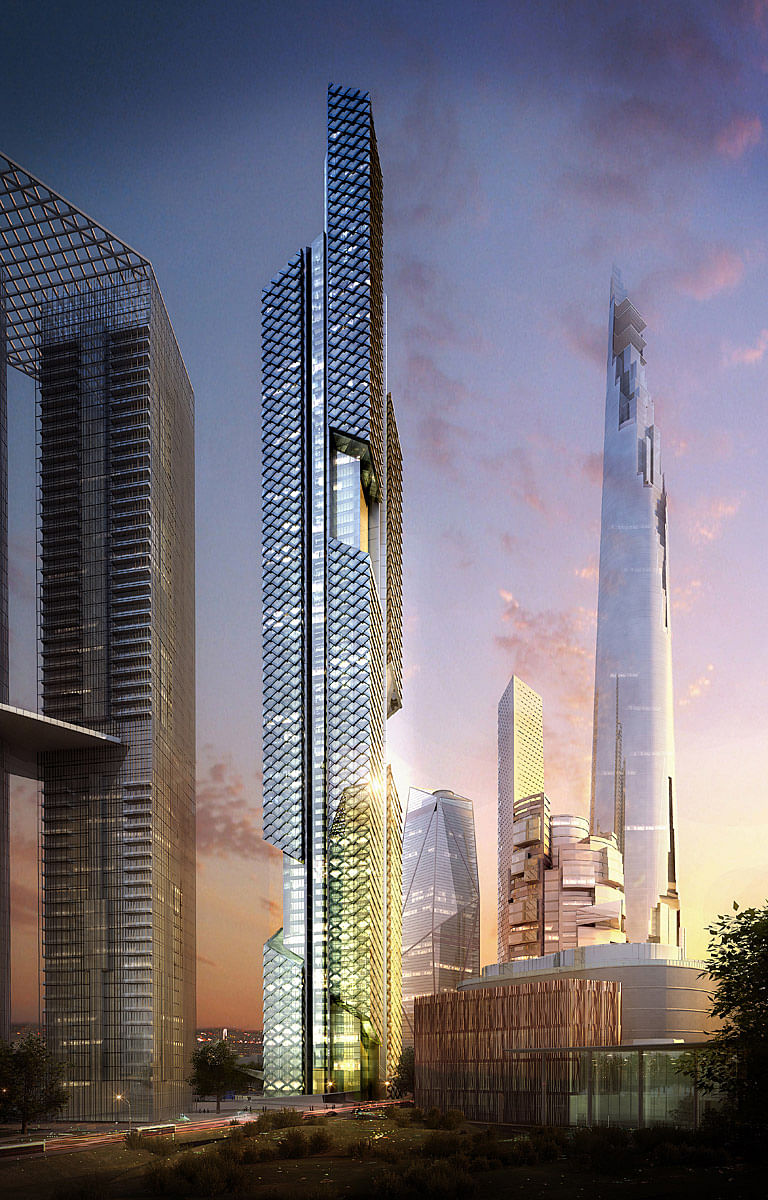
Tower 2 at dusk (Image: Adrian Smith + Gordon Gill Architecture)

“There’s a sympathetic and complementary relationship between the two masses at the level of the cuts, almost as though they were dancing,” says Adrian Smith, FAIA, RIBA. “It’s always important for our designs to reflect and interpret the cultures they serve, and the Dancing Dragons complex certainly does that, although in an abstract and highly technological manner. We try to design in a way that is at once beautiful and focused on performance.”
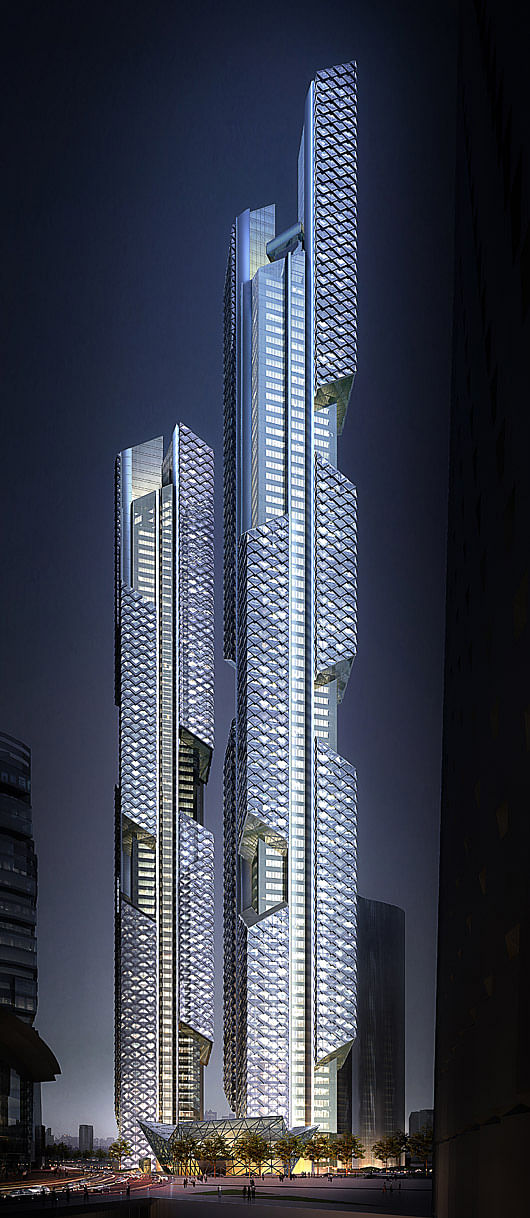
Tower 1 and Tower 2 at night (Image: Adrian Smith + Gordon Gill Architecture)

In both buildings, the mini-tower cuts are clad in glass at the top and bottom, making for dramatic skylights above the units at the highest levels and a transparent floor beneath the units at the lowest levels. This offers the opportunity for special high-value penthouse duplex units with spectacular 360-degree views of downtown Seoul and the adjacent Han River, along with an abundance of natural light.
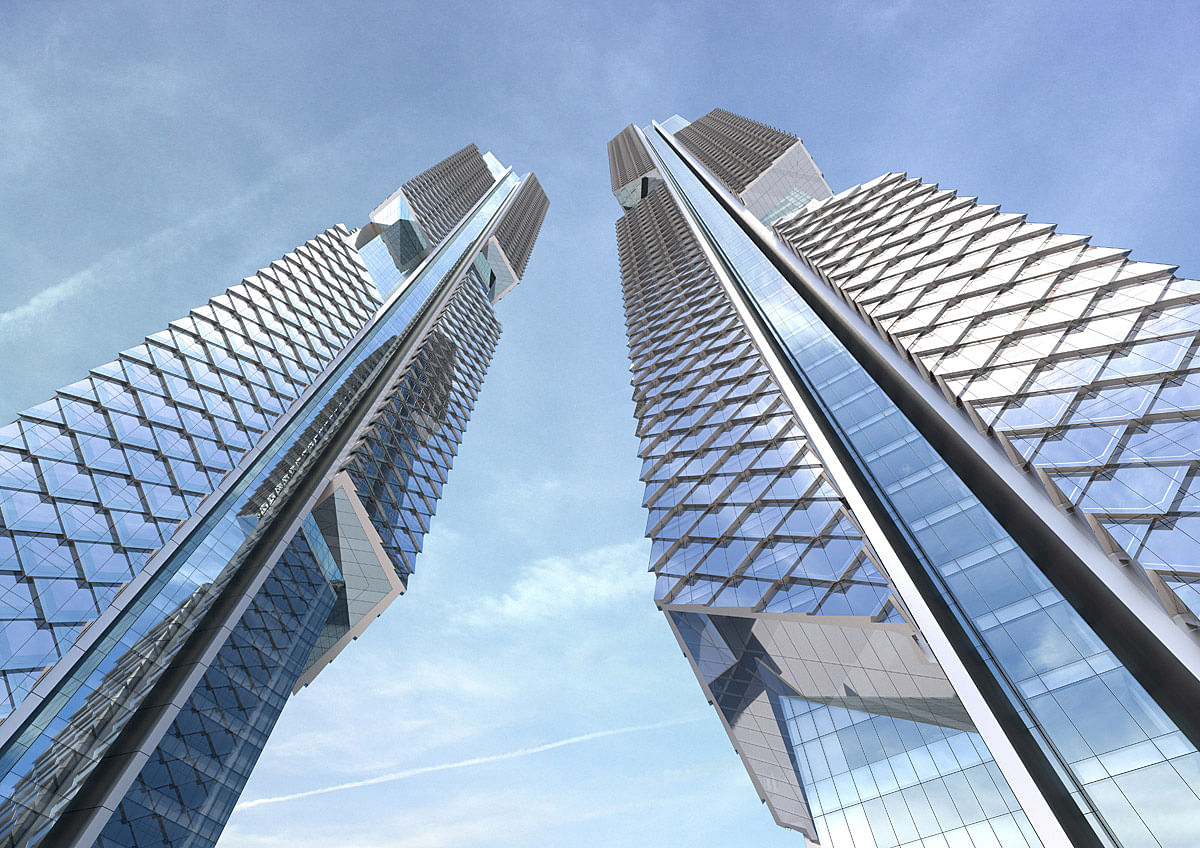
Tower 1 and Tower 2 looking up (Image: Adrian Smith + Gordon Gill Architecture)

“The abstract recall of the historic structures gives the towers a unique perspective from the ground and the sky while creating unique interior experiences,” says Gordon Gill, AIA. “The shingled texture of the skin is developed with integrated breathable mullions and self-shading cantilevers. It’s a great honor to be joining several other top international architecture firms designing buildings for this remarkable master plan by Studio Daniel Libeskind.”
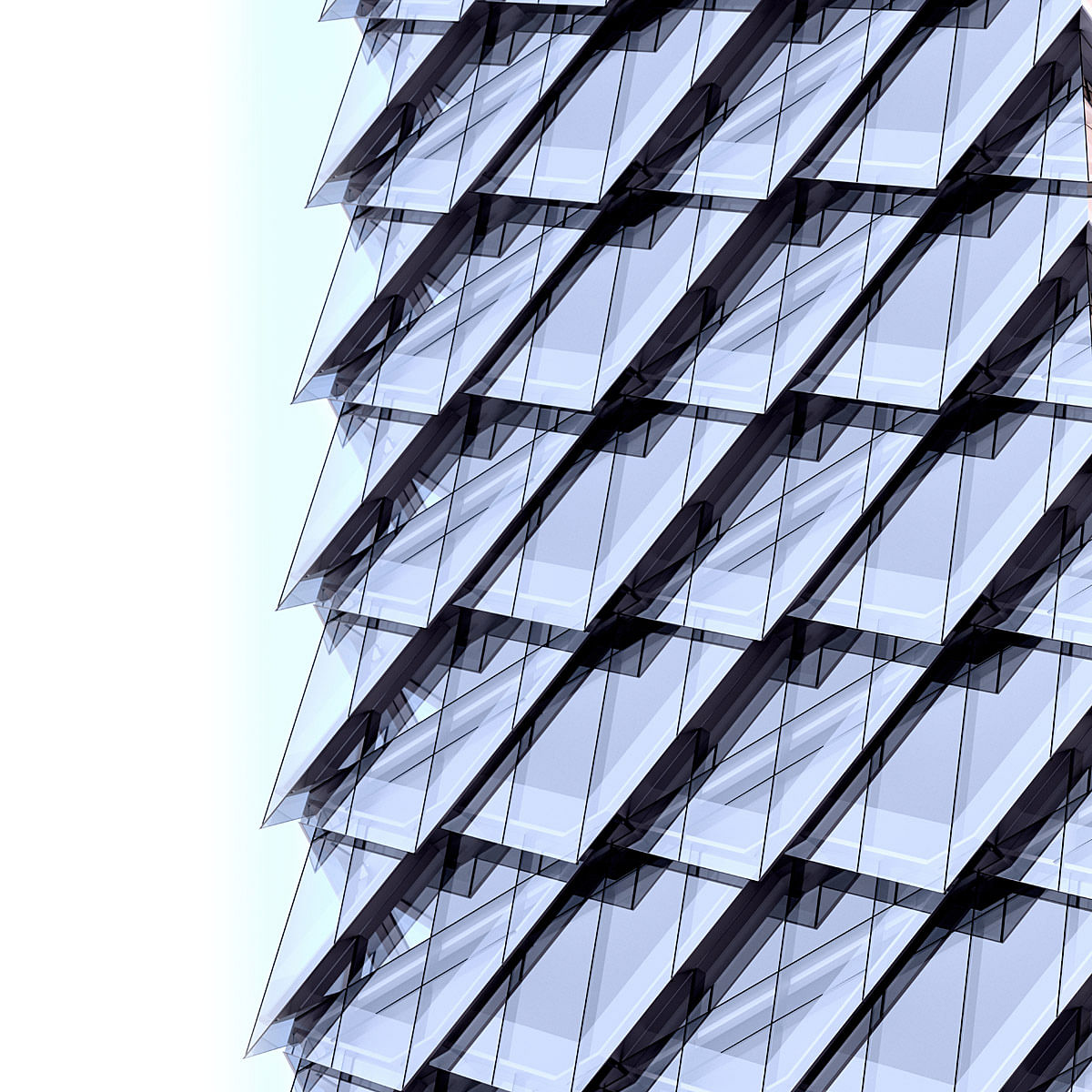
Tower 1 facade close-up (Image: Adrian Smith + Gordon Gill Architecture)

AS+GG partner Robert Forest, AIA, notes that Dancing Dragons represents AS+GG’s second major project in downtown Seoul. The other is the Head Office of the Federation of Korean Industries, an innovative and highly sustainable office building now under construction and scheduled to be completed next year. “We’re very excited to be making a sustainable contribution to the built environment of Seoul, one of the world’s great cities, in a manner that addresses the need for sustainable high density development while respecting Korean culture,” Forest says. “YIBD, which promises to become one of Seoul’s most dynamic and vital neighborhoods, will be an example of high-quality high-density design, and we’re proud to be a part of that.”
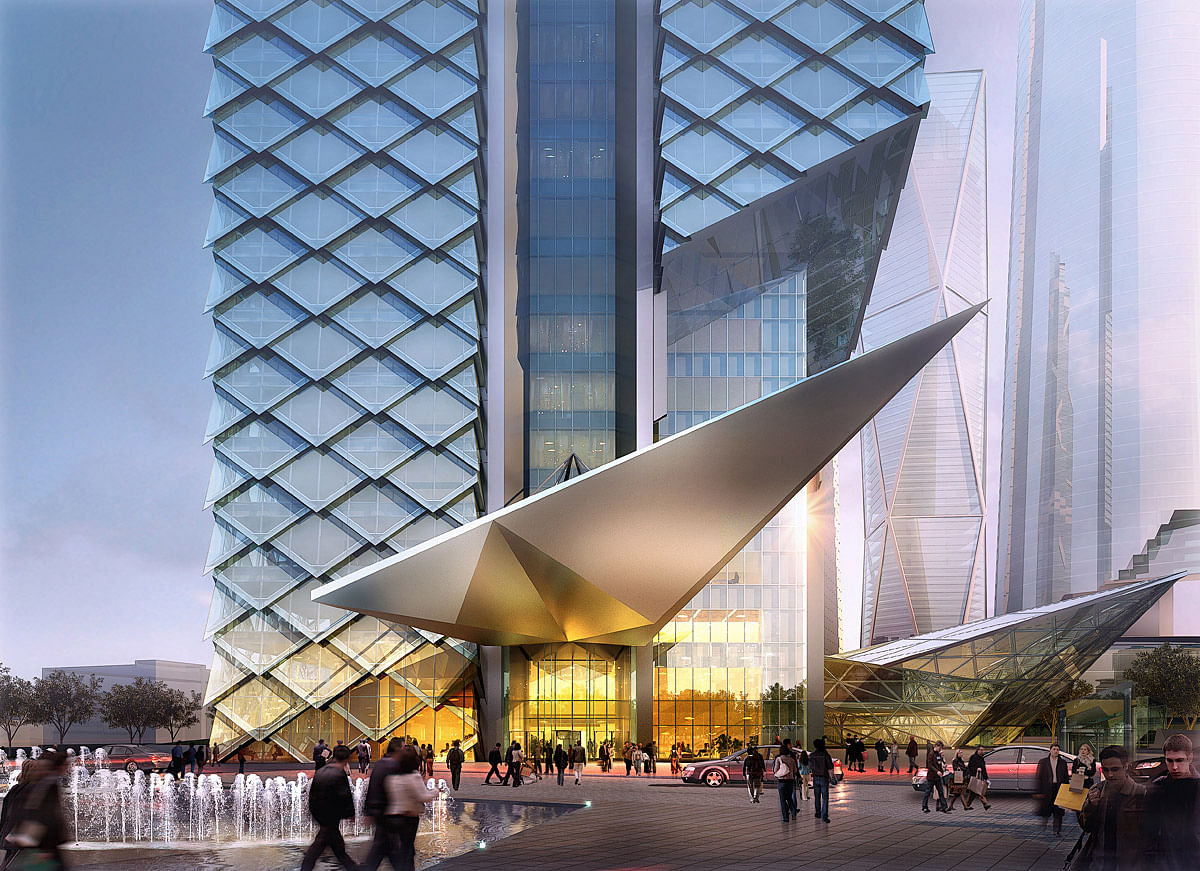
Tower 1 drop-off (Image: Adrian Smith + Gordon Gill Architecture)

The design team also includes PositivEnergy Practice, a Chicago-based engineering and energy consulting firm that is designing a series of innovative building systems for the project. Sustainable features of the building system design include triple-glazed window units, which minimize heat loss; an overlapping exterior wall system, which creates a self-shading effect; and natural ventilation in all units through operable mullions. Other systems include radiant heating; fuel-cell cogeneration units at the basement level; photovoltaic arrays on the roof surfaces; daylight-linked lighting controls; and heat recovery via electric centrifugal chillers.
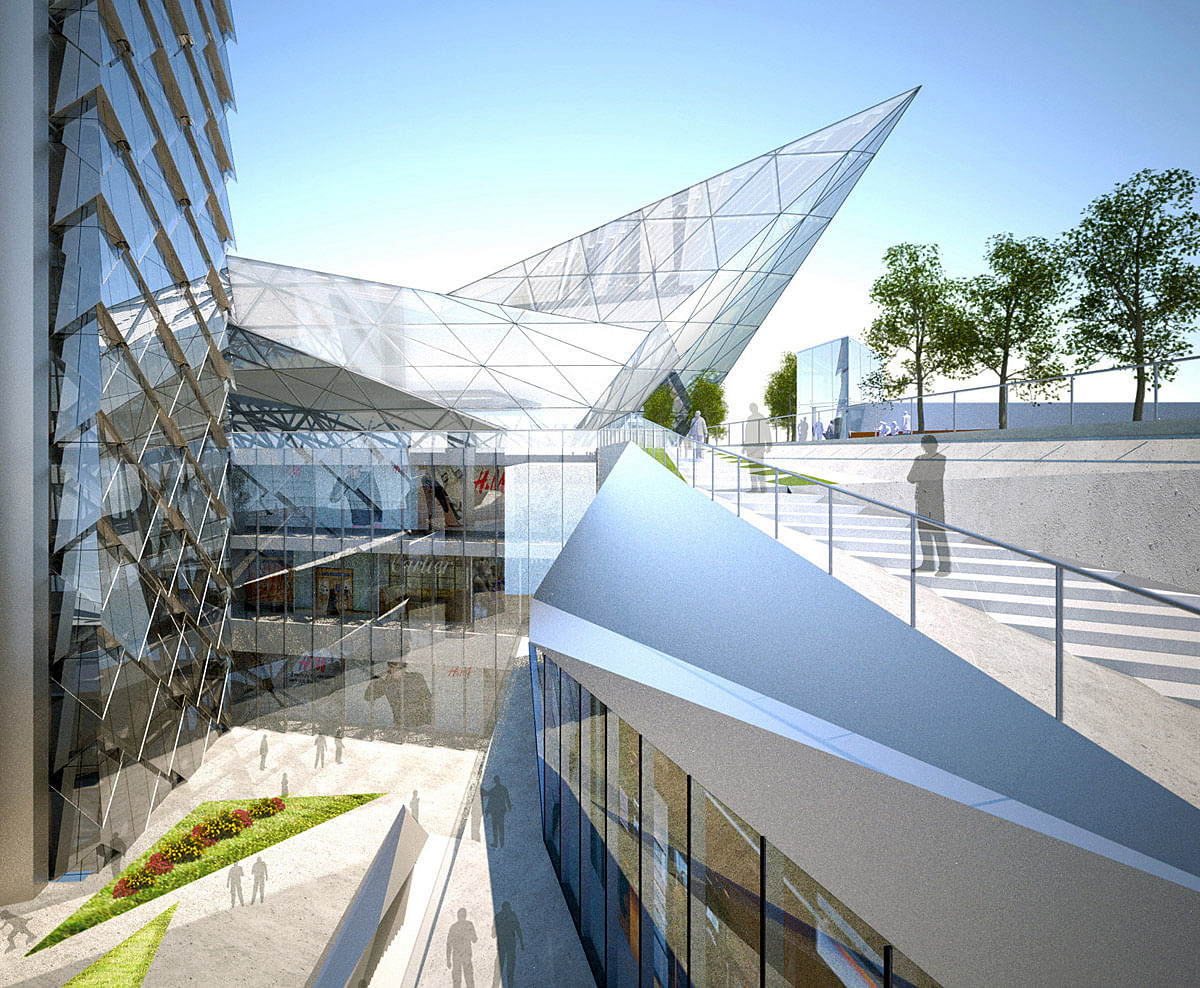
Sunken podium (Image: Adrian Smith + Gordon Gill Architecture)

The structural scheme for Dancing Dragons, developed by AS+GG in collaboration with the international structural engineering firm Werner Sobek, features eight mega-columns that traverse the vertical length of both cores. The mini-towers are hung off the cruciform cores in a balanced fashion by means of a belt truss system, stabilizing the structure.
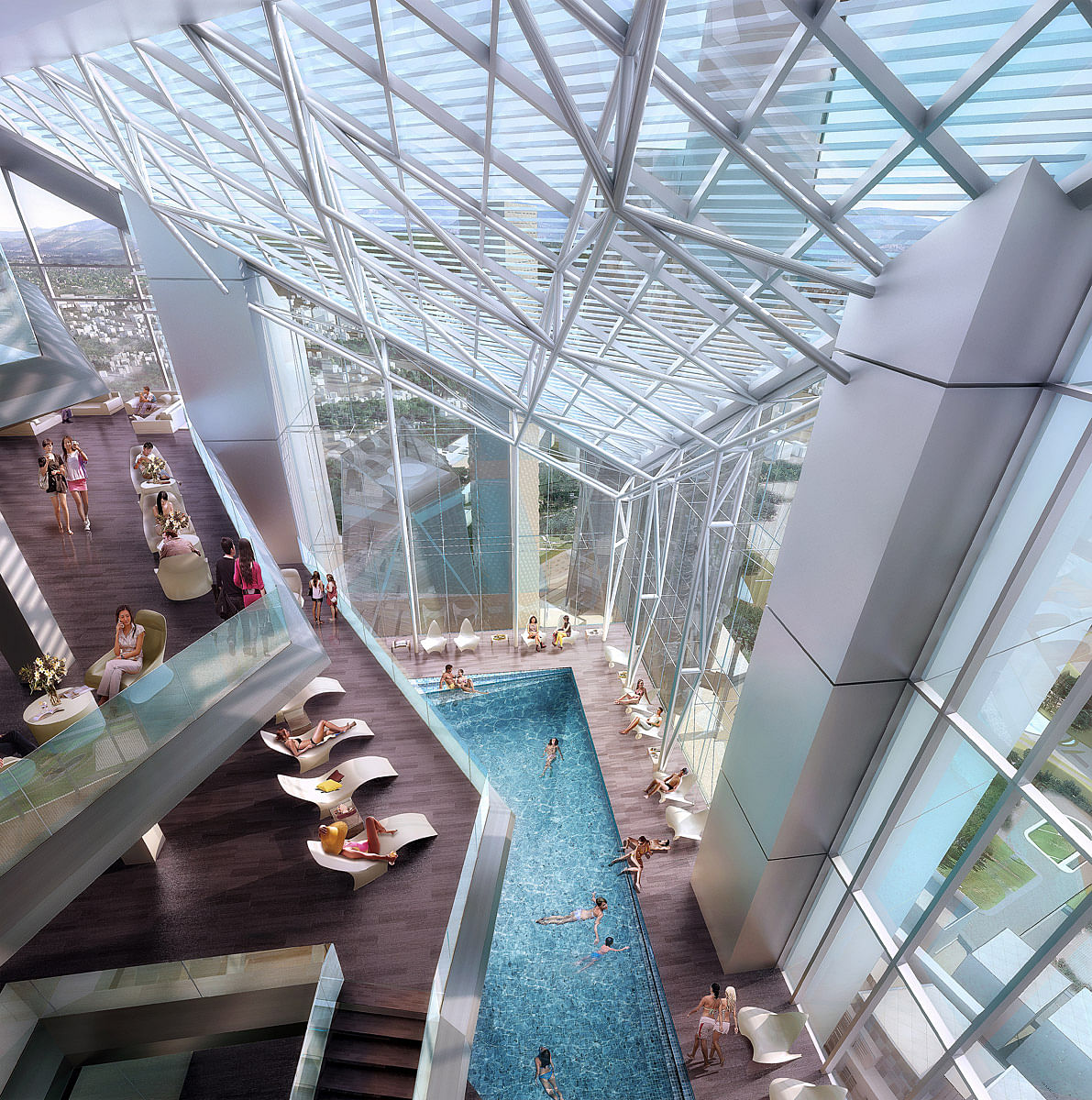
Tower 2 atrium (Image: Adrian Smith + Gordon Gill Architecture)

The design of the 23,000-square-meter site—part of the larger Yongsan master plan —reinforces the angular geometry of the building massing and skin.  Landscape features, designed in collaboration with Martha Schwartz Partners, include sloped berms that echo that geometry. The site also includes a retail podium with a crystalline sculptural form and sunken garden that provide access to a large below-grade retail complex.
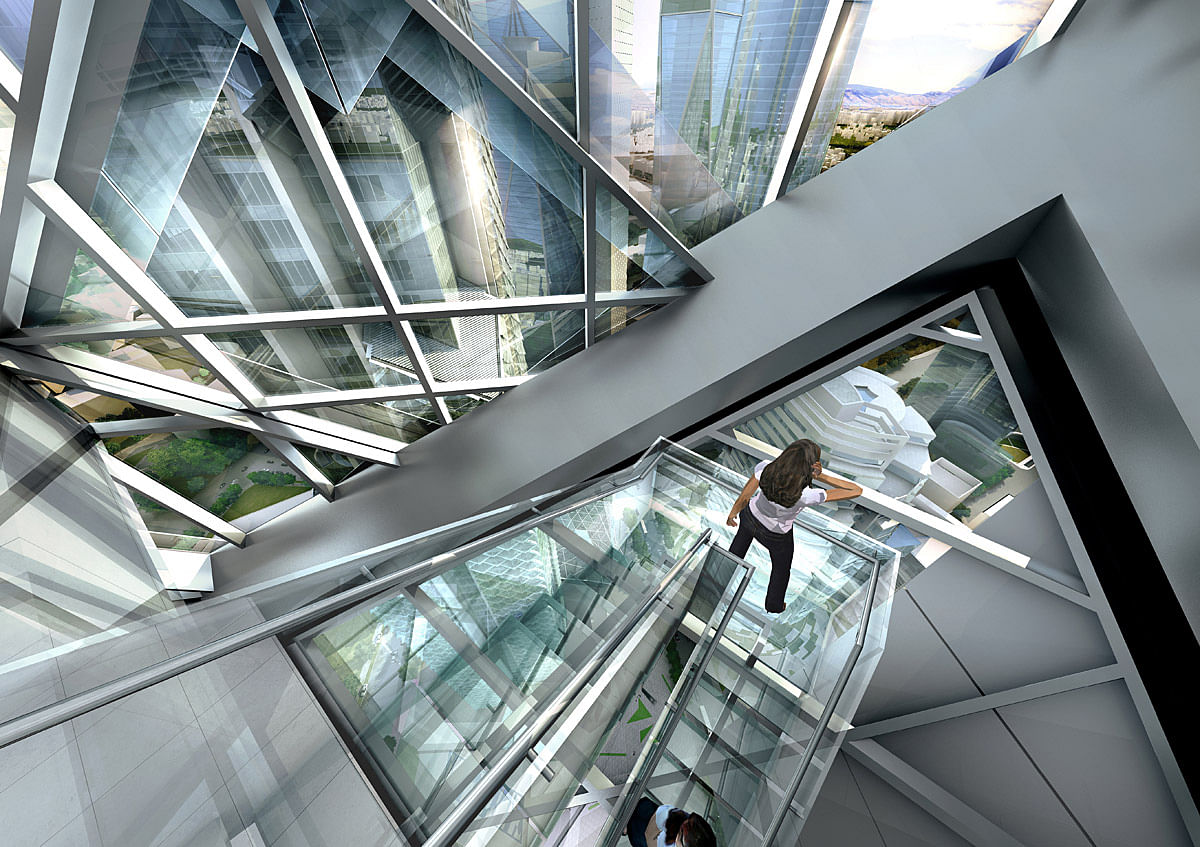
Down cut (Image: Adrian Smith + Gordon Gill Architecture)

Related

adrian smith + gordon gill architecture ● as+gg ● asia ● high-rise ● korea ● office ● residential ● seoul ● skyscraper ● south korea ● tower ● yongsan

Share

  • Follow

    0 Comments

  • Comment as :

AS+GG Designs Dancing Dragons Complex for Seoul's Yongsan District

Best small projects chosen at AIA Small Project Award 2026

10 standout sustainable projects honored at AIA COTE Top Ten Award 2026

Best residential architecture of 2026 honored at AIA Housing Award

Best new interiors of 2026 chosen at AIA Interior Architecture Awards

Best global architecture honored at RIBA International Awards 2026

World’s most beautiful airports of 2026 chosen by Prix Versailles

New architecture and design competitions: Brick in Architecture Awards, Study Architecture Student Showcase, N.Y.C. Groceries, and New York High Falls Riverfront Market

SmithGroup’s ‘pioneering’ Philip Merrill Environmental Center wins AIA Twenty-five Year Award

Sign up for Bustler's Email Newsletters

Sponsored Post by Buildner

Museum of Emotions / Edition #8 FINAL registration deadline is in 5 DAYS!

Here are the winners of the 2026 AIA Architecture Awards

40 emerging architects and designers under 40 from Europe honored

Northwestern University selects 12-firm longlist to design new engineering building

New architecture and design competitions: Exploring 130 Years of American Design, Christo & Jeanne-Claude Center, 13 White Houses, and La Pyramide

Micro-architecture honored in latest Tiny House Architecture Competition

World’s most beautiful restaurants of 2026 chosen by Prix Versailles

Next page » Loading

AS+GG Designs Dancing Dragons Complex for Seoul's Yongsan District

By Bustler Editors|

Thursday, May 10, 2012

Share

Aerial view of the AS+GG-designed Dancing Dragons Complex for the new Yongsan International Business District in Seoul, South Korea (Image: Adrian Smith + Gordon Gill Architecture)

Related

adrian smith + gordon gill architecture ● as+gg ● asia ● high-rise ● korea ● office ● residential ● seoul ● skyscraper ● south korea ● tower ● yongsan

Chicago-based firm Adrian Smith + Gordon Gill Architecture just released its design for Dancing Dragons, a pair of landmark supertall mixed-use towers for the new Yongsan International Business District in Seoul, South Korea. The buildings, which include residential, “officetel” and retail elements, consist of slender, sharply angled mini-towers cantilevered around a central core.

Project Description from the Architects:

The mini-towers feature a dramatic series of diagonal massing cuts that create living spaces that float beyond the structure.This recalls the eaves of traditional Korean temples—a design theme echoed both in the geometry of the building skin and the jutting canopies at the towers’ base. The theme is extended in the building skin, which suggests the scales of Korean mythical dragons, which seem to dance around the core—hence the project’s name. (Yongsan, the name of the overall development, means “Dragon Hill” in Korean.)

Dancing Dragons’ scale-like skin is also a performative element. Gaps between its overlapping panels feature operable 600-mm vents through which air can circulate, making the skin “breathable” like that of certain animals.

Overall view, north (Image: Adrian Smith + Gordon Gill Architecture)

Towers 1 and 2—about 450 meters and 390 meters tall, respectively—share an architectural language and, therefore, a close family resemblance, but are not identical. In the taller structure, the 88-level Tower 1, the massing cuts at the top and bottom of the mini-towers are V-shaped. In the 77-level Tower 2, the cuts move diagonally in a single unbroken line; they are also arranged in a radial pattern around the core that is perceptible as viewers move around the tower.

Tower 2 at dusk (Image: Adrian Smith + Gordon Gill Architecture)

“There’s a sympathetic and complementary relationship between the two masses at the level of the cuts, almost as though they were dancing,” says Adrian Smith, FAIA, RIBA. “It’s always important for our designs to reflect and interpret the cultures they serve, and the Dancing Dragons complex certainly does that, although in an abstract and highly technological manner. We try to design in a way that is at once beautiful and focused on performance.”

Tower 1 and Tower 2 at night (Image: Adrian Smith + Gordon Gill Architecture)

In both buildings, the mini-tower cuts are clad in glass at the top and bottom, making for dramatic skylights above the units at the highest levels and a transparent floor beneath the units at the lowest levels. This offers the opportunity for special high-value penthouse duplex units with spectacular 360-degree views of downtown Seoul and the adjacent Han River, along with an abundance of natural light.

Tower 1 and Tower 2 looking up (Image: Adrian Smith + Gordon Gill Architecture)

“The abstract recall of the historic structures gives the towers a unique perspective from the ground and the sky while creating unique interior experiences,” says Gordon Gill, AIA. “The shingled texture of the skin is developed with integrated breathable mullions and self-shading cantilevers. It’s a great honor to be joining several other top international architecture firms designing buildings for this remarkable master plan by Studio Daniel Libeskind.”

Tower 1 facade close-up (Image: Adrian Smith + Gordon Gill Architecture)

AS+GG partner Robert Forest, AIA, notes that Dancing Dragons represents AS+GG’s second major project in downtown Seoul. The other is the Head Office of the Federation of Korean Industries, an innovative and highly sustainable office building now under construction and scheduled to be completed next year. “We’re very excited to be making a sustainable contribution to the built environment of Seoul, one of the world’s great cities, in a manner that addresses the need for sustainable high density development while respecting Korean culture,” Forest says. “YIBD, which promises to become one of Seoul’s most dynamic and vital neighborhoods, will be an example of high-quality high-density design, and we’re proud to be a part of that.”

Tower 1 drop-off (Image: Adrian Smith + Gordon Gill Architecture)

The design team also includes PositivEnergy Practice, a Chicago-based engineering and energy consulting firm that is designing a series of innovative building systems for the project. Sustainable features of the building system design include triple-glazed window units, which minimize heat loss; an overlapping exterior wall system, which creates a self-shading effect; and natural ventilation in all units through operable mullions. Other systems include radiant heating; fuel-cell cogeneration units at the basement level; photovoltaic arrays on the roof surfaces; daylight-linked lighting controls; and heat recovery via electric centrifugal chillers.

Sunken podium (Image: Adrian Smith + Gordon Gill Architecture)

The structural scheme for Dancing Dragons, developed by AS+GG in collaboration with the international structural engineering firm Werner Sobek, features eight mega-columns that traverse the vertical length of both cores. The mini-towers are hung off the cruciform cores in a balanced fashion by means of a belt truss system, stabilizing the structure.

Tower 2 atrium (Image: Adrian Smith + Gordon Gill Architecture)

The design of the 23,000-square-meter site—part of the larger Yongsan master plan —reinforces the angular geometry of the building massing and skin.  Landscape features, designed in collaboration with Martha Schwartz Partners, include sloped berms that echo that geometry. The site also includes a retail podium with a crystalline sculptural form and sunken garden that provide access to a large below-grade retail complex.

Down cut (Image: Adrian Smith + Gordon Gill Architecture)

Share

  • Follow

    0 Comments

  • Comment as :

Archinect JobsArchinect Jobs

The Archinect Job Board attracts the world's top architectural design talents.

VIEW ALL JOBS POST A JOB

Architectural/Structural Drafter

New Beginnings Engineering

Architectural/Structural Drafter

Irvine, CA, US

Marketing + Communications Specialist

Trahan Architects

Marketing + Communications Specialist

New York, NY, US

Junior/Intermediate Architect

Archimaera Architecture

Junior/Intermediate Architect

New York, NY, US

Miami Senior Project Coordinator

BMA Architects

Miami Senior Project Coordinator

Miami, FL, US

Project Manager - Residential

DAHLIN Architecture | Planning | Interiors

Project Manager - Residential

Bellevue, WA, US

Healthcare Project Manager

NK Architects

Healthcare Project Manager

New York, NY, US

Architectural Designer Level 2

Arthur Chabon Architect

Architectural Designer Level 2

New York, NY, US

Architect / Architectural Designer (3-5 years experience)

Resolution: 4 Architecture

Architect / Architectural Designer (3-5 years experience)

New York, NY, US

Hospitality Project Architect

bonetti/kozerski architecture DPC

Hospitality Project Architect

New York, NY, US

Junior Architect in nyc

Lara Apelian Studio

Junior Architect in nyc

New York, NY, US

Next page » Loading