• Login / Join
  • About
  • •
  • Contact
  • •
  • Advertising
bustler logo
bustler logo
  • News
  • Competitions
  • Events
  • Bustler is powered by Archinect
  • Sign up for Bustler's Email Newsletters

  • Follow these Bustler feeds:

  • Search

    Search in

  • Submit

    What are you submitting?

    News Pitch
    Competition
    Event
  • Login / Join
  • News|Competitions|Events
  • Search
    | Submit
    | Follow
  • Search in

    What are you submitting?

    News Pitch
    Competition
    Event

    Follow these Bustler feeds:

  • About|Contact|Advertising
  • Login / Join

Atlantic City Boardwalk Holocaust Memorial - 1st Prize Winner

By Bustler Editors|

Monday, Jan 24, 2011
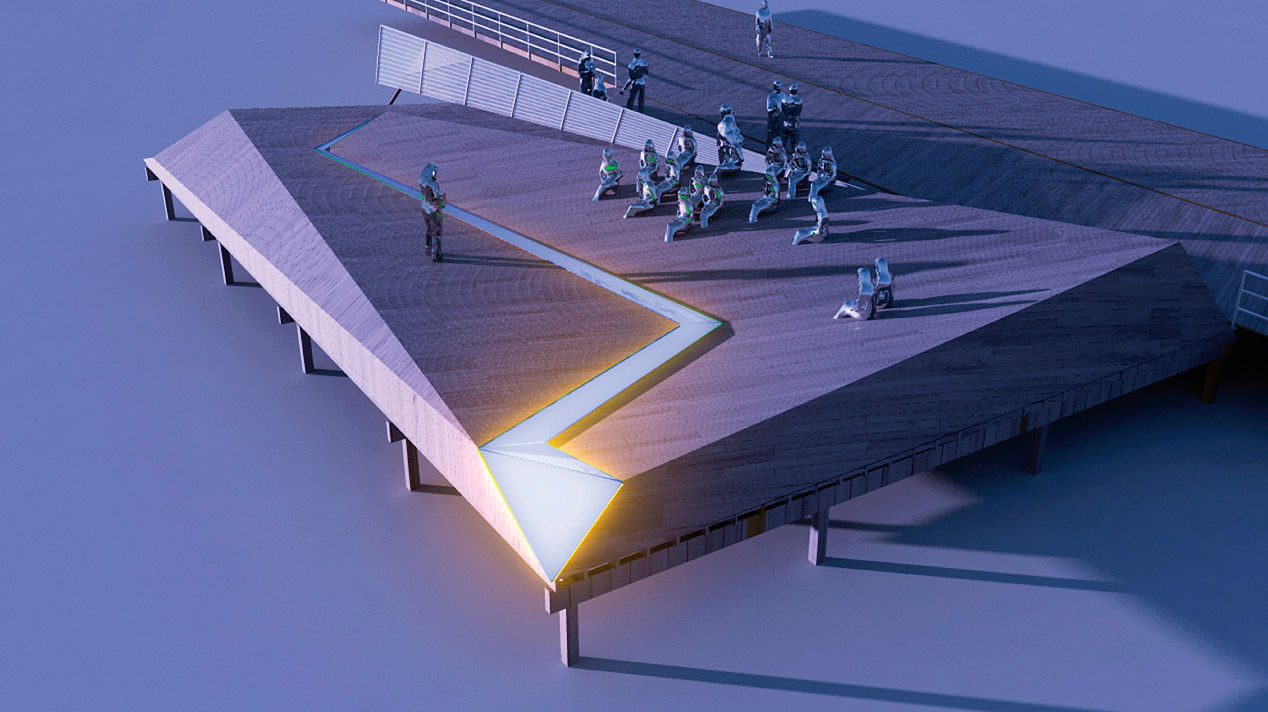
Winning entry at the Atlantic City Boardwalk Holocaust Memorial competition by Patrick Lausell and Paola Marquez

Patrick Lausell and Paola Marquez, students at Columbia University School of Architecture and First Prize-winners of the recent Atlantic City Boardwalk Holocaust Memorial competition, have sent us more material on their winning entry "Fractured Landscapes". The jury, comprising Daniel Libeskind, Richard Meier, Michael Berenbaum, Clifford Chanin, Wendy Evans Joseph, and James E. Young, selected this project from over 700 competition entries from 55 countries.

Project Description from the Architects:

“We wish to remember. But we wish to remember for a purpose, namely to ensure that never again will evil prevail, as it did for the millions of innocent victims of Nazism.” - John Paul II

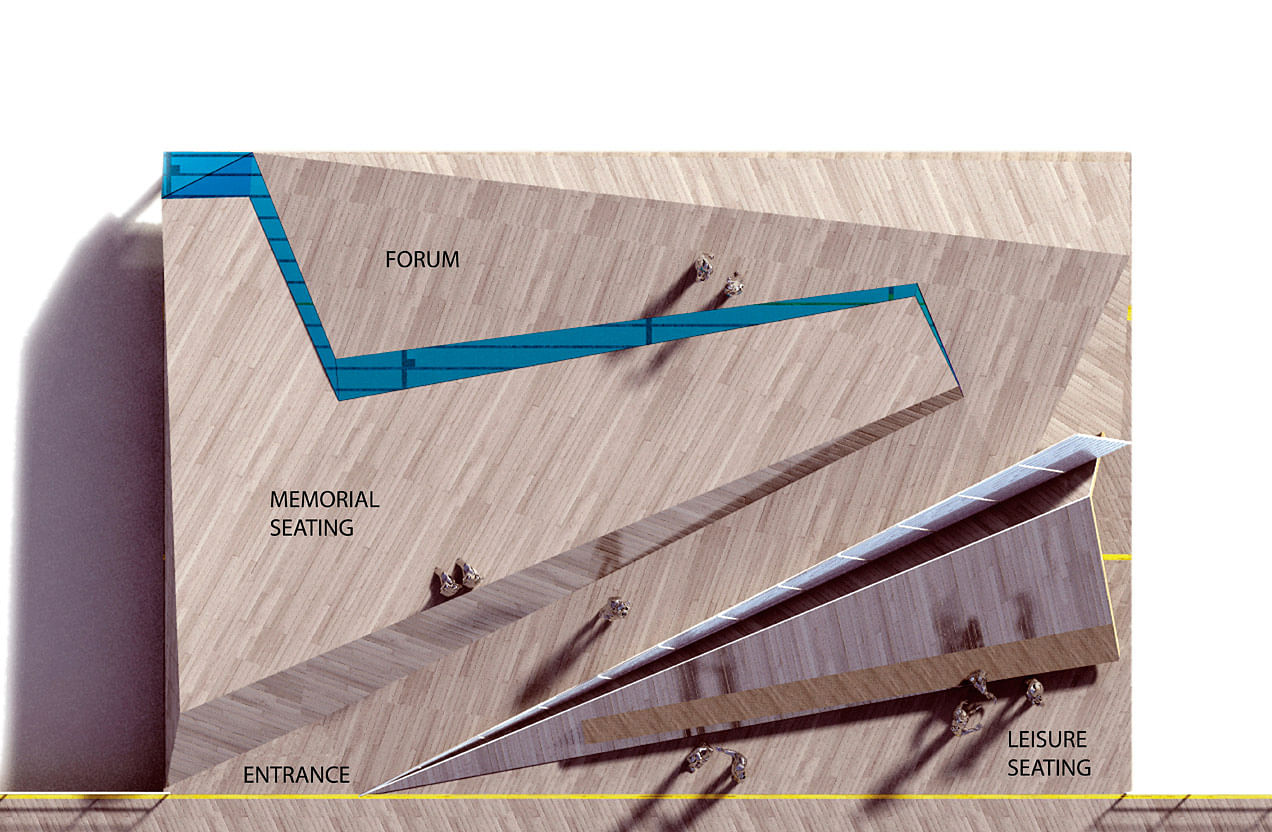
Interrupting the linearity of the boardwalk, the platform is a rupture, a disruptive force, an illogical moment inFractured Landscapesed Lndcs the sequence of history. Wedged between the broken surfaces, is a flowing sliver of light that offers a solemn moment of completeness and continuity. The visual rupture that initially pulls the curious passerby into the structure leads to a moment of solace, enveloping the visitor in the diaphanous glow from the stream of light.
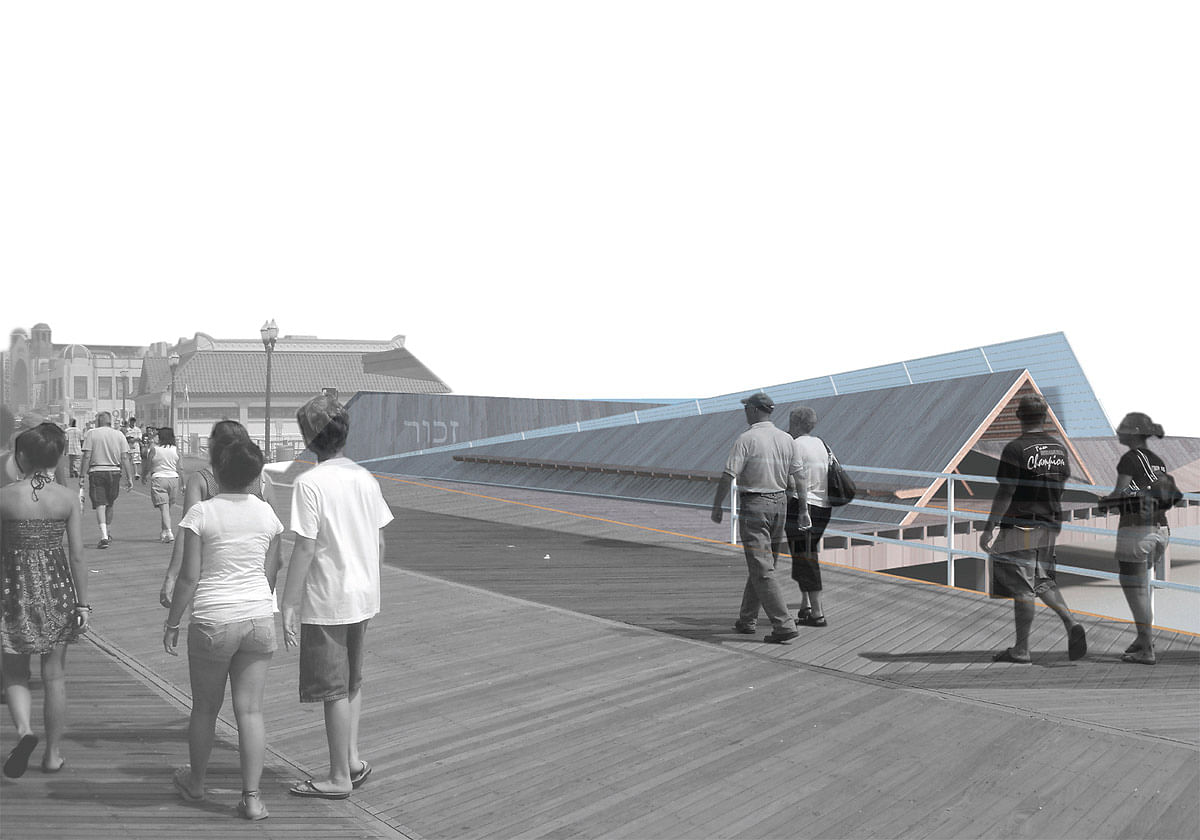
Perspective

Our design proposal creates an intimate space along the Atlantic City Boardwalk to reflect upon and create awareness of the Holocaust and other acts of genocide. The memorial is conceived as a fractured landscape, symbolizing the violence of the Shoah, and a river of light, that stitches the disjoined surface and expresses our desire for peace. Global acts of genocide, beginning with the holocau st, are documented on the memorials folding surface.
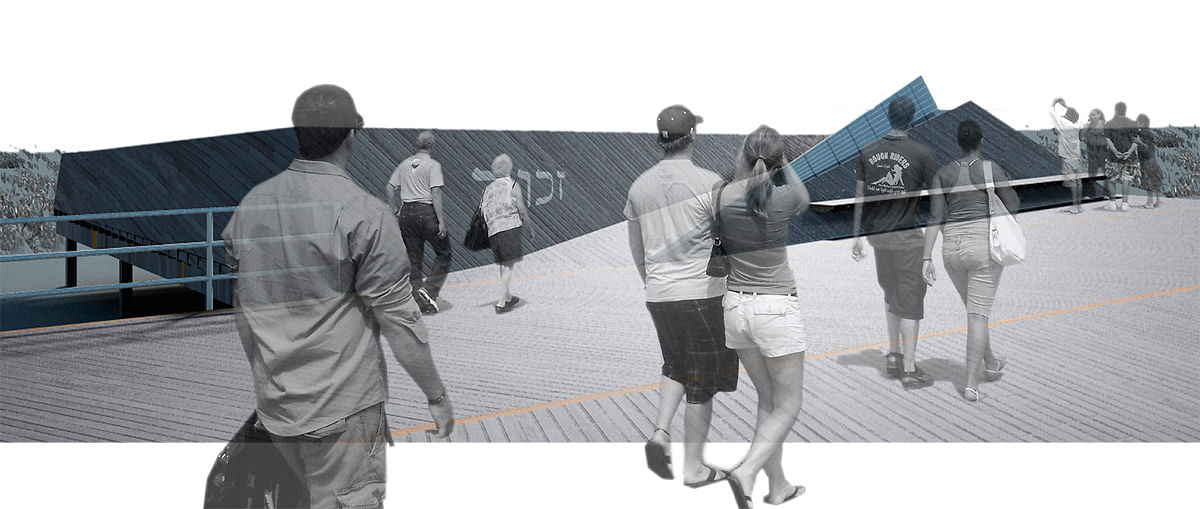
Perspective

The names and dates of these tragic events are etched on the memorials Ipe wood planks. Future acts of genocide would be acknowledged by being permanently etched on the memorial. The documenting of these violent acts creates awareness of the continuation of genocide, and reminds us that to ensure peace in the future we must not forget the crimes of the past.
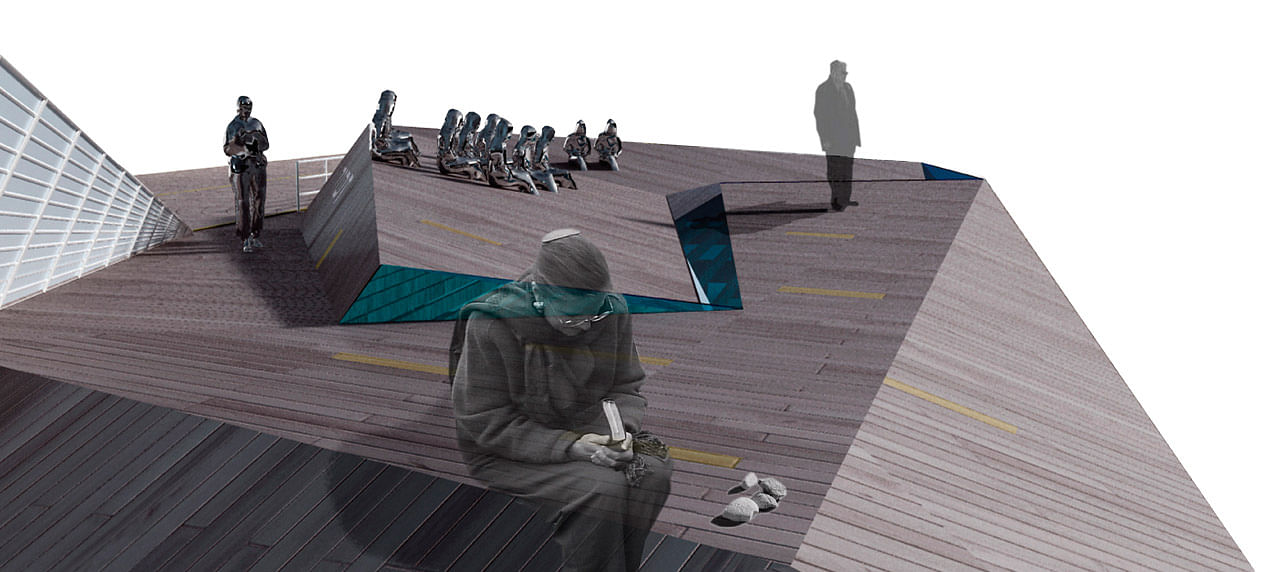
Perspective

Comments from the Judges:

Prof. James E. Young: "This is a light sculpture. Its conceptual underpinning is the idea that there would be a tectonic shift somehow that would actually kind of buckle the landscape around you and that this would be you point of entry. It is okay to open up the question of other genocides.....This memorial is a descendant of Maya Lin's approach. Maya Lin when she went to propose her Vietnam Veterans Memorial had a very simple concept in mind. She wanted to open a space in the landscape that opened a space within us for memory. And it worked, and it's a very subtle minimalist gesture, and really a whole generation of architects, I think, since then, when they think about memorials, understand what is now possible."
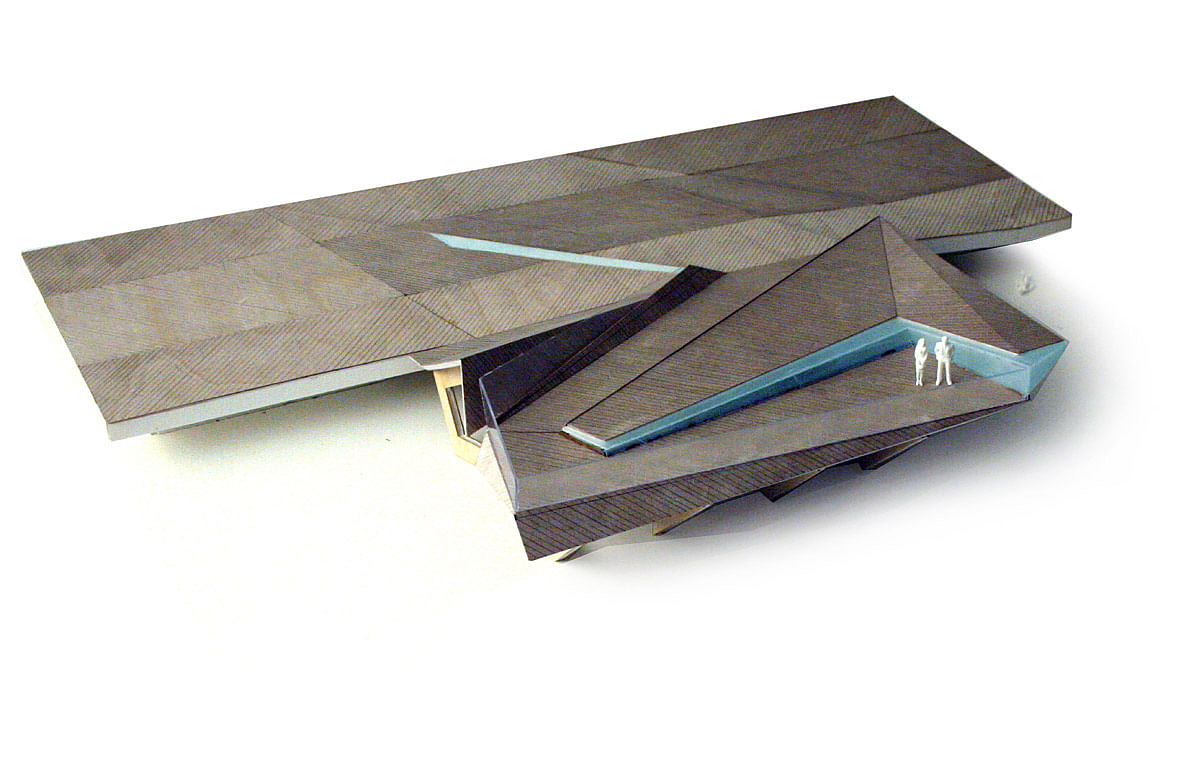
Model photo

Daniel Libeskind: "This memorial does not represent the Holocaust. Nothing can represent the Holocaust. So why was it built, some may ask. This memorial is meant to be dedicated to thinking and reflecting on the Holocaust. It is a space created in a certain context for contemplation with a certain attitude. It communicates a greater whole, which I think in time can become very much a part of people's experience of Atlantic City and one of the sites that will definitely visit when they come to the city."
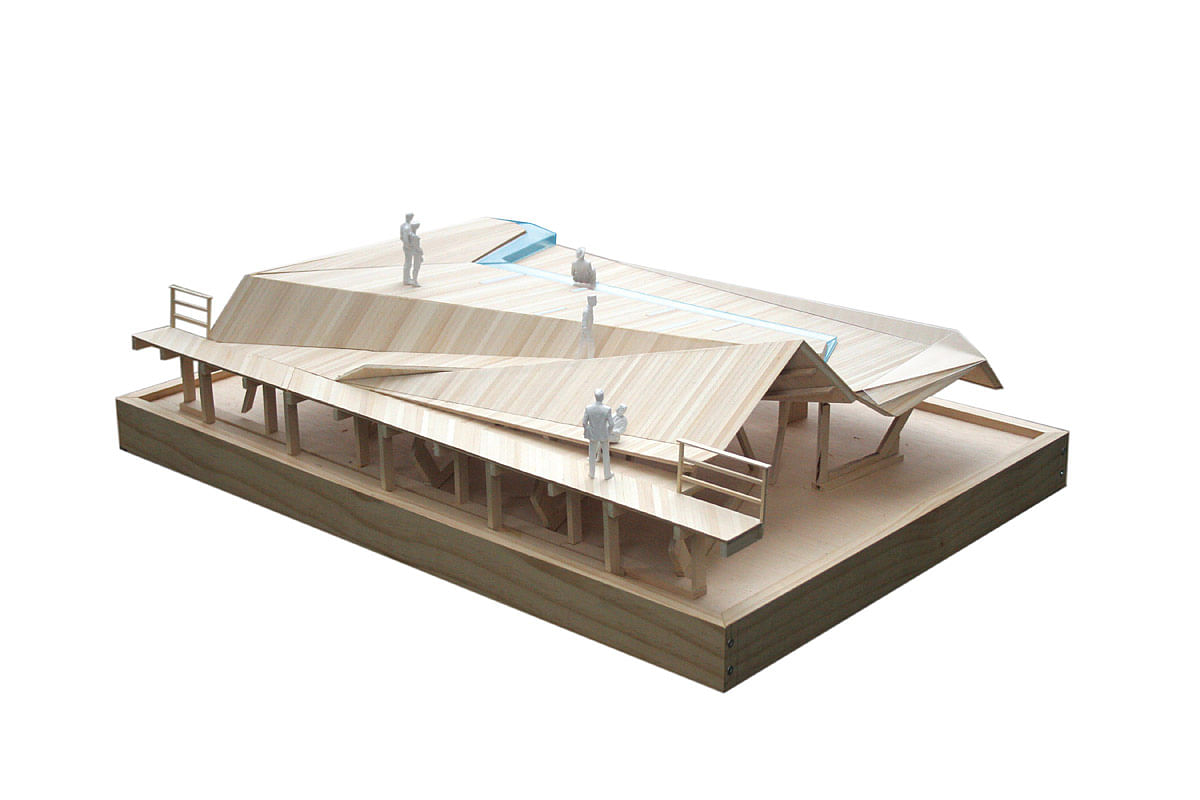
Model photo

Wendy Evans Joseph: "This design has a dramatic quality to it that gives you this wonderful feeling. During the day you come up to this nice place off the boardwalk, you have the shadows, and you have the view as you look out over the water. And the night experience is wonderful.... Over 700 entries, and from all over the world, and by chance it turrns out that the architects are from somwhat nearby. It is a relatively young architecture firm and both have the capability to execute something like this and make changes if required."
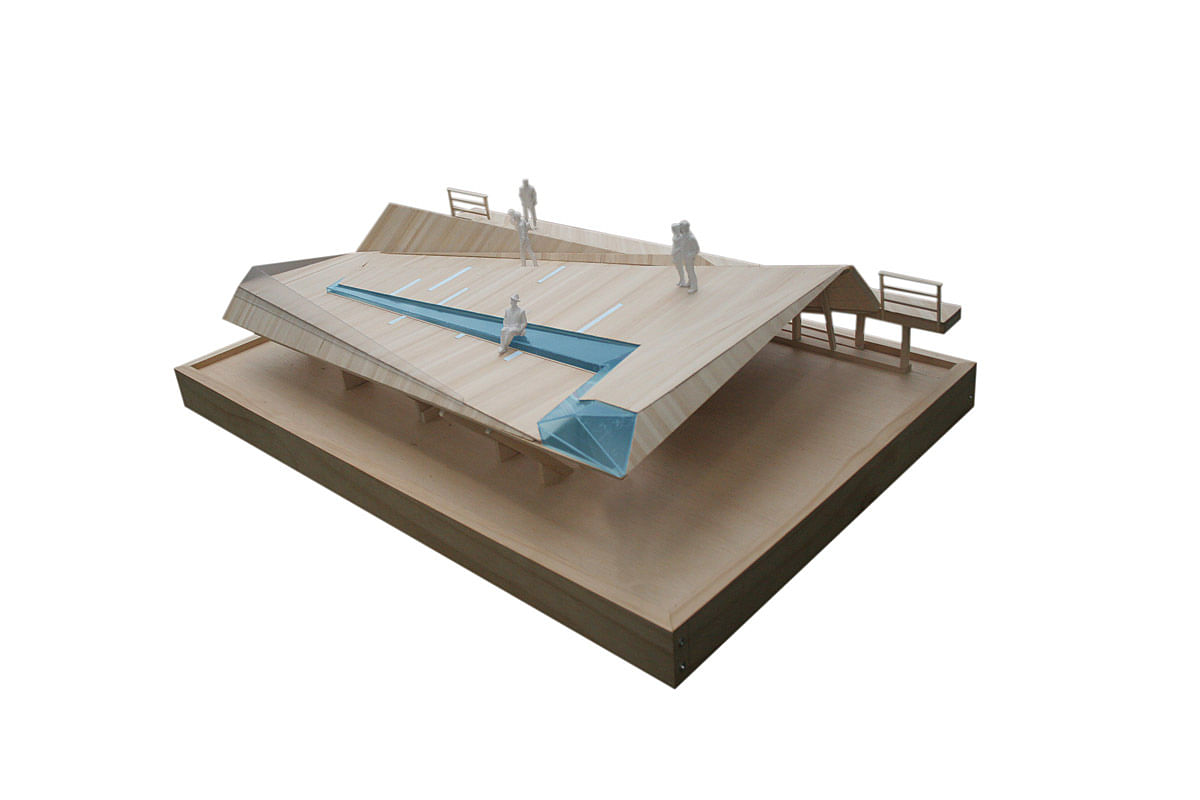
Model photo

Richard Meier: "There is no realistic possibility that could express what people think and how they react to the Holocaust. However, I do believe that the wall that exists in this design is an opportunity to do something meaningful so people can understand as they come and say, you know, how does this relate to the Holocaust? What does the Holocaust mean?"
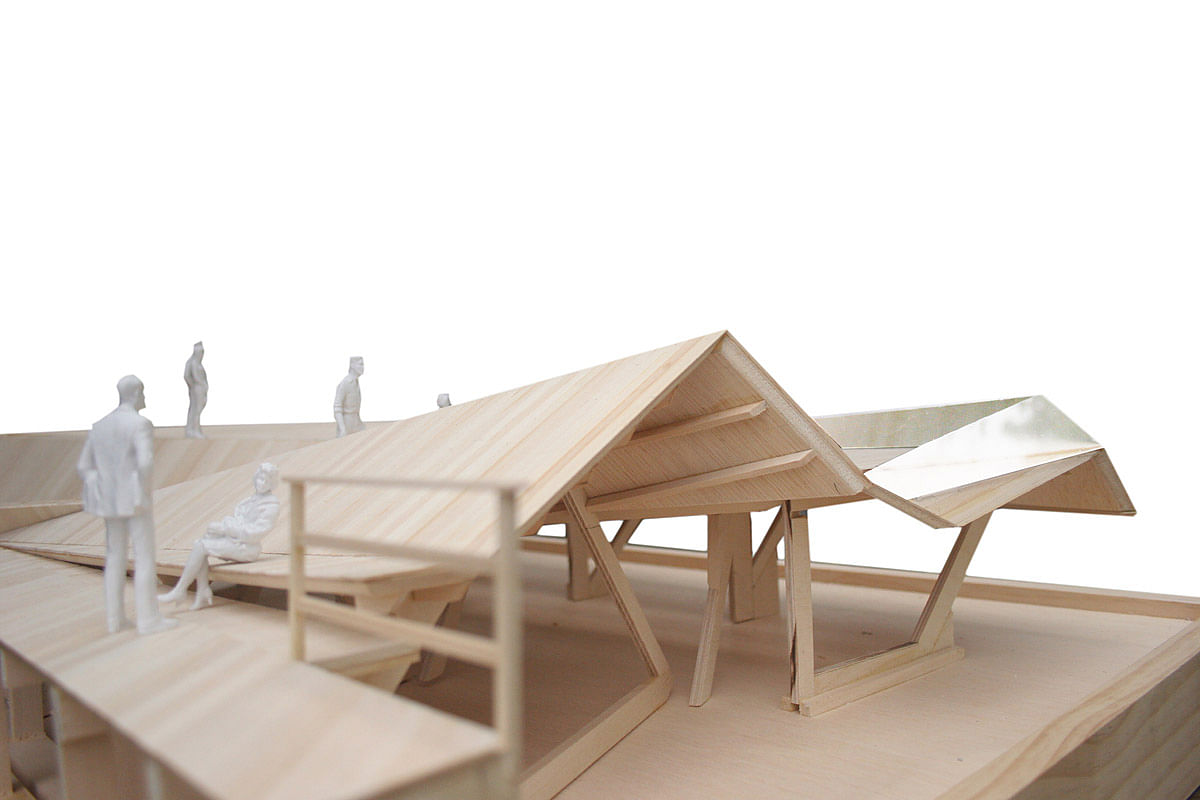
Model photo

Prof. Michael Berenbaum: "The artistic language transitions over time. One generation would have been touched by something directly representational. The other generation would be jaded to that representational. This is more subtle. We have to invite the visitor to experience it."

Plan view

Clifford Chanin: "The younger generation, which is the audience for this essentially, is going to look at this in a very differrent way than we would; that the literal representation fo this horrible moment that is capturred in time and deep in the past may not be the most effective way of communicating to them....When you get the critique that you need to show suffering figures on the boardwalk, you have to come back to that because there was a moment in time, say the fifties, when that made sense, where the reality of this had not sunk in. Fifty years later, it is not really relevant anymore to people who are young who are going to see this. You have people walking on the boardwalk, and your memorial is a reminder of what happened and you're telling them it's related to the life they live today. There's a reason for remembering, and that reason has to do with fracture and dislocation, the kind of symbolic things you're seeing here. This memorial is a reflection of the contemorary meaning of the Holocaust. It's about how we live in a world where six million Jews were killed. A design like this, abstract, in 2010, takes as a starting point the reality that it happened, that it influences the world today. The reason you're building it today is because the event is still meaningful today. That's why you build a memorial today, and that's why you build a memorial like this. You no longer have to prove what happened. What you have to do is explore why what happened then has real meaning today."

All images courtesy of Patrick Lausell and Paola Marquez. Judges comments via ACBHM.

Related

usa ● patrick lausell ● paola marquez ● memorial ● landscape ● holocaust ● atlantic city boardwalk holocaust memorial ● atlantic city

Share

  • Follow

    0 Comments

  • Comment as :

Atlantic City Boardwalk Holocaust Memorial - 1st Prize Winner

Micro-architecture honored in latest Tiny House Architecture Competition

World’s most beautiful restaurants of 2026 chosen by Prix Versailles

Sponsored Post by Buildner

Design a wine tasting room in Italy! Valli Wine Tasting Room is launched!

10 can't-miss architecture & design events to see this June in London, Los Angeles, Chicago, San Francisco, Detroit, San Diego, Porto, and Barcelona

Sponsored Post by Buildner

Museum of Emotions / Edition #8 FINAL registration deadline is approaching!

Seven global projects make AR Public Awards shortlist 2026

Sponsored Post by Buildner

Design a slow-living restaurant in Portugal! Portugal Long Table Restaurant is launched!

World's best tall buildings honored at the CVU 2026 Award of Excellence

Sign up for Bustler's Email Newsletters

Sponsored Post by TWOPAGES

Final call: TWOPAGES X Design Contest 2026 submissions close June 5

Kengo Kuma & Paul Raff win Alberta national park visitor center competition with landscape-focused design

2026 Moira Gemmill and MJ Long prizes announced by W Awards

New architecture and design competitions: Kinderspace, Stewardson Keefe LeBrun Travel Grant, SMALL PROJECT BIG IMPACT, and Garden of University House, Bucharest

The Century of Gehry: New retrospective explores the late architect's work & collaborations

Sponsored Post by Buildner

Rome Rain Rooms FINAL registration deadline is in 5 DAYS!

UIA and UN Habitat unveil sustainability-focused winners for UIA 2030 Award

Next page » Loading

Atlantic City Boardwalk Holocaust Memorial - 1st Prize Winner

By Bustler Editors|

Monday, Jan 24, 2011

Share

Winning entry at the Atlantic City Boardwalk Holocaust Memorial competition by Patrick Lausell and Paola Marquez

Related

usa ● patrick lausell ● paola marquez ● memorial ● landscape ● holocaust ● atlantic city boardwalk holocaust memorial ● atlantic city

Patrick Lausell and Paola Marquez, students at Columbia University School of Architecture and First Prize-winners of the recent Atlantic City Boardwalk Holocaust Memorial competition, have sent us more material on their winning entry "Fractured Landscapes". The jury, comprising Daniel Libeskind, Richard Meier, Michael Berenbaum, Clifford Chanin, Wendy Evans Joseph, and James E. Young, selected this project from over 700 competition entries from 55 countries.

Project Description from the Architects:

“We wish to remember. But we wish to remember for a purpose, namely to ensure that never again will evil prevail, as it did for the millions of innocent victims of Nazism.” - John Paul II

Interrupting the linearity of the boardwalk, the platform is a rupture, a disruptive force, an illogical moment inFractured Landscapesed Lndcs the sequence of history. Wedged between the broken surfaces, is a flowing sliver of light that offers a solemn moment of completeness and continuity. The visual rupture that initially pulls the curious passerby into the structure leads to a moment of solace, enveloping the visitor in the diaphanous glow from the stream of light.

Perspective

Our design proposal creates an intimate space along the Atlantic City Boardwalk to reflect upon and create awareness of the Holocaust and other acts of genocide. The memorial is conceived as a fractured landscape, symbolizing the violence of the Shoah, and a river of light, that stitches the disjoined surface and expresses our desire for peace. Global acts of genocide, beginning with the holocau st, are documented on the memorials folding surface.

Perspective

The names and dates of these tragic events are etched on the memorials Ipe wood planks. Future acts of genocide would be acknowledged by being permanently etched on the memorial. The documenting of these violent acts creates awareness of the continuation of genocide, and reminds us that to ensure peace in the future we must not forget the crimes of the past.

Perspective

Comments from the Judges:

Prof. James E. Young: "This is a light sculpture. Its conceptual underpinning is the idea that there would be a tectonic shift somehow that would actually kind of buckle the landscape around you and that this would be you point of entry. It is okay to open up the question of other genocides.....This memorial is a descendant of Maya Lin's approach. Maya Lin when she went to propose her Vietnam Veterans Memorial had a very simple concept in mind. She wanted to open a space in the landscape that opened a space within us for memory. And it worked, and it's a very subtle minimalist gesture, and really a whole generation of architects, I think, since then, when they think about memorials, understand what is now possible."

Model photo

Daniel Libeskind: "This memorial does not represent the Holocaust. Nothing can represent the Holocaust. So why was it built, some may ask. This memorial is meant to be dedicated to thinking and reflecting on the Holocaust. It is a space created in a certain context for contemplation with a certain attitude. It communicates a greater whole, which I think in time can become very much a part of people's experience of Atlantic City and one of the sites that will definitely visit when they come to the city."

Model photo

Wendy Evans Joseph: "This design has a dramatic quality to it that gives you this wonderful feeling. During the day you come up to this nice place off the boardwalk, you have the shadows, and you have the view as you look out over the water. And the night experience is wonderful.... Over 700 entries, and from all over the world, and by chance it turrns out that the architects are from somwhat nearby. It is a relatively young architecture firm and both have the capability to execute something like this and make changes if required."

Model photo

Richard Meier: "There is no realistic possibility that could express what people think and how they react to the Holocaust. However, I do believe that the wall that exists in this design is an opportunity to do something meaningful so people can understand as they come and say, you know, how does this relate to the Holocaust? What does the Holocaust mean?"

Model photo

Prof. Michael Berenbaum: "The artistic language transitions over time. One generation would have been touched by something directly representational. The other generation would be jaded to that representational. This is more subtle. We have to invite the visitor to experience it."

Plan view

Clifford Chanin: "The younger generation, which is the audience for this essentially, is going to look at this in a very differrent way than we would; that the literal representation fo this horrible moment that is capturred in time and deep in the past may not be the most effective way of communicating to them....When you get the critique that you need to show suffering figures on the boardwalk, you have to come back to that because there was a moment in time, say the fifties, when that made sense, where the reality of this had not sunk in. Fifty years later, it is not really relevant anymore to people who are young who are going to see this. You have people walking on the boardwalk, and your memorial is a reminder of what happened and you're telling them it's related to the life they live today. There's a reason for remembering, and that reason has to do with fracture and dislocation, the kind of symbolic things you're seeing here. This memorial is a reflection of the contemorary meaning of the Holocaust. It's about how we live in a world where six million Jews were killed. A design like this, abstract, in 2010, takes as a starting point the reality that it happened, that it influences the world today. The reason you're building it today is because the event is still meaningful today. That's why you build a memorial today, and that's why you build a memorial like this. You no longer have to prove what happened. What you have to do is explore why what happened then has real meaning today."

All images courtesy of Patrick Lausell and Paola Marquez. Judges comments via ACBHM.

Share

  • Follow

    0 Comments

  • Comment as :

Archinect JobsArchinect Jobs

The Archinect Job Board attracts the world's top architectural design talents.

VIEW ALL JOBS POST A JOB

Graduate Architect

RATIO Design

Graduate Architect

Chicago, IL, US

Project Architect

Berliner Architects

Project Architect

Culver City, CA, US

Job Captain

Field Architecture

Job Captain

Palo Alto, CA, US

Architecture Project Manager

RDH Architecture + Interior Design

Architecture Project Manager

Las Vegas, NV, US

Interior Project Manager

HLW International LLP

Interior Project Manager

New York, NY, US

Architectural Designer

Build Block Inc.

Architectural Designer

Los Angeles, CA, US

Project Architect

BuildingWork

Project Architect

Seattle, WA, US

Intermediate Architect

IMC Architecture

Intermediate Architect

Brooklyn, NY, US

Intermediate Architect (Advanced Revit User)

O'Neil Langan Architects

Intermediate Architect (Advanced Revit User)

New York, NY, US

Architectural Job Captain

Christopher Courts Inc.

Architectural Job Captain

Los Angeles, CA, US

Next page » Loading