• Login / Join
  • About
  • •
  • Contact
  • •
  • Advertising
bustler logo
bustler logo
  • News
  • Competitions
  • Events
  • Bustler is powered by Archinect
  • Sign up for Bustler's Email Newsletters

  • Follow these Bustler feeds:

  • Search

    Search in

  • Submit

    What are you submitting?

    News Pitch
    Competition
    Event
  • Login / Join
  • News|Competitions|Events
  • Search
    | Submit
    | Follow
  • Search in

    What are you submitting?

    News Pitch
    Competition
    Event

    Follow these Bustler feeds:

  • About|Contact|Advertising
  • Login / Join

Barcelona's Cinematheque de Catalunya Completed

By Bustler Editors|

Monday, Sep 26, 2011

Salvador Seguí Square Facade (Photo: Adrià Goula)

Mateo Arquitectura recently completed the new building for the Film Library of Catalonia in the Raval district of Barcelona. Designed by Josep Lluís Mateo, the project won the first prize in a restricted competition in 2004 and houses archives, a library and cinema halls on a total area of 7,515 sqm (80,891 sqft).

Headquarters of the New Film Theatre of Catalonia from Josep Lluis Mateo on Vimeo.

Project Description from the Architects:

Josep Lluís Mateo: "About the form… The ruins mark the structure of the buildings. The Roman forum formalizes the plane of foundations and drains.

In the old town, my building sets out to express itself as pure structure—no cladding, no finishes.

The bare concrete beams-cum-walls that form the façades are very varied, proving themselves members of the family of the dilapidated neighbouring walls, where plaster crumbles to reveal their original central mass.

Filters are juxtaposed on the wall. This cinematographic metaphor is not just conceptual; it is above all physical, sensible. In the old town, with very close relations between buildings, interaction must be mediated, filtered. And this is implemented by a variety of devices, with a vague cinematographic reference.

About the space… The space is organized around two movements: a) The descent into the darkness of the cinemas, with the reflection of the spectators (in turn reflected, actors seen in a series of mirrors); b) The ascent towards the light, towards the places of work.

Two courtyards, connected but not continuous, accompany and construct the movement."

Ascent towards the places of work (Photo: Adrià Goula)

Place and Project

The new film theatre building presents a façade on Plaça de Salvador Seguí, at an angle to Carrer de Sant Pau. Together with the existing constructions, it forms Carrer d’Espalter.

It is very close to the mythical Carrer de Robador, in an area which, despite the major clean-ups still going on and the change in population, is still a popular, built-up, oppressively Mediterranean/port neighbourhood.

Its relation with its setting operates on the following levels:

The project and Plaça de Salvador Seguí:

The plaza represents a clearing in the built-up district of El Raval which, thanks to this construction, attracts new users and hosts large-scale events. A porch on the ground floor can be opened or closed according to functional needs.
The film theatre is a continuation of the building line of the street, blending in with its setting.

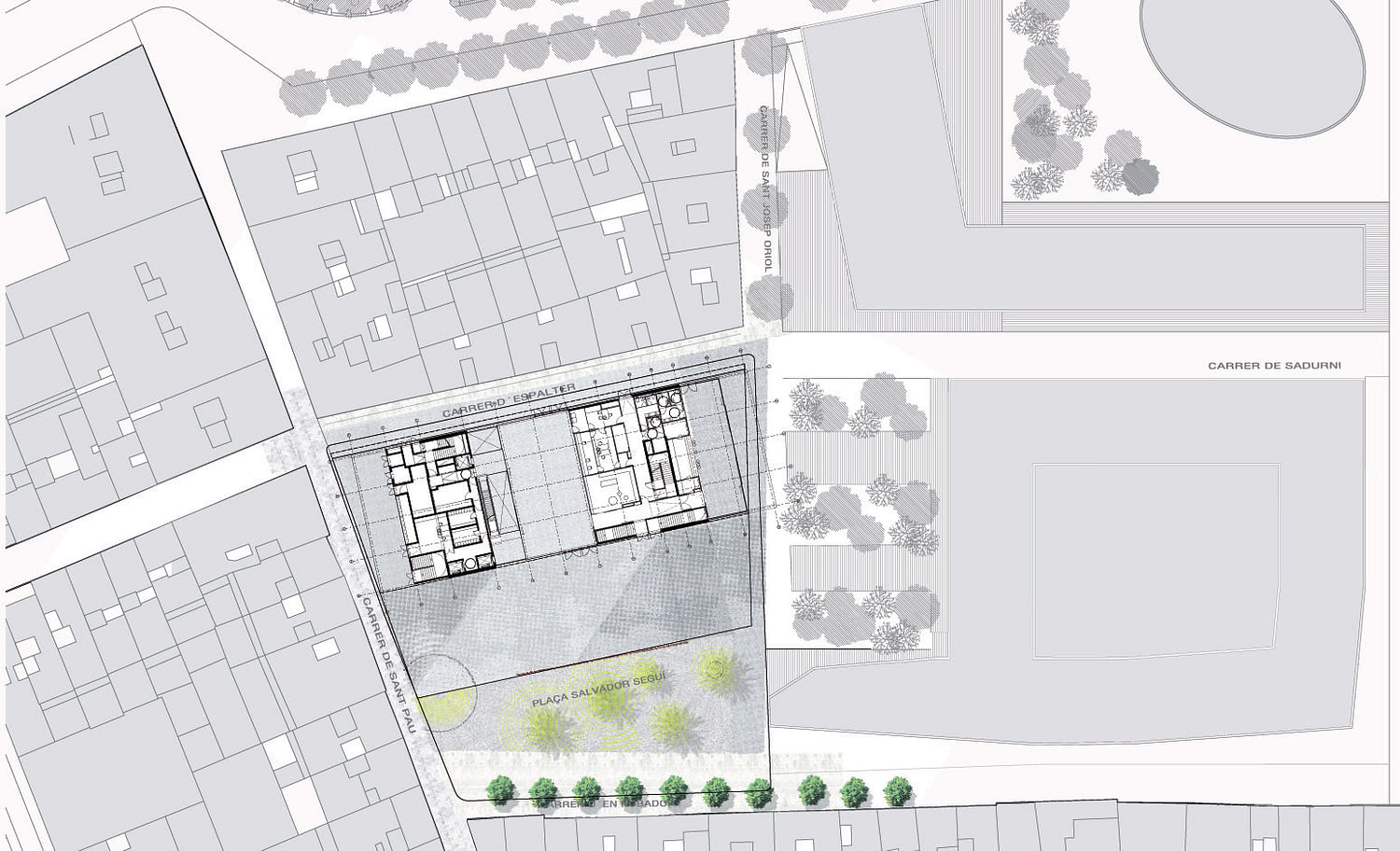
The Site. Raval District
Ground Floor

The project and its immediate surroundings: Carrer d’Espalter:

The volume of the cinemas is undergrounded, thereby reducing the scale and visual impact of the building. The street is widened a little, drawing the construction back from the building line. The new building reduces the ground floor section at the end walls, which also makes the street wider.
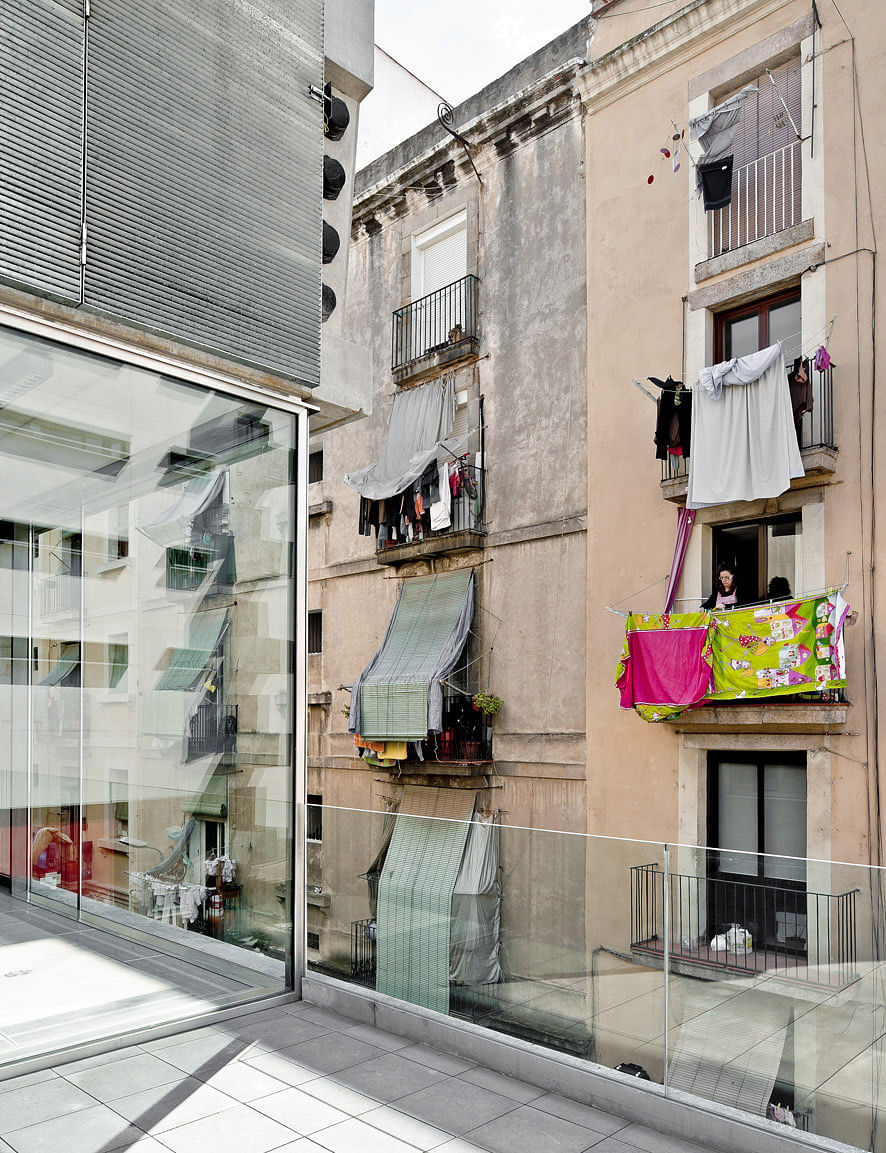
The Building and Espalter Street (Photo: Adrià Goula)

Material/Form

The Film Theatre was conceived as a form “under construction”, as mass and volume without detail. The principal material used is therefore concrete—hard and strong. To accentuate this “unfinished” appearance, the beams extend to the exterior with their tensioning cables.

The building is basically a beam-cum-wall that also frees up space without imposing a domestic presence.

Facade. Concrete Texture (Photo: Adrià Goula)

The brief

The brief brings together in a single building functions that were previously housed separately: the library, the archive and the two cinemas, along with administrative and other functions, such as preparing publicity and information. There are also galleries and a cafeteria-bar.

The ground floor houses the reception and foyer to the cinemas, the vertical communication shafts, the cafeteria-bar and the necessary complementary services (ticket desk, etc.)

Entrance Hall. Ground Floor (Photo: Adrià Goula)

On the first floor are the library and a permanent exhibition gallery, and the second and third floors house the offices of the ICIC (Catalan Institute of Cultural Industries). The second floor is an open-plan space that looks out over the plaza and the street, Carrer d’Espalter, with a terrace overlooking Carrer de Sant Josep Oriol. The third floor is partially lit by a courtyard that becomes a skylight in the roof of the second floor.

ICIC offices. 2nd Floor (Photo: Adrià Goula)

In the basement, beneath the building’s projection, are the two floors of archives and storage, and the part of the basement below the plaza houses the two cinemas.

One of the two cinemas. Floor -2 (Photo: Adrià Goula)

Project Details:

Site: Plaza Salvador Seguí, distrito del raval, Barcelona
Surface: 7,515 m2
Author: Josep Lluís Mateo
Client: ICIC (Institut Català de les Indústries Culturals)
Budget: 12,000,000 Euros
Structural Engineering: BOMA, Agustí Obiol
Installations Engineering: Grupo JG
Budget Control: Tram
Fire Protection Francesc Labastida
Constructor: Emcofa

Related

theater ● spain ● mateo arquitectura ● library ● josep lluís mateo ● film ● europe ● completion ● cinema ● barcelona

Share

  • Follow

    0 Comments

  • Comment as :

Barcelona's Cinematheque de Catalunya Completed

Eight innovative timber projects honored at 2026 Wood in Architecture Awards

Beautiful brick architecture honored at BRICK AWARD 26

Over $500,000 awarded to architectural discourse projects by Graham Foundation

Best in urban planning recognized at AIA Regional & Urban Design Award 2026

Sponsored Post by Buildner

Re:Form - New Life for Old Spaces / Edition #3 advance registration deadline is approaching!

New architecture and design competitions: IDEAS Awards, UIA-HYP CUP International Student Competition, Vancouver Tall Challenge, and Memorial to the Sixth Extinction

Best small projects chosen at AIA Small Project Award 2026

10 standout sustainable projects honored at AIA COTE Top Ten Award 2026

Sign up for Bustler's Email Newsletters

Best residential architecture of 2026 honored at AIA Housing Award

Best new interiors of 2026 chosen at AIA Interior Architecture Awards

Best global architecture honored at RIBA International Awards 2026

World’s most beautiful airports of 2026 chosen by Prix Versailles

New architecture and design competitions: Brick in Architecture Awards, Study Architecture Student Showcase, N.Y.C. Groceries, and New York High Falls Riverfront Market

SmithGroup’s ‘pioneering’ Philip Merrill Environmental Center wins AIA Twenty-five Year Award

Sponsored Post by Buildner

Museum of Emotions / Edition #8 FINAL registration deadline is in 5 DAYS!

Next page » Loading

Barcelona's Cinematheque de Catalunya Completed

By Bustler Editors|

Monday, Sep 26, 2011

Share

Salvador Seguí Square Facade (Photo: Adrià Goula)

Related

theater ● spain ● mateo arquitectura ● library ● josep lluís mateo ● film ● europe ● completion ● cinema ● barcelona

Mateo Arquitectura recently completed the new building for the Film Library of Catalonia in the Raval district of Barcelona. Designed by Josep Lluís Mateo, the project won the first prize in a restricted competition in 2004 and houses archives, a library and cinema halls on a total area of 7,515 sqm (80,891 sqft).

Headquarters of the New Film Theatre of Catalonia from Josep Lluis Mateo on Vimeo.

Project Description from the Architects:

Josep Lluís Mateo: "About the form… The ruins mark the structure of the buildings. The Roman forum formalizes the plane of foundations and drains.

In the old town, my building sets out to express itself as pure structure—no cladding, no finishes.

The bare concrete beams-cum-walls that form the façades are very varied, proving themselves members of the family of the dilapidated neighbouring walls, where plaster crumbles to reveal their original central mass.

Filters are juxtaposed on the wall. This cinematographic metaphor is not just conceptual; it is above all physical, sensible. In the old town, with very close relations between buildings, interaction must be mediated, filtered. And this is implemented by a variety of devices, with a vague cinematographic reference.

About the space… The space is organized around two movements: a) The descent into the darkness of the cinemas, with the reflection of the spectators (in turn reflected, actors seen in a series of mirrors); b) The ascent towards the light, towards the places of work.

Two courtyards, connected but not continuous, accompany and construct the movement."

Ascent towards the places of work (Photo: Adrià Goula)

Place and Project

The new film theatre building presents a façade on Plaça de Salvador Seguí, at an angle to Carrer de Sant Pau. Together with the existing constructions, it forms Carrer d’Espalter.

It is very close to the mythical Carrer de Robador, in an area which, despite the major clean-ups still going on and the change in population, is still a popular, built-up, oppressively Mediterranean/port neighbourhood.

Its relation with its setting operates on the following levels:

The project and Plaça de Salvador Seguí:

The plaza represents a clearing in the built-up district of El Raval which, thanks to this construction, attracts new users and hosts large-scale events. A porch on the ground floor can be opened or closed according to functional needs.
The film theatre is a continuation of the building line of the street, blending in with its setting.

The Site. Raval District
Ground Floor

The project and its immediate surroundings: Carrer d’Espalter:

The volume of the cinemas is undergrounded, thereby reducing the scale and visual impact of the building. The street is widened a little, drawing the construction back from the building line. The new building reduces the ground floor section at the end walls, which also makes the street wider.

The Building and Espalter Street (Photo: Adrià Goula)

Material/Form

The Film Theatre was conceived as a form “under construction”, as mass and volume without detail. The principal material used is therefore concrete—hard and strong. To accentuate this “unfinished” appearance, the beams extend to the exterior with their tensioning cables.

The building is basically a beam-cum-wall that also frees up space without imposing a domestic presence.

Facade. Concrete Texture (Photo: Adrià Goula)

The brief

The brief brings together in a single building functions that were previously housed separately: the library, the archive and the two cinemas, along with administrative and other functions, such as preparing publicity and information. There are also galleries and a cafeteria-bar.

The ground floor houses the reception and foyer to the cinemas, the vertical communication shafts, the cafeteria-bar and the necessary complementary services (ticket desk, etc.)

Entrance Hall. Ground Floor (Photo: Adrià Goula)

On the first floor are the library and a permanent exhibition gallery, and the second and third floors house the offices of the ICIC (Catalan Institute of Cultural Industries). The second floor is an open-plan space that looks out over the plaza and the street, Carrer d’Espalter, with a terrace overlooking Carrer de Sant Josep Oriol. The third floor is partially lit by a courtyard that becomes a skylight in the roof of the second floor.

ICIC offices. 2nd Floor (Photo: Adrià Goula)

In the basement, beneath the building’s projection, are the two floors of archives and storage, and the part of the basement below the plaza houses the two cinemas.

One of the two cinemas. Floor -2 (Photo: Adrià Goula)

Project Details:

Site: Plaza Salvador Seguí, distrito del raval, Barcelona
Surface: 7,515 m2
Author: Josep Lluís Mateo
Client: ICIC (Institut Català de les Indústries Culturals)
Budget: 12,000,000 Euros
Structural Engineering: BOMA, Agustí Obiol
Installations Engineering: Grupo JG
Budget Control: Tram
Fire Protection Francesc Labastida
Constructor: Emcofa

Share

  • Follow

    0 Comments

  • Comment as :

Archinect JobsArchinect Jobs

The Archinect Job Board attracts the world's top architectural design talents.

VIEW ALL JOBS POST A JOB

Intermediate Architect

GF55 Architects

Intermediate Architect

New York, NY, US

Miami Senior Project Coordinator

BMA Architects

Miami Senior Project Coordinator

Miami, FL, US

BIM Application Specialist

Lake Flato Architects

BIM Application Specialist

San Antonio, TX, US

Architectural Designer II

Studio AR&D Architects

Architectural Designer II

Los Angeles, CA, US

Architect/Project Manager - Commercial

DAHLIN Architecture | Planning | Interiors

Architect/Project Manager - Commercial

Pleasanton, CA, US

Interior Designer

Fowlkes Studio

Interior Designer

Washington, DC, US

Project Captain

Practice (formerly GGA+)

Project Captain

Pasadena, CA, US

Project Manager/Designer

BOTO Design Architects

Project Manager/Designer

Santa Monica, CA, US

Design Technologist / BIM Lead

The American Housing Corporation

Design Technologist / BIM Lead

Austin, TX, US

Designer (Level 3)

KPMB

Designer (Level 3)

Cambridge, MA, US

Next page » Loading