Construction Starts on MVRDV’s Future Towers in Pune, India
Posted: Thursday, March 17, 2011 | ↓ 16 comments

Indian real estate developer City Corporation Ltd has started construction on the first phase of Amanora Apartment City - Future Towers, designed by MVRDV. The project is located in Pune in the Indian state of Maharashtra and features 1,068 apartments & public amenities, as a part of a large scale housing development with a total of 400,000 m2, comprising 3,500 apartments. Completion is expected by summer 2014. The apartments and facilities are interwoven and create a vertical city which will, due to its various apartment types, offer housing to a diverse group of residents.

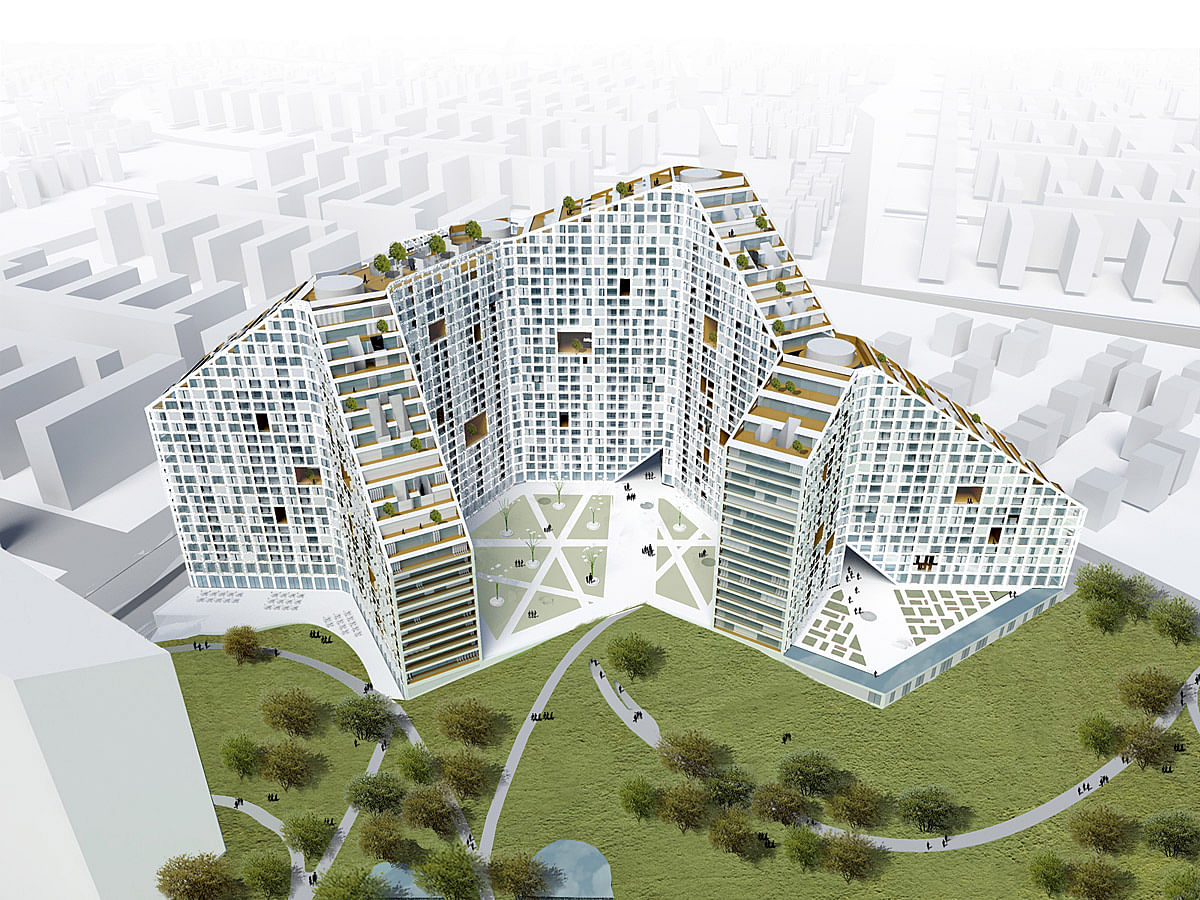
Future Towers phase one: The total surface of the first phase is about 210,000m2 comprising of 115,000m2 housing, 8,400m2 public amenities and 49,662m2 parking. Image: MVRDV

Click above image to view slideshow
Future Towers phase one: The total surface of the first phase is about 210,000m2 comprising of 115,000m2 housing, 8,400m2 public amenities and 49,662m2 parking. Image: MVRDV

Project Description from the Architects:

India is currently in a rapid development to provide housing for millions; as a result often monotonous large scale housing estates appear. MVRDV takes on the challenge to participate in this development which seems dominated by efficiency rather than quality. The Future Towers project introduces lost qualities to mass housing: increased density combined with amenities, public facilities, parks and a mix of inhabitants resulting in a vertical city. The 1,068 apartments of the first phase vary from 42m2 to 530m2 and are set to attract a diverse mix oIndia is currently in a rapid development to provide housing for millions; as a result often monotonous large scale housing estates appear. MVRDV takes on the challenge to participate in this development which seems dominated by efficiency rather than quality.
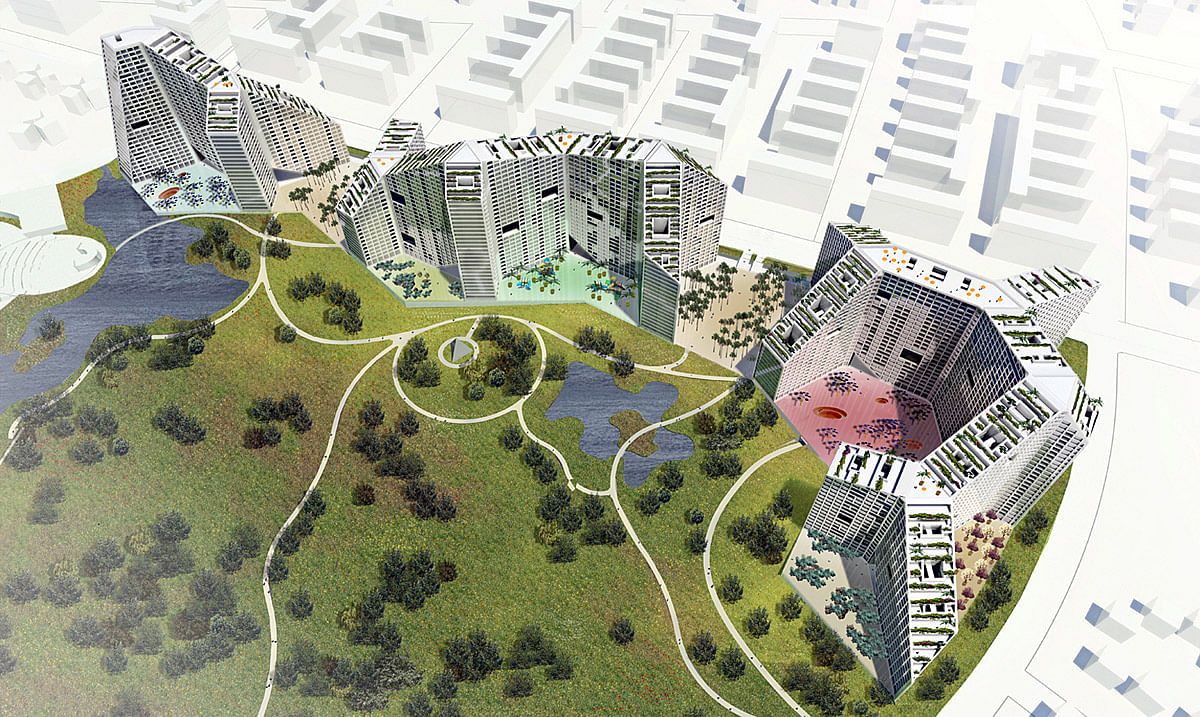
MVRDV Future Towers, Pune: overview of total plan, on the right hand phase one which is currently under construction.  Image: MVRDV

Click above image to view slideshow
MVRDV Future Towers, Pune: overview of total plan, on the right hand phase one which is currently under construction. Image: MVRDV

The Future Towers project introduces lost qualities to mass housing: increased density combined with amenities, public facilities, parks and a mix of inhabitants resulting in a vertical city. The 1,068 apartments of the first phase vary from 42m2 to 530m2 and are set to attract a diverse mix of population to the new neighbourhood with the ambition of creating a lively sub-centre for Pune. The studio to villa size apartments are designed according to an analysis of modern Indian housing standards. They are in general equipped with balconies, naturally ventilated service spaces and almost each bedroom has an individual bathroom. The hill shape structure with its peaks, valleys, canyons, bays, grottos and caves adds identity to the city and provides a large number of apartments with fine views and spacious balconies; its public space offers possibilities for interaction and communal activities.
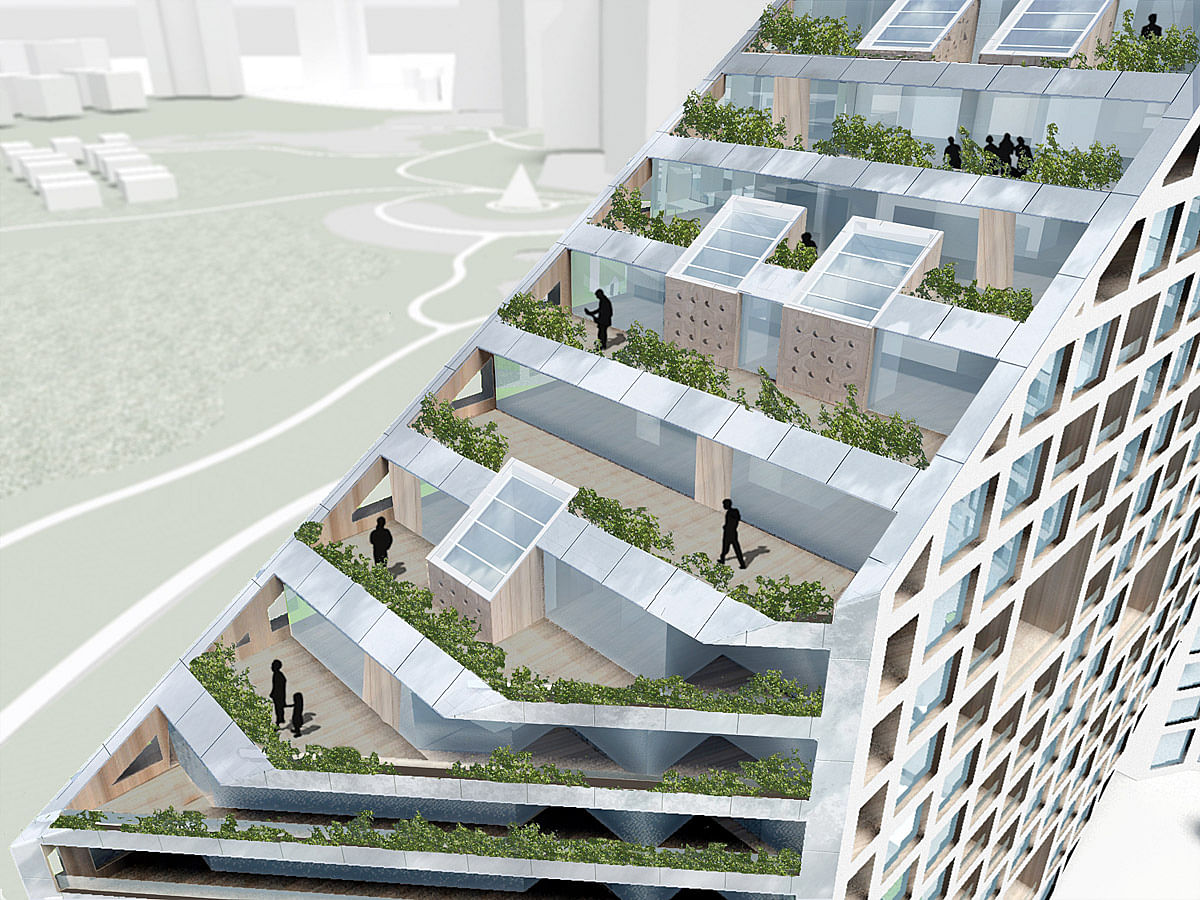
MVRDV Future Towers, Pune: the hill shape allows for wide outside spaces. Image: MVRDV

Click above image to view slideshow
MVRDV Future Towers, Pune: the hill shape allows for wide outside spaces. Image: MVRDV

The 400 acres site is located 10 kilometres from the city centre of Pune in the centre of the Amanora Park Town development; the plot will be built up with FAR5 but still maintain large gardens. The first phase building is raised by a basement and plinth which contain parking and various public facilities: A school, swimming pool, retail, bars, cafes and a cinema. At the tallest point of the structure a sky lounge will be established.
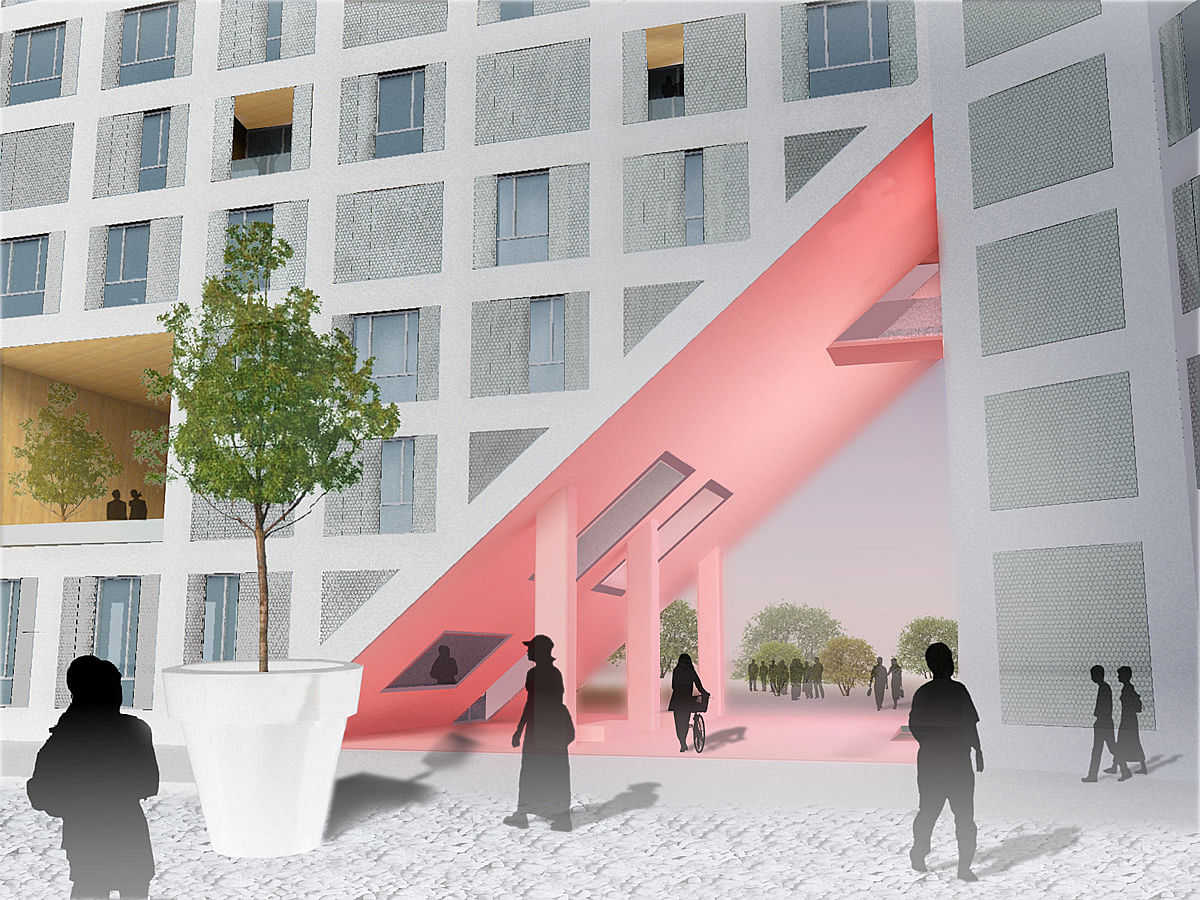
MVRDV Future Towers, Pune: street level. Image: MVRDV

Click above image to view slideshow
MVRDV Future Towers, Pune: street level. Image: MVRDV

The building follows a hexagonal grid to provide views and natural light to the apartments. This allows the 9 wings with double loaded corridors to be efficiently serviced by 4 cores. The interconnected courtyards are programmed to offer the inhabitants relaxing and social environments. There will be an herb garden, an event plaza, a flowerpot garden, a playground and a sculpture garden. In-between the volumes of each of the three phase's gardens are planned.

The facade will be made of concrete and the large windows will have sun protection by ornamented metal shutters, allowing for natural ventilation between facade and the many ventilation shafts that cross the structure vertically. The circulation spaces and public spaces will be clad in natural stone; the balconies are all clad in wood.
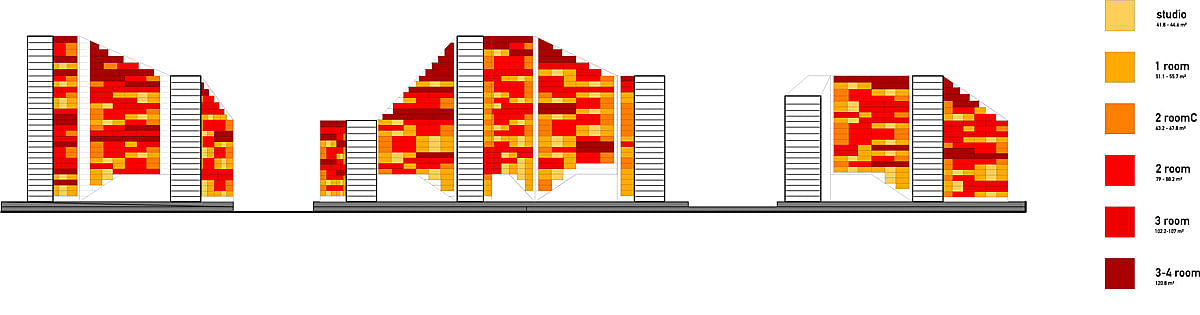
Diagram of the different housing types that are interwoven - not separately - placed in the volume.  Image: MVRDV

Click above image to view slideshow
Diagram of the different housing types that are interwoven - not separately - placed in the volume. Image: MVRDV

City Corporation Ltd. has commissioned MVRDV to design in total 3 phases of Future Towers with in total approximately 3,500 apartments or 400,000m2 of housing and amenities. Besides MVRDV the team is based in Pune: Project Management by Northcroft India, co-architecture and MEP by Neilsoft, Structural Design by J+W.

Future Towers was a competition won by MVRDV in November 2009 and it is the first MVRDV project in India presented to the public. MVRDV is currently also working on a range of projects in Mumbai and Bangalore.


Comments:
Rebecca
Thursday, March 17, 2011
Future Towers? This development looks like the worst of 70's architecture on steroids. - Its Bijlmermeer without the hindsight.

This project seems to offer little in terms of an urban fabric, or spatial quality, based on base architectural values.

Why is it that when building in/for the developing world EU standards of quality are the first to go?

sara
Thursday, March 17, 2011
low quality has nothing to do with which country you're in.

but yes, this is low quality design. ask MVRDV.

Triz
Friday, March 18, 2011
Much greater minds have failed with much better explorations in the past, so why are we seeing a flurry of these ridiculous residential schemes from the likes of MVRDV, BIG etc? Are Architectural History books not available in Holland and Denmark? Any knuckle head responsible for designing this garbage, should be made to live in it.

Angel
Friday, March 18, 2011
Those oppressive forms, the heavy-handed and crude massing is like the worst dictator-driven projects from 1960's Russia. This has "amateur hour" written all over it. It looks like a slum in the making.

Harvey
Friday, March 18, 2011
It looks like something out of Studio Daniel Libeskind. (Which means it looks like one of the dumbest designs imaginable.)

Nima
Toronto, Canada
Sunday, March 20, 2011
In one interview Winy Maas once said Zaha sells style whereas we (MVRDV) sell ideas. Not to disregard MRDV's contribution to the discipline, i must say that in the long run ( considering all the forces of status quo) stubborn pursuit of personal style (Zaha) has more dignity than idea driven architecture compromised with the normative realities of the development.

Jan @ MVRDV
Rotterdam
Monday, March 21, 2011
Is it ridiculous to be involved in mass housing which is currently built on an unprecedented scale in the world with poor quality and hardly touched by inspired architects? They would not burn their hands with this.

The Amanora projects is the outcome of months of thinking and testing. The sheer scale is already beyond EU standards and yet we designed with every last user in mind - hence the hexagon.

allSTAR
Pune, India
Monday, March 21, 2011
HEY... CUT THESE GUYS SOME SLACK.... HAVE U SEEN THE "CONTEXT" (INDIAN R.E. MARKET) THEY ARE WORKING WITHIN? THIS IS PROPOSAL STILL BETTER THAN THE SHIT BEING BUILT AROUND IT. ITS UNFAIR TO COMPARE IT TO RANDOM RESIDENTIAL DEVELOPMENTS AROUND THE WORLD... UNDERSTAND THE CONTEXT BEFORE U CRITIQUE!

jek
nyc
Monday, March 21, 2011
Jan, point taken but the sheer density of it is pretty startling i guess

there is so much landscape on your site - at least it appears so from the images... why not spread out?

Scottyvalentine
Brisbane
Tuesday, March 22, 2011
Agree with AllSTAR, Indian Architecture blows

odaku
India
Wednesday, March 23, 2011
Pretty sure that the design is of EU standards but doubt if it is designed with every last user in mind. Just by looking at the exterior it is clear that it is not designed for the local climate, thereby ignoring the comfort of every user.

Having said that, i agree that local architecture is absolutely crappy and India could use a dose of innovative and new ideas from outside.

But please, please, don't confuse standards with comfort.

Nima
Toronto
Thursday, March 24, 2011
@Jan
MVRDV was not the first to deal with high density housing and its issues (efficiency, light, views,.. thus hexagon) but perhaps the first to embrace the problems of high density as a potential for great architecture. This project has a compromised dose of those potentials and as viewers we can only see that it is a mediocre project. As for EU vs. India standards, high standards do not guarantee good architecture they guarantee high level of comfort for the users. I doubt that your office's previous projects were the most comfortable ones, but used to be great architecture.

Alejandro Gomez
Portugal
Friday, March 25, 2011
Nice concept!!! Brilliant!

sv
Sunday, May 01, 2011
architects have a knack of 'designing around' problems, its as if one can design around a corrupt state, low infrastructure, polarized earning scales, greedy developers.....old trick....its like saying we built ridiculously high density in one place of low infrastructure simply to expose the problem....give me a break...these guys had their share of fun while being in the Middle east and now they have arrived in Bombay and Beijing! idiots.

victor
Rotterdam
Tuesday, May 03, 2011
Nice human-sized ant-farm! I guess every office needs a easy money-making project in these dire times.

Cyril
Thursday, July 19, 2012
I have seen better than this kind of architecture from MVRDV. Becauce this will age very badly.

Name:
Email:
Location:
URL:
Comment:
Remember my personal information
Notify me of follow-up comments?

Prove you're not a spammer by answering the following question:
A super tall building is called a "sky..."


Featured Competitions:
image
Register/Submit: Sep 1
image
Register: May 24 / Submit: Jul 12
image
Register: Sep 30 / Submit: Oct 20
image
Register/Submit: Jul 1

Search News by Keyword:
Advertisement