• Login / Join
  • About
  • •
  • Contact
  • •
  • Advertising
bustler logo
bustler logo
  • News
  • Competitions
  • Events
  • Bustler is powered by Archinect
  • Sign up for Bustler's Email Newsletters

  • Follow these Bustler feeds:

  • Search

    Search in

  • Submit

    What are you submitting?

    News Pitch
    Competition
    Event
  • Login / Join
  • News|Competitions|Events
  • Search
    | Submit
    | Follow
  • Search in

    What are you submitting?

    News Pitch
    Competition
    Event

    Follow these Bustler feeds:

  • About|Contact|Advertising
  • Login / Join

Designing for Adaptable Futures (DAF) Winners Announced

By Bustler Editors|

Thursday, Jul 5, 2012

Joint First Prize: Factory Home by Johnny Killok: Still from the Factory Home film: work mode

The Adaptable Futures (AF) group at Loughborough University in England today announced the winners of its first international student competition, Designing for Adaptable Futures (DAF). The competition asked students to illustrate how the life of their proposal - whether product, building or urban intervention - would unfold through time: over an hour, day, year, decade, or perhaps a century.

The international jury of architects included Charles Holland, Director (FAT Architecture); Daisy Froud, Director (AOC); Megumi Matsubara, Founder (Assistant, Japan); Søren Nielson, Director (Vankunsten Architects, Denmark); David Rowley, Director (Nightingale Associates); and Paul Warner, Director (3D Reid Architects).

Joint First Prize: Factory Home by Johnny Killok from AdaptableFutures on Vimeo.

Top submissions were shortlisted, from which the judges selected three winning submissions (a joint first place and a third place) along with five submissions deserving honorable mention. Overall the competition received over 150 submissions from 26 countries around the world.

Joint First Prize: Factory Home
by Johnny Killok (University of Westminster, UK)

Factory Home focuses on reshaping the live/work spatial relationship as part of a ‘third industrial revolution’. The proposal organizes the building as three distinct zones – living, working and transition which are blurred through the use of flexible modules sliding in and out of the transition zone as needed throughout the day. - boards (PDF)

Joint First Prize: Village Green
by Jeffrey Adjei (University for the Creative Arts Canterbury, UK)

Village Green (for the people by the people) in New Addington proposes several ideas about how to construct transient social structures for a high quality public space which evolve with community needs. The proposal embraces Walter Segal’s concept of self-build and looks extensively at the collaborative process, linking the community with a vast network of charity and government organizations through a continual building process. - boards (PDF)
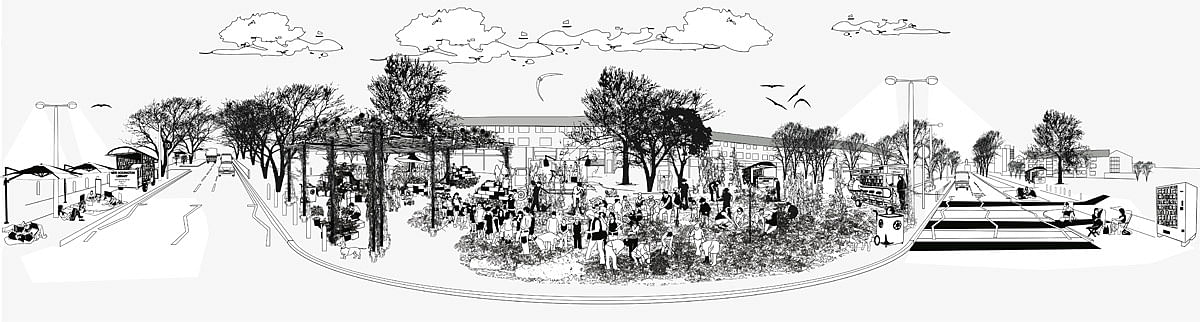
Joint First Prize: Village Green by Jeffrey Adjei: Village Green's public space

Third Prize: Adaptable Street
by Maxime Rousseau and Paul Jaquet (Université de Montréal, Canada)

Adaptable Street focuses on exploiting (and expanding) the capacity in our major cities to create and adapt spaces at and around street level, creating ‘thick streets’ for a vibrant mix of uses. The proposal explores how the uses and spaces would transform linearly, seasonally and over time. - boards (PDF)
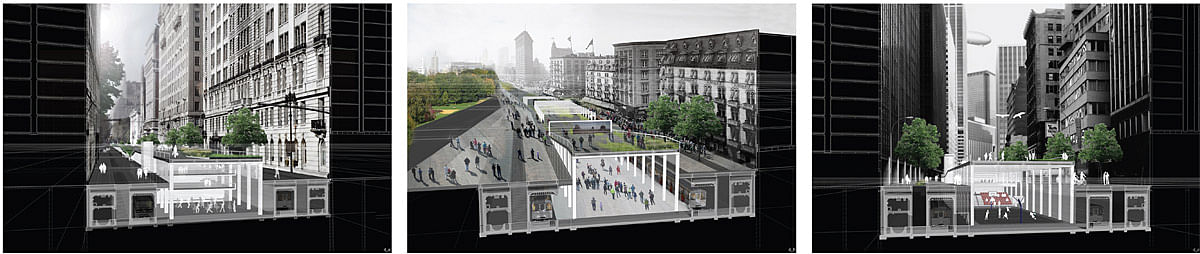
Third Prize: Adaptable Street by Maxime Rousseau and Paul Jaquet: Sections through street

Regarding the winning submissions, Daisy Froud of AOC stated; “I'm really glad that the two joint winners reflect two very different approaches, one more traditionally architectural - it's a big building with bits that slide, but that is nonetheless rooted in thinking about how people in central London live and work - and one that has more in common with social sculpture, its speculations based on research into a specific cultural and perhaps even 'small-p political' context."

Jury members were inspired by the quality of the visual and narrative ideas presented. David Rowley of Nightingale Associates commented: “I was impressed by the time and effort many of the students put into the submissions, and how effectively they showcased their ideas using both presentation boards and film.  The best submissions fully embraced adaptability with sustainability in its broadest sense, taking into account social and political factors as well as accounting for the visual environment and longevity.”

The integration of time in their design proposal was framed around three criteria presented in the brief: strategies for change (AF frame cycle), building layers and design guidelines (spatial, material and mind set). 

Students were allowed to submit two A0 boards and/or a three minute film. The three competition winners will share a £3,500 (US$5,433) cash prize and have been invited to participate and present at this autumn’s AF event in London. 

The jury also awarded Honorable Mentions to following five projects:

Honorable Mention: Favela Flex
by Bruno Amadei, Camila Jardim, Mariana Correa and Renata Romanach (Fluminense Federal University, Brazil)

The charming and playful film proposes a module for the incremental construction of a favela in Rio de Janeiro. The proposal builds on the adaptability inherent in the informal approach which constructs existing favelas already, but attempts to provide a simple set of ‘rules’ which can augment the organic process.  The system adapts to the often extreme topography of favela construction (concrete slab and metal structure), is divided into wet and dry zones, expandable by 2m, and allows the owner to choose wall finishes/colors.

Honorable Mention: Favela Flex by Bruno Amadei, Camila Jardim, Mariana Correa and Renata Romanach from AdaptableFutures on Vimeo.
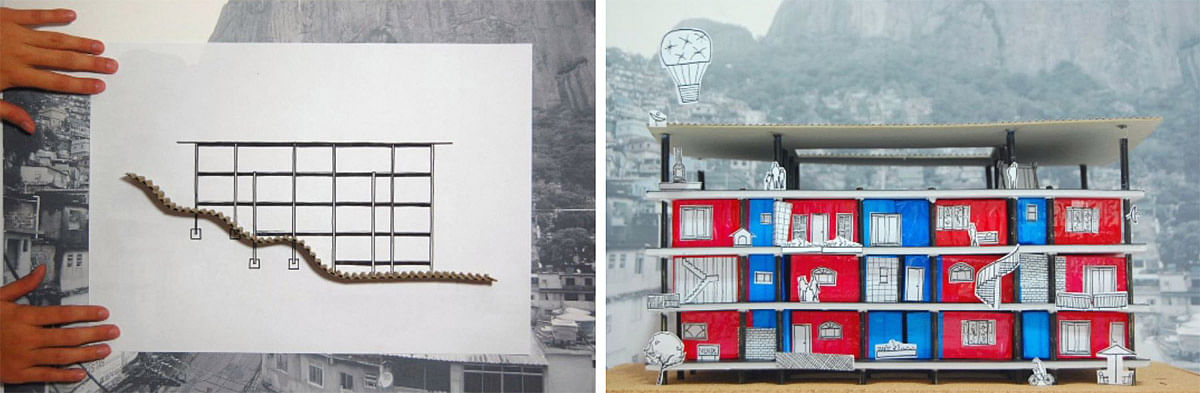
Honorable Mention: Favela Flex by Bruno Amadei, Camila Jardim, Mariana Correa and Renata Romanach

Honorable Mention: Designing for Sport
by David Weir-McCall (Robert Gordon University, Scotland)

Designing for Sport looks at the legacy of the buildings constructed for the Commonwealth Games in Glasgow – it proposes an energy generating dome as a ‘permanent’ public landmark that adapts to shifting climatic and use conditions underneath (stadium to college to park). The submission puts forth several smaller aluminum framed venues under a single roof (opposed to one large shared venue).  The film focuses on the layered roof structure (grid shell dome) and the explored fiber optic panels. - boards (PDF)

Honorable Mention: Designing for Sport by David Weir-McCall from AdaptableFutures on Vimeo.
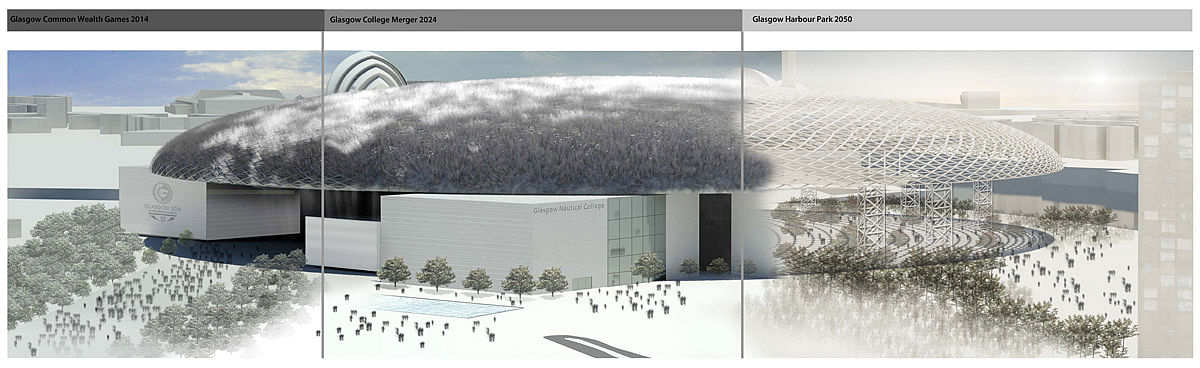
Honorable Mention: Designing for Sport by David Weir-McCall

Honorable Mention: How to Grow a City?
by Stanislaw Mlynski (University of Technology in Poznan, Poland)

How to grow a city illustrates a layered module (the crate) which can adapt to lifestyle and activity shifts via self-organization to regenerate the Gdynia shipyard. It embraces its cultural and social context (proposed form, use and construction) through the implementation of unused objects on site (cranes, rail tracks) and a community workshop. The proposal focuses on three evolving variables over time: age, function and social preferences offering an appropriate blend of social catalysts for change. - boards (PDF)

Honorable Mention: How to Grow a City? by Stanislaw Mlynski from jak wyhodowac miasto? on Vimeo.

Honorable Mention: How to Grow a City? by Stanislaw Mlynski

Honorable Mention: Inside and Out of the Box
by Megan Jenkin (University of Cincinnati, USA)

The proposal provides a DIY guide (rules) to ‘expanding’ one’s home via the wall as an element of focus applying sustainable practices for small, incremental changes which are conventionally desirable regarding home ownership. The steps are interchangeable allowing the user to mix and match as needed to transform one’s home over time. The tall, ‘tight’ units are designed for single person urban living conditions. ‘Waste’ becomes ubiquitous getting reused by the owner or filtering into a larger trade network. - boards (PDF)
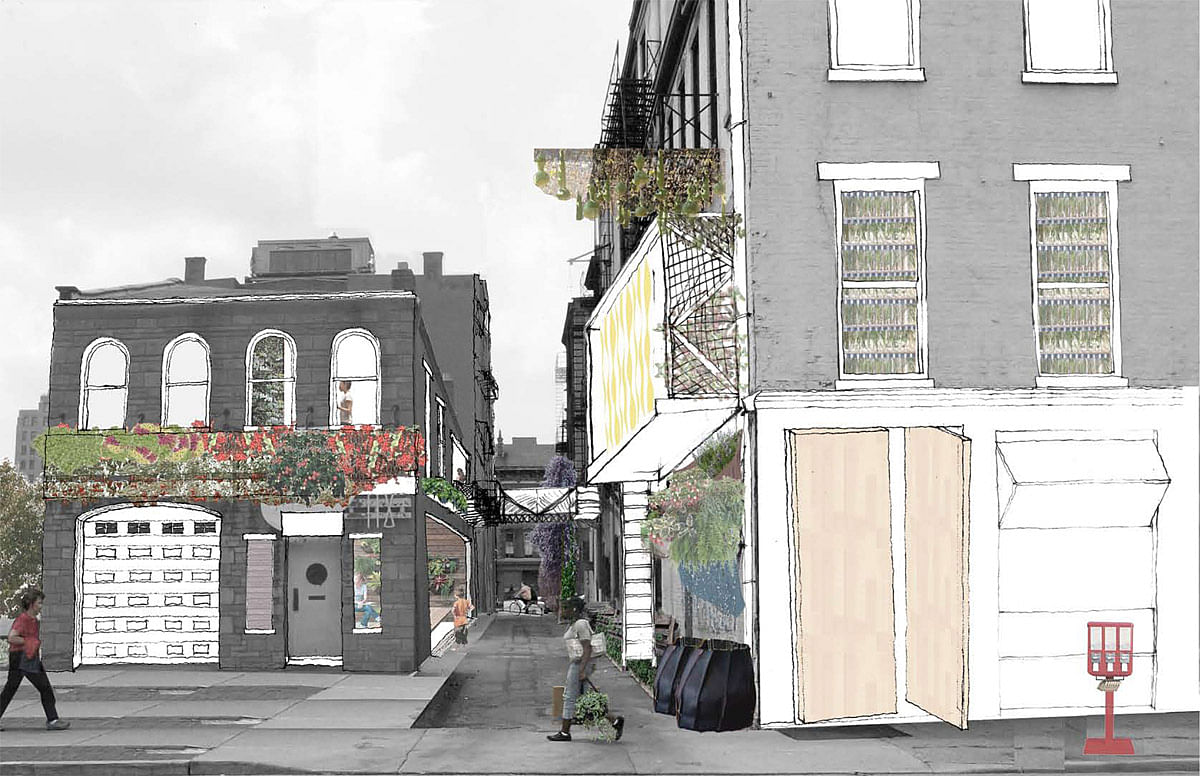
Honorable Mention: Inside and Out of the Box by Megan Jenkin

Honorable Mention: Factory to Community Centre
by Yuxin Cao (Dalian University of Technology, China)

The proposal tackles a common adaptation scenario across the world (finding a new use for a large abandoned factory space), however, the sheer amount of scenarios explored provides a tremendous level of ownership/ understanding of the project – how people experience the building at various points in time throughout a day, week and over several years is reflected upon through interesting spatial uses and a changing physical environment. - boards (PDF)
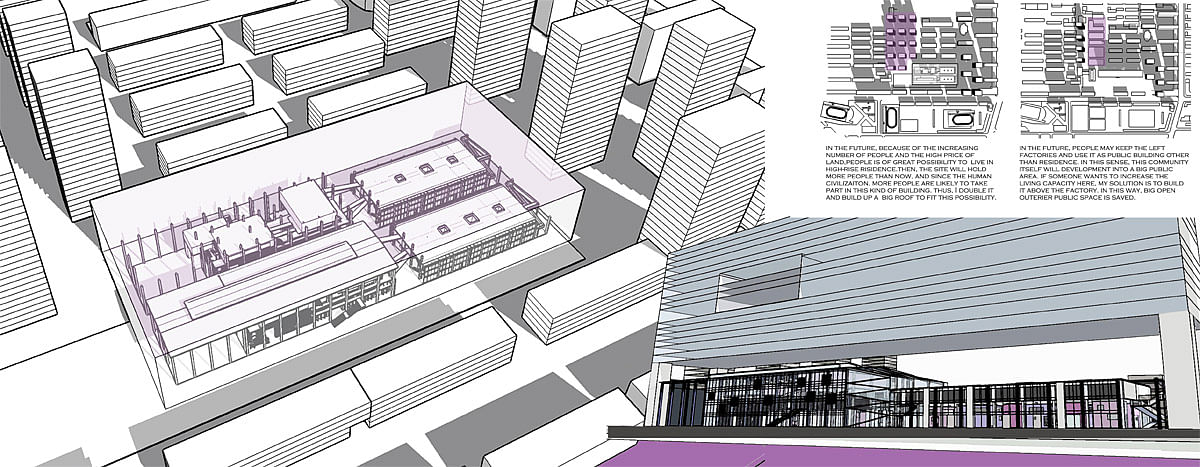
Honorable Mention: Factory to Community Centre by Yuxin Cao

To see all the shortlisted entries, visit: adaptablefutures.com/competition-results.

Related

video ● united kingdom ● sustainability ● student ● school ● loughborough university ● england ● adaptable futures

Share

  • Follow

    0 Comments

  • Comment as :

Designing for Adaptable Futures (DAF) Winners Announced

New architecture and design competitions: Exploring 130 Years of American Design, Christo & Jeanne-Claude Center, 13 White Houses, and La Pyramide

Micro-architecture honored in latest Tiny House Architecture Competition

World’s most beautiful restaurants of 2026 chosen by Prix Versailles

Sponsored Post by Buildner

Design a wine tasting room in Italy! Valli Wine Tasting Room is launched!

10 can't-miss architecture & design events to see this June in London, Los Angeles, Chicago, San Francisco, Detroit, San Diego, Porto, and Barcelona

Sponsored Post by Buildner

Museum of Emotions / Edition #8 FINAL registration deadline is approaching!

Seven global projects make AR Public Awards shortlist 2026

Sponsored Post by Buildner

Design a slow-living restaurant in Portugal! Portugal Long Table Restaurant is launched!

Sign up for Bustler's Email Newsletters

World's best tall buildings honored at the CVU 2026 Award of Excellence

Sponsored Post by TWOPAGES

Final call: TWOPAGES X Design Contest 2026 submissions close June 5

Kengo Kuma & Paul Raff win Alberta national park visitor center competition with landscape-focused design

2026 Moira Gemmill and MJ Long prizes announced by W Awards

New architecture and design competitions: Kinderspace, Stewardson Keefe LeBrun Travel Grant, SMALL PROJECT BIG IMPACT, and Garden of University House, Bucharest

The Century of Gehry: New retrospective explores the late architect's work & collaborations

Sponsored Post by Buildner

Rome Rain Rooms FINAL registration deadline is in 5 DAYS!

Next page » Loading

Designing for Adaptable Futures (DAF) Winners Announced

By Bustler Editors|

Thursday, Jul 5, 2012

Share

Joint First Prize: Factory Home by Johnny Killok: Still from the Factory Home film: work mode

Related

video ● united kingdom ● sustainability ● student ● school ● loughborough university ● england ● adaptable futures

The Adaptable Futures (AF) group at Loughborough University in England today announced the winners of its first international student competition, Designing for Adaptable Futures (DAF). The competition asked students to illustrate how the life of their proposal - whether product, building or urban intervention - would unfold through time: over an hour, day, year, decade, or perhaps a century.

The international jury of architects included Charles Holland, Director (FAT Architecture); Daisy Froud, Director (AOC); Megumi Matsubara, Founder (Assistant, Japan); Søren Nielson, Director (Vankunsten Architects, Denmark); David Rowley, Director (Nightingale Associates); and Paul Warner, Director (3D Reid Architects).

Joint First Prize: Factory Home by Johnny Killok from AdaptableFutures on Vimeo.

Top submissions were shortlisted, from which the judges selected three winning submissions (a joint first place and a third place) along with five submissions deserving honorable mention. Overall the competition received over 150 submissions from 26 countries around the world.

Joint First Prize: Factory Home
by Johnny Killok (University of Westminster, UK)

Factory Home focuses on reshaping the live/work spatial relationship as part of a ‘third industrial revolution’. The proposal organizes the building as three distinct zones – living, working and transition which are blurred through the use of flexible modules sliding in and out of the transition zone as needed throughout the day. - boards (PDF)

Joint First Prize: Village Green
by Jeffrey Adjei (University for the Creative Arts Canterbury, UK)

Village Green (for the people by the people) in New Addington proposes several ideas about how to construct transient social structures for a high quality public space which evolve with community needs. The proposal embraces Walter Segal’s concept of self-build and looks extensively at the collaborative process, linking the community with a vast network of charity and government organizations through a continual building process. - boards (PDF)

Joint First Prize: Village Green by Jeffrey Adjei: Village Green's public space

Third Prize: Adaptable Street
by Maxime Rousseau and Paul Jaquet (Université de Montréal, Canada)

Adaptable Street focuses on exploiting (and expanding) the capacity in our major cities to create and adapt spaces at and around street level, creating ‘thick streets’ for a vibrant mix of uses. The proposal explores how the uses and spaces would transform linearly, seasonally and over time. - boards (PDF)

Third Prize: Adaptable Street by Maxime Rousseau and Paul Jaquet: Sections through street

Regarding the winning submissions, Daisy Froud of AOC stated; “I'm really glad that the two joint winners reflect two very different approaches, one more traditionally architectural - it's a big building with bits that slide, but that is nonetheless rooted in thinking about how people in central London live and work - and one that has more in common with social sculpture, its speculations based on research into a specific cultural and perhaps even 'small-p political' context."

Jury members were inspired by the quality of the visual and narrative ideas presented. David Rowley of Nightingale Associates commented: “I was impressed by the time and effort many of the students put into the submissions, and how effectively they showcased their ideas using both presentation boards and film.  The best submissions fully embraced adaptability with sustainability in its broadest sense, taking into account social and political factors as well as accounting for the visual environment and longevity.”

The integration of time in their design proposal was framed around three criteria presented in the brief: strategies for change (AF frame cycle), building layers and design guidelines (spatial, material and mind set). 

Students were allowed to submit two A0 boards and/or a three minute film. The three competition winners will share a £3,500 (US$5,433) cash prize and have been invited to participate and present at this autumn’s AF event in London. 

The jury also awarded Honorable Mentions to following five projects:

Honorable Mention: Favela Flex
by Bruno Amadei, Camila Jardim, Mariana Correa and Renata Romanach (Fluminense Federal University, Brazil)

The charming and playful film proposes a module for the incremental construction of a favela in Rio de Janeiro. The proposal builds on the adaptability inherent in the informal approach which constructs existing favelas already, but attempts to provide a simple set of ‘rules’ which can augment the organic process.  The system adapts to the often extreme topography of favela construction (concrete slab and metal structure), is divided into wet and dry zones, expandable by 2m, and allows the owner to choose wall finishes/colors.

Honorable Mention: Favela Flex by Bruno Amadei, Camila Jardim, Mariana Correa and Renata Romanach from AdaptableFutures on Vimeo.

Honorable Mention: Favela Flex by Bruno Amadei, Camila Jardim, Mariana Correa and Renata Romanach

Honorable Mention: Designing for Sport
by David Weir-McCall (Robert Gordon University, Scotland)

Designing for Sport looks at the legacy of the buildings constructed for the Commonwealth Games in Glasgow – it proposes an energy generating dome as a ‘permanent’ public landmark that adapts to shifting climatic and use conditions underneath (stadium to college to park). The submission puts forth several smaller aluminum framed venues under a single roof (opposed to one large shared venue).  The film focuses on the layered roof structure (grid shell dome) and the explored fiber optic panels. - boards (PDF)

Honorable Mention: Designing for Sport by David Weir-McCall from AdaptableFutures on Vimeo.

Honorable Mention: Designing for Sport by David Weir-McCall

Honorable Mention: How to Grow a City?
by Stanislaw Mlynski (University of Technology in Poznan, Poland)

How to grow a city illustrates a layered module (the crate) which can adapt to lifestyle and activity shifts via self-organization to regenerate the Gdynia shipyard. It embraces its cultural and social context (proposed form, use and construction) through the implementation of unused objects on site (cranes, rail tracks) and a community workshop. The proposal focuses on three evolving variables over time: age, function and social preferences offering an appropriate blend of social catalysts for change. - boards (PDF)

Honorable Mention: How to Grow a City? by Stanislaw Mlynski from jak wyhodowac miasto? on Vimeo.

Honorable Mention: How to Grow a City? by Stanislaw Mlynski

Honorable Mention: Inside and Out of the Box
by Megan Jenkin (University of Cincinnati, USA)

The proposal provides a DIY guide (rules) to ‘expanding’ one’s home via the wall as an element of focus applying sustainable practices for small, incremental changes which are conventionally desirable regarding home ownership. The steps are interchangeable allowing the user to mix and match as needed to transform one’s home over time. The tall, ‘tight’ units are designed for single person urban living conditions. ‘Waste’ becomes ubiquitous getting reused by the owner or filtering into a larger trade network. - boards (PDF)

Honorable Mention: Inside and Out of the Box by Megan Jenkin

Honorable Mention: Factory to Community Centre
by Yuxin Cao (Dalian University of Technology, China)

The proposal tackles a common adaptation scenario across the world (finding a new use for a large abandoned factory space), however, the sheer amount of scenarios explored provides a tremendous level of ownership/ understanding of the project – how people experience the building at various points in time throughout a day, week and over several years is reflected upon through interesting spatial uses and a changing physical environment. - boards (PDF)

Honorable Mention: Factory to Community Centre by Yuxin Cao

To see all the shortlisted entries, visit: adaptablefutures.com/competition-results.

Share

  • Follow

    0 Comments

  • Comment as :

Archinect JobsArchinect Jobs

The Archinect Job Board attracts the world's top architectural design talents.

VIEW ALL JOBS POST A JOB

Project Architect / Senior Designer

Touloukian Touloukian Inc.

Project Architect / Senior Designer

Boston, MA, US

Graduate Architect

RATIO Design

Graduate Architect

Chicago, IL, US

Architecture Project Manager

RDH Architecture + Interior Design

Architecture Project Manager

Las Vegas, NV, US

Senior Designer - Residential Design

Laura U Design Collective

Senior Designer - Residential Design

Houston, TX, US

Architectural Job Captain

Christopher Courts Inc.

Architectural Job Captain

Los Angeles, CA, US

Business Development Manager

WORKac

Business Development Manager

New York, NY, US

Project Designer (3 to 5 years)

Swift Lee Office

Project Designer (3 to 5 years)

Los Angeles, CA, US

Project Manager - Civic/Community

DAHLIN ARCHITECTURE | PLANNING | INTERIORS

Project Manager - Civic/Community

Irvine, CA, US

Associate - Interior Designer

FitzGerald Associates Architects

Associate - Interior Designer

Chicago, IL, US

Junior Architect

PRDG architecture + design

Junior Architect

New York, NY, US

Next page » Loading