• Login / Join
  • About
  • •
  • Contact
  • •
  • Advertising
bustler logo
bustler logo
  • News
  • Competitions
  • Events
  • Bustler is powered by Archinect
  • Sign up for Bustler's Email Newsletters

  • Follow these Bustler feeds:

  • Search

    Search in

  • Submit

    What are you submitting?

    News Pitch
    Competition
    Event
  • Login / Join
  • News|Competitions|Events
  • Search
    | Submit
    | Follow
  • Search in

    What are you submitting?

    News Pitch
    Competition
    Event

    Follow these Bustler feeds:

  • About|Contact|Advertising
  • Login / Join

Film Library of Catalonia Almost Completed in Barcelona

By Bustler Editors|

Tuesday, Nov 30, 2010
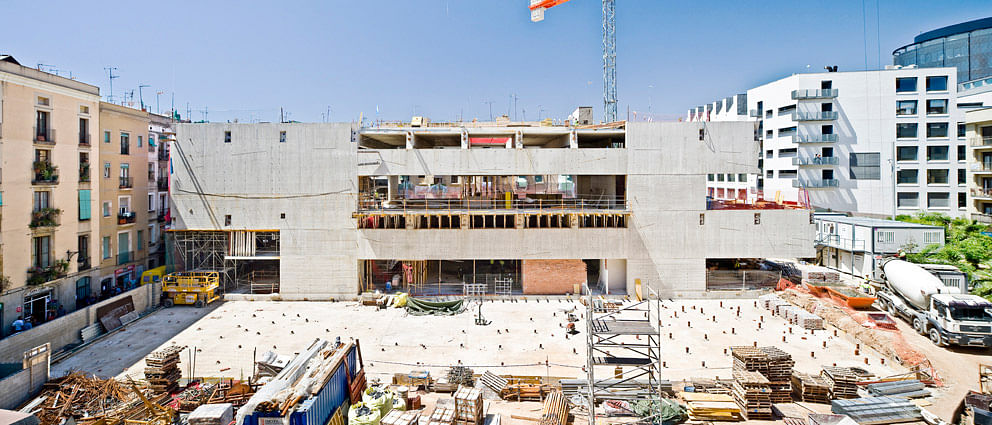
Photo: Adrià Goula

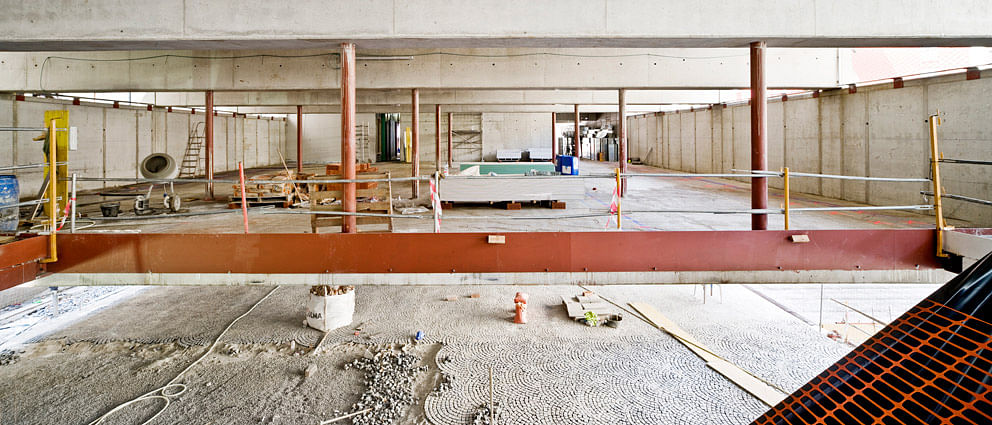
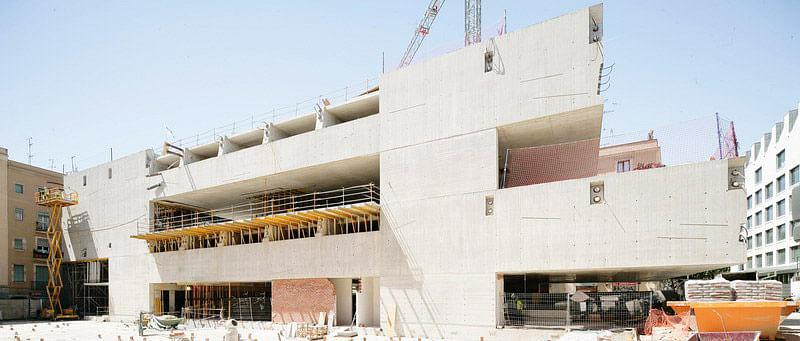
Barcelona-based Mateo Arquitectura have shared with us some fascinating material documenting the construction progress of a new building for the Cinematheque de Catalunya in the Raval, Barcelona. Designed by Josep Lluís Mateo, the project won the first prize in a restricted competition in 2004 and will house archives, a library and cinema halls on a total area of 7,515 sqm (80,891 sqft). Construction is scheduled to be completed in December/January.

Film Library of Catalonia by Mateo Arquitectura under construction in Barcelona


"The new building will stand in the Raval, one of the most run-down parts of Barcelona’s historic centre and currently the object of an energetic policy of demolition and new run-of-the-mill construction.
It is a public building that configures the plaza it borders. It is designed to underline differences in order to establish an affectionate relationship with its shabby old neighbours and dissociate itself from the presences of its contemporaries.
The building for the new Filmoteca de Catalunya has been conceived as something between an industrial premises and a building under construction, pure technique almost without any finish." -- Josep Lluís Mateo

Work in Progress:

Extract of the meeting between Josep Lluís Mateo and José Luis Guerín, director of the film En construcción (Work in progress), about the Raval district in Barcelona, which served as a reference for Josep Lluís Mateo’s project for the new Film Theatre of Catalonia. From Occasions ed. Actar (2009)

Guerín: I’m a very keen cinema-goer, so this will be my home, the home of cinema, la Maison du Cinéma. I say it in French because it was Langlois who invented the film theatre. The world’s first film archive was actually Henri Langlois’ bathtub, and Langlois was also very much involved in the way the Trocadero was planned.(...)
The existing one in Barcelona is rather sad and unpleasant. People don’t argue about films; this may be a sign of the times, but nor is there a place that incites you to do so. The café is a vital place in this respect.

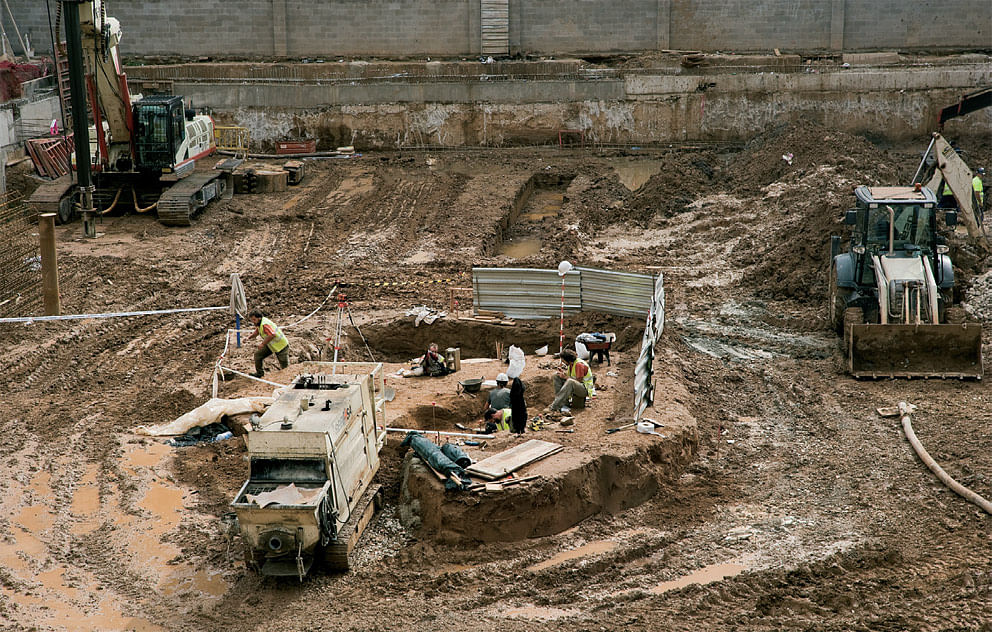
Mateo: There are pictures of the site for the new film theatre showing machines building the piles alongside archaeologists. There was a wonderful moment when there were awnings put up, like on an Egyptian excavation site. Awnings, with huge machines moving earth beside them. They found pieces of an axe, from the Bronze Age, tiny pieces. They also found lots of pottery and a skeleton. They were very thorough, to my great despair.
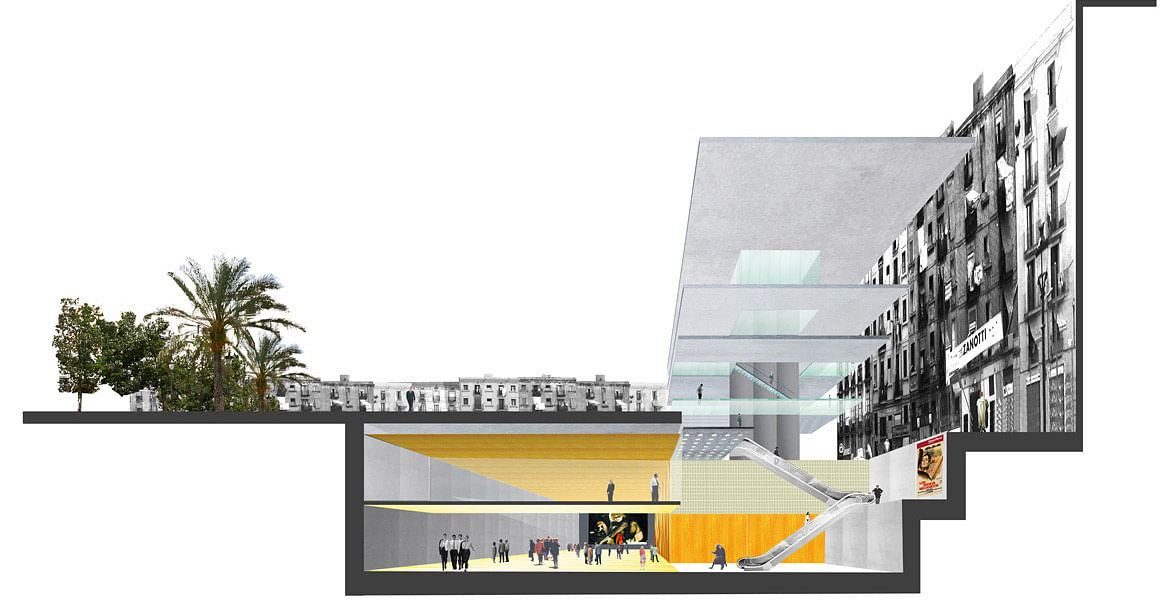
Section

Guerín: What are they going to do with the remains? What they usually do is put them in sad bags in a warehouse, where they lie in row upon row with their number tags. I should make a film in one, one day. It’s like a great rubbish dump, with lampposts, statues of Franco, and so on; like a great film set, with all the useless things cast off by the city. It would be great if that vessel were placed in the building’s museum. The film theatre is a space for heritage and memory, so those remains should come to rest there..(…)

Guerín: In the new project, how far will we have to go down to get to the cinema?

Mateo: Six metres. There will be two cinemas, a large one and a smaller one.

Guerín: Isn’t there a risk that films will be showing in both, and the sound from one will be audible in the other? There are cinemas where this happens.

Mateo: No. Under the mezzanine, an acoustic buffer alongside the curtains separates the two.
The problem is that it’ll be like a descent into hell. The fact that you notice you’re underground, the concrete, everything painted black—it’ll be like falling down.

Guerín: Initially, I find it quite shocking that the cinema is practically hidden. It’s dark and subterranean, and without any further explanation, it doesn’t seem very logical; it seems as though what, for me, is the central, the most important space, is down with the drains.
We viewers occupy a marginal space in comparison with the workers and other spaces in the film theatre.

Mateo: The Trocadero was underground, too. I seem to recall that it was all down below.
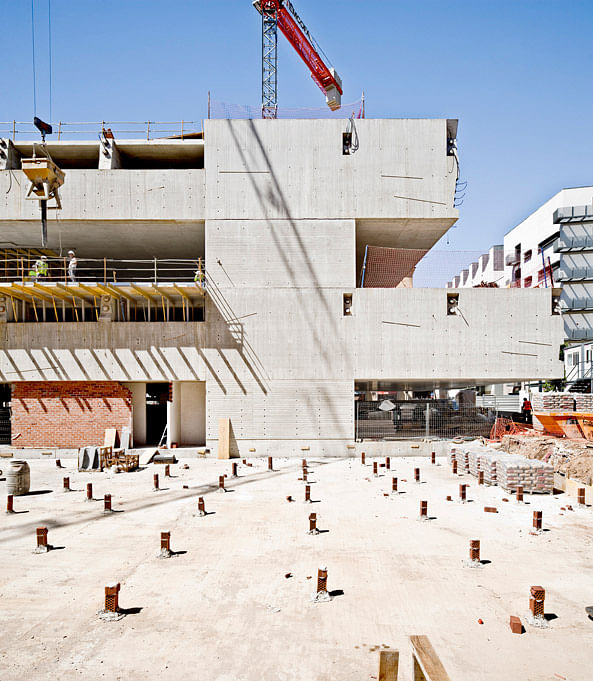
Photo: Adrià Goula

Guerín: Yes, that’s true. For us cinema-goers it was a real underground moment, it seems to me, almost an archaeological experience.

Mateo: To cheer things up a bit, there’ll be light pouring down from above. There’ll be a museum, spaces for processing films, the library, etc. The administrative workers will be right at the top.

Guerín: I was thinking about cinema venues. The first were ephemeral fairground architecture; that was where the cinema was born. Later, with the desire to legitimize it, film production companies started to think: how can we get the middle classes to go to the cinema? And that was when the iconographic names started to appear…

Mateo: Buildings for the cinema started out as a poor imitation of theatres.

Guerín: The first names chosen for cinemas were things like Capitol, Capitel, Capitolium, or Arcade in France, Arcadia (I think that’s the loveliest name), Olympia, Coliseo, Coliseum…
Whichever city you go to, the signs and names are very similar. Then cinema names were associated with a notion of glamour. (...)
Later, in the 1950s and ‘60s, the cinema came up against the problem of television. What can we do to rival that? So they emphasised the typology, and lots of cinemas changed to very long, rectangular screens. The square screen changed, and so did the way cinemas were built. (...)

Mateo: (...)There was a time, in the fifties, when many of the cinemas that you liked—the Astoria or Balañá cinemas, for example—were designed by Antonio Bonet, who was a good architect. (...)
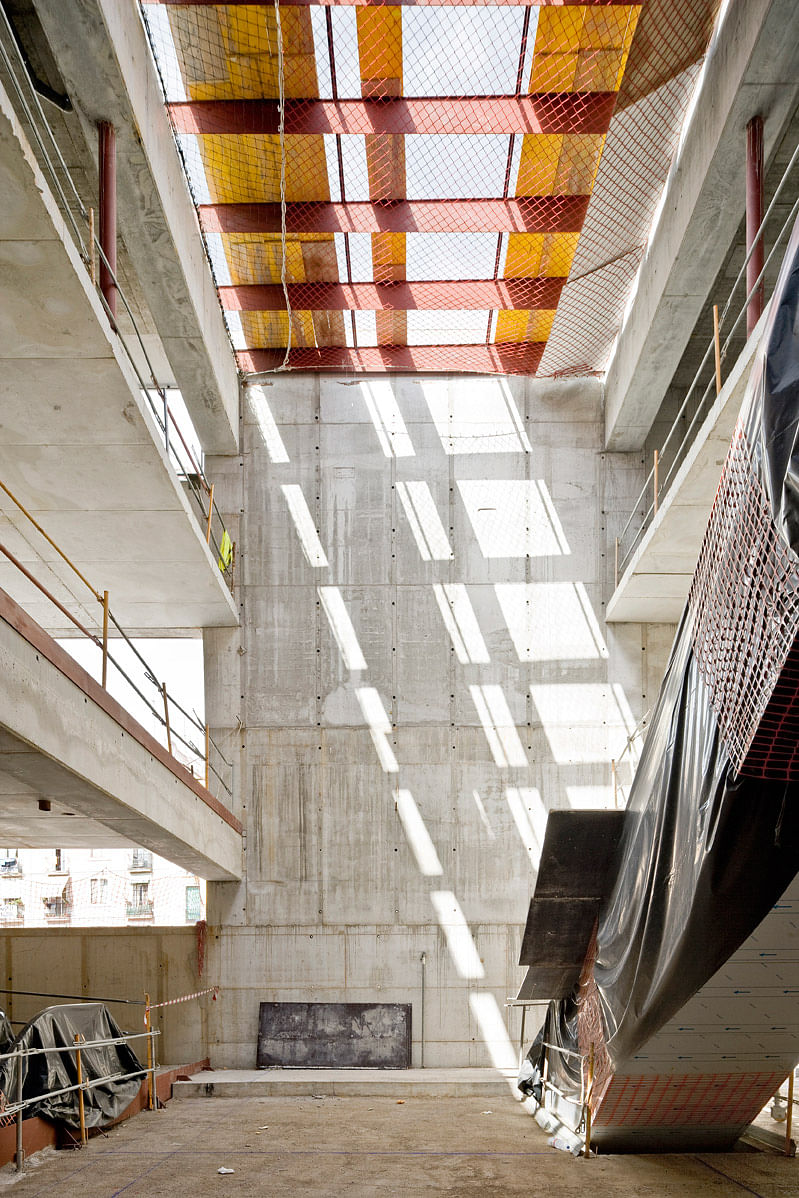
Photo: Adrià Goula

Guerín: One thing I really like about the neighbourhood is its nooks and crannies, its irregularities. I think there is something about the human condition that won’t let popular characters live in a city without odd little corners. (...). The intrusion of a new block or a new building often attracts my attention, and I find it aggressive; it’s like the imposition of a bunker that crushes this more meandering idea of little corners that I see as being so characteristic of popular memory and these neighbourhoods that have formed haphazardly over the years, creating little corners.

Mateo: What I find interesting are the edges and corners. The building is a more or less parallelepiped volume. The two longitudinal façades (on the street and the plaza) were obvious, but the real interest lay in the other two. One gives rise to the fourth corner with Carrer Sant Pau, and the other appears at the end of Carrer Josep Oriol.
This fourth corner covers the street with a huge projection, like a room with a ceiling. The volume dissolves at its edges.
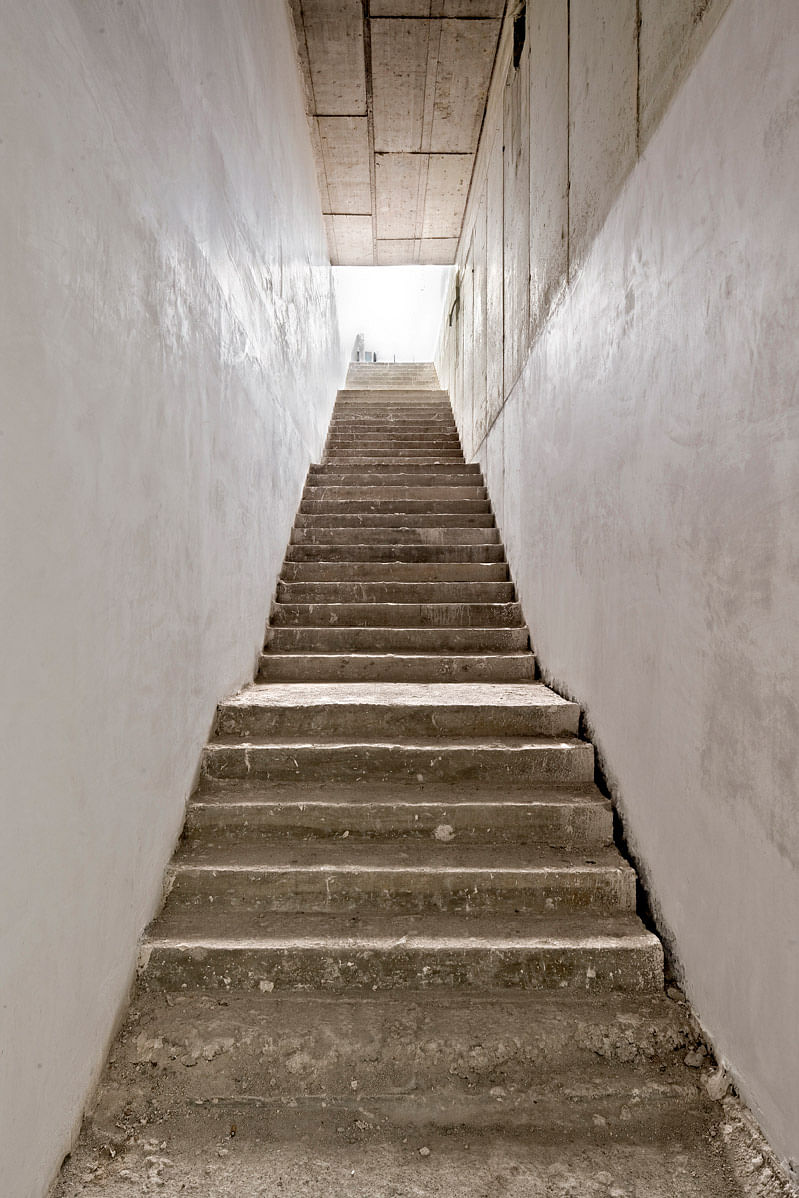
Photo: Adrià Goula

Guerín: So, this will be a new corner within the complex. People can enter through it.

Mateo: Yes, it’s a kind of porch open to the street and the plaza. The bar and the cafeteria are also supposed to open up to the plaza.
It will be a local café. Open all day, or all night, whatever the opening times are. You can go in from the outside; you won’t have to go right inside the film theatre.
The structure means that it is a floating building. So you can go into the plaza or downstairs, to where the cinemas are, or upstairs.
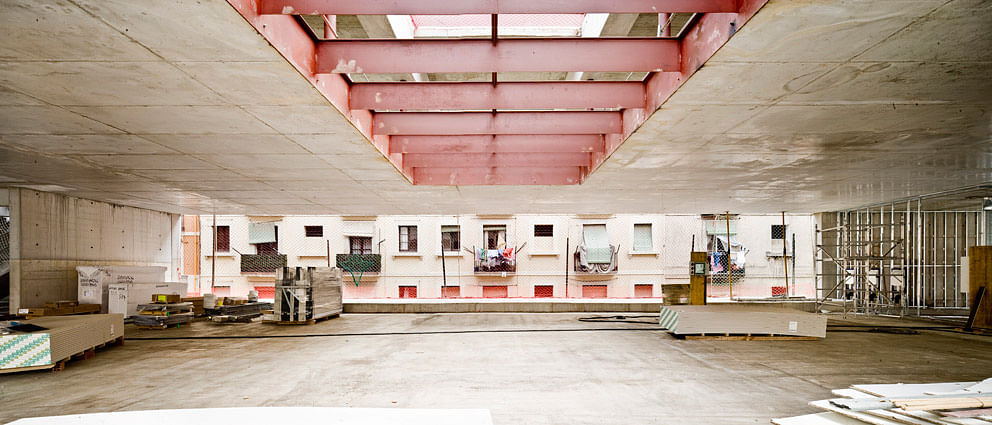
Photo: Adrià Goula

Mateo: The library area is a fabulous space, with a huge window overlooking the plaza and the street. Its transparency is lovely; it’s a space without pillars and with a window on either side, which is sort of floating and surrounded by books. At the top, which is enclosed, are the quieter work tables and the terrace. But it is a space without limits, with books and without limits in its two façades.

Guerín: Will there be curtains?

Mateo: On the outside there’s a great metal blind to filter the light and nuance the views. The blind is designed to be Arabic in style, with a pattern, so it can be moved to create a space that is more closed or more open—to create a degree of opaqueness, really. So you can control the views. I’d like to work on it on site, because it’s difficult to create the desired effect. There comes a point where it’s very difficult to complete the details before—or, at least, five years before.

Guerín: Is it a regular pattern?

Mateo: No, it should have a rhythm, not just a single motif …
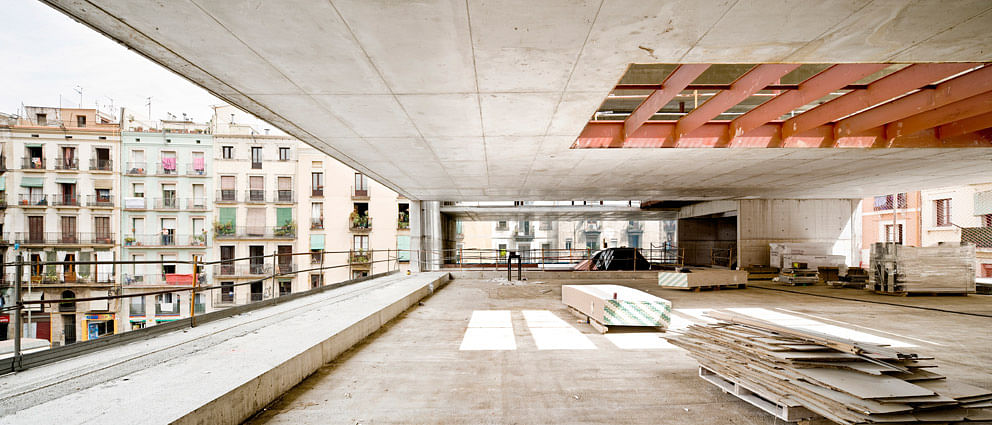
Photo: Adrià Goula

Guerín: One idea for a motif could be film frames, breaking down movement, like in the origins of the cinema. A succession of frames was used to analyse the motion of going downstairs, step by step, or birds in flight, showing the gestation of a movement.

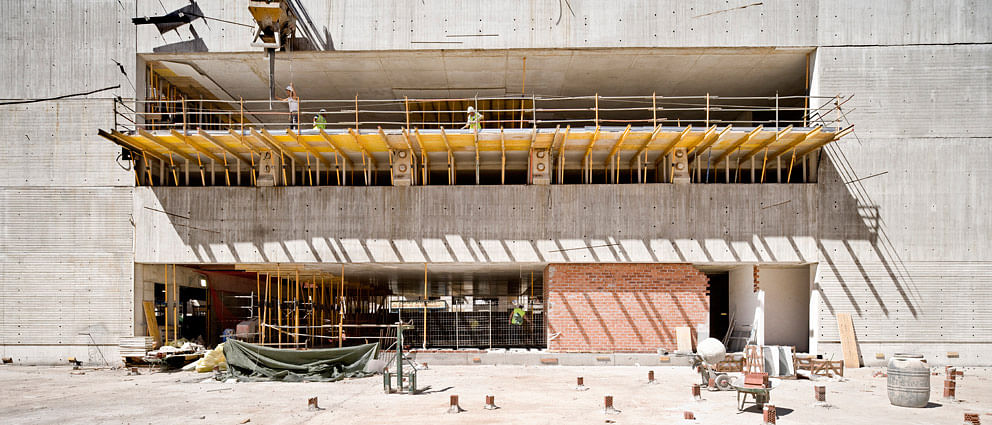
Mateo: From the outside, you’ll see a great concrete screen with a large window, which is where the library is situated. It will be covered with this kind of bronze metal blind that acts as a kind of curtain. From the street, you’ll see a building that looks like it’s floating, that allows you to connect, to enter; it acts as a filter, but it is open to the plaza.
It’s quite complicated to make it all bare concrete, materials, tubes, etc., with nothing hidden. There are beams supported by ties, and the structure is very curious, basically to produce a pillar-free space. It’s a space like an industrial warehouse, like a bridge. (…)
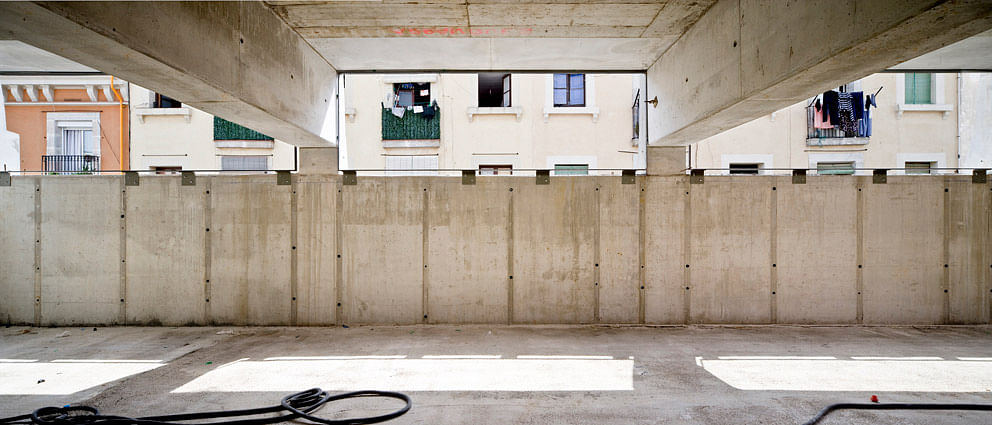
Photo: Adrià Goula

Mateo: My mother was from a village where they would bring the film in from outside. When you went to the pictures, you took your own chair. It was a kind of contract—a very interactive, community thing. Well, that kind of thing could happen here, too.The fourth corner creates a kind of “head”. This is where we suggested screening films in the summer, so it could be used as a screen that can be seen from the plaza.

Guerín: I think that’s very important.

Mateo: It would be great. First, it would give the plaza meaning, too. The plaza would have people coming and going, the bar…

Guerín: Even if it’s not used, I think the idea of the screen is very important. It is an outward expression of the cinema, this vocation of reaching out and communicating with the public space, the neighbourhood and the people. Otherwise, the place runs the risk of being endogamic, closed in on itself.

Mateo: the plaza, the film would be screened on a light grey concrete surface. Two types of colour are combined. The slightly darker concrete is used at the bottom, next to the ground, which will be all grey, as usual, and we’ll try to use white cement, too, to make it a bit more reflective.

Guerín: Anything that evokes a white screen is great.

Mateo: It is very difficult to produce a well-finished concrete surface. So I expect it to be slightly rough, natural and unfinished. (…)
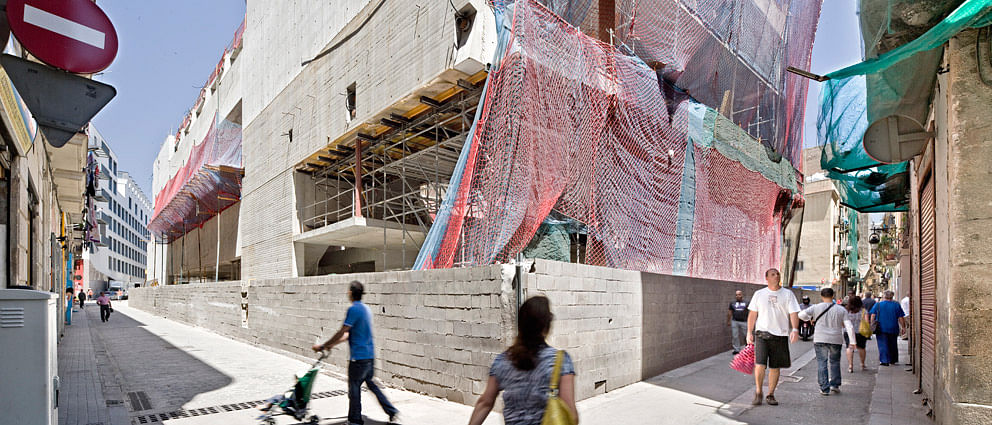
Photo: Adrià Goula

Mateo: I think all this bustle is great for the plaza. Because here it is closer to the street.

Guerín: That’s very important; it’s like the opposite of the basement. The basement is for the film buffs. It’s good to create a space to remind us that the cinema was a great popular art in the 20th century, which established this relation with society and the neighbourhood—the local cinema. (…)

Guerín: Do you control the light? What sort of lighting will there be at night? Remember that cinema-goers rarely see the light of day.

Mateo: Of course, the lighting is fundamental.
The offices will be on the top floor. There’ll be an inner courtyard, and all the machinery, like the air-conditioning, will be housed there, too. So the building won’t have machinery on the roof; it’ll be inside so that it doesn’t change the volume or upset the neighbours. This courtyard will also provide light for the library. The skylight will draw overhead lighting into the centre of the library. It is a very large space.
Light is really magical. We are used to working with harder things, like walls, but light defines a space without using matter. (…)

Guerín: Light is the soul of the stage. In the past, cinemas even had special lighting to ritualize the film as an event; the lights would go down, and there were still curtains, the last trace of archaeology. The idea was to make it like the theatre, even using something that film never needs, such as curtains…(...)


See more construction photos in the image gallery below:
Related

theater ● spain ● progress ● mateo arquitectura ● library ● film ● europe ● culture ● construction ● cinema ● catalonia ● barcelona

Share

  • Follow

    0 Comments

  • Comment as :

Film Library of Catalonia Almost Completed in Barcelona

Northwestern University selects 12-firm longlist to design new engineering building

New architecture and design competitions: Exploring 130 Years of American Design, Christo & Jeanne-Claude Center, 13 White Houses, and La Pyramide

Micro-architecture honored in latest Tiny House Architecture Competition

World’s most beautiful restaurants of 2026 chosen by Prix Versailles

Sponsored Post by Buildner

Design a wine tasting room in Italy! Valli Wine Tasting Room is launched!

10 can't-miss architecture & design events to see this June in London, Los Angeles, Chicago, San Francisco, Detroit, San Diego, Porto, and Barcelona

Sponsored Post by Buildner

Museum of Emotions / Edition #8 FINAL registration deadline is approaching!

Seven global projects make AR Public Awards shortlist 2026

Sign up for Bustler's Email Newsletters

Sponsored Post by Buildner

Design a slow-living restaurant in Portugal! Portugal Long Table Restaurant is launched!

World's best tall buildings honored at the CVU 2026 Award of Excellence

Sponsored Post by TWOPAGES

Final call: TWOPAGES X Design Contest 2026 submissions close June 5

Kengo Kuma & Paul Raff win Alberta national park visitor center competition with landscape-focused design

2026 Moira Gemmill and MJ Long prizes announced by W Awards

New architecture and design competitions: Kinderspace, Stewardson Keefe LeBrun Travel Grant, SMALL PROJECT BIG IMPACT, and Garden of University House, Bucharest

The Century of Gehry: New retrospective explores the late architect's work & collaborations

Next page » Loading

Film Library of Catalonia Almost Completed in Barcelona

By Bustler Editors|

Tuesday, Nov 30, 2010

Share

Photo: Adrià Goula

Related

theater ● spain ● progress ● mateo arquitectura ● library ● film ● europe ● culture ● construction ● cinema ● catalonia ● barcelona

Barcelona-based Mateo Arquitectura have shared with us some fascinating material documenting the construction progress of a new building for the Cinematheque de Catalunya in the Raval, Barcelona. Designed by Josep Lluís Mateo, the project won the first prize in a restricted competition in 2004 and will house archives, a library and cinema halls on a total area of 7,515 sqm (80,891 sqft). Construction is scheduled to be completed in December/January.

Film Library of Catalonia by Mateo Arquitectura under construction in Barcelona


"The new building will stand in the Raval, one of the most run-down parts of Barcelona’s historic centre and currently the object of an energetic policy of demolition and new run-of-the-mill construction.
It is a public building that configures the plaza it borders. It is designed to underline differences in order to establish an affectionate relationship with its shabby old neighbours and dissociate itself from the presences of its contemporaries.
The building for the new Filmoteca de Catalunya has been conceived as something between an industrial premises and a building under construction, pure technique almost without any finish." -- Josep Lluís Mateo

Work in Progress:

Extract of the meeting between Josep Lluís Mateo and José Luis Guerín, director of the film En construcción (Work in progress), about the Raval district in Barcelona, which served as a reference for Josep Lluís Mateo’s project for the new Film Theatre of Catalonia. From Occasions ed. Actar (2009)

Guerín: I’m a very keen cinema-goer, so this will be my home, the home of cinema, la Maison du Cinéma. I say it in French because it was Langlois who invented the film theatre. The world’s first film archive was actually Henri Langlois’ bathtub, and Langlois was also very much involved in the way the Trocadero was planned.(...)
The existing one in Barcelona is rather sad and unpleasant. People don’t argue about films; this may be a sign of the times, but nor is there a place that incites you to do so. The café is a vital place in this respect.

Mateo: There are pictures of the site for the new film theatre showing machines building the piles alongside archaeologists. There was a wonderful moment when there were awnings put up, like on an Egyptian excavation site. Awnings, with huge machines moving earth beside them. They found pieces of an axe, from the Bronze Age, tiny pieces. They also found lots of pottery and a skeleton. They were very thorough, to my great despair.

Section

Guerín: What are they going to do with the remains? What they usually do is put them in sad bags in a warehouse, where they lie in row upon row with their number tags. I should make a film in one, one day. It’s like a great rubbish dump, with lampposts, statues of Franco, and so on; like a great film set, with all the useless things cast off by the city. It would be great if that vessel were placed in the building’s museum. The film theatre is a space for heritage and memory, so those remains should come to rest there..(…)

Guerín: In the new project, how far will we have to go down to get to the cinema?

Mateo: Six metres. There will be two cinemas, a large one and a smaller one.

Guerín: Isn’t there a risk that films will be showing in both, and the sound from one will be audible in the other? There are cinemas where this happens.

Mateo: No. Under the mezzanine, an acoustic buffer alongside the curtains separates the two.
The problem is that it’ll be like a descent into hell. The fact that you notice you’re underground, the concrete, everything painted black—it’ll be like falling down.

Guerín: Initially, I find it quite shocking that the cinema is practically hidden. It’s dark and subterranean, and without any further explanation, it doesn’t seem very logical; it seems as though what, for me, is the central, the most important space, is down with the drains.
We viewers occupy a marginal space in comparison with the workers and other spaces in the film theatre.

Mateo: The Trocadero was underground, too. I seem to recall that it was all down below.

Photo: Adrià Goula

Guerín: Yes, that’s true. For us cinema-goers it was a real underground moment, it seems to me, almost an archaeological experience.

Mateo: To cheer things up a bit, there’ll be light pouring down from above. There’ll be a museum, spaces for processing films, the library, etc. The administrative workers will be right at the top.

Guerín: I was thinking about cinema venues. The first were ephemeral fairground architecture; that was where the cinema was born. Later, with the desire to legitimize it, film production companies started to think: how can we get the middle classes to go to the cinema? And that was when the iconographic names started to appear…

Mateo: Buildings for the cinema started out as a poor imitation of theatres.

Guerín: The first names chosen for cinemas were things like Capitol, Capitel, Capitolium, or Arcade in France, Arcadia (I think that’s the loveliest name), Olympia, Coliseo, Coliseum…
Whichever city you go to, the signs and names are very similar. Then cinema names were associated with a notion of glamour. (...)
Later, in the 1950s and ‘60s, the cinema came up against the problem of television. What can we do to rival that? So they emphasised the typology, and lots of cinemas changed to very long, rectangular screens. The square screen changed, and so did the way cinemas were built. (...)

Mateo: (...)There was a time, in the fifties, when many of the cinemas that you liked—the Astoria or Balañá cinemas, for example—were designed by Antonio Bonet, who was a good architect. (...)

Photo: Adrià Goula

Guerín: One thing I really like about the neighbourhood is its nooks and crannies, its irregularities. I think there is something about the human condition that won’t let popular characters live in a city without odd little corners. (...). The intrusion of a new block or a new building often attracts my attention, and I find it aggressive; it’s like the imposition of a bunker that crushes this more meandering idea of little corners that I see as being so characteristic of popular memory and these neighbourhoods that have formed haphazardly over the years, creating little corners.

Mateo: What I find interesting are the edges and corners. The building is a more or less parallelepiped volume. The two longitudinal façades (on the street and the plaza) were obvious, but the real interest lay in the other two. One gives rise to the fourth corner with Carrer Sant Pau, and the other appears at the end of Carrer Josep Oriol.
This fourth corner covers the street with a huge projection, like a room with a ceiling. The volume dissolves at its edges.

Photo: Adrià Goula

Guerín: So, this will be a new corner within the complex. People can enter through it.

Mateo: Yes, it’s a kind of porch open to the street and the plaza. The bar and the cafeteria are also supposed to open up to the plaza.
It will be a local café. Open all day, or all night, whatever the opening times are. You can go in from the outside; you won’t have to go right inside the film theatre.
The structure means that it is a floating building. So you can go into the plaza or downstairs, to where the cinemas are, or upstairs.

Photo: Adrià Goula

Mateo: The library area is a fabulous space, with a huge window overlooking the plaza and the street. Its transparency is lovely; it’s a space without pillars and with a window on either side, which is sort of floating and surrounded by books. At the top, which is enclosed, are the quieter work tables and the terrace. But it is a space without limits, with books and without limits in its two façades.

Guerín: Will there be curtains?

Mateo: On the outside there’s a great metal blind to filter the light and nuance the views. The blind is designed to be Arabic in style, with a pattern, so it can be moved to create a space that is more closed or more open—to create a degree of opaqueness, really. So you can control the views. I’d like to work on it on site, because it’s difficult to create the desired effect. There comes a point where it’s very difficult to complete the details before—or, at least, five years before.

Guerín: Is it a regular pattern?

Mateo: No, it should have a rhythm, not just a single motif …

Photo: Adrià Goula

Guerín: One idea for a motif could be film frames, breaking down movement, like in the origins of the cinema. A succession of frames was used to analyse the motion of going downstairs, step by step, or birds in flight, showing the gestation of a movement.

Mateo: From the outside, you’ll see a great concrete screen with a large window, which is where the library is situated. It will be covered with this kind of bronze metal blind that acts as a kind of curtain. From the street, you’ll see a building that looks like it’s floating, that allows you to connect, to enter; it acts as a filter, but it is open to the plaza.
It’s quite complicated to make it all bare concrete, materials, tubes, etc., with nothing hidden. There are beams supported by ties, and the structure is very curious, basically to produce a pillar-free space. It’s a space like an industrial warehouse, like a bridge. (…)

Photo: Adrià Goula

Mateo: My mother was from a village where they would bring the film in from outside. When you went to the pictures, you took your own chair. It was a kind of contract—a very interactive, community thing. Well, that kind of thing could happen here, too.The fourth corner creates a kind of “head”. This is where we suggested screening films in the summer, so it could be used as a screen that can be seen from the plaza.

Guerín: I think that’s very important.

Mateo: It would be great. First, it would give the plaza meaning, too. The plaza would have people coming and going, the bar…

Guerín: Even if it’s not used, I think the idea of the screen is very important. It is an outward expression of the cinema, this vocation of reaching out and communicating with the public space, the neighbourhood and the people. Otherwise, the place runs the risk of being endogamic, closed in on itself.

Mateo: the plaza, the film would be screened on a light grey concrete surface. Two types of colour are combined. The slightly darker concrete is used at the bottom, next to the ground, which will be all grey, as usual, and we’ll try to use white cement, too, to make it a bit more reflective.

Guerín: Anything that evokes a white screen is great.

Mateo: It is very difficult to produce a well-finished concrete surface. So I expect it to be slightly rough, natural and unfinished. (…)

Photo: Adrià Goula

Mateo: I think all this bustle is great for the plaza. Because here it is closer to the street.

Guerín: That’s very important; it’s like the opposite of the basement. The basement is for the film buffs. It’s good to create a space to remind us that the cinema was a great popular art in the 20th century, which established this relation with society and the neighbourhood—the local cinema. (…)

Guerín: Do you control the light? What sort of lighting will there be at night? Remember that cinema-goers rarely see the light of day.

Mateo: Of course, the lighting is fundamental.
The offices will be on the top floor. There’ll be an inner courtyard, and all the machinery, like the air-conditioning, will be housed there, too. So the building won’t have machinery on the roof; it’ll be inside so that it doesn’t change the volume or upset the neighbours. This courtyard will also provide light for the library. The skylight will draw overhead lighting into the centre of the library. It is a very large space.
Light is really magical. We are used to working with harder things, like walls, but light defines a space without using matter. (…)

Guerín: Light is the soul of the stage. In the past, cinemas even had special lighting to ritualize the film as an event; the lights would go down, and there were still curtains, the last trace of archaeology. The idea was to make it like the theatre, even using something that film never needs, such as curtains…(...)


See more construction photos in the image gallery below:

Share

  • Follow

    0 Comments

  • Comment as :

Archinect JobsArchinect Jobs

The Archinect Job Board attracts the world's top architectural design talents.

VIEW ALL JOBS POST A JOB

Project Architect

Arrowstreet

Project Architect

Boston, MA, US

Senior Architectural Project Manager (Systems Driven, Human-Centric) (Hourly)

Local Parti Architecture, PC

Senior Architectural Project Manager (Systems Driven, Human-Centric) (Hourly)

New York, NY, US

Intermediate Architect

FAME Architecture & Interior Design

Intermediate Architect

Los Angeles, CA, US

Graduate Architect

RATIO Design

Graduate Architect

Chicago, IL, US

Intermediate Architectural Designer

David Smotrich & Partners LLP

Intermediate Architectural Designer

New York, NY, US

Intermediate Architect

FROM Architecture DPC

Intermediate Architect

New York, NY, US

Junior Architect

Eric Colbert & Associates

Junior Architect

Washington, DC, US

Architecture Project Manager

RDH Architecture + Interior Design

Architecture Project Manager

Las Vegas, NV, US

Architectural Designer (3-5 Years) - Commercial & Hospitality Focus

Pfeffer Torode Architecture

Architectural Designer (3-5 Years) - Commercial & Hospitality Focus

Nashville, TN, US

Architect 10+

Standard Architects

Architect 10+

Long Island City, NY, US

Next page » Loading