• Login / Join
  • About
  • •
  • Contact
  • •
  • Advertising
bustler logo
bustler logo
  • News
  • Competitions
  • Events
  • Bustler is powered by Archinect
  • Sign up for Bustler's Email Newsletters

  • Follow these Bustler feeds:

  • Search

    Search in

  • Submit

    What are you submitting?

    News Pitch
    Competition
    Event
  • Login / Join
  • News|Competitions|Events
  • Search
    | Submit
    | Follow
  • Search in

    What are you submitting?

    News Pitch
    Competition
    Event

    Follow these Bustler feeds:

  • About|Contact|Advertising
  • Login / Join

Finalists of APPLIED Research Through Fabrication Competition

By Bustler Editors|

Monday, Jun 18, 2012

First Round Finalist in the categories Continuing Research and Speculative Research: FAB POD, SPIN-VALENCE, CAST THICKET, and LATENT METHODS (clock-wise from top-left)

Four projects have today been announced as First Round Finalists in TEX-FAB Digital Fabrication Alliance’s 2012 international competition, APPLIED Research Through Fabrication.

In the two categories 'Continuing Research' and 'Speculative Research,' a total of 68 entries from 13 countries on 4 continents with roughly an even split between the two were received. Proposals dealing with acoustics, material structure, ambient light occlusion and movement monitoring through haptic and sensory relays all bid to proceed to the second round with $1,000 in funding.

Jury members Gil Akos and Ronnie Parsons from Studio Mode, Billie Faircloth from Kieran Timberlake, Jonathan Mallie from SHoP and Jason Vollen from C.A.S.E. convened on June 11 to deliberate over their initial short-list of 12 selections.

Over the next 4 months, the finalists will further develop their proposals into larger scale prototypes and mock-ups to test feasibility and technique. Afterwards, they are to be exhibited at ACADIA 2012 next October at the Synthetic Digital Ecologies conference which is hosted at the California College of the Arts. At that time, the second round will be juried and a winner will be chosen that will be build, full scale in Dallas, Texas for the TEX-FAB 4.0 conference.

The Second Round Jury will be comprised of Nader Tehrani, Head of Jury (NADAAA); Andrew Kudless (Matsys Design); Vlad Tenu (V. Tenu); and Neri Oxman (Neri Oxman).

These are the four First Round Finalists:

First Round Finalist - Continuing Research:
FAB POD by Jane Burry and Nicholas Williams

Fab Pod proved to be a clear choice for the jury as little deliberation was needed to narrow down its strengths as a finalist. Noted by the jury, ‘the use of the digital tools to create a true performative surface, that is not about shading, is refreshing. Acoustics in architecture is highly mathematical, often understood by only those in the discipline of acoustic sciences, and often the expressions of performance are lost in the overall design of acoustically performing spaces. This project is one of a new breed of digitally related expressions where form and performance are seeking equal ground.’
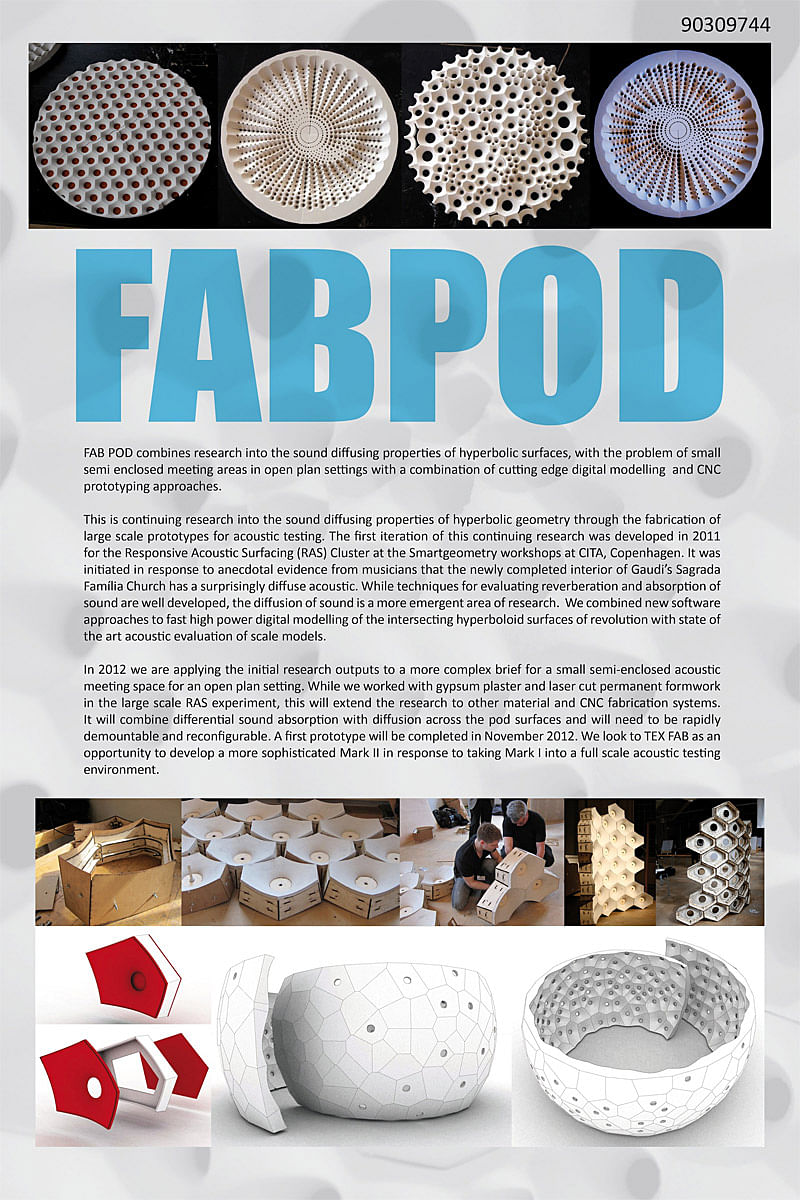
First Round Finalist - Continuing Research: FAB POD by Jane Burry and Nicholas Williams

First Round Finalist - Continuing Research:
SPIN-VALENCE by Emily Baker

The jury’s comments ranged over time from disinterest to support as this underdog, with just one initial vote, gained more appeal and finally was narrowed down as a finalist. Noted during the deliberation as having a thorough understanding on the means and methods of its potential, despite its overtly ‘simplistic’ process, Spin-Valence ultimately garnered quite a lot of praise in its ‘technique not developed to rationalize a complex form, rather the technique imposes an advanced structural integrity of a flat surface without cost implications of additive structural members’.

First Round Finalist - Continuing Research: SPIN-VALENCE by Emily Baker

First Round Finalist - Speculative Proposal:
CAST THICKET by Christine Yogiaman and Ken Tracy

In the initial conversations about Cast Thicket, the jury found that it ‘offers a promising example of hybridizing contemporary means of representation and production with more traditional means of construction.’ Upon further review and some inspired deliberation issues arose that warranted some pause. Being that the proposal did not necessarily require being cast as inherent to its formal articulation, as the design could be realized in metal or other. The jury however, given the thoroughness and potential in Cast Thicket’s development, sided on enabling the exploration, underpinning the desire to support the role of basic research in the competition brief, where an outcome is not known.

First Round Finalist - Speculative Proposal: CAST THICKET by Christine Yogiaman and Ken Tracy

First Round Finalist - Speculative Proposal:
LATENT METHODS by Eli Allen

With broad and open support, Latent Methods was chosen for its ‘clear as well as critical framework for the exploration of contemporary surface effects through the reevaluation of the shingle architecture vernacular. Another juror summed up their thoughts with no uncertain resolve, ‘one word - Architecture. With roots dating to the middle ages in Europe, nothing digital is needed for this project at all, yet, it is by far the most purely architectural of all the speculative entries.’ Ultimately the jury chose Latent Methods over the other entries with minimal deliberation as noted above that it presented a direct connection to past that informed by an intelligent use of digital means, would greatly benefit from further exploration.
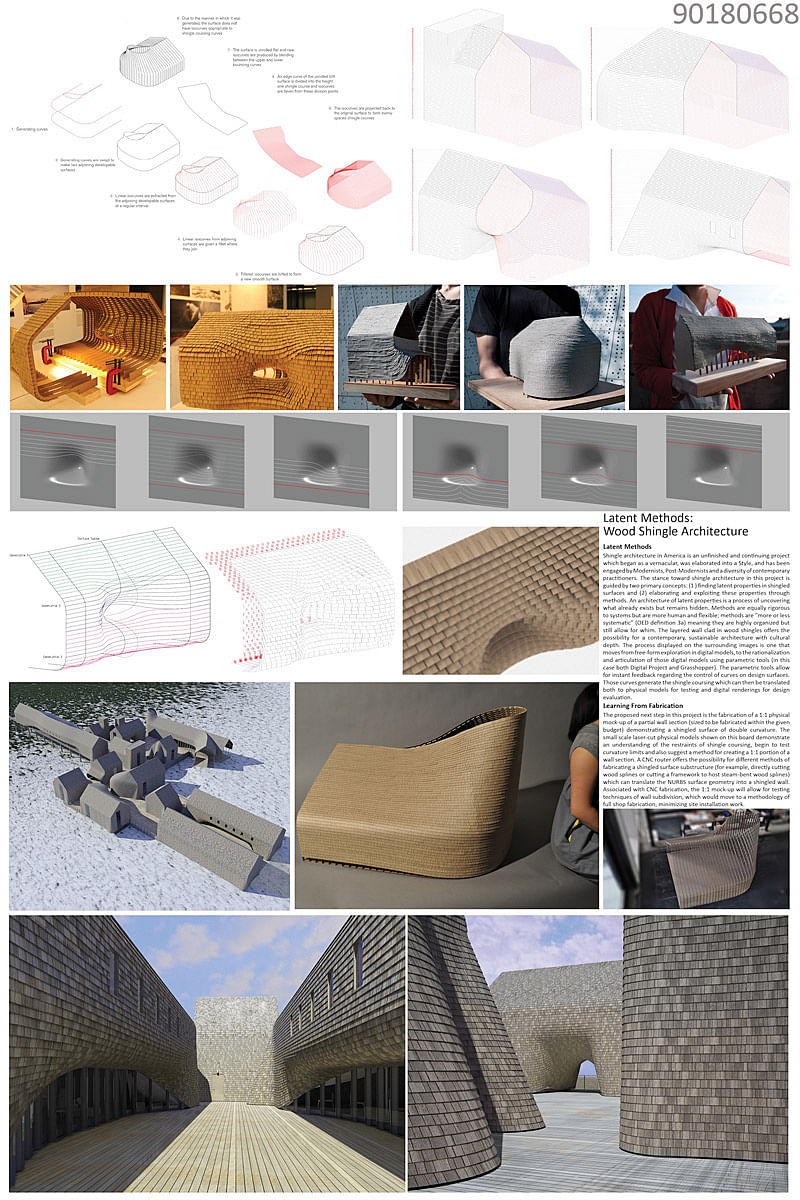
First Round Finalist - Speculative Proposal: LATENT METHODS by Eli Allen

An additional two proposals were chosen as Honorable Mentions at the discretion of the jury due to their skill and effort in presenting proposals of high merit.

Honorable Mention - Continuing Research:
CURVED DIE | CREASED STRUCTURE by Brigette Borders and Justin Fabrikant

With deliberation noting its interesting formal development that is generated from the ‘process’, Curved Die | Creased Structure, ‘presents a clear and well articulated proposal for an extremely promising research agenda.’ Additionally noted the, ‘The coupling of computational design methods with traditional means of fabrication provides a robust platform through which to interrogate the peculiarities of each within the context of the other.’ Ultimately the jury felt that the project, ‘shows innovation in material and fabrication logics’ that elevated it above other entries warranting its place as an Honorable Mention.

Honorable Mention - Continuing Research: CURVED DIE | CREASED STRUCTURE by Brigette Borders and Justin Fabrikant

Honorable Mention - Speculative Proposal:
RE-FLEX by Hernan Molina, Jordan Kepsel, Brendan O'Grady, Aaron Shenefelt, Michael Cagle, Jonathan LeMaster, Hon Yan Mok, Sang Yoon Kim, Dustin Wekesser, Rickey Crum and Robert Ting

The inherent beauty and elegance of RE-FLEX led the jury to comment that the proposal with intelligent performative ‘digitally fabricated joinery has built in flexibility/capacity to take-on or influence formal characteristics.’ While its ‘aperture informs form/light transmittance and resultant structural proposition’, finally suggesting that the proposal would benefit from further work as the ‘surface thickness provides potential for sustainable structural system – compression of joinery at highly compressed moments in mobius band must be studied further.’

Honorable Mention - Speculative Proposal: RE-FLEX by Hernan Molina, Jordan Kepsel, Brendan O'Grady, Aaron Shenefelt, Michael Cagle, Jonathan LeMaster, Hon Yan Mok, Sang Yoon Kim, Dustin Wekesser, Rickey Crum and Robert Ting

All images courtesy of TEX-FAB.

Related

tex-fab ● research ● parametric design ● finalists ● digital fabrication ● computation ● applied research ● applied

Share

  • Follow

    0 Comments

  • Comment as :

Finalists of APPLIED Research Through Fabrication Competition

Northwestern University selects 12-firm longlist to design new engineering building

New architecture and design competitions: Exploring 130 Years of American Design, Christo & Jeanne-Claude Center, 13 White Houses, and La Pyramide

Micro-architecture honored in latest Tiny House Architecture Competition

World’s most beautiful restaurants of 2026 chosen by Prix Versailles

Sponsored Post by Buildner

Design a wine tasting room in Italy! Valli Wine Tasting Room is launched!

10 can't-miss architecture & design events to see this June in London, Los Angeles, Chicago, San Francisco, Detroit, San Diego, Porto, and Barcelona

Sponsored Post by Buildner

Museum of Emotions / Edition #8 FINAL registration deadline is approaching!

Seven global projects make AR Public Awards shortlist 2026

Sign up for Bustler's Email Newsletters

Sponsored Post by Buildner

Design a slow-living restaurant in Portugal! Portugal Long Table Restaurant is launched!

World's best tall buildings honored at the CVU 2026 Award of Excellence

Sponsored Post by TWOPAGES

Final call: TWOPAGES X Design Contest 2026 submissions close June 5

Kengo Kuma & Paul Raff win Alberta national park visitor center competition with landscape-focused design

2026 Moira Gemmill and MJ Long prizes announced by W Awards

New architecture and design competitions: Kinderspace, Stewardson Keefe LeBrun Travel Grant, SMALL PROJECT BIG IMPACT, and Garden of University House, Bucharest

The Century of Gehry: New retrospective explores the late architect's work & collaborations

Next page » Loading

Finalists of APPLIED Research Through Fabrication Competition

By Bustler Editors|

Monday, Jun 18, 2012

Share

First Round Finalist in the categories Continuing Research and Speculative Research: FAB POD, SPIN-VALENCE, CAST THICKET, and LATENT METHODS (clock-wise from top-left)

Related

tex-fab ● research ● parametric design ● finalists ● digital fabrication ● computation ● applied research ● applied

Four projects have today been announced as First Round Finalists in TEX-FAB Digital Fabrication Alliance’s 2012 international competition, APPLIED Research Through Fabrication.

In the two categories 'Continuing Research' and 'Speculative Research,' a total of 68 entries from 13 countries on 4 continents with roughly an even split between the two were received. Proposals dealing with acoustics, material structure, ambient light occlusion and movement monitoring through haptic and sensory relays all bid to proceed to the second round with $1,000 in funding.

Jury members Gil Akos and Ronnie Parsons from Studio Mode, Billie Faircloth from Kieran Timberlake, Jonathan Mallie from SHoP and Jason Vollen from C.A.S.E. convened on June 11 to deliberate over their initial short-list of 12 selections.

Over the next 4 months, the finalists will further develop their proposals into larger scale prototypes and mock-ups to test feasibility and technique. Afterwards, they are to be exhibited at ACADIA 2012 next October at the Synthetic Digital Ecologies conference which is hosted at the California College of the Arts. At that time, the second round will be juried and a winner will be chosen that will be build, full scale in Dallas, Texas for the TEX-FAB 4.0 conference.

The Second Round Jury will be comprised of Nader Tehrani, Head of Jury (NADAAA); Andrew Kudless (Matsys Design); Vlad Tenu (V. Tenu); and Neri Oxman (Neri Oxman).

These are the four First Round Finalists:

First Round Finalist - Continuing Research:
FAB POD by Jane Burry and Nicholas Williams

Fab Pod proved to be a clear choice for the jury as little deliberation was needed to narrow down its strengths as a finalist. Noted by the jury, ‘the use of the digital tools to create a true performative surface, that is not about shading, is refreshing. Acoustics in architecture is highly mathematical, often understood by only those in the discipline of acoustic sciences, and often the expressions of performance are lost in the overall design of acoustically performing spaces. This project is one of a new breed of digitally related expressions where form and performance are seeking equal ground.’

First Round Finalist - Continuing Research: FAB POD by Jane Burry and Nicholas Williams

First Round Finalist - Continuing Research:
SPIN-VALENCE by Emily Baker

The jury’s comments ranged over time from disinterest to support as this underdog, with just one initial vote, gained more appeal and finally was narrowed down as a finalist. Noted during the deliberation as having a thorough understanding on the means and methods of its potential, despite its overtly ‘simplistic’ process, Spin-Valence ultimately garnered quite a lot of praise in its ‘technique not developed to rationalize a complex form, rather the technique imposes an advanced structural integrity of a flat surface without cost implications of additive structural members’.

First Round Finalist - Continuing Research: SPIN-VALENCE by Emily Baker

First Round Finalist - Speculative Proposal:
CAST THICKET by Christine Yogiaman and Ken Tracy

In the initial conversations about Cast Thicket, the jury found that it ‘offers a promising example of hybridizing contemporary means of representation and production with more traditional means of construction.’ Upon further review and some inspired deliberation issues arose that warranted some pause. Being that the proposal did not necessarily require being cast as inherent to its formal articulation, as the design could be realized in metal or other. The jury however, given the thoroughness and potential in Cast Thicket’s development, sided on enabling the exploration, underpinning the desire to support the role of basic research in the competition brief, where an outcome is not known.

First Round Finalist - Speculative Proposal: CAST THICKET by Christine Yogiaman and Ken Tracy

First Round Finalist - Speculative Proposal:
LATENT METHODS by Eli Allen

With broad and open support, Latent Methods was chosen for its ‘clear as well as critical framework for the exploration of contemporary surface effects through the reevaluation of the shingle architecture vernacular. Another juror summed up their thoughts with no uncertain resolve, ‘one word - Architecture. With roots dating to the middle ages in Europe, nothing digital is needed for this project at all, yet, it is by far the most purely architectural of all the speculative entries.’ Ultimately the jury chose Latent Methods over the other entries with minimal deliberation as noted above that it presented a direct connection to past that informed by an intelligent use of digital means, would greatly benefit from further exploration.

First Round Finalist - Speculative Proposal: LATENT METHODS by Eli Allen

An additional two proposals were chosen as Honorable Mentions at the discretion of the jury due to their skill and effort in presenting proposals of high merit.

Honorable Mention - Continuing Research:
CURVED DIE | CREASED STRUCTURE by Brigette Borders and Justin Fabrikant

With deliberation noting its interesting formal development that is generated from the ‘process’, Curved Die | Creased Structure, ‘presents a clear and well articulated proposal for an extremely promising research agenda.’ Additionally noted the, ‘The coupling of computational design methods with traditional means of fabrication provides a robust platform through which to interrogate the peculiarities of each within the context of the other.’ Ultimately the jury felt that the project, ‘shows innovation in material and fabrication logics’ that elevated it above other entries warranting its place as an Honorable Mention.

Honorable Mention - Continuing Research: CURVED DIE | CREASED STRUCTURE by Brigette Borders and Justin Fabrikant

Honorable Mention - Speculative Proposal:
RE-FLEX by Hernan Molina, Jordan Kepsel, Brendan O'Grady, Aaron Shenefelt, Michael Cagle, Jonathan LeMaster, Hon Yan Mok, Sang Yoon Kim, Dustin Wekesser, Rickey Crum and Robert Ting

The inherent beauty and elegance of RE-FLEX led the jury to comment that the proposal with intelligent performative ‘digitally fabricated joinery has built in flexibility/capacity to take-on or influence formal characteristics.’ While its ‘aperture informs form/light transmittance and resultant structural proposition’, finally suggesting that the proposal would benefit from further work as the ‘surface thickness provides potential for sustainable structural system – compression of joinery at highly compressed moments in mobius band must be studied further.’

Honorable Mention - Speculative Proposal: RE-FLEX by Hernan Molina, Jordan Kepsel, Brendan O'Grady, Aaron Shenefelt, Michael Cagle, Jonathan LeMaster, Hon Yan Mok, Sang Yoon Kim, Dustin Wekesser, Rickey Crum and Robert Ting

All images courtesy of TEX-FAB.

Share

  • Follow

    0 Comments

  • Comment as :

Archinect JobsArchinect Jobs

The Archinect Job Board attracts the world's top architectural design talents.

VIEW ALL JOBS POST A JOB

Associate - Interior Designer

FitzGerald Associates Architects

Associate - Interior Designer

Chicago, IL, US

Graduate Architect

RATIO Design

Graduate Architect

Chicago, IL, US

Project Architect

Arrowstreet

Project Architect

Boston, MA, US

Senior Designer / Architect

NardiHaus

Senior Designer / Architect

Pasadena, CA, US

Project Architect/Job Captain

HLW International LLP

Project Architect/Job Captain

West Palm Beach, FL, US

Project Architect LA & NYC

Montalba Architects, Inc.

Project Architect LA & NYC

Los Angeles, CA, US

Intermediate Architectural Designer

David Smotrich & Partners LLP

Intermediate Architectural Designer

New York, NY, US

Architectural Job Captain

Christopher Courts Inc.

Architectural Job Captain

Los Angeles, CA, US

Project Manager / Project Architect (5–10 Years’ Experience)

Millan Architect / Studio Inc.

Project Manager / Project Architect (5–10 Years’ Experience)

Venice, CA, US

 Intermediate Architect

Curtis + Ginsberg Architects LLP

Intermediate Architect

New York, NY, US

Next page » Loading