• Login / Join
  • About
  • •
  • Contact
  • •
  • Advertising
bustler logo
bustler logo
  • News
  • Competitions
  • Events
  • Bustler is powered by Archinect
  • Sign up for Bustler's Email Newsletters

  • Follow these Bustler feeds:

  • Search

    Search in

  • Submit

    What are you submitting?

    News Pitch
    Competition
    Event
  • Login / Join
  • News|Competitions|Events
  • Search
    | Submit
    | Follow
  • Search in

    What are you submitting?

    News Pitch
    Competition
    Event

    Follow these Bustler feeds:

  • About|Contact|Advertising
  • Login / Join

FLIP/CITY SHANGHAI by PinkCloud.dk

By Bustler Editors|

Tuesday, Jun 12, 2012

Eye-level view of a FLIP/CITY cluster inserted in Shanghai’s cityscape (Image: PinkCloud.dk)

Copenhagen firm PinkCloud.dk has shared with us the concept FLIP/CITY, a recent shortlist entry in the 2012 Rethinking Shanghai competition. Design team members Nico Schlapps and Fabian Busse decided to literally flip a flat cityscape vertically to create, explore and grow new types of spaces.

Project Description from the Architects:

FLIP/CITY proposes a new urban identity for Shanghai as a model for the development of future cities.
By questioning traditional typologies, FLIP/CITY redefines methods of organizing communities by preserving the human scale.

Aerial view of different FLIP/CITY clusters (Image: PinkCloud.dk)

The proposal flips the horizontal cityscape to the vertical.
Footprints of Shanghai’s existing typologies, only visible by plane, embody the new face of the vertical city.  By expressing distinct functions for its citizens, FLIP/CITY relates strongly to the human scale while simultaneously increasing density and green space at the urban scale.

View from inside a city-cluster (Image: PinkCloud.dk)
Aerial view of a possible city-cluster (Image: PinkCloud.dk)
Section of one possible city-cluster (Image: PinkCloud.dk)

By expanding Shanghai up along the vertical plane unused urban voids will be activated. Proximity and numerous informal meeting spaces catalyze synergy and a vivid community life.

FLIP/CITY is a new urban typology that answers the needs of modern Shanghai, its economy, social structures and ecological plans for the future while embracing Shanghai’s rich history and its citizens.

Diagram (Image: PinkCloud.dk)

VISION

Imagine a city of a unique new typology that meets the needs of its inhabitants while maximizing the quality of life and work.  This typology would embrace communities and their citizens as a flexible framework which adapts to environmental and economic changes. As a reactive healing force, this city could renew weak urban zones in decline by filling voids and dead space with functioning, thriving neighborhoods.  Most importantly, this new typology would have the capacity to maximize green space and solve infrastructural issues while creating an efficient, accessible circulation system for public transit.

Diagram (Image: PinkCloud.dk)

CONCEPT

FLIP/CITY realizes this urban typology in the context of Shanghai, a prime location for sustainable innovation at an immense scale.  Shanghai faces problems incurred by high population density, heavy pollution, rapid growth, and decreasing viable land.  
FLIP/CITY challenges these issues by transforming the orientation of Shanghai’s city grid.  The proposal flips the cityscape from the horizontal plane to the vertical plane, thereby generating a new typology.  In this model, the footprints of Shanghai’s existing typologies, only visible on maps or by plane, embody the new face of the vertical city.  By literally expressing distinct functions for its citizens, FLIP/CITY relates strongly to the human scale while simultaneously increasing density and green space at the urban scale.

Diagram (Image: PinkCloud.dk)

WHY?

Shanghai’s exponential population growth was incurred by its international importance as a financial epicenter. This population boom lead to the import of Western urban typologies in Shanghai. While the high-rise typology effectively challenges high density with a small footprint, it is typically plagued with a homogeneous function. This contributes to the issue of exclusivity of the city center as a commercial zone. City centers often resemble the financial hub of the city, gradually extending into residential sprawl. This necessitates more transportation infrastructure to bridge long distances between office and residence.  High-rise typologies also lose the intimacy of the human scale, forcing citizens to live and work in increasingly alienating, pollutive, and disconnected environments.

Diagram (Image: PinkCloud.dk)

HOW?

By expanding Shanghai up along the vertical plane, Shanghai’s characteristic urban pattern of patchwork typologies can accommodate a wider range of functions. Residential, commercial, educational, cultural, and infrastructural functions are arranged at the human scale to enable walking distance between all vital functions.  Urban voids and abandoned sites are infilled with infrastructural installations and equipment.  3-Dimensional blocking in the vertical village constructs more numerous meeting spaces and communal green zones for the public.

Diagram (Image: PinkCloud.dk)

Micro Scale

Seven modular typologies are constructed in the micro scale (House, Y, O, =, ?), visible from the human eye at street scale.  Each typology houses a function that is clearly readable from near and far distances. This enables clear wayfinding and navigation for inhabitants. 

Diagram (Image: PinkCloud.dk)

Macro Scale

Unique typologies are configured and distributed with a parametric algorithm to maintain human scale throughout the project.  The designer can choose the number of housing and office modules and select the density and footprint.  The algorithm optimizes the arrangement of modules into close communities and uses site-specific qualities as parameters to optimize the composition.

Diagram (Image: PinkCloud.dk)

Mega Scale

The mega-scale of FLIP/CITY uses different footprints to optimize the parametric arrangement of its modules. The proposal is adaptable to a wide range of situations from environmental influences to social structures. We have selected six diverse sites with unique urban problems for analysis.  All six scenarios are tested with the FLIP/CITY model to test its flexibility and adaptability. 

Diagram (Image: PinkCloud.dk)

SUSTAINABILITY

FLIP/CITY addresses four crucial aspects of sustainability.  In the realm of social sustainability, the anonymous feeling of immense cities is challenged by interconnecting typically isolated diverse city zones.  In the economical sense, increase green space invigorates the morale of Shanghai’s dense society. Dead spaces, voids and abandoned sites are also renewed.  Ecological sustainability is achieved by recycling greywater of the Suzhou Creek. Heating and cooling is accomplished by collecting solar and wind energy. Finally, FLIP/CITY sustains the cultural heritage of Shanghai by reinterpreting its historical urban framework.

Diagram (Image: PinkCloud.dk)

IMPACT

FLIP/CITY proposes a new urban identity for Shanghai as a model for the development of future cities.  By questioning traditional typologies, FLIP/CITY redefines historical methods of organizing communities by preserving intimacy at the human scale. FLIP/CITY utilizes the naturally high population density of Shanghai as a tool to connect its citizens in close proximity to their needs.  
By re-thinking our standard urban typologies, we can effectively re-think Shanghai.
FLIP/CITY is a new urban typology that answers the needs of modern Shanghai, its economy, social structures and ecological plans for the future while embracing Shanghai’s rich history and its citizens.

Diagram (Image: PinkCloud.dk)

Related

urban design ● urban ● shanghai ● pinkcloud.dk ● city ● china ● asia

Share

  • Follow

    0 Comments

  • Comment as :

FLIP/CITY SHANGHAI by PinkCloud.dk

Eight innovative timber projects honored at 2026 Wood in Architecture Awards

Beautiful brick architecture honored at BRICK AWARD 26

Over $500,000 awarded to architectural discourse projects by Graham Foundation

Best in urban planning recognized at AIA Regional & Urban Design Award 2026

Sponsored Post by Buildner

Re:Form - New Life for Old Spaces / Edition #3 advance registration deadline is approaching!

New architecture and design competitions: IDEAS Awards, UIA-HYP CUP International Student Competition, Vancouver Tall Challenge, and Memorial to the Sixth Extinction

Best small projects chosen at AIA Small Project Award 2026

10 standout sustainable projects honored at AIA COTE Top Ten Award 2026

Sign up for Bustler's Email Newsletters

Best residential architecture of 2026 honored at AIA Housing Award

Best new interiors of 2026 chosen at AIA Interior Architecture Awards

Best global architecture honored at RIBA International Awards 2026

World’s most beautiful airports of 2026 chosen by Prix Versailles

New architecture and design competitions: Brick in Architecture Awards, Study Architecture Student Showcase, N.Y.C. Groceries, and New York High Falls Riverfront Market

SmithGroup’s ‘pioneering’ Philip Merrill Environmental Center wins AIA Twenty-five Year Award

Sponsored Post by Buildner

Museum of Emotions / Edition #8 FINAL registration deadline is in 5 DAYS!

Next page » Loading

FLIP/CITY SHANGHAI by PinkCloud.dk

By Bustler Editors|

Tuesday, Jun 12, 2012

Share

Eye-level view of a FLIP/CITY cluster inserted in Shanghai’s cityscape (Image: PinkCloud.dk)

Related

urban design ● urban ● shanghai ● pinkcloud.dk ● city ● china ● asia

Copenhagen firm PinkCloud.dk has shared with us the concept FLIP/CITY, a recent shortlist entry in the 2012 Rethinking Shanghai competition. Design team members Nico Schlapps and Fabian Busse decided to literally flip a flat cityscape vertically to create, explore and grow new types of spaces.

Project Description from the Architects:

FLIP/CITY proposes a new urban identity for Shanghai as a model for the development of future cities.
By questioning traditional typologies, FLIP/CITY redefines methods of organizing communities by preserving the human scale.

Aerial view of different FLIP/CITY clusters (Image: PinkCloud.dk)

The proposal flips the horizontal cityscape to the vertical.
Footprints of Shanghai’s existing typologies, only visible by plane, embody the new face of the vertical city.  By expressing distinct functions for its citizens, FLIP/CITY relates strongly to the human scale while simultaneously increasing density and green space at the urban scale.

View from inside a city-cluster (Image: PinkCloud.dk)
Aerial view of a possible city-cluster (Image: PinkCloud.dk)
Section of one possible city-cluster (Image: PinkCloud.dk)

By expanding Shanghai up along the vertical plane unused urban voids will be activated. Proximity and numerous informal meeting spaces catalyze synergy and a vivid community life.

FLIP/CITY is a new urban typology that answers the needs of modern Shanghai, its economy, social structures and ecological plans for the future while embracing Shanghai’s rich history and its citizens.

Diagram (Image: PinkCloud.dk)

VISION

Imagine a city of a unique new typology that meets the needs of its inhabitants while maximizing the quality of life and work.  This typology would embrace communities and their citizens as a flexible framework which adapts to environmental and economic changes. As a reactive healing force, this city could renew weak urban zones in decline by filling voids and dead space with functioning, thriving neighborhoods.  Most importantly, this new typology would have the capacity to maximize green space and solve infrastructural issues while creating an efficient, accessible circulation system for public transit.

Diagram (Image: PinkCloud.dk)

CONCEPT

FLIP/CITY realizes this urban typology in the context of Shanghai, a prime location for sustainable innovation at an immense scale.  Shanghai faces problems incurred by high population density, heavy pollution, rapid growth, and decreasing viable land.  
FLIP/CITY challenges these issues by transforming the orientation of Shanghai’s city grid.  The proposal flips the cityscape from the horizontal plane to the vertical plane, thereby generating a new typology.  In this model, the footprints of Shanghai’s existing typologies, only visible on maps or by plane, embody the new face of the vertical city.  By literally expressing distinct functions for its citizens, FLIP/CITY relates strongly to the human scale while simultaneously increasing density and green space at the urban scale.

Diagram (Image: PinkCloud.dk)

WHY?

Shanghai’s exponential population growth was incurred by its international importance as a financial epicenter. This population boom lead to the import of Western urban typologies in Shanghai. While the high-rise typology effectively challenges high density with a small footprint, it is typically plagued with a homogeneous function. This contributes to the issue of exclusivity of the city center as a commercial zone. City centers often resemble the financial hub of the city, gradually extending into residential sprawl. This necessitates more transportation infrastructure to bridge long distances between office and residence.  High-rise typologies also lose the intimacy of the human scale, forcing citizens to live and work in increasingly alienating, pollutive, and disconnected environments.

Diagram (Image: PinkCloud.dk)

HOW?

By expanding Shanghai up along the vertical plane, Shanghai’s characteristic urban pattern of patchwork typologies can accommodate a wider range of functions. Residential, commercial, educational, cultural, and infrastructural functions are arranged at the human scale to enable walking distance between all vital functions.  Urban voids and abandoned sites are infilled with infrastructural installations and equipment.  3-Dimensional blocking in the vertical village constructs more numerous meeting spaces and communal green zones for the public.
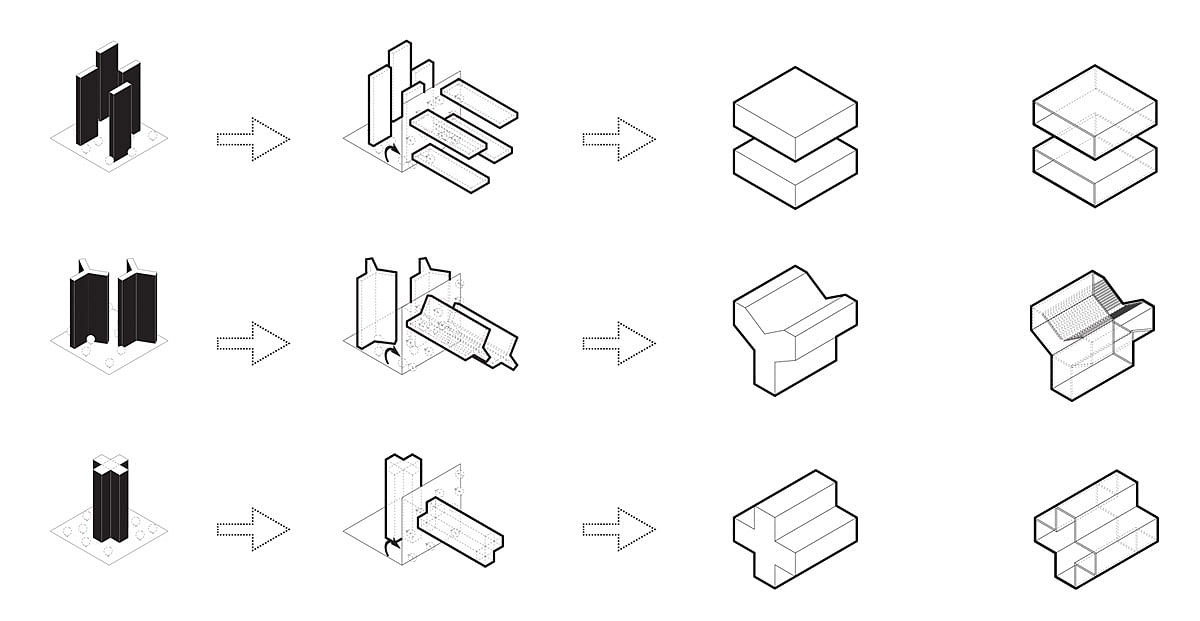
Diagram (Image: PinkCloud.dk)

Micro Scale

Seven modular typologies are constructed in the micro scale (House, Y, O, =, ?), visible from the human eye at street scale.  Each typology houses a function that is clearly readable from near and far distances. This enables clear wayfinding and navigation for inhabitants. 

Diagram (Image: PinkCloud.dk)

Macro Scale

Unique typologies are configured and distributed with a parametric algorithm to maintain human scale throughout the project.  The designer can choose the number of housing and office modules and select the density and footprint.  The algorithm optimizes the arrangement of modules into close communities and uses site-specific qualities as parameters to optimize the composition.
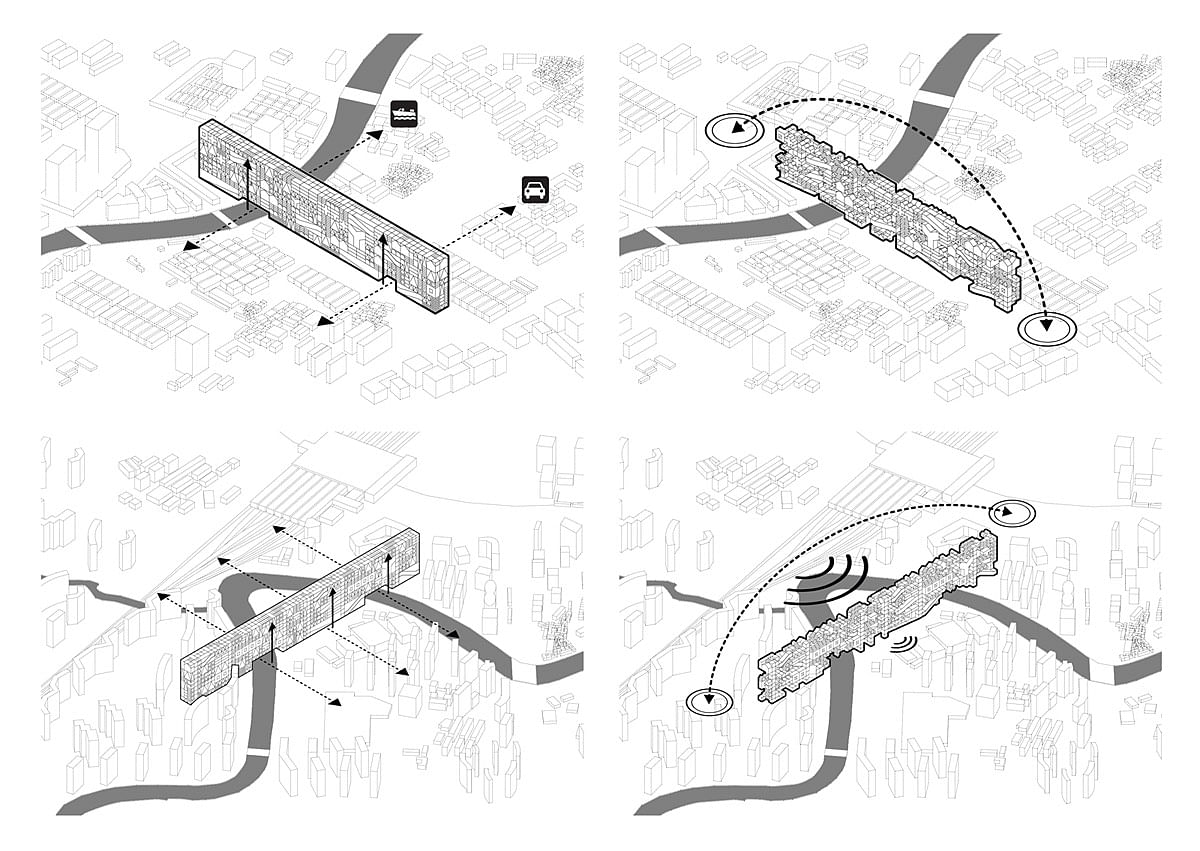
Diagram (Image: PinkCloud.dk)

Mega Scale

The mega-scale of FLIP/CITY uses different footprints to optimize the parametric arrangement of its modules. The proposal is adaptable to a wide range of situations from environmental influences to social structures. We have selected six diverse sites with unique urban problems for analysis.  All six scenarios are tested with the FLIP/CITY model to test its flexibility and adaptability. 

Diagram (Image: PinkCloud.dk)

SUSTAINABILITY

FLIP/CITY addresses four crucial aspects of sustainability.  In the realm of social sustainability, the anonymous feeling of immense cities is challenged by interconnecting typically isolated diverse city zones.  In the economical sense, increase green space invigorates the morale of Shanghai’s dense society. Dead spaces, voids and abandoned sites are also renewed.  Ecological sustainability is achieved by recycling greywater of the Suzhou Creek. Heating and cooling is accomplished by collecting solar and wind energy. Finally, FLIP/CITY sustains the cultural heritage of Shanghai by reinterpreting its historical urban framework.

Diagram (Image: PinkCloud.dk)

IMPACT

FLIP/CITY proposes a new urban identity for Shanghai as a model for the development of future cities.  By questioning traditional typologies, FLIP/CITY redefines historical methods of organizing communities by preserving intimacy at the human scale. FLIP/CITY utilizes the naturally high population density of Shanghai as a tool to connect its citizens in close proximity to their needs.  
By re-thinking our standard urban typologies, we can effectively re-think Shanghai.
FLIP/CITY is a new urban typology that answers the needs of modern Shanghai, its economy, social structures and ecological plans for the future while embracing Shanghai’s rich history and its citizens.

Diagram (Image: PinkCloud.dk)

Share

  • Follow

    0 Comments

  • Comment as :

Archinect JobsArchinect Jobs

The Archinect Job Board attracts the world's top architectural design talents.

VIEW ALL JOBS POST A JOB

Interior Designer

Fowlkes Studio

Interior Designer

Washington, DC, US

Senior Technical Designer, Commercial Interiors - New York Office

Fogarty Finger

Senior Technical Designer, Commercial Interiors - New York Office

New York, NY, US

Project Architect

Fowlkes Studio

Project Architect

Washington, DC, US

Architecture & Design Manager

7th Street Burger

Architecture & Design Manager

New York, NY, US

Project Architect at High End Boutique Townhouse Firm in BK

Steering House Design and Development

Project Architect at High End Boutique Townhouse Firm in BK

Brooklyn, NY, US

Designer (Level 3)

KPMB

Designer (Level 3)

Cambridge, MA, US

Intermediate Architectural Designer, Ground-Up - New York Office

Fogarty Finger

Intermediate Architectural Designer, Ground-Up - New York Office

New York, NY, US

Junior/Intermediate Architect

Archimaera Architecture

Junior/Intermediate Architect

New York, NY, US

Architectural Design Manager for Architectural Lighting Design Firm

Castelli-Design

Architectural Design Manager for Architectural Lighting Design Firm

New York, NY, US

Interior Designer

Megan Grehl

Interior Designer

New York, NY, US

Next page » Loading