• Login / Join
  • About
  • •
  • Contact
  • •
  • Advertising
bustler logo
bustler logo
  • News
  • Competitions
  • Events
  • Bustler is powered by Archinect
  • Sign up for Bustler's Email Newsletters

  • Follow these Bustler feeds:

  • Search

    Search in

  • Submit

    What are you submitting?

    News Pitch
    Competition
    Event
  • Login / Join
  • News|Competitions|Events
  • Search
    | Submit
    | Follow
  • Search in

    What are you submitting?

    News Pitch
    Competition
    Event

    Follow these Bustler feeds:

  • About|Contact|Advertising
  • Login / Join

Fourth Plinth 2010 Shortlist Exhibition Opened in London

By Bustler Editors|

Tuesday, Aug 24, 2010
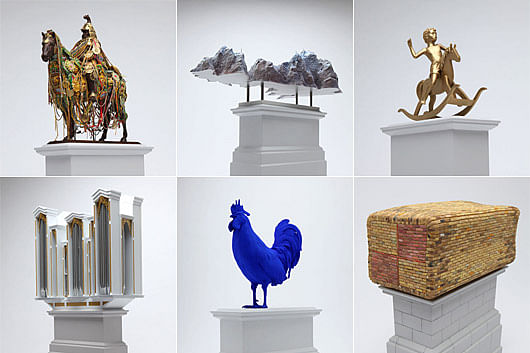
The six 2010 shortlist entries

Six of the world’s most exciting contemporary artists have been shortlisted to propose a new artwork for the Fourth Plinth in Trafalgar Square in London, England. This year’s winning artist will have their work on display during the 2012 Olympic and Paralympic Games.

Over the past four years the ‘empty’ fourth plinth in the Northwest corner of Trafalgar Square has been home to some of the world’s most innovative artworks. The Plinth was originally designed by Sir Charles Barry in 1841 to display an equestrian statue, however due to insufficient funds the statue was never completed. In 1998 – over one hundred and fifty years later – the Royal Society for the encouragement of Arts, Manufactures and Commerce (RSA) commissioned three contemporary sculptures by Mark Wallinger, Bill Woodrow and Rachel Whiteread to be displayed temporarily on the Plinth.
 
Following the enormous public interest generated by these commissions, the Mayor of London began the Fourth Plinth Commission to continue this tradition and build on its success.

The maquettes of this year's shortlisted artists’ ideas can be seen in an exciting interactive exhibition in the lobby of St Martin-in-the-Field at Trafalgar Square. Visitors to the exhibition can take a look at the actual models, hear what the artists think about their ideas as well as hearing what supporters of the program such as Boris Johnson, Mayor of London and Ekow Eshun, Director of the Institute of Contemporary Arts, London think about the program.

The exhibition will be on display until October 31, 2010. On Thursday, September 16 from 6 to 8 pm, the exhibition hosts an artists panel discussion. Please RSVP via [email protected].

Below are the six shortlisted 2010 entries:
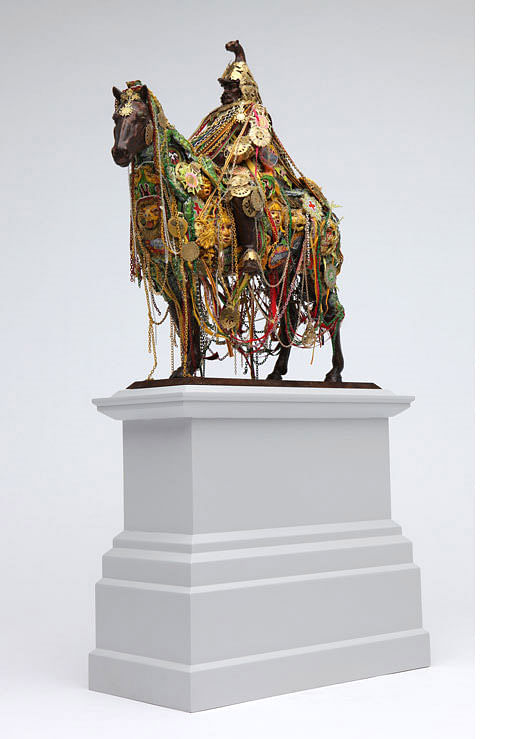
Sikandar by Hew Locke

Sikandar by Hew Locke

Sikandar replicates the statue of Field Marshal, Sir George White (1835 – 1912) that stands in Portland Place and transforms it into a fetish object. The sculpture will be embellished with horse-brasses, charms, medals, sabres, ex-votos, jewels, Bactrian treasure and Hellenistic masks, creating layers of material and meaning with multiple possible readings.

Sikandar, translates as Alexander in Urdu; Khandahar being one of the cities Alexander the Great named after himself. Commanders to this day measure themselves against him, and at this moment somewhere in Afghanistan, a member of our troops will be reading his histories. Alexander's military empire was short-lived, but his Hellenic cultural influence lasted centuries.

The work will bring a social and historic focus to the Square, contributing to its role as a place of dissent and celebration. The proposal is not an anti-military critique. It is an investigation into the idea of the Hero and the problematic and changing nature of heroism.
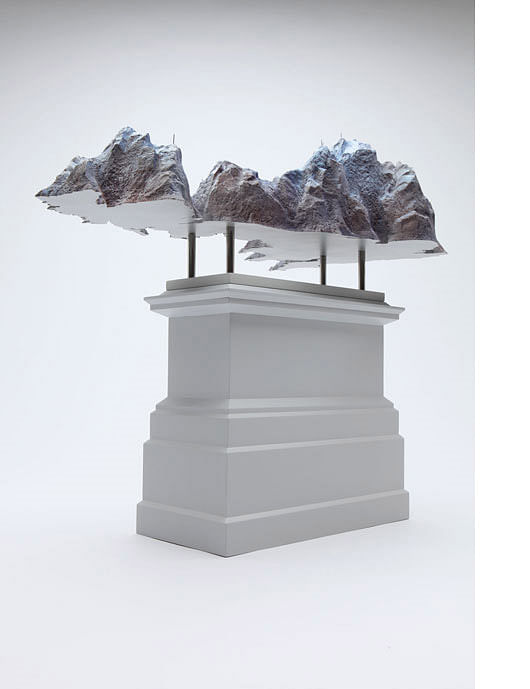
 

It’s Never Too Late And You Can’t Go Back by Mariele Neudecker

It’s Never Too Late And You Can’t Go Back by Mariele Neudecker

It’s Never Too Late And You Can’t Go Back is elevated above the Plinth and represents a fictional mountainscape. It is ‘specific in its dramatically modelled detail’ and if viewed from above reveals the flipped and reversed shape of Britain. From below, the map is the right way around and more familiar. The juxtaposition of different views shifts the observer’s perception of the mountain from majestic and generic landscape to territorial space.

Historically mountains represent monumentality, conquest, glory, ownership. In turn, the sentiments frequently attached to landscapes have often served as reminders of our more fragile, human, moral and mortal positions in the grandest considerations of the sublime.
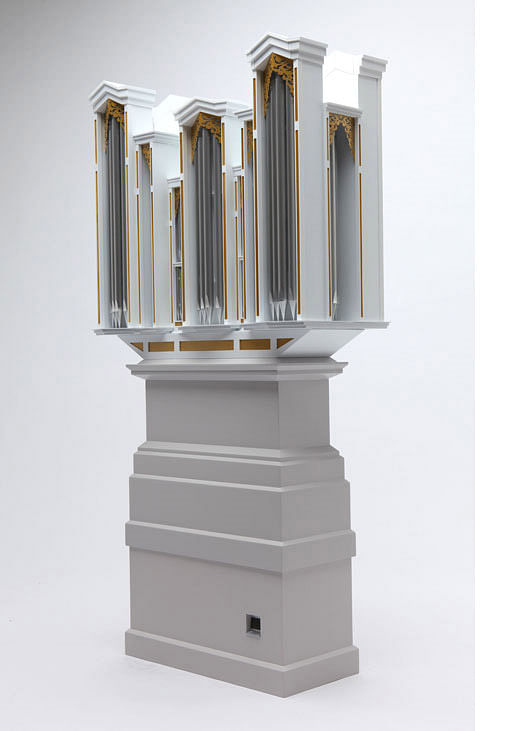
 

Untitled (ATM/Organ) by Allora and Calzadilla

Untitled (ATM/Organ) by Allora and Calzadilla

Untitled (ATM/Organ) consists of installing an automated teller machine (ATM) in the Fourth Plinth, connected to a functioning pipe organ which will produce sound by driving pressurised air through pipes selected via the ATM machine keyboard.

Each time customers press the ATM keyboard to access bank accounts worldwide to make cash withdrawals, credit card cash advances, account balance inquiries and so on, it will trigger the pipe organ to produce a range of notes and chords at varying degrees of loudness which will reverberate throughout Trafalgar Square.
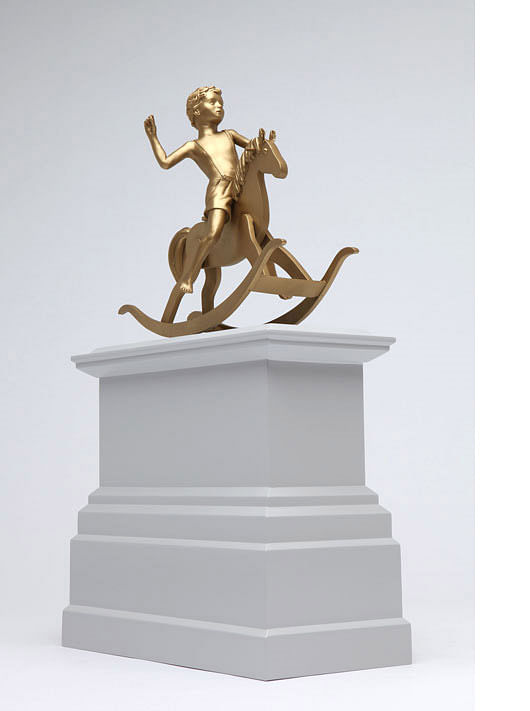
 

Powerless Structures, Fig. 101 by Elmgreen & Dragset

Powerless Structures, Fig. 101 by Elmgreen & Dragset

In this portrayal of a boy astride his rocking horse, a child has been elevated to the status of a historical hero, though there is not yet a history to commemorate – only a future to hope for. Elmgreen & Dragset’s work proposes a paraphrase of a traditional war monument beyond a dualistic worldview predicated on either victory or defeat. Instead of acknowledging the heroism of the powerful, Powerless Structures, Fig. 101 celebrates the heroism of growing up. It is a visual statement celebrating expectation and change rather than glorifying the past.
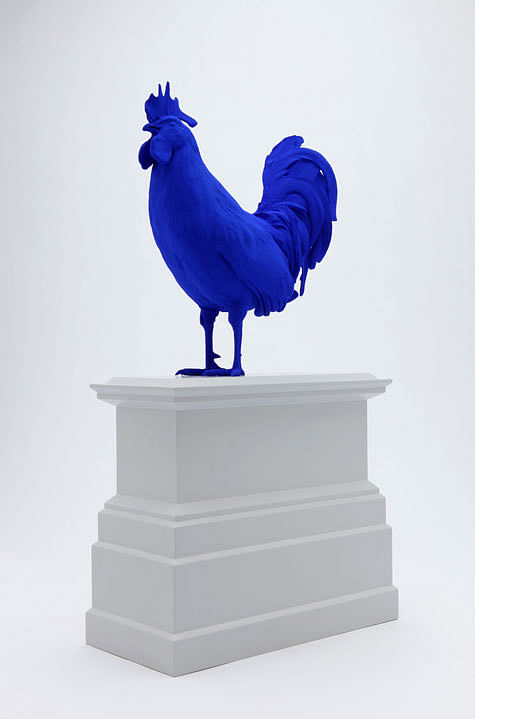
 

Hahn / Cock by Katharina Fritsch

Hahn / Cock by Katharina Fritsch

The sculpture, a larger than life cockerel in ultramarine blue communicates on different levels. First of all is the consideration of the formal aspect of its placement: the mostly grey architecture of Trafalgar Square would receive an unexpectedly strong colour accentuation, the size and colour of the animal making the whole situation surreal or simply unusual. The cockerel is also a symbol for regeneration, awakening and strength and finally, the work refers, in an ironic way, to male-defined British society and thoughts about biological determinism.
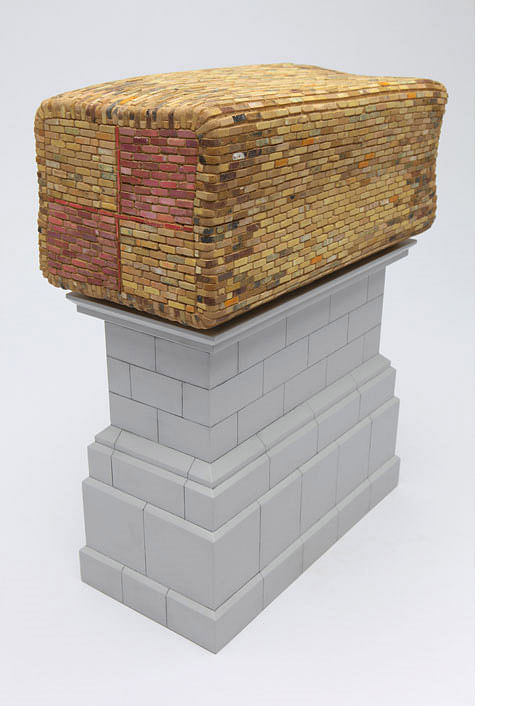
 

Battenberg by Brian Griffiths

Battenberg by Brian Griffiths

The Battenberg cake was invented on the advent of the marriage of Queen Victoria’s granddaughter – Princess Victoria of Hesse – to Prince Louis of Battenberg in 1884. As such, the pink and yellow cake is a humble commemoration of the Victorian era and a link with a British past that has slowly crumbled. Yet this past still influences contemporary life, not least in our cities where we are surrounded by Victorian public sculpture. Increased to gigantic proportion, fashioned from a selection of traditionally made household bricks and placed on a plinth alongside other Victorian statues in Trafalgar Square, the cake becomes a wry monument to monumentality. It highlights a much-changed contemporary Britain while gently questioning the role of contemporary art in today’s late capitalist society where our perception of culture is as a consumer experience.
 

Related

united kingdom ● trafalgar square ● monument ● london ● fourth plinth ● exhibition ● event ● europe ● art

Share

  • Follow

    0 Comments

  • Comment as :

Fourth Plinth 2010 Shortlist Exhibition Opened in London

A proposal reusing decommissioned buses as mobile playgrounds wins the 2026 Davidson Prize

Carlo Ratti and Park Associati to redevelop Italian hospital by linking architecture and healing

Sponsored Post by Buildner

Mujassam Watan Urban Sculpture Challenge #8 FINAL registration deadline is approaching!

Excellence in sacred architecture reflected across the 2026 Faith & Form International Awards for Religious Architecture & Art winners

Sponsored Post by Buildner

Underbridge / Edition #2 advance registration deadline is approaching!

World’s most beautiful commercial stores of 2026 selected by Prix Versailles

Sponsored Post by Buildner

Buildner’s Unbuilt Award 2026 advance registration deadline is approaching!

Eight innovative timber projects honored at 2026 Wood in Architecture Awards

Sign up for Bustler's Email Newsletters

Beautiful brick architecture honored at BRICK AWARD 26

Over $500,000 awarded to architectural discourse projects by Graham Foundation

Best in urban planning recognized at AIA Regional & Urban Design Award 2026

Sponsored Post by Buildner

Re:Form - New Life for Old Spaces / Edition #3 advance registration deadline is approaching!

New architecture and design competitions: IDEAS Awards, UIA-HYP CUP International Student Competition, Vancouver Tall Challenge, and Memorial to the Sixth Extinction

Best small projects chosen at AIA Small Project Award 2026

10 standout sustainable projects honored at AIA COTE Top Ten Award 2026

Next page » Loading

Fourth Plinth 2010 Shortlist Exhibition Opened in London

By Bustler Editors|

Tuesday, Aug 24, 2010

Share

The six 2010 shortlist entries

Related

united kingdom ● trafalgar square ● monument ● london ● fourth plinth ● exhibition ● event ● europe ● art

Six of the world’s most exciting contemporary artists have been shortlisted to propose a new artwork for the Fourth Plinth in Trafalgar Square in London, England. This year’s winning artist will have their work on display during the 2012 Olympic and Paralympic Games.

Over the past four years the ‘empty’ fourth plinth in the Northwest corner of Trafalgar Square has been home to some of the world’s most innovative artworks. The Plinth was originally designed by Sir Charles Barry in 1841 to display an equestrian statue, however due to insufficient funds the statue was never completed. In 1998 – over one hundred and fifty years later – the Royal Society for the encouragement of Arts, Manufactures and Commerce (RSA) commissioned three contemporary sculptures by Mark Wallinger, Bill Woodrow and Rachel Whiteread to be displayed temporarily on the Plinth.
 
Following the enormous public interest generated by these commissions, the Mayor of London began the Fourth Plinth Commission to continue this tradition and build on its success.

The maquettes of this year's shortlisted artists’ ideas can be seen in an exciting interactive exhibition in the lobby of St Martin-in-the-Field at Trafalgar Square. Visitors to the exhibition can take a look at the actual models, hear what the artists think about their ideas as well as hearing what supporters of the program such as Boris Johnson, Mayor of London and Ekow Eshun, Director of the Institute of Contemporary Arts, London think about the program.

The exhibition will be on display until October 31, 2010. On Thursday, September 16 from 6 to 8 pm, the exhibition hosts an artists panel discussion. Please RSVP via [email protected].

Below are the six shortlisted 2010 entries:

Sikandar by Hew Locke

Sikandar by Hew Locke

Sikandar replicates the statue of Field Marshal, Sir George White (1835 – 1912) that stands in Portland Place and transforms it into a fetish object. The sculpture will be embellished with horse-brasses, charms, medals, sabres, ex-votos, jewels, Bactrian treasure and Hellenistic masks, creating layers of material and meaning with multiple possible readings.

Sikandar, translates as Alexander in Urdu; Khandahar being one of the cities Alexander the Great named after himself. Commanders to this day measure themselves against him, and at this moment somewhere in Afghanistan, a member of our troops will be reading his histories. Alexander's military empire was short-lived, but his Hellenic cultural influence lasted centuries.

The work will bring a social and historic focus to the Square, contributing to its role as a place of dissent and celebration. The proposal is not an anti-military critique. It is an investigation into the idea of the Hero and the problematic and changing nature of heroism.
 

It’s Never Too Late And You Can’t Go Back by Mariele Neudecker

It’s Never Too Late And You Can’t Go Back by Mariele Neudecker

It’s Never Too Late And You Can’t Go Back is elevated above the Plinth and represents a fictional mountainscape. It is ‘specific in its dramatically modelled detail’ and if viewed from above reveals the flipped and reversed shape of Britain. From below, the map is the right way around and more familiar. The juxtaposition of different views shifts the observer’s perception of the mountain from majestic and generic landscape to territorial space.

Historically mountains represent monumentality, conquest, glory, ownership. In turn, the sentiments frequently attached to landscapes have often served as reminders of our more fragile, human, moral and mortal positions in the grandest considerations of the sublime.
 

Untitled (ATM/Organ) by Allora and Calzadilla

Untitled (ATM/Organ) by Allora and Calzadilla

Untitled (ATM/Organ) consists of installing an automated teller machine (ATM) in the Fourth Plinth, connected to a functioning pipe organ which will produce sound by driving pressurised air through pipes selected via the ATM machine keyboard.

Each time customers press the ATM keyboard to access bank accounts worldwide to make cash withdrawals, credit card cash advances, account balance inquiries and so on, it will trigger the pipe organ to produce a range of notes and chords at varying degrees of loudness which will reverberate throughout Trafalgar Square.
 

Powerless Structures, Fig. 101 by Elmgreen & Dragset

Powerless Structures, Fig. 101 by Elmgreen & Dragset

In this portrayal of a boy astride his rocking horse, a child has been elevated to the status of a historical hero, though there is not yet a history to commemorate – only a future to hope for. Elmgreen & Dragset’s work proposes a paraphrase of a traditional war monument beyond a dualistic worldview predicated on either victory or defeat. Instead of acknowledging the heroism of the powerful, Powerless Structures, Fig. 101 celebrates the heroism of growing up. It is a visual statement celebrating expectation and change rather than glorifying the past.
 

Hahn / Cock by Katharina Fritsch

Hahn / Cock by Katharina Fritsch

The sculpture, a larger than life cockerel in ultramarine blue communicates on different levels. First of all is the consideration of the formal aspect of its placement: the mostly grey architecture of Trafalgar Square would receive an unexpectedly strong colour accentuation, the size and colour of the animal making the whole situation surreal or simply unusual. The cockerel is also a symbol for regeneration, awakening and strength and finally, the work refers, in an ironic way, to male-defined British society and thoughts about biological determinism.
 

Battenberg by Brian Griffiths

Battenberg by Brian Griffiths

The Battenberg cake was invented on the advent of the marriage of Queen Victoria’s granddaughter – Princess Victoria of Hesse – to Prince Louis of Battenberg in 1884. As such, the pink and yellow cake is a humble commemoration of the Victorian era and a link with a British past that has slowly crumbled. Yet this past still influences contemporary life, not least in our cities where we are surrounded by Victorian public sculpture. Increased to gigantic proportion, fashioned from a selection of traditionally made household bricks and placed on a plinth alongside other Victorian statues in Trafalgar Square, the cake becomes a wry monument to monumentality. It highlights a much-changed contemporary Britain while gently questioning the role of contemporary art in today’s late capitalist society where our perception of culture is as a consumer experience.
 

Share

  • Follow

    0 Comments

  • Comment as :

Archinect JobsArchinect Jobs

The Archinect Job Board attracts the world's top architectural design talents.

VIEW ALL JOBS POST A JOB

Project Designer / Job Captain

Kadre Architects, Inc

Project Designer / Job Captain

Los Angeles, CA, US

Architect

ThinkForm Architects

Architect

Hopewell, NJ, US

Intermediate Architect - Retail (AutoCAD-based)

O'Neil Langan Architects

Intermediate Architect - Retail (AutoCAD-based)

New York, NY, US

Architectural Designer with 2 - 5 years

Architecture Work Office

Architectural Designer with 2 - 5 years

New York, NY, US

Senior Technical Designer, Commercial Interiors - New York Office

Fogarty Finger

Senior Technical Designer, Commercial Interiors - New York Office

New York, NY, US

Junior Designer

Larson Architecture Works pllc

Junior Designer

New York, NY, US

Designer

Jayson Architecture

Designer

San Francisco, CA, US

Project Designer / Manager

BuiltIN Studio

Project Designer / Manager

New York, NY, US

Technical Designer

D L English Design Studio

Technical Designer

Pasadena, CA, US

Lead Architect

Emaar Enterprise

Lead Architect

Fontana, CA, US

Next page » Loading