• Login / Join
  • About
  • •
  • Contact
  • •
  • Advertising
bustler logo
bustler logo
  • News
  • Competitions
  • Events
  • Bustler is powered by Archinect
  • Sign up for Bustler's Email Newsletters

  • Follow these Bustler feeds:

  • Search

    Search in

  • Submit

    What are you submitting?

    News Pitch
    Competition
    Event
  • Login / Join
  • News|Competitions|Events
  • Search
    | Submit
    | Follow
  • Search in

    What are you submitting?

    News Pitch
    Competition
    Event

    Follow these Bustler feeds:

  • About|Contact|Advertising
  • Login / Join

Herzog & de Meuron and Ai Weiwei to Design Serpentine Pavilion 2012

By Bustler Editors|

Tuesday, Feb 7, 2012
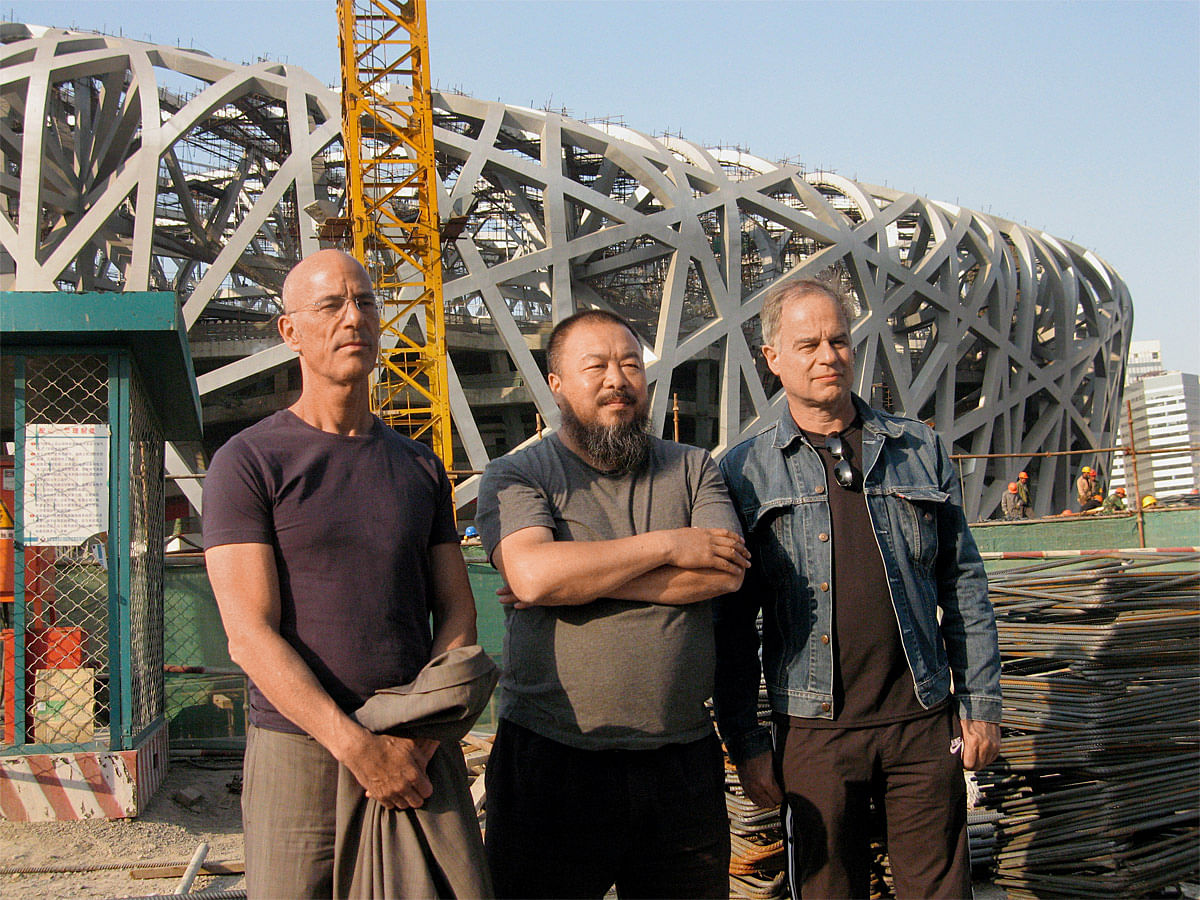
Jacques Herzog, Ai Weiwei, Pierre de Meuron in front of the 'Bird's Nest', Beijing National Stadium (Photo: T&C Film AG)

The Serpentine Gallery in London today announced that Herzog & de Meuron and Ai Weiwei will create the 2012 Serpentine Gallery Pavilion. It will be the twelfth commission in the gallery’s highly prestigious annual series.

The design team responsible for the celebrated Beijing National Stadium, which was built for the 2008 Olympic Games and won the RIBA Lubetkin Prize, will come together again in London in 2012 in a special development of the Serpentine’s acclaimed annual commission which will be presented as part of the London 2012 Festival, the culmination of the Cultural Olympiad. The Pavilion will be Herzog & de Meuron and Ai Weiwei’s first collaborative built structure in the UK.

This year’s Pavilion will take visitors beneath the Serpentine’s lawn to explore the hidden history of its previous Pavilions. Eleven columns characterizing each past Pavilion and a twelfth column will support a floating platform roof 1.5 meters above ground. Taking an archaeological approach, the architects have created a design that will inspire visitors to look beneath the surface of the park as well as back in time across the ghosts of the earlier structures.

Julia Peyton-Jones, Director, and Hans Ulrich Obrist, Co-Director, Serpentine Gallery, said: “It is a great honor to be working with Herzog & de Meuron and Ai Weiwei. We are delighted that our annual commission will bring this unique architectural collaboration to Europe to mark the continuity between the Beijing 2008 and the London 2012 Games.”
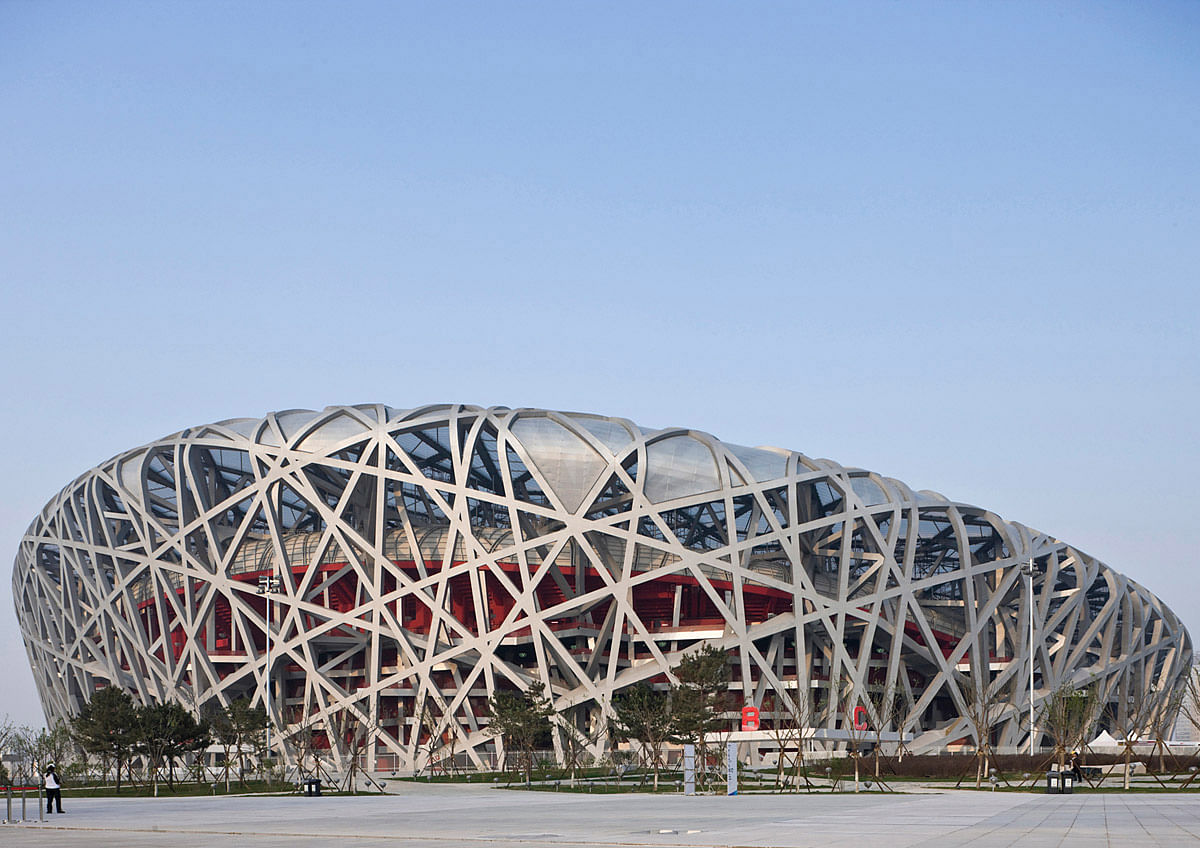
National Stadium, Bejing, China, The Main Stadium for the 2008 Olympic Games designed by Herzog & de Meuron and Ai Weiwei (Photo: Iwan Baan)

Describing their design concept Herzog & de Meuron and Ai Weiwei said: “Every year since 2000, a different architect has been responsible for creating the Serpentine Gallery’s summer Pavilion for Kensington Gardens. That makes eleven Pavilions so far, our contribution will be the twelfth. So many Pavilions in so many different shapes and out of so many different materials have been conceived and built that we tried instinctively to sidestep the unavoidable problem of creating an object, a concrete shape.

“Our path to an alternative solution involves digging down some five feet into the soil of the park until we reach the groundwater. There we dig a waterhole, a kind of well, to collect all of the London rain that falls in the area of the Pavilion. In that way we incorporate an otherwise invisible aspect of reality in the park – the water under the ground – into our Pavilion. As we dig down into the earth, we encounter a diversity of constructed realities such as telephone cables and former foundations. Like a team of archaeologists, we identify these physical fragments as remains of the eleven Pavilions built between 2000 and 2011. Their shape varies: circular, long and narrow, dots and also large, constructed hollows that have been filled in. These remains testify to the existence of the former Pavilions and their greater or lesser intervention in the natural environment of the park.

“All of these foundations will now be uncovered and reconstructed. The old foundations form a jumble of convoluted lines, like a sewing pattern. A distinctive landscape emerges out of the reconstructed foundations which is unlike anything we could have invented; its form and shape is actually a serendipitous gift. The three-dimensional reality of this landscape is astonishing and it is also the perfect place to sit, stand, lie down or just look and be amazed. In other words, the ideal environment for continuing to do what visitors have been doing in the Serpentine Gallery Pavilions over the past eleven years – and a discovery for the many new visitors anticipated for the London 2012 Olympic Games.

“On the foundations of each single Pavilion, we extrude a new structure (supports, walls) as load-bearing elements for the roof of our Pavilion – eleven supports all told, plus our own column that we can place at will, like a wild card. The roof resembles that of an archaeological site. It floats some five feet above the grass of the park, so that everyone visiting can see the water on it, its surface reflecting the infinitely varied, atmospheric skies of London. For special events, the water can be drained off the roof as from a bathtub, from whence it flows back into the waterhole, the deepest point in the Pavilion landscape. The dry roof can then be used as a dance floor or simply as a platform suspended above the park.”
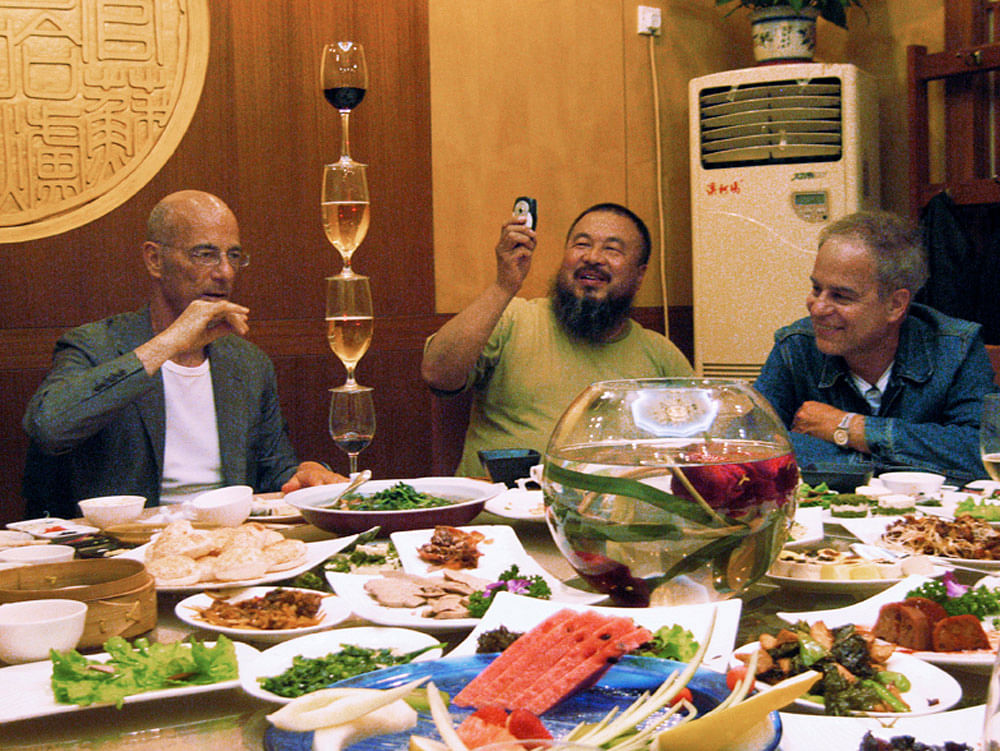
Still from the documentary "Bird's Nest" (Photo: T&C Film AG)

The Serpentine Gallery Pavilion will operate as a public space and as a venue for Park Nights, the Gallery’s high-profile program of public talks and events. Connecting to the archaeological focus of the Pavilion design Park Nights will culminate in October with the Serpentine Gallery Memory Marathon, the latest edition of the annual Serpentine Marathon series conceived by Hans Ulrich Obrist, now in its seventh year. The Marathon series began in 2006 with the 24-hour Serpentine Gallery Interview Marathon; followed by the Experiment Marathon in 2007; the Manifesto Marathon in 2008; the Poetry Marathon in 2009, the Map Marathon in 2010 and the Garden Marathon in 2011.

The Pavilion architects to date are: Peter Zumthor, 2011; Jean Nouvel, 2010; Kazuyo Sejima and Ryue Nishizawa, SANAA, 2009; Frank Gehry, 2008; Olafur Eliasson and Kjetil Thorsen, 2007; Rem Koolhaas and Cecil Balmond, with Arup, 2006; Álvaro Siza and Eduardo Souto de Moura with Cecil Balmond, Arup, 2005; MVRDV with Arup, 2004 (un-realised); Oscar Niemeyer, 2003; Toyo Ito and Cecil Balmond - with Arup, 2002; Daniel Libeskind with Arup, 2001; and Zaha Hadid, 2000.

The Serpentine Gallery Pavilion 2012 designed by Herzog & de Meuron and Ai Weiwei will open from June – October 2012.

Related

europe ● ai weiwei ● herzog & de meuron ● london ● pavilion ● serpentine pavilion ● united kingdom

Share

  • Follow

    0 Comments

  • Comment as :

Herzog & de Meuron and Ai Weiwei to Design Serpentine Pavilion 2012

Northwestern University selects 12-firm longlist to design new engineering building

New architecture and design competitions: Exploring 130 Years of American Design, Christo & Jeanne-Claude Center, 13 White Houses, and La Pyramide

Micro-architecture honored in latest Tiny House Architecture Competition

World’s most beautiful restaurants of 2026 chosen by Prix Versailles

Sponsored Post by Buildner

Design a wine tasting room in Italy! Valli Wine Tasting Room is launched!

10 can't-miss architecture & design events to see this June in London, Los Angeles, Chicago, San Francisco, Detroit, San Diego, Porto, and Barcelona

Sponsored Post by Buildner

Museum of Emotions / Edition #8 FINAL registration deadline is approaching!

Seven global projects make AR Public Awards shortlist 2026

Sign up for Bustler's Email Newsletters

Sponsored Post by Buildner

Design a slow-living restaurant in Portugal! Portugal Long Table Restaurant is launched!

World's best tall buildings honored at the CVU 2026 Award of Excellence

Sponsored Post by TWOPAGES

Final call: TWOPAGES X Design Contest 2026 submissions close June 5

Kengo Kuma & Paul Raff win Alberta national park visitor center competition with landscape-focused design

2026 Moira Gemmill and MJ Long prizes announced by W Awards

New architecture and design competitions: Kinderspace, Stewardson Keefe LeBrun Travel Grant, SMALL PROJECT BIG IMPACT, and Garden of University House, Bucharest

The Century of Gehry: New retrospective explores the late architect's work & collaborations

Next page » Loading

Herzog & de Meuron and Ai Weiwei to Design Serpentine Pavilion 2012

By Bustler Editors|

Tuesday, Feb 7, 2012

Share

Jacques Herzog, Ai Weiwei, Pierre de Meuron in front of the 'Bird's Nest', Beijing National Stadium (Photo: T&C Film AG)

Related

europe ● ai weiwei ● herzog & de meuron ● london ● pavilion ● serpentine pavilion ● united kingdom

The Serpentine Gallery in London today announced that Herzog & de Meuron and Ai Weiwei will create the 2012 Serpentine Gallery Pavilion. It will be the twelfth commission in the gallery’s highly prestigious annual series.

The design team responsible for the celebrated Beijing National Stadium, which was built for the 2008 Olympic Games and won the RIBA Lubetkin Prize, will come together again in London in 2012 in a special development of the Serpentine’s acclaimed annual commission which will be presented as part of the London 2012 Festival, the culmination of the Cultural Olympiad. The Pavilion will be Herzog & de Meuron and Ai Weiwei’s first collaborative built structure in the UK.

This year’s Pavilion will take visitors beneath the Serpentine’s lawn to explore the hidden history of its previous Pavilions. Eleven columns characterizing each past Pavilion and a twelfth column will support a floating platform roof 1.5 meters above ground. Taking an archaeological approach, the architects have created a design that will inspire visitors to look beneath the surface of the park as well as back in time across the ghosts of the earlier structures.

Julia Peyton-Jones, Director, and Hans Ulrich Obrist, Co-Director, Serpentine Gallery, said: “It is a great honor to be working with Herzog & de Meuron and Ai Weiwei. We are delighted that our annual commission will bring this unique architectural collaboration to Europe to mark the continuity between the Beijing 2008 and the London 2012 Games.”

National Stadium, Bejing, China, The Main Stadium for the 2008 Olympic Games designed by Herzog & de Meuron and Ai Weiwei (Photo: Iwan Baan)

Describing their design concept Herzog & de Meuron and Ai Weiwei said: “Every year since 2000, a different architect has been responsible for creating the Serpentine Gallery’s summer Pavilion for Kensington Gardens. That makes eleven Pavilions so far, our contribution will be the twelfth. So many Pavilions in so many different shapes and out of so many different materials have been conceived and built that we tried instinctively to sidestep the unavoidable problem of creating an object, a concrete shape.

“Our path to an alternative solution involves digging down some five feet into the soil of the park until we reach the groundwater. There we dig a waterhole, a kind of well, to collect all of the London rain that falls in the area of the Pavilion. In that way we incorporate an otherwise invisible aspect of reality in the park – the water under the ground – into our Pavilion. As we dig down into the earth, we encounter a diversity of constructed realities such as telephone cables and former foundations. Like a team of archaeologists, we identify these physical fragments as remains of the eleven Pavilions built between 2000 and 2011. Their shape varies: circular, long and narrow, dots and also large, constructed hollows that have been filled in. These remains testify to the existence of the former Pavilions and their greater or lesser intervention in the natural environment of the park.

“All of these foundations will now be uncovered and reconstructed. The old foundations form a jumble of convoluted lines, like a sewing pattern. A distinctive landscape emerges out of the reconstructed foundations which is unlike anything we could have invented; its form and shape is actually a serendipitous gift. The three-dimensional reality of this landscape is astonishing and it is also the perfect place to sit, stand, lie down or just look and be amazed. In other words, the ideal environment for continuing to do what visitors have been doing in the Serpentine Gallery Pavilions over the past eleven years – and a discovery for the many new visitors anticipated for the London 2012 Olympic Games.

“On the foundations of each single Pavilion, we extrude a new structure (supports, walls) as load-bearing elements for the roof of our Pavilion – eleven supports all told, plus our own column that we can place at will, like a wild card. The roof resembles that of an archaeological site. It floats some five feet above the grass of the park, so that everyone visiting can see the water on it, its surface reflecting the infinitely varied, atmospheric skies of London. For special events, the water can be drained off the roof as from a bathtub, from whence it flows back into the waterhole, the deepest point in the Pavilion landscape. The dry roof can then be used as a dance floor or simply as a platform suspended above the park.”

Still from the documentary "Bird's Nest" (Photo: T&C Film AG)

The Serpentine Gallery Pavilion will operate as a public space and as a venue for Park Nights, the Gallery’s high-profile program of public talks and events. Connecting to the archaeological focus of the Pavilion design Park Nights will culminate in October with the Serpentine Gallery Memory Marathon, the latest edition of the annual Serpentine Marathon series conceived by Hans Ulrich Obrist, now in its seventh year. The Marathon series began in 2006 with the 24-hour Serpentine Gallery Interview Marathon; followed by the Experiment Marathon in 2007; the Manifesto Marathon in 2008; the Poetry Marathon in 2009, the Map Marathon in 2010 and the Garden Marathon in 2011.

The Pavilion architects to date are: Peter Zumthor, 2011; Jean Nouvel, 2010; Kazuyo Sejima and Ryue Nishizawa, SANAA, 2009; Frank Gehry, 2008; Olafur Eliasson and Kjetil Thorsen, 2007; Rem Koolhaas and Cecil Balmond, with Arup, 2006; Álvaro Siza and Eduardo Souto de Moura with Cecil Balmond, Arup, 2005; MVRDV with Arup, 2004 (un-realised); Oscar Niemeyer, 2003; Toyo Ito and Cecil Balmond - with Arup, 2002; Daniel Libeskind with Arup, 2001; and Zaha Hadid, 2000.

The Serpentine Gallery Pavilion 2012 designed by Herzog & de Meuron and Ai Weiwei will open from June – October 2012.

Share

  • Follow

    0 Comments

  • Comment as :

Archinect JobsArchinect Jobs

The Archinect Job Board attracts the world's top architectural design talents.

VIEW ALL JOBS POST A JOB

Job Captain / Project Manager

Breland – Harper

Job Captain / Project Manager

Los Angeles, CA, US

Project Designer (3 to 5 years)

Swift Lee Office

Project Designer (3 to 5 years)

Los Angeles, CA, US

Project Architect/ Designer

Nandinee Phookan Architect, P.C.

Project Architect/ Designer

New York, NY, US

Architectural Designer (5-7 Years) - Commercial & Hospitality Focus

Pfeffer Torode Architecture

Architectural Designer (5-7 Years) - Commercial & Hospitality Focus

Nashville, TN, US

Marketing Coordinator

Blair + Mui Dowd Architects

Marketing Coordinator

New York, NY, US

Intermediate Architect

NDKazalas Architecture PC

Intermediate Architect

New York, NY, US

Interior Designer, 5+ Years Experience

Cass Calder Smith

Interior Designer, 5+ Years Experience

San Francisco, CA, US

Junior Designer

OLIVER FREUNDLICH DESIGN

Junior Designer

New York, NY, US

Interior Designer | Education & Institutional Work

Berliner Architects

Interior Designer | Education & Institutional Work

Culver City, CA, US

Project Architect

BuildingWork

Project Architect

Seattle, WA, US

Next page » Loading