• Login / Join
  • About
  • •
  • Contact
  • •
  • Advertising
bustler logo
bustler logo
  • News
  • Competitions
  • Events
  • Bustler is powered by Archinect
  • Sign up for Bustler's Email Newsletters

  • Follow these Bustler feeds:

  • Search

    Search in

  • Submit

    What are you submitting?

    News Pitch
    Competition
    Event
  • Login / Join
  • News|Competitions|Events
  • Search
    | Submit
    | Follow
  • Search in

    What are you submitting?

    News Pitch
    Competition
    Event

    Follow these Bustler feeds:

  • About|Contact|Advertising
  • Login / Join

Lines of Memories - 2nd place winner of the Gallipoli Peninsula Historical Natural Park competition

By Bustler Editors|

Thursday, Jun 26, 2014

Image Courtesy of ONZ Architects & MDesign

Lines of Memories by ONZ Architects, MDESIGN, LOLA landscape architects and 24H Architecture recently won second prize in the Gallipoli Peninsula Historical Natural Park Areas of Focus Ideas Competition.

Interdisciplinary teams proposed contemporary design solutions to improve the connectivity and experience of the existing memorial parks in Gallipoli, Turkey, where the high-casualty Battle of Gallipoli during World War I took place. Proposals had to be sensitive to the area's rich historical heritage as well as its natural landscape.

Check out the proposal right below.

Project description:

"CONCEPT:  'A visit to Gallipoli has the potential to change p eople, who they are, and how they see the world. A visit has the potential to lift them up so that they might see beyond their existing horizons. This is no ordinary place. The strong Gallipoli landscape has a great deal to say. A 5000 year history.' -- Tony Watkins

The events that took place on the Gallipoli peninsula and the Dardanelles have been so devastating and atrocious, that they will forever inspire people to commemorate the war. When surrounded by the natural beauty of the peninsula it’s hard to imagine this was once the backdrop of such violence. And yet, the more these events fade away in history, the more important it is to commemorate, to keep the history alive and to imagine what it’s like to fear for your live and to honour those who died.

The landscape that we can see nowadays is still the same as it was when the battle took place. Now memorials and burials have taken the pla ce of the armies and their equipment. These two elements - the landscape and the memorials – are almost everything that is needed for a spiritual experience. Of course in the decades that followed the war everyday life also re-entered this peninsula. It can be seen in the growing towns, the beaches, the infrastructure and around the memorials.

This design proposal creates a new balance between everyday life, the extraordinary history and the beautiful nature. It offers the chance to shortly forget about everyday life and to concentrate on the war and the nature. Remembrance requires not only acoustic silence, but also visual silence. Therefore the design approach is minimalistic."

FOCAL POINT 1 | AERIAL VIEW - Image Courtesy of ONZ Architects & MDesign

"Memory Trails: The multitude of memorials spread over the peninsul a makes it possible to realize the extents of the battle that took place. The best way to experience this is on foot. Walking is the best way to remember things, as well as processing emotions. The scale of the peninsula is so, that one can walk from memorial to memorial. Nowadays the majority of the visitors arrives by car or autobus. Travelling by foot or by bike requires a mentality change and can be stimulated by laying out a path network that connects al the war memorials. It will accommodate walking routes of one day, but also a week. In this network, towns like Kilitbahir and Alçitepe will offer gastronomy and accommodation. Walking on Gallipoli could become li ke walking the trail to Santiago de Compostela: a healing experience. On this island one can commemorate the dead, but also remember that one’s own life is final (memento mori)."

FOCAL POINT 1 | AERIAL VIEW - Image Courtesy of ONZ Architects & MDesign

"By connecting existing dirt paths and roads, a coherent path network is easily created. This network leads to the various biotopes of the island and the various moments in the history of the battle. It is built up by a low route, roughly following the coast line, and a network of inland connections, leading through pastures, meadows, forests, hills and valleys. As the Gallipoli Campaign was fought both on land and at sea, the locations where boats have sunken are marked by floating lights that can be seen at night. The viewpoints from which these locations can be seen are marked and connected by the path network. The 124,000 soldiers that died during the battle, are spread over the different armies: Turkish, English, French, Australian and from New Zealand. But in the end it doesn’t matter who had which nationality: every soldier is a human being, and every died soldier should be grieved. Therefore the memory trails should be universal, leading equally to all memorials and burials."

FOCAL POINT 2 | PERSPECTIVE - Image Courtesy of ONZ Architects & MDesign

"A Medal For Every Soldier: To represent the casualties, regardless on which si de they fought, one universal medal is made for each dead soldier. The figure of the medal combines a crescent and a cross and is made of steel. The 124,000 medals will be pressed in the ground, and together they form the trail network on the peninsula. Averagely there will be one medal every two meters, which makes it easy to follow the trail. While walking, one will be overwhelmed by the enormous amount of casualties: the abstract number becomes real and tangible.

The medal is open, so it can be pressed in any surf ace: tarmac, concrete, clay, sand. Over time, small plants will start to grow in the openin gs of the medal, and nature becomes part of the symbol. On green surfaces, concrete will be us ed to stabilize the medal, and making sure that after time the medal will stay visible. The medal will be also become the symbol of the pen insula, used in other forms of communication."

FOCAL POINT 3 | PERSPECTIVE - Image Courtesy of ONZ Architects & MDesign

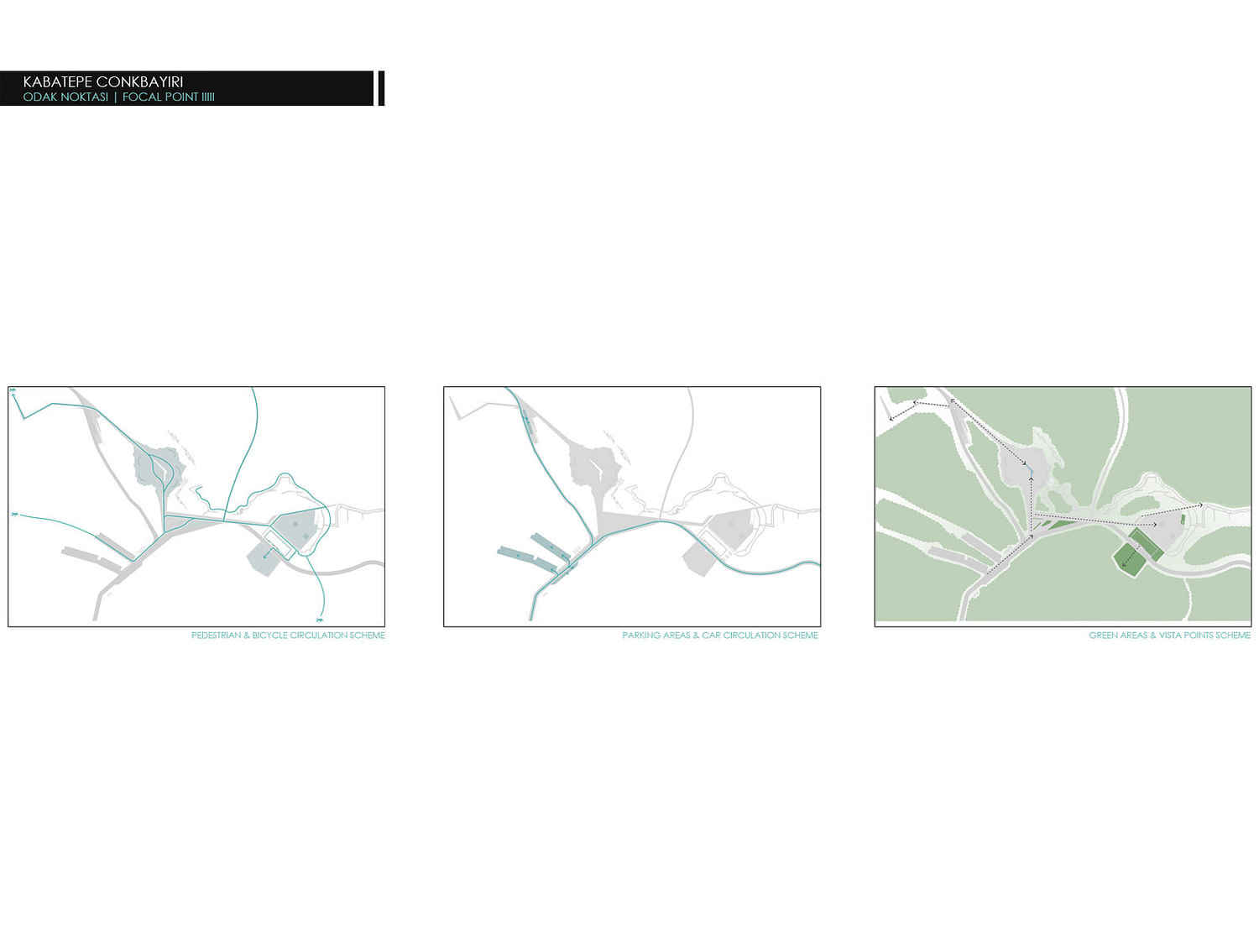
"Focal Points: Each memorial site is unique and tells its own part of the total story. They can best be described as an ensemble of elements individually can be found on many memorial sites, but always in a different form and configuration. The elements are: memorial, burial, plaquette, parking, shops, square, road, path. Since the shape and position of many of the elements is fixed, and only some elements can be moved or trans formed, it is not possible to create more coherence and recognisability in the ensemble. What can be done, is shaping the connections in a recognisable way: the paths that c onnect the different elements."

FOCAL POINT 4 | PERSPECTIVE - Image Courtesy of ONZ Architects & MDesign

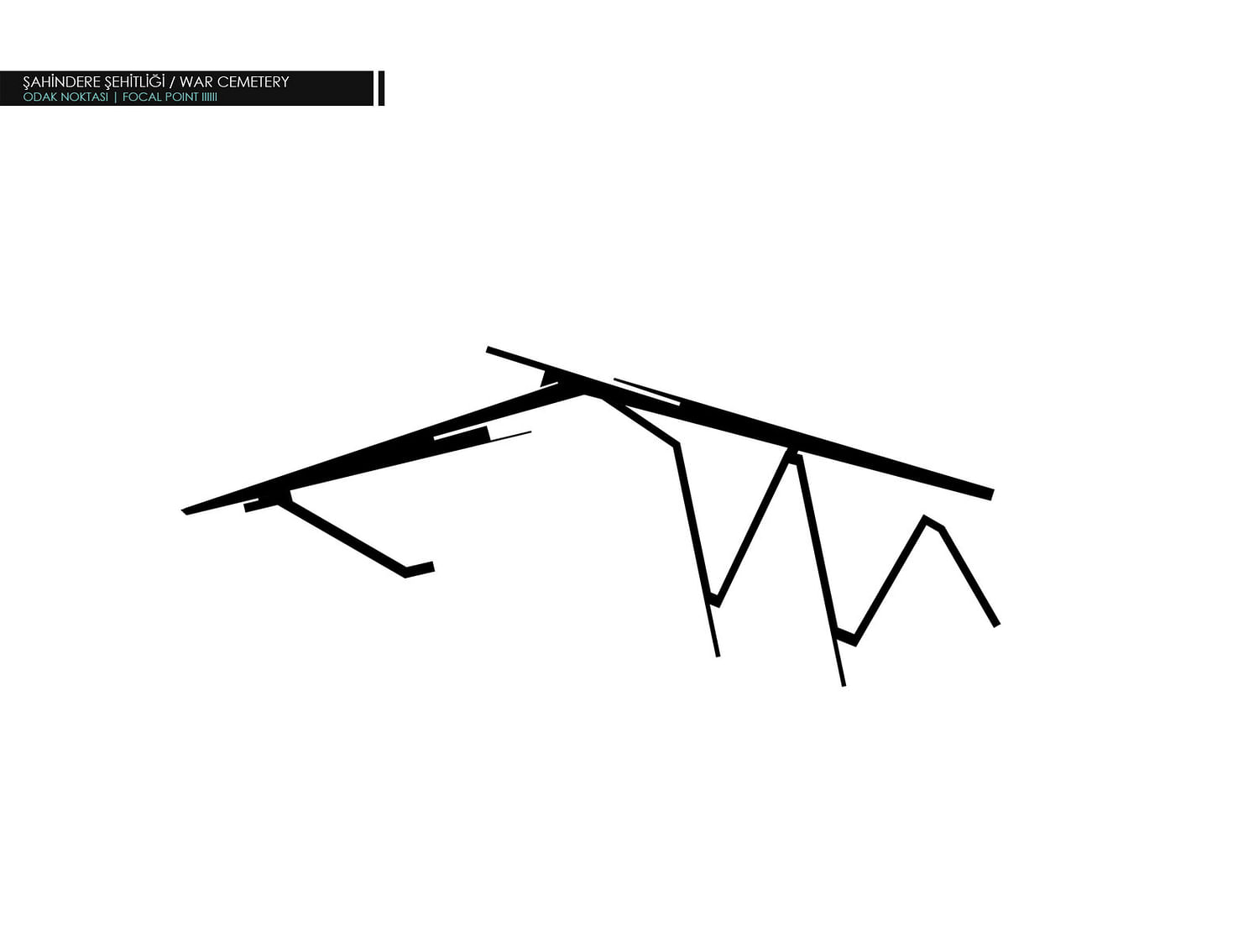
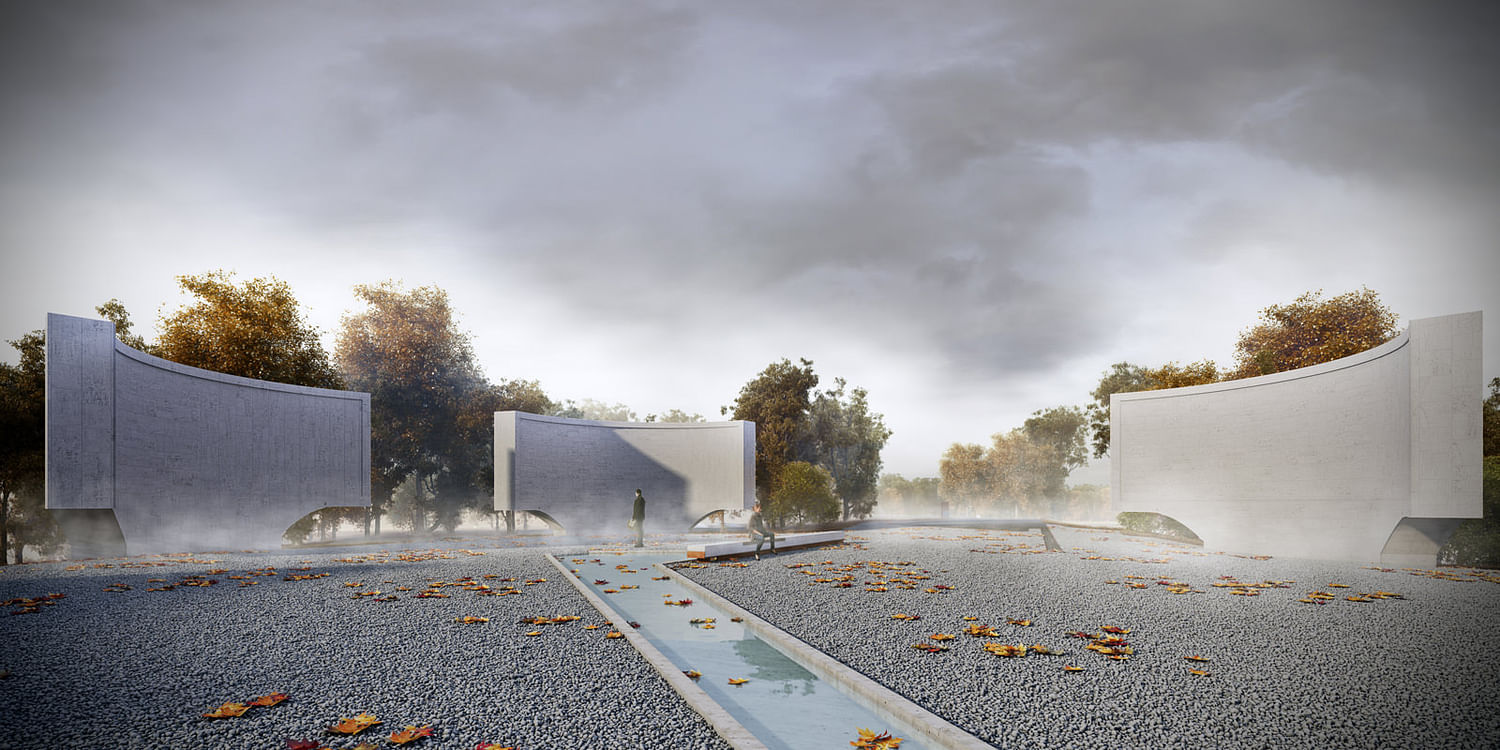
A recognisable path network is laid out slightly sunken, accompanied by corroded steel edges, wild flowers, signs and other elements. The sunken path brings visitors closer to the earth of the landscape, and creates a focus on the route ahead, while paths in the surroundings stay unrevealed. It creates a 1 on 1 relation with the landscape. The earth that is excavated to lower the path is put at the sides, creating a soft scratch in the surface of the landscape. The paths are never steep, and accessibl e for wheelchairs. Therefore on sloped terrain the paths make sharp angles, increasing the length of the path and the distance between the different memorials. Along the track, wild flowers are sown, selected to blossom when the ceremonies take place."
FOCAL POINT 5 | PERSPECTIVE - Image Courtesy of ONZ Architects & MDesign

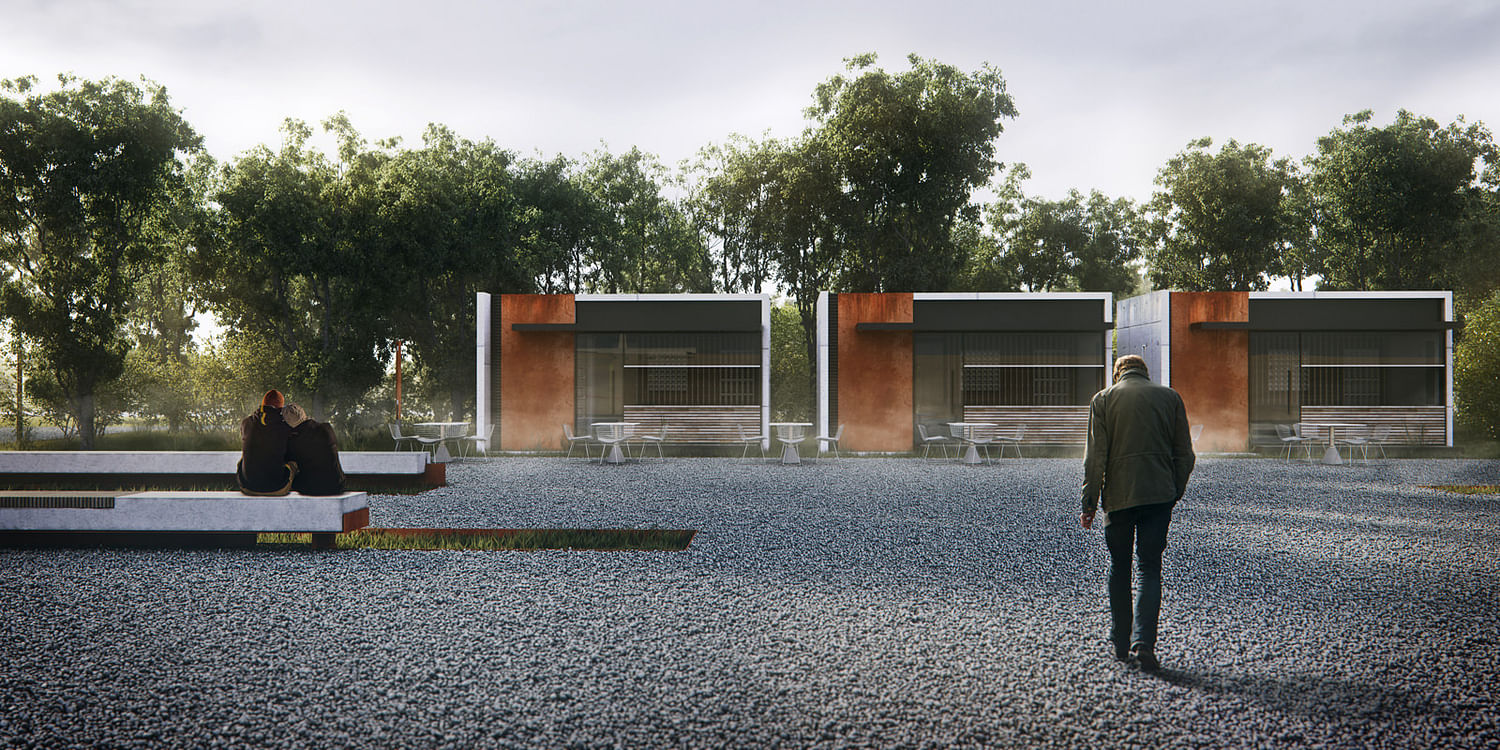
"When possible, parking is placed more at a distance, and a gathering space is introduced before entering the memorial site. When the space is available, more than one route is offered to reach the monument or the burial. In this way the visitors have a more individual experience. By applying these basic principles on each site, a different scratch pattern is created; recognisable by its material but unique in its trajectory. Additional elements like lamp posts, sign posts and bins all have a very quiet and minimal design, with corroded steel and concrete as their two main components. These colours will blend in the landscape in a natural way."
FOCAL POINT 6 | PERSPECTIVE - Image Courtesy of ONZ Architects & MDesign

Project Credits:

Design Team: ONZ Architects + MDesign + Lola + 24H Architecture

  • Onat Öktem
  • Zeynep Öktem
  • Murat Memlük
  • Mehmet Çıkrık
  • Maartje Lammers
  • Boris Zeisser
  • Peter Veenstra
  • Olav Bruin
  • Sevgi Çalı
  • Seda Özçelik
  • Okan Mutlu Akpınar
  • Esat Can Meker
  • Besmir Kamberi
  • Brigitta Van Weeren
  • Robbert Jongerius
  • Candaş Şiman
  • Refik Burak Atatür
  • Gürel Kutlular

Consultant: Tony Watkins

Related

war ● turkey ● park ● onz architects ● memorial ● mdesign ● lola landscape architects ● lines of memories ● landscape ● ideas competition ● history ● gallipoli ● 24h architecture

Share

  • Follow

    0 Comments

  • Comment as :

Lines of Memories - 2nd place winner of the Gallipoli Peninsula Historical Natural Park competition

New architecture and design competitions: Brick in Architecture Awards, Study Architecture Student Showcase, N.Y.C. Groceries, and New York High Falls Riverfront Market

SmithGroup’s ‘pioneering’ Philip Merrill Environmental Center wins AIA Twenty-five Year Award

Sponsored Post by Buildner

Museum of Emotions / Edition #8 FINAL registration deadline is in 5 DAYS!

Here are the winners of the 2026 AIA Architecture Awards

40 emerging architects and designers under 40 from Europe honored

Northwestern University selects 12-firm longlist to design new engineering building

New architecture and design competitions: Exploring 130 Years of American Design, Christo & Jeanne-Claude Center, 13 White Houses, and La Pyramide

Micro-architecture honored in latest Tiny House Architecture Competition

Sign up for Bustler's Email Newsletters

World’s most beautiful restaurants of 2026 chosen by Prix Versailles

Sponsored Post by Buildner

Design a wine tasting room in Italy! Valli Wine Tasting Room is launched!

10 can't-miss architecture & design events to see this June in London, Los Angeles, Chicago, San Francisco, Detroit, San Diego, Porto, and Barcelona

Sponsored Post by Buildner

Museum of Emotions / Edition #8 FINAL registration deadline is approaching!

Seven global projects make AR Public Awards shortlist 2026

Sponsored Post by Buildner

Design a slow-living restaurant in Portugal! Portugal Long Table Restaurant is launched!

World's best tall buildings honored at the CVU 2026 Award of Excellence

Next page » Loading

Lines of Memories - 2nd place winner of the Gallipoli Peninsula Historical Natural Park competition

By Bustler Editors|

Thursday, Jun 26, 2014

Share

Image Courtesy of ONZ Architects & MDesign

Related

war ● turkey ● park ● onz architects ● memorial ● mdesign ● lola landscape architects ● lines of memories ● landscape ● ideas competition ● history ● gallipoli ● 24h architecture

Lines of Memories by ONZ Architects, MDESIGN, LOLA landscape architects and 24H Architecture recently won second prize in the Gallipoli Peninsula Historical Natural Park Areas of Focus Ideas Competition.

Interdisciplinary teams proposed contemporary design solutions to improve the connectivity and experience of the existing memorial parks in Gallipoli, Turkey, where the high-casualty Battle of Gallipoli during World War I took place. Proposals had to be sensitive to the area's rich historical heritage as well as its natural landscape.

Check out the proposal right below.

Project description:

"CONCEPT:  'A visit to Gallipoli has the potential to change p eople, who they are, and how they see the world. A visit has the potential to lift them up so that they might see beyond their existing horizons. This is no ordinary place. The strong Gallipoli landscape has a great deal to say. A 5000 year history.' -- Tony Watkins

The events that took place on the Gallipoli peninsula and the Dardanelles have been so devastating and atrocious, that they will forever inspire people to commemorate the war. When surrounded by the natural beauty of the peninsula it’s hard to imagine this was once the backdrop of such violence. And yet, the more these events fade away in history, the more important it is to commemorate, to keep the history alive and to imagine what it’s like to fear for your live and to honour those who died.

The landscape that we can see nowadays is still the same as it was when the battle took place. Now memorials and burials have taken the pla ce of the armies and their equipment. These two elements - the landscape and the memorials – are almost everything that is needed for a spiritual experience. Of course in the decades that followed the war everyday life also re-entered this peninsula. It can be seen in the growing towns, the beaches, the infrastructure and around the memorials.

This design proposal creates a new balance between everyday life, the extraordinary history and the beautiful nature. It offers the chance to shortly forget about everyday life and to concentrate on the war and the nature. Remembrance requires not only acoustic silence, but also visual silence. Therefore the design approach is minimalistic."

FOCAL POINT 1 | AERIAL VIEW - Image Courtesy of ONZ Architects & MDesign

"Memory Trails: The multitude of memorials spread over the peninsul a makes it possible to realize the extents of the battle that took place. The best way to experience this is on foot. Walking is the best way to remember things, as well as processing emotions. The scale of the peninsula is so, that one can walk from memorial to memorial. Nowadays the majority of the visitors arrives by car or autobus. Travelling by foot or by bike requires a mentality change and can be stimulated by laying out a path network that connects al the war memorials. It will accommodate walking routes of one day, but also a week. In this network, towns like Kilitbahir and Alçitepe will offer gastronomy and accommodation. Walking on Gallipoli could become li ke walking the trail to Santiago de Compostela: a healing experience. On this island one can commemorate the dead, but also remember that one’s own life is final (memento mori)."

FOCAL POINT 1 | AERIAL VIEW - Image Courtesy of ONZ Architects & MDesign

"By connecting existing dirt paths and roads, a coherent path network is easily created. This network leads to the various biotopes of the island and the various moments in the history of the battle. It is built up by a low route, roughly following the coast line, and a network of inland connections, leading through pastures, meadows, forests, hills and valleys. As the Gallipoli Campaign was fought both on land and at sea, the locations where boats have sunken are marked by floating lights that can be seen at night. The viewpoints from which these locations can be seen are marked and connected by the path network. The 124,000 soldiers that died during the battle, are spread over the different armies: Turkish, English, French, Australian and from New Zealand. But in the end it doesn’t matter who had which nationality: every soldier is a human being, and every died soldier should be grieved. Therefore the memory trails should be universal, leading equally to all memorials and burials."

FOCAL POINT 2 | PERSPECTIVE - Image Courtesy of ONZ Architects & MDesign

"A Medal For Every Soldier: To represent the casualties, regardless on which si de they fought, one universal medal is made for each dead soldier. The figure of the medal combines a crescent and a cross and is made of steel. The 124,000 medals will be pressed in the ground, and together they form the trail network on the peninsula. Averagely there will be one medal every two meters, which makes it easy to follow the trail. While walking, one will be overwhelmed by the enormous amount of casualties: the abstract number becomes real and tangible.

The medal is open, so it can be pressed in any surf ace: tarmac, concrete, clay, sand. Over time, small plants will start to grow in the openin gs of the medal, and nature becomes part of the symbol. On green surfaces, concrete will be us ed to stabilize the medal, and making sure that after time the medal will stay visible. The medal will be also become the symbol of the pen insula, used in other forms of communication."

FOCAL POINT 3 | PERSPECTIVE - Image Courtesy of ONZ Architects & MDesign

"Focal Points: Each memorial site is unique and tells its own part of the total story. They can best be described as an ensemble of elements individually can be found on many memorial sites, but always in a different form and configuration. The elements are: memorial, burial, plaquette, parking, shops, square, road, path. Since the shape and position of many of the elements is fixed, and only some elements can be moved or trans formed, it is not possible to create more coherence and recognisability in the ensemble. What can be done, is shaping the connections in a recognisable way: the paths that c onnect the different elements."

FOCAL POINT 4 | PERSPECTIVE - Image Courtesy of ONZ Architects & MDesign

A recognisable path network is laid out slightly sunken, accompanied by corroded steel edges, wild flowers, signs and other elements. The sunken path brings visitors closer to the earth of the landscape, and creates a focus on the route ahead, while paths in the surroundings stay unrevealed. It creates a 1 on 1 relation with the landscape. The earth that is excavated to lower the path is put at the sides, creating a soft scratch in the surface of the landscape. The paths are never steep, and accessibl e for wheelchairs. Therefore on sloped terrain the paths make sharp angles, increasing the length of the path and the distance between the different memorials. Along the track, wild flowers are sown, selected to blossom when the ceremonies take place."

FOCAL POINT 5 | PERSPECTIVE - Image Courtesy of ONZ Architects & MDesign

"When possible, parking is placed more at a distance, and a gathering space is introduced before entering the memorial site. When the space is available, more than one route is offered to reach the monument or the burial. In this way the visitors have a more individual experience. By applying these basic principles on each site, a different scratch pattern is created; recognisable by its material but unique in its trajectory. Additional elements like lamp posts, sign posts and bins all have a very quiet and minimal design, with corroded steel and concrete as their two main components. These colours will blend in the landscape in a natural way."

FOCAL POINT 6 | PERSPECTIVE - Image Courtesy of ONZ Architects & MDesign

Project Credits:

Design Team: ONZ Architects + MDesign + Lola + 24H Architecture

  • Onat Öktem
  • Zeynep Öktem
  • Murat Memlük
  • Mehmet Çıkrık
  • Maartje Lammers
  • Boris Zeisser
  • Peter Veenstra
  • Olav Bruin
  • Sevgi Çalı
  • Seda Özçelik
  • Okan Mutlu Akpınar
  • Esat Can Meker
  • Besmir Kamberi
  • Brigitta Van Weeren
  • Robbert Jongerius
  • Candaş Şiman
  • Refik Burak Atatür
  • Gürel Kutlular

Consultant: Tony Watkins

Share

  • Follow

    0 Comments

  • Comment as :

Archinect JobsArchinect Jobs

The Archinect Job Board attracts the world's top architectural design talents.

VIEW ALL JOBS POST A JOB

Senior Project Architect

Breland – Harper

Senior Project Architect

Los Angeles, CA, US

AutoCAD Drafter/Architectural Designer

Kari Whitman Interiors

AutoCAD Drafter/Architectural Designer

Boulder, CO, US

Project Architect LA & NYC

Montalba Architects, Inc.

Project Architect LA & NYC

Los Angeles, CA, US

Intermediate Architect (Advanced Revit User)

O'Neil Langan Architects

Intermediate Architect (Advanced Revit User)

New York, NY, US

Junior Designer

Shadow Architect, P.C.

Junior Designer

New York, NY, US

Designer

HATCH ARCHITECTURE

Designer

Los Angeles, CA, US

Project Designer / Manager

BuiltIN Studio

Project Designer / Manager

New York, NY, US

Intermediate Residential Architect

52XConsulting

Intermediate Residential Architect

New York, NY, US

Project Manager - Civic/Community

DAHLIN Architecture | Planning | Interiors

Project Manager - Civic/Community

Irvine, CA, US

Project Manager/architect

MKNH Architects

Project Manager/architect

New York, NY, US

Next page » Loading