• Login / Join
  • About
  • •
  • Contact
  • •
  • Advertising
bustler logo
bustler logo
  • News
  • Competitions
  • Events
  • Bustler is powered by Archinect
  • Sign up for Bustler's Email Newsletters

  • Follow these Bustler feeds:

  • Search

    Search in

  • Submit

    What are you submitting?

    News Pitch
    Competition
    Event
  • Login / Join
  • News|Competitions|Events
  • Search
    | Submit
    | Follow
  • Search in

    What are you submitting?

    News Pitch
    Competition
    Event

    Follow these Bustler feeds:

  • About|Contact|Advertising
  • Login / Join

Lompreta Nolte's Entry to the MUMA Museum of the Environment Expansion Competition

By Bustler Editors|

Monday, Aug 9, 2010

Perspective of Entrance

Following up on last week's story about Jose Herrasti and Maria Fernanda Oppermann Bento's submission to the MUMA Museum of the Environment Expansion in the Rio de Janeiro Botanical Garden, today we bring you the entry by Rio-based Lompreta Nolte Arquitetos, with Daniel Feldman and Elizabeth Añaños.

The “Cultural Complex” at the entrance of the Botanical Garden has shown an immense growth of events, and the Environmental Museum is supposed to be the next and one of the most important elements of the Complex.  Thus the project for the Museum Annex is mainly a project about integration – integration of the Museum into the existing facilities and in the environment of the Botanical Garden.

Perspective

The “Cultural Complex” at the entrance of the Botanical Garden has shown an immense growth of events, and the Environmental Museum is supposed to be the next and one of the most important elements of the Complex.  Thus the project for the Museum Annex is mainly a project about integration – integration of the Museum into the existing facilities and in the environment of the Botanical Garden.

Design Process

INTEGRATION

The center point of the “Cultural Complex” is localized on the square in front of the visitor´s center (16th century construction, imperator´s residence) and serves as the main access to the Park as well to all the cultural installations. The project for the Museum proposes a complete inversion of the existing internal organization in order to enter it from the square side, offering a new linear entrance square and thus connecting it with the visitor´s center and the cultural complex.

Site Plan

The project proposes the fusion of the room-program in a single construction. In that way liberates the areas around the center square and valorizes the historical context.The building consists in a stack of wood-boxes, which are orientated to the main buildings and views of the micro-urban context. Visual axis and terraces form the principal elements of the volumetric composition. The axis of the linear entrance square finds a continuation on top of the stacked wood-boxes creating a landscape in different levels, all connected with the Museum interior.
 

Diagram

INTERIOR SPACE

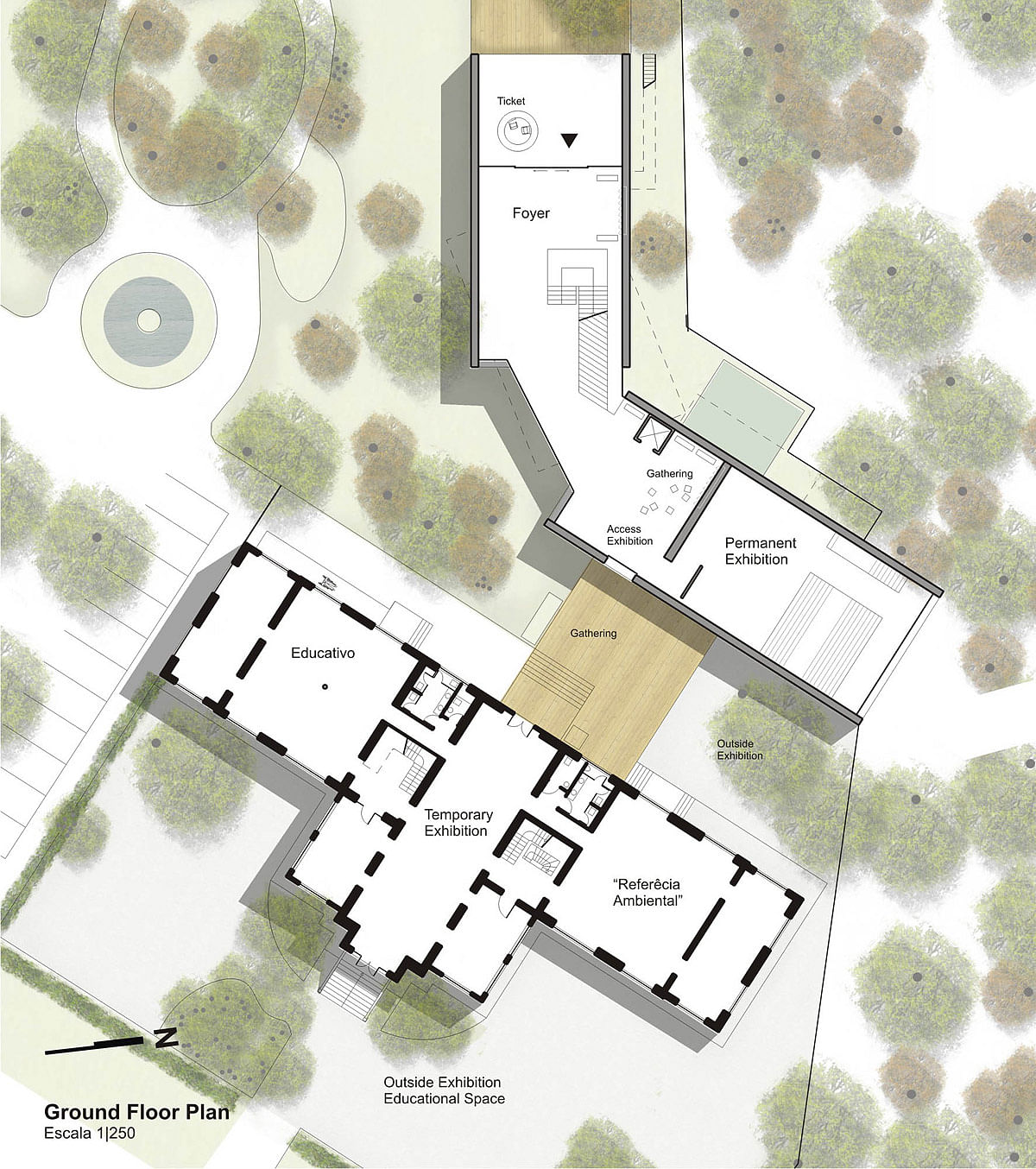
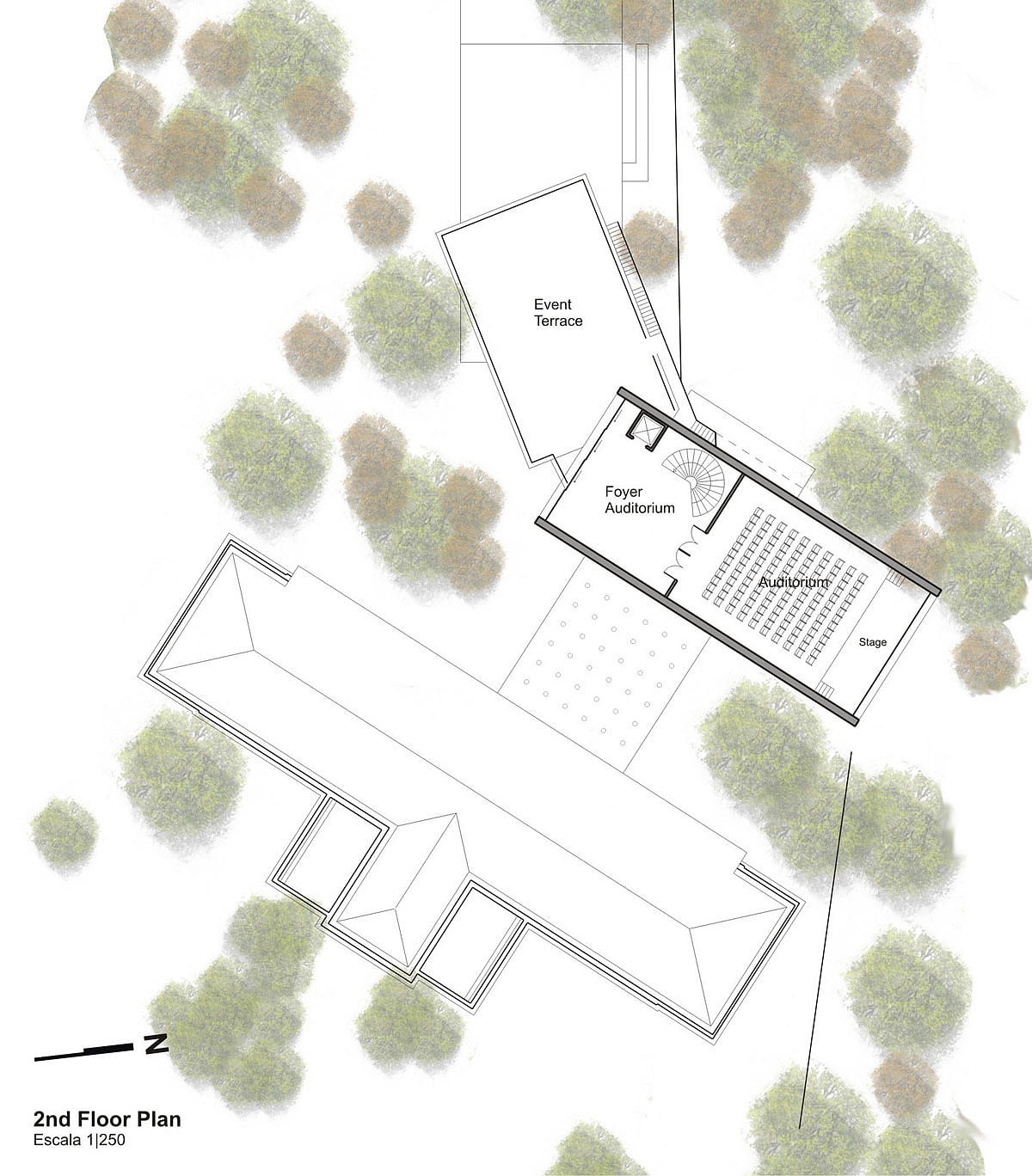
With the new entrance the Museum receives a central access to all Museum Facilities, such as the exhibitions (permanent and temporary) and auditory with restricted access, as also the free spaces like foyer, café, shop and terraces. These rather public spaces are directly connected to the terraces, which form a continuous landscape with its very special views.
Ground Floor

The exhibitions are organized in order to offer flexible circuits connecting the historical and the new part of the Museum. The external spaces around the historical building become outdoor exhibition areas with restricted access amplifying the Museum area.

First Floor

SUSTAINABILTY / ENERGY EFFICIENCY

The Museum Annex is composed by stacked boxes with clearly defined relation between isolated facades and openings. Its concept for the public spaces is based on cross ventilation, which together with shadowing is the most efficient cooling method in hot humid climate. The rather closed exhibition spaces have to use air condition, working with geothermic pre-cooling of the external air.
Second Floor

Green roofs and wood facades provide materials with low absorption rates on order to prevent heat island effects on the building.

Sections

Reuse of rainwater and onsite energy production are not only parts of the project, but especially part of the exposition. Apparent installation have the educational effect to explain strategies of energy efficiency to the visitors, including it in environmental education.

Framed View Axis

ECOSYSTEM

Within the intense bioma of the Tropical Coast Forest  “Mata Atlântica”, the insertion of a building can be compared to a formation of rocks, a solid in nature. Understanding the building in that form, it is a space which shall naturally be occupied by “rupicola” vegetation, a local vegetation type, which is dominant on local rocky formation (including the sugar loaf). The sequence of terraces gives space to that local vegetation, and offer to the Museum the representation of a local vegetation specie not yet present in the Botanical Garden.

Framed View Axis

Related

rio de janeiro ● environment museum ● brazil ● brasil

Share

  • Follow

    0 Comments

  • Comment as :

Lompreta Nolte's Entry to the MUMA Museum of the Environment Expansion Competition

Northwestern University selects 12-firm longlist to design new engineering building

New architecture and design competitions: Exploring 130 Years of American Design, Christo & Jeanne-Claude Center, 13 White Houses, and La Pyramide

Micro-architecture honored in latest Tiny House Architecture Competition

World’s most beautiful restaurants of 2026 chosen by Prix Versailles

Sponsored Post by Buildner

Design a wine tasting room in Italy! Valli Wine Tasting Room is launched!

10 can't-miss architecture & design events to see this June in London, Los Angeles, Chicago, San Francisco, Detroit, San Diego, Porto, and Barcelona

Sponsored Post by Buildner

Museum of Emotions / Edition #8 FINAL registration deadline is approaching!

Seven global projects make AR Public Awards shortlist 2026

Sign up for Bustler's Email Newsletters

Sponsored Post by Buildner

Design a slow-living restaurant in Portugal! Portugal Long Table Restaurant is launched!

World's best tall buildings honored at the CVU 2026 Award of Excellence

Sponsored Post by TWOPAGES

Final call: TWOPAGES X Design Contest 2026 submissions close June 5

Kengo Kuma & Paul Raff win Alberta national park visitor center competition with landscape-focused design

2026 Moira Gemmill and MJ Long prizes announced by W Awards

New architecture and design competitions: Kinderspace, Stewardson Keefe LeBrun Travel Grant, SMALL PROJECT BIG IMPACT, and Garden of University House, Bucharest

The Century of Gehry: New retrospective explores the late architect's work & collaborations

Next page » Loading

Lompreta Nolte's Entry to the MUMA Museum of the Environment Expansion Competition

By Bustler Editors|

Monday, Aug 9, 2010

Share

Perspective of Entrance

Related

rio de janeiro ● environment museum ● brazil ● brasil

Following up on last week's story about Jose Herrasti and Maria Fernanda Oppermann Bento's submission to the MUMA Museum of the Environment Expansion in the Rio de Janeiro Botanical Garden, today we bring you the entry by Rio-based Lompreta Nolte Arquitetos, with Daniel Feldman and Elizabeth Añaños.

The “Cultural Complex” at the entrance of the Botanical Garden has shown an immense growth of events, and the Environmental Museum is supposed to be the next and one of the most important elements of the Complex.  Thus the project for the Museum Annex is mainly a project about integration – integration of the Museum into the existing facilities and in the environment of the Botanical Garden.

Perspective

The “Cultural Complex” at the entrance of the Botanical Garden has shown an immense growth of events, and the Environmental Museum is supposed to be the next and one of the most important elements of the Complex.  Thus the project for the Museum Annex is mainly a project about integration – integration of the Museum into the existing facilities and in the environment of the Botanical Garden.

Design Process

INTEGRATION

The center point of the “Cultural Complex” is localized on the square in front of the visitor´s center (16th century construction, imperator´s residence) and serves as the main access to the Park as well to all the cultural installations. The project for the Museum proposes a complete inversion of the existing internal organization in order to enter it from the square side, offering a new linear entrance square and thus connecting it with the visitor´s center and the cultural complex.

Site Plan

The project proposes the fusion of the room-program in a single construction. In that way liberates the areas around the center square and valorizes the historical context.The building consists in a stack of wood-boxes, which are orientated to the main buildings and views of the micro-urban context. Visual axis and terraces form the principal elements of the volumetric composition. The axis of the linear entrance square finds a continuation on top of the stacked wood-boxes creating a landscape in different levels, all connected with the Museum interior.
 

Diagram

INTERIOR SPACE

With the new entrance the Museum receives a central access to all Museum Facilities, such as the exhibitions (permanent and temporary) and auditory with restricted access, as also the free spaces like foyer, café, shop and terraces. These rather public spaces are directly connected to the terraces, which form a continuous landscape with its very special views.

Ground Floor

The exhibitions are organized in order to offer flexible circuits connecting the historical and the new part of the Museum. The external spaces around the historical building become outdoor exhibition areas with restricted access amplifying the Museum area.

First Floor

SUSTAINABILTY / ENERGY EFFICIENCY

The Museum Annex is composed by stacked boxes with clearly defined relation between isolated facades and openings. Its concept for the public spaces is based on cross ventilation, which together with shadowing is the most efficient cooling method in hot humid climate. The rather closed exhibition spaces have to use air condition, working with geothermic pre-cooling of the external air.

Second Floor

Green roofs and wood facades provide materials with low absorption rates on order to prevent heat island effects on the building.

Sections

Reuse of rainwater and onsite energy production are not only parts of the project, but especially part of the exposition. Apparent installation have the educational effect to explain strategies of energy efficiency to the visitors, including it in environmental education.

Framed View Axis

ECOSYSTEM

Within the intense bioma of the Tropical Coast Forest  “Mata Atlântica”, the insertion of a building can be compared to a formation of rocks, a solid in nature. Understanding the building in that form, it is a space which shall naturally be occupied by “rupicola” vegetation, a local vegetation type, which is dominant on local rocky formation (including the sugar loaf). The sequence of terraces gives space to that local vegetation, and offer to the Museum the representation of a local vegetation specie not yet present in the Botanical Garden.

Framed View Axis

Share

  • Follow

    0 Comments

  • Comment as :

Archinect JobsArchinect Jobs

The Archinect Job Board attracts the world's top architectural design talents.

VIEW ALL JOBS POST A JOB

Architecture Project Manager

RDH Architecture + Interior Design

Architecture Project Manager

Las Vegas, NV, US

Job Captain

Studio AR&D Architects

Job Captain

Los Angeles, CA, US

Project Manager

VanderHorn Architects

Project Manager

Greenwich, CT, US

Project Manager - Civic/Community

DAHLIN ARCHITECTURE | PLANNING | INTERIORS

Project Manager - Civic/Community

Irvine, CA, US

Project Architect/ Designer

Nandinee Phookan Architect, P.C.

Project Architect/ Designer

New York, NY, US

Intermediate Architect

FROM Architecture DPC

Intermediate Architect

New York, NY, US

Interior Designer, 5+ Years Experience

Cass Calder Smith

Interior Designer, 5+ Years Experience

San Francisco, CA, US

Interior Designer | Education & Institutional Work

Berliner Architects

Interior Designer | Education & Institutional Work

Culver City, CA, US

Project Architect / Senior Designer

Touloukian Touloukian Inc.

Project Architect / Senior Designer

Boston, MA, US

Designer

HATCH ARCHITECTURE

Designer

Los Angeles, CA, US

Next page » Loading