• Login / Join
  • About
  • •
  • Contact
  • •
  • Advertising
bustler logo
bustler logo
  • News
  • Competitions
  • Events
  • Bustler is powered by Archinect
  • Sign up for Bustler's Email Newsletters

  • Follow these Bustler feeds:

  • Search

    Search in

  • Submit

    What are you submitting?

    News Pitch
    Competition
    Event
  • Login / Join
  • News|Competitions|Events
  • Search
    | Submit
    | Follow
  • Search in

    What are you submitting?

    News Pitch
    Competition
    Event

    Follow these Bustler feeds:

  • About|Contact|Advertising
  • Login / Join

MODU's "Weather (Un)Control" exhibition explores the post-Sandy indoor air environment

By Bustler Editors|

Thursday, Dec 12, 2013
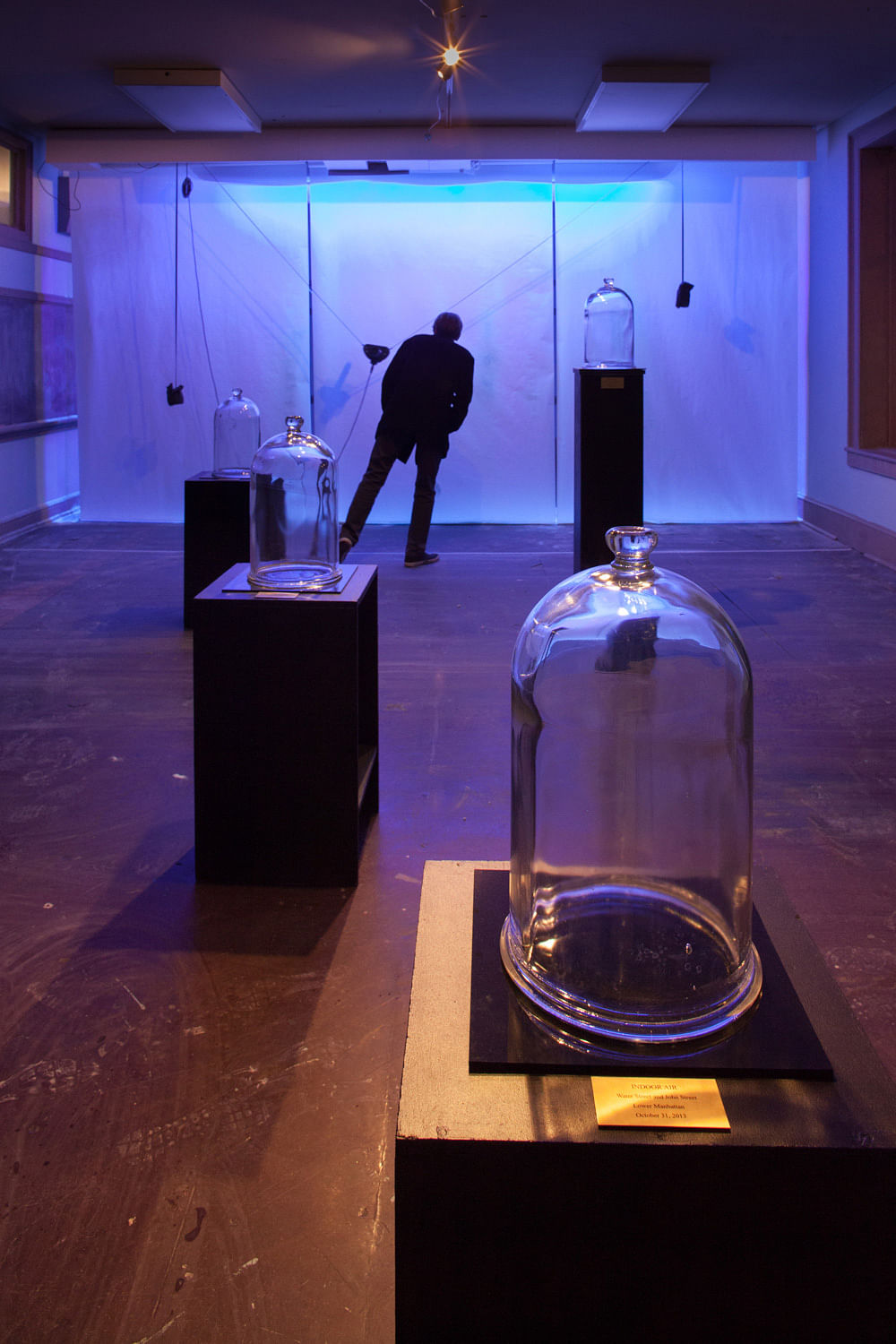
"Weather (Un)control" by MODU. Photo: Brett Beyer

As America's East Coast continues to recover from Hurricane Sandy, MODU's recently completed "Weather (Un)control" exhibition of the Marfa Dialogues/NY highlights an overlooked issue of the storm's aftermath that still remains: the invisible contaminants in indoor air.

The installation features drawings made from artificial dust and static electricity to address the current shortsighted methods for indoor air quality inspection and a "right" to better indoor air.

Weather (Un)Control with Storefront for Art and Architecture for Marfa Dialogues/NY from MODU on Vimeo.

Project description:

"The installation included an indoor weather system generated by two forms of air contamination: dust and static electricity. The project was a timely exploration of the invisible contaminants that fill indoor air long after the weather clears. This invisibly contaminated air, which goes unmeasured by the insurance companies charged with inspecting affected sites, recasts the term 'air rights' as an interior issue."
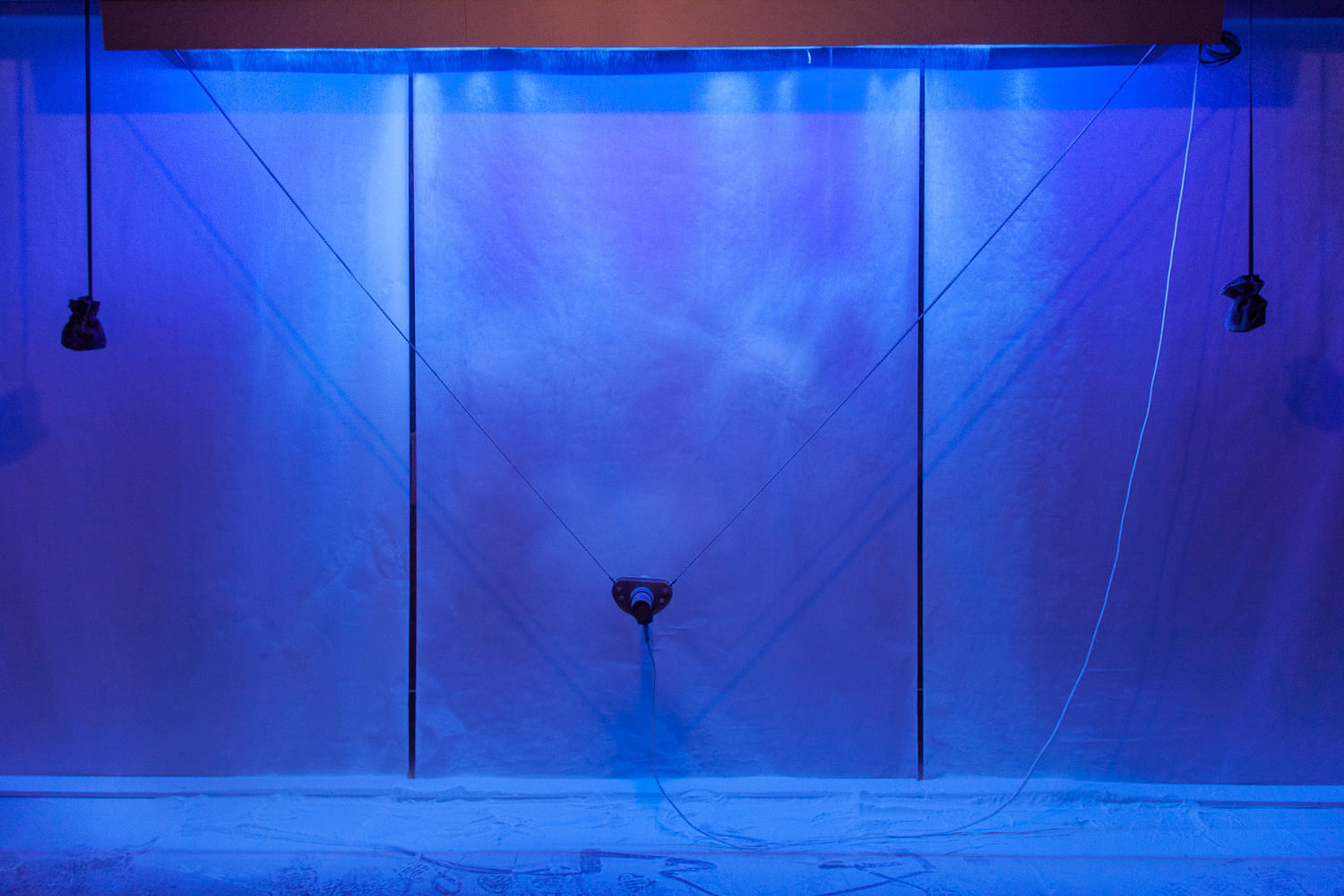
Photo: Brett Beyer

"Ten percent of New York City buildings sustained storm damage during  Hurricane Sandy. While billions of dollars were spent on the recovery effort, the storm’s invisible effects still linger in the air. Health risks in the indoor air of buildings—in the form of mold and dust—are beyond the reach of health officials, who rely mostly on outdoor air monitors."
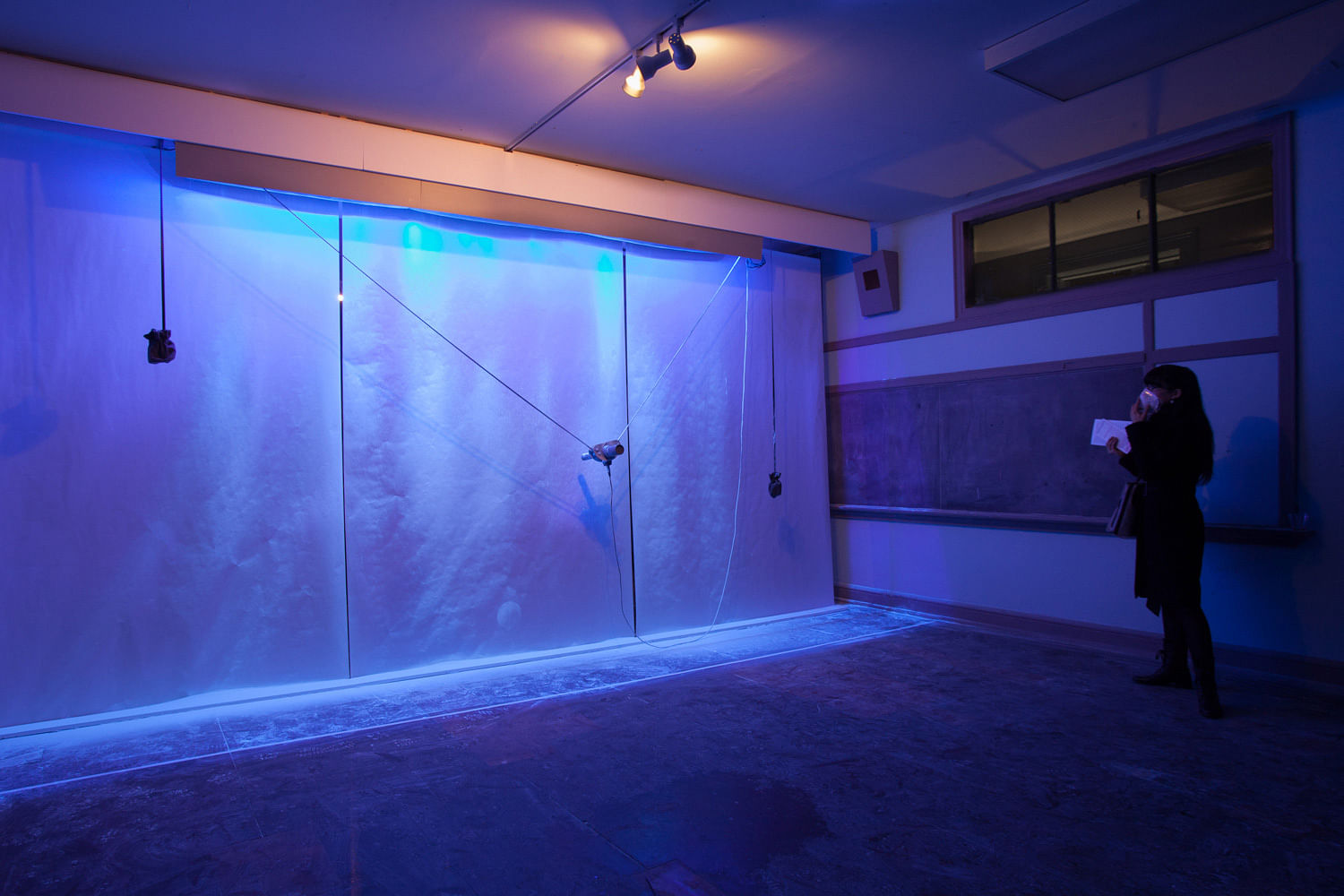
Photo: Brett Beyer

"Dust in Sandy- affected buildings—including asbestos, silica, and gypsum—was produced not only by storm damage but, even more substantially, by the rebuilding that has followed. It remains in the air a year later. Weather (Un)Control presented a 'dust wall' that used two robotic plotters to create ephemeral drawings made of static electricity and artificial dust."

Photo: Brett Beyer

"Since there are no government agencies monitoring indoor air quality, oversight has been left to the insurance companies that determine access to indoor 'air rights.' Rather than conduct air quality tests, the insurance industry relies on visual inspections to measure air contamination as well as determine insurance risk. Weather (Un)Control highlighted the inefficiency of these visual inspections with 'dust wall' drawings that remained invisible unless lit with ultraviolet light."
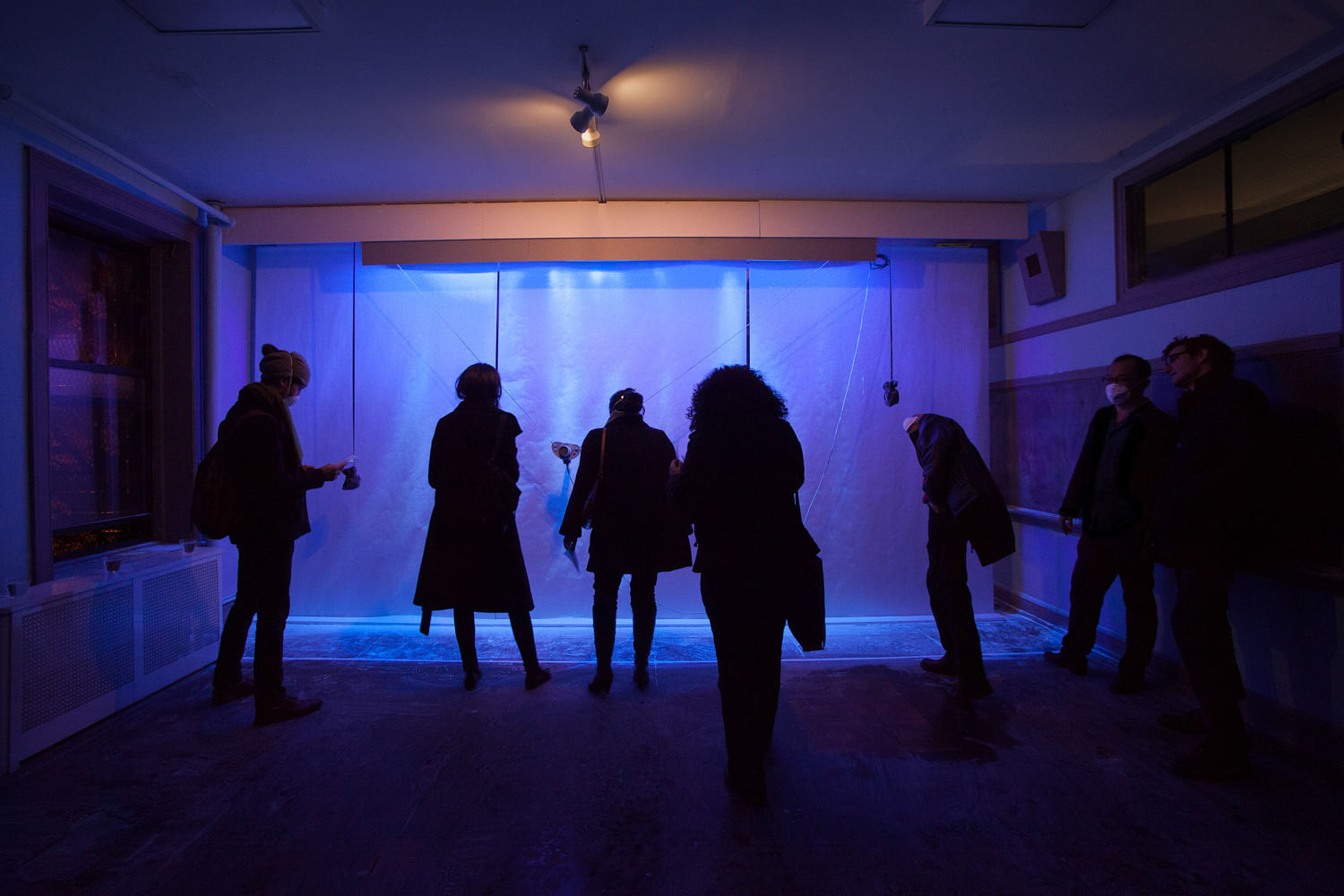
Photo: Brett Beyer

"The drawings were based on the level of contaminant--asbestos, silica, or gypsum--in the captured air samples, exhibited in glass bell jars. The bell jars contained air from the Environmental Protection Agency’s post-Sandy monitor locations; either 'clean' outdoor air or 'dirty' indoor air from buildings."
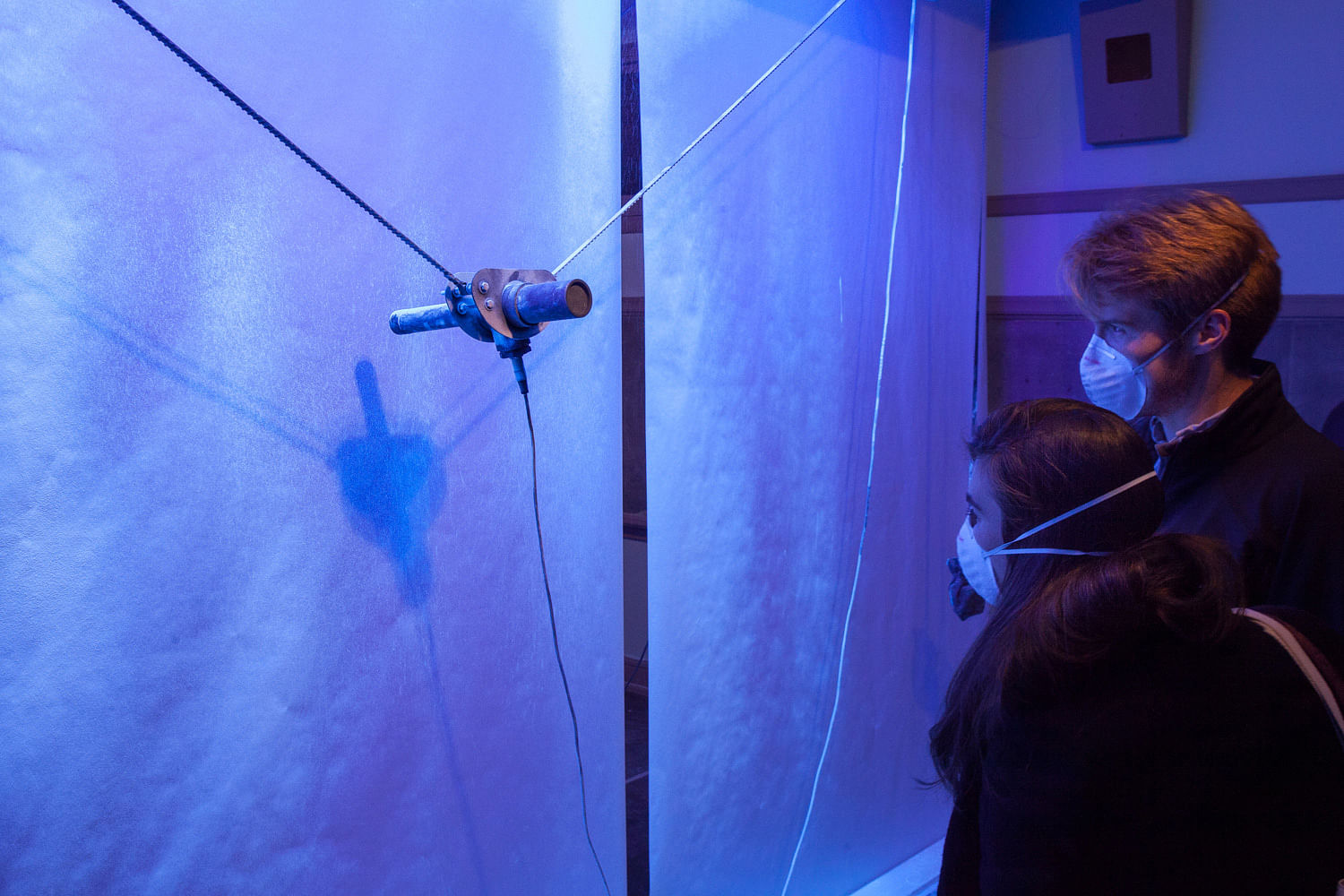
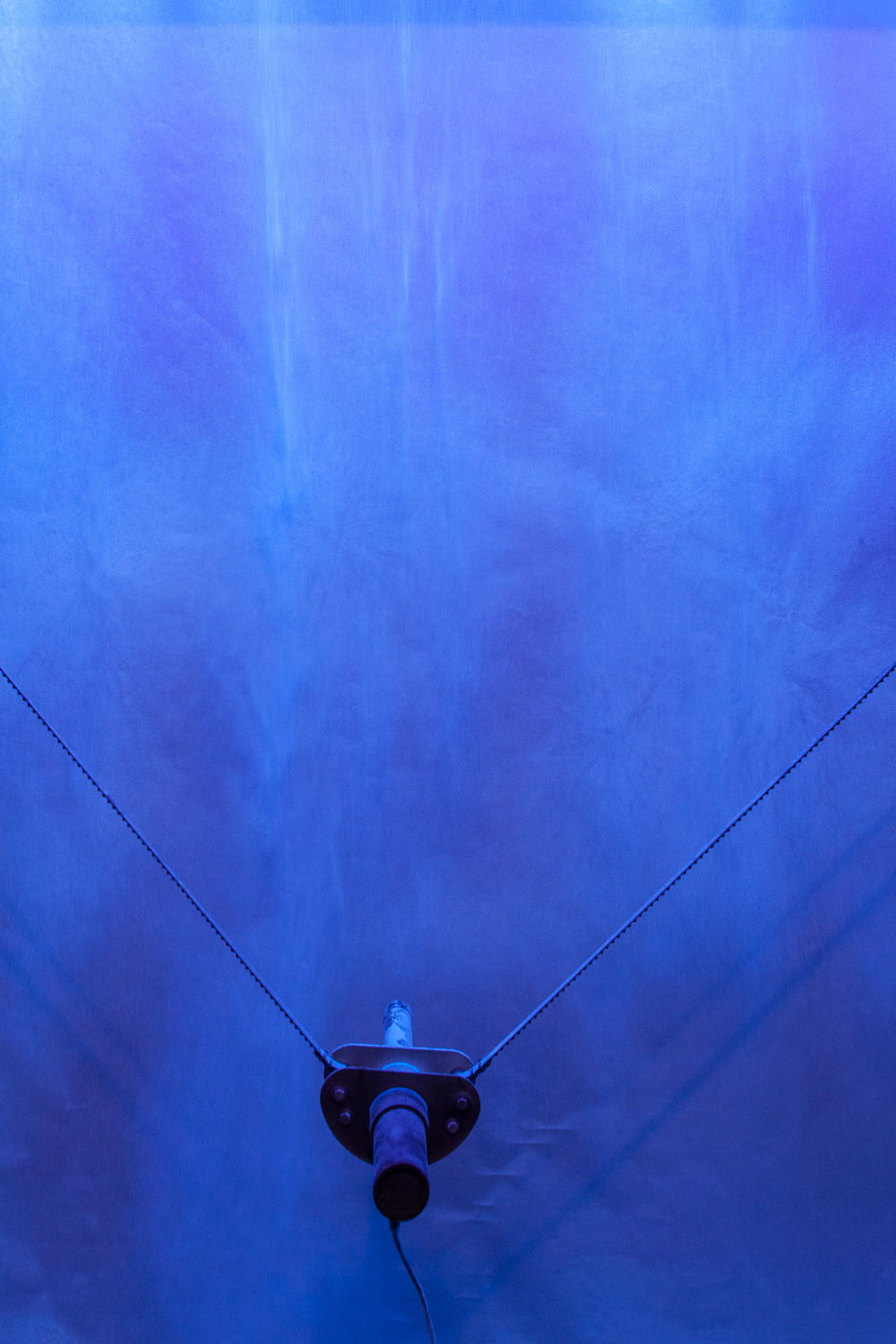
Photo: Brett Beyer
Photo: Brett Beyer

"Instead of drawing with ink, the robotic plotter on one side of the wall discharged invisible positive ions to attract the falling dust; the other plotter used negative ions to clean the wall. The negative ions in the 'clean room' passed through the wall, causing more dust to gather in the 'dirty room.'"

Photo: MODU

"Weather (Un)Control revealed the cyclical and invisible nature of air contamination after extreme weather events, unseen and overlooked by   insurance companies that stake claim to our indoor 'air rights.'"

Photo: Brett Beyer

The research and images from the exhibition are now on display at the Bi-City Bienniale of Urbanism/Architecture in Shenzhen, China.

Engineering for the project was developed by Amanda Parkes/Skinteractive Studio.

All images courtesy of MODU.

Similar MODU projects we've featured on Bustler include the "Outdoor Room" in Beijing and their Art Basel "Exhale" pavilion.

Related

usa ● post-hurricane sandy ● new york ● modu ● marfa dialogues ● living environment ● invisible ● indoor ● hurricane sandy ● environmental issues ● contaminants ● air quality

Share

  • Follow

    0 Comments

  • Comment as :

MODU's "Weather (Un)Control" exhibition explores the post-Sandy indoor air environment

Best in urban planning recognized at AIA Regional & Urban Design Award 2026

Sponsored Post by Buildner

Re:Form - New Life for Old Spaces / Edition #3 advance registration deadline is approaching!

New architecture and design competitions: IDEAS Awards, UIA-HYP CUP International Student Competition, Vancouver Tall Challenge, and Memorial to the Sixth Extinction

Best small projects chosen at AIA Small Project Award 2026

10 standout sustainable projects honored at AIA COTE Top Ten Award 2026

Best residential architecture of 2026 honored at AIA Housing Award

Best new interiors of 2026 chosen at AIA Interior Architecture Awards

Best global architecture honored at RIBA International Awards 2026

Sign up for Bustler's Email Newsletters

World’s most beautiful airports of 2026 chosen by Prix Versailles

New architecture and design competitions: Brick in Architecture Awards, Study Architecture Student Showcase, N.Y.C. Groceries, and New York High Falls Riverfront Market

SmithGroup’s ‘pioneering’ Philip Merrill Environmental Center wins AIA Twenty-five Year Award

Sponsored Post by Buildner

Museum of Emotions / Edition #8 FINAL registration deadline is in 5 DAYS!

Here are the winners of the 2026 AIA Architecture Awards

40 emerging architects and designers under 40 from Europe honored

Northwestern University selects 12-firm longlist to design new engineering building

Next page » Loading

MODU's "Weather (Un)Control" exhibition explores the post-Sandy indoor air environment

By Bustler Editors|

Thursday, Dec 12, 2013

Share

"Weather (Un)control" by MODU. Photo: Brett Beyer

Related

usa ● post-hurricane sandy ● new york ● modu ● marfa dialogues ● living environment ● invisible ● indoor ● hurricane sandy ● environmental issues ● contaminants ● air quality

As America's East Coast continues to recover from Hurricane Sandy, MODU's recently completed "Weather (Un)control" exhibition of the Marfa Dialogues/NY highlights an overlooked issue of the storm's aftermath that still remains: the invisible contaminants in indoor air.

The installation features drawings made from artificial dust and static electricity to address the current shortsighted methods for indoor air quality inspection and a "right" to better indoor air.

Weather (Un)Control with Storefront for Art and Architecture for Marfa Dialogues/NY from MODU on Vimeo.

Project description:

"The installation included an indoor weather system generated by two forms of air contamination: dust and static electricity. The project was a timely exploration of the invisible contaminants that fill indoor air long after the weather clears. This invisibly contaminated air, which goes unmeasured by the insurance companies charged with inspecting affected sites, recasts the term 'air rights' as an interior issue."

Photo: Brett Beyer

"Ten percent of New York City buildings sustained storm damage during  Hurricane Sandy. While billions of dollars were spent on the recovery effort, the storm’s invisible effects still linger in the air. Health risks in the indoor air of buildings—in the form of mold and dust—are beyond the reach of health officials, who rely mostly on outdoor air monitors."

Photo: Brett Beyer

"Dust in Sandy- affected buildings—including asbestos, silica, and gypsum—was produced not only by storm damage but, even more substantially, by the rebuilding that has followed. It remains in the air a year later. Weather (Un)Control presented a 'dust wall' that used two robotic plotters to create ephemeral drawings made of static electricity and artificial dust."

Photo: Brett Beyer

"Since there are no government agencies monitoring indoor air quality, oversight has been left to the insurance companies that determine access to indoor 'air rights.' Rather than conduct air quality tests, the insurance industry relies on visual inspections to measure air contamination as well as determine insurance risk. Weather (Un)Control highlighted the inefficiency of these visual inspections with 'dust wall' drawings that remained invisible unless lit with ultraviolet light."

Photo: Brett Beyer

"The drawings were based on the level of contaminant--asbestos, silica, or gypsum--in the captured air samples, exhibited in glass bell jars. The bell jars contained air from the Environmental Protection Agency’s post-Sandy monitor locations; either 'clean' outdoor air or 'dirty' indoor air from buildings."

Photo: Brett Beyer
Photo: Brett Beyer

"Instead of drawing with ink, the robotic plotter on one side of the wall discharged invisible positive ions to attract the falling dust; the other plotter used negative ions to clean the wall. The negative ions in the 'clean room' passed through the wall, causing more dust to gather in the 'dirty room.'"

Photo: MODU

"Weather (Un)Control revealed the cyclical and invisible nature of air contamination after extreme weather events, unseen and overlooked by   insurance companies that stake claim to our indoor 'air rights.'"

Photo: Brett Beyer

The research and images from the exhibition are now on display at the Bi-City Bienniale of Urbanism/Architecture in Shenzhen, China.

Engineering for the project was developed by Amanda Parkes/Skinteractive Studio.

All images courtesy of MODU.

Similar MODU projects we've featured on Bustler include the "Outdoor Room" in Beijing and their Art Basel "Exhale" pavilion.

Share

  • Follow

    0 Comments

  • Comment as :

Archinect JobsArchinect Jobs

The Archinect Job Board attracts the world's top architectural design talents.

VIEW ALL JOBS POST A JOB

Architectural Project Manager - Residential

DAHLIN Architecture | Planning | Interiors

Architectural Project Manager - Residential

Pleasanton, CA, US

Job Captain / Designer

Heather Young Architects

Job Captain / Designer

Palo Alto, CA, US

Marketing and Architectural Assistant

AGENCIE / Architecture & Engineering

Marketing and Architectural Assistant

New York, NY, US

Design Director or Sr. Architect

b.hills architecture, P.C.

Design Director or Sr. Architect

Boise, ID, US

Landscape Architect

EDR - Environmental Design & Research

Landscape Architect

Syracuse, NY, US

Architectural Designer

7th Street Burger

Architectural Designer

New York, NY, US

Intermediate Designer

Rafael Viñoly Architects

Intermediate Designer

New York, NY, US

Job Captain - Education

DAHLIN Architecture | Planning | Interiors

Job Captain - Education

San Diego, CA, US

Architectural Designer (5-7 Years) - Commercial & Hospitality Focus

Pfeffer Torode Architecture

Architectural Designer (5-7 Years) - Commercial & Hospitality Focus

Nashville, TN, US

Architectural/Structural Drafter

New Beginnings Engineering

Architectural/Structural Drafter

Irvine, CA, US

Next page » Loading