• Login / Join
  • About
  • •
  • Contact
  • •
  • Advertising
bustler logo
bustler logo
  • News
  • Competitions
  • Events
  • Bustler is powered by Archinect
  • Sign up for Bustler's Email Newsletters

  • Follow these Bustler feeds:

  • Search

    Search in

  • Submit

    What are you submitting?

    News Pitch
    Competition
    Event
  • Login / Join
  • News|Competitions|Events
  • Search
    | Submit
    | Follow
  • Search in

    What are you submitting?

    News Pitch
    Competition
    Event

    Follow these Bustler feeds:

  • About|Contact|Advertising
  • Login / Join

REX's Proposal for the Munch Area Competition in Oslo

By Bustler Editors|

Friday, Apr 3, 2009

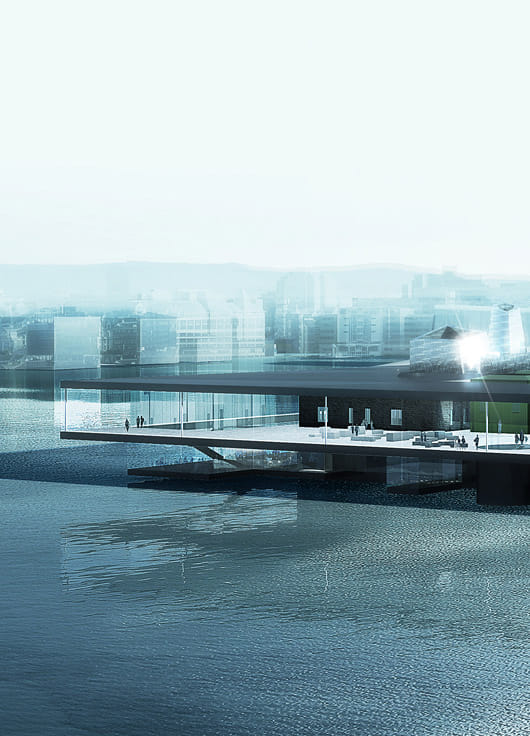
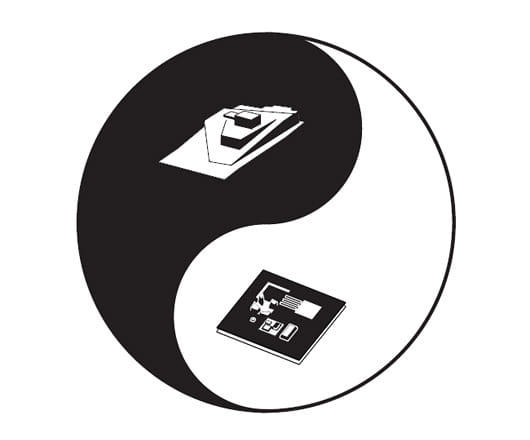
Last week, Bustler reported on the winners of the international competition for the new Munch Area in Oslo’s waterfront neighborhood Bjørvika. The proposal “Yin Yang” by New York-based architecture firm REX won the second prize in this competition (together with the proposal “Girls on the Bridge” by Christ & Gantenbein, Switzerland and Lie Øyen Arkitekter, Norway).

Here’s a closer look at REX’s concept for “Yin Yang”:
image

2nd prize winner in Oslo: the proposal “Yin Yang” by REX

MUNCH MUSEUM AND STENERSEN MUSEUM COLLECTIONS
Oslo, Norway

CLIENT HAV Eiendom, Oslo Kommune
PROGRAM Art museum housing the Munch and Stenersen Collections, self-produced exhibitions, and travelling exhibitions
AREA 16,585 m² (178,520 sf)
PROJECT COST NA
STATUS Limited competition, second prize, 2009
ARCHITECT REX
KEY PERSONNEL Lee Altman, Haviland Argo, Gabrielle Brainard, Keith Burns, Alex Diez, Jeffrey Franklin, Javier Haddad, David Menicovich, Joshua Prince-Ramus, Jacob Reidel
CONSULTANTS José Miguel Iribas, Lord, Magnusson Klemencic, Transsolar
image

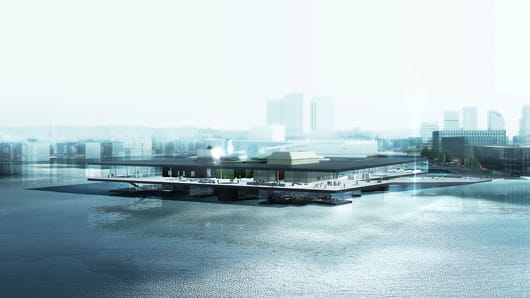
Daytime Rendering

image

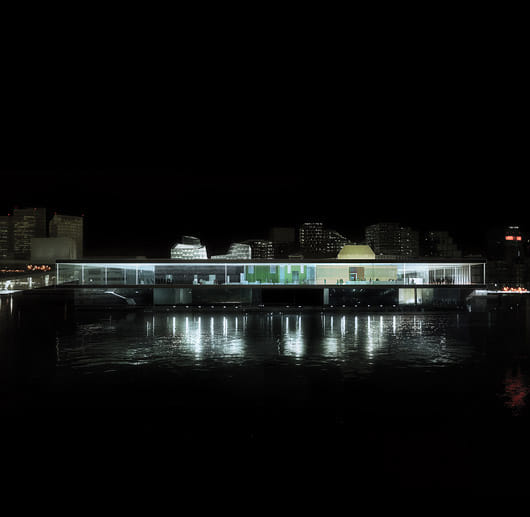
Nighttime Rendering

Oslo recently celebrated the opening of its world-acclaimed Opera House, an important step in the city’s commitment to developing Bjørvika and to unifying Oslo’s eastern and western centres. With four more significant projects under development within the district—Oslo Central Station, the Barcode, the Deichman Axis and the Munch Area—Oslo must be wary of overwhelming Bjørvika with too many strong visual landmarks. Such a constellation would undermine the Opera’s iconographic power, and dilute the identity of the city as a whole.
image

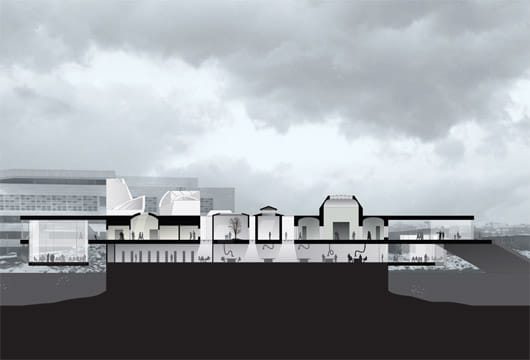
The skylight and glass floor in the Munch Studios Gallery allow natural light into the administration rooms and the painting, paper, and sculpture studios.

image

To best complement the Opera, the Munch Museum should forge a new kind of iconography—one based on innovative building performance, not signature form—to command a significant place within Oslo’s mental landscape. Where the Opera is strong, REX’s “Yin Yang” proposal for the new Munch Museum is strategic, establishing itself as a worthy counterpart by radically addressing two cardinal challenges facing contemporary museum design.
image

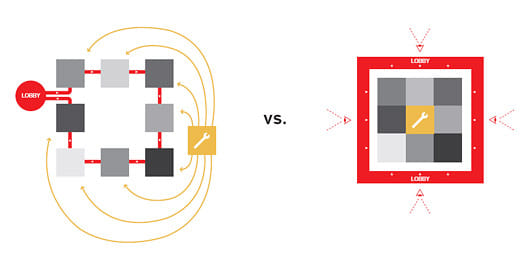
Challenge 1: The new Munch Museum demands its galleries to be extremely flexible. They must accommodate all types of artistic idioms, to grow or shrink in accord with the number and size of temporary exhibitions, to be intimate or majestic, sky-lit or blacked out, permeable or soundproof. Contemporary museum flexibility is typically conceived as generic white boxes—a blank slate—in which any exhibition format can be constructed. In practice however, as artistic media grow more diverse and museum operational budgets become more limited, a blank slate becomes constrictive: museums can not afford to endlessly transform their generic galleries. The result is not freedom, but imprisonment within a white box.

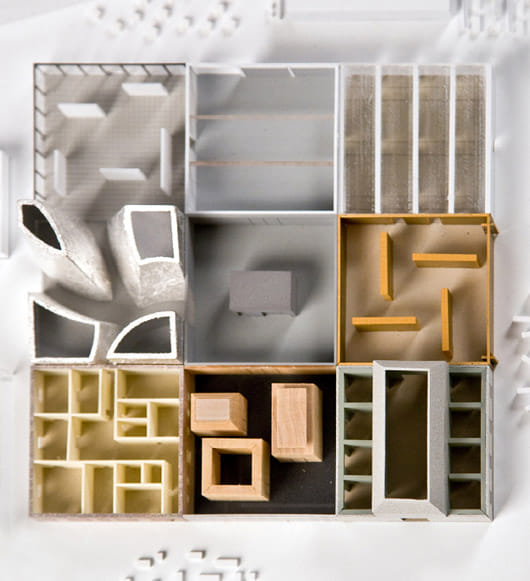
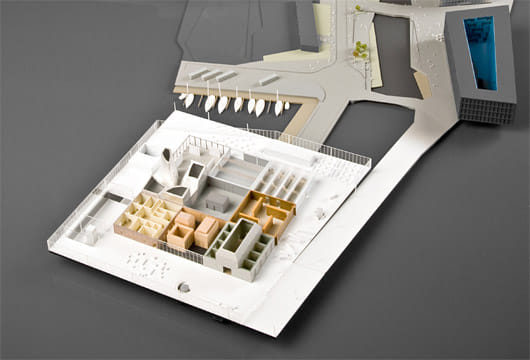
Strategy 1: By embracing a new form of gallery flexibility, REX’s proposal for the new Munch Museum avoids this trap. Yin Yang offers complete flexibility—without increasing operational costs—by providing built-in tools. The galleries are arranged into an array of eight, distinct typologies, each with its own proportions, materiality, lighting, circulation and form of flexibility. While a museum with a single gallery type requires great expense to transform itself, the array’s range of galleries guarantees curatorial freedom regardless of budgetary constraints. It can accommodate a spectrum of curatorial visions and can be reconfigured, both with no future additional cost.
image

Manifested as a flexible array of distinct gallery types surrounded by a ring of public circulation, Yin Yang asserts a unique, performance-driven presence in Bjørvika while still deferring to the new Opera’s iconic power.

Challenge 2: The new Munch Museum requires a flexible circulation sequence capable of individually or simultaneously presenting the museum’s own collections, self-produced exhibitions and travelling exhibitions. The classic museum procession is a lobby that begins and ends a linear loop of galleries. This compulsory circulation causes major curatorial and operational problems for the institutions it organizes: they must use all their galleries at once and cannot easily subdivide their space for simultaneous shows. Institutions with this sequence have to continuously “feed the beast,” exhibiting blockbuster after blockbuster, and must support staffs capable of managing shows this size.

Strategy 2: The REX proposal for the new Munch Museum wraps all un-ticketed spaces into a public “ring” around the galleries. Rather than imposing a fixed procession on curators and patrons, this organization provides independent access to each gallery, or a procession through any plausible combination or permutation of galleries. The public ring—including shops, lecture hall, auditorium, café, restaurant, education spaces and sponsors lounges—doubles as the main circulation for the galleries, fostering new, dynamic relationships between the two and increasing area efficiency.
image

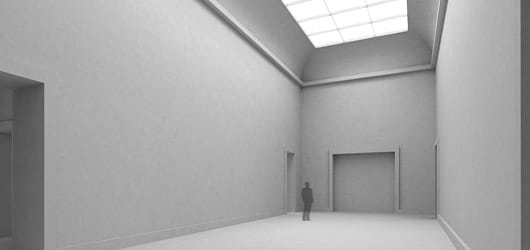
The walls of the Classical Gallery’s central hall are designed high enough to exhibit monumental works, such as Munch’s The Sun, Alma Mater, and The Human Mountain. Similarly, its floor is designed to display Munch’s delicate, oversized sketches that are too fragile to mount on stretchers. The Classical Gallery is closest to the main entrance, and if desired, can serve as the entrée to Munch’s work.

image

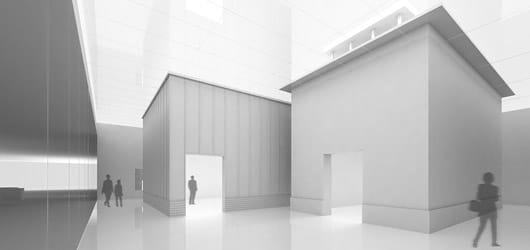
Three pavilions are based upon Munch’s studios at Ekely, Norway, and both the interiors and exteriors of the pavilions can be used for art display. One pavilion is open to the sky to simulate Munch’s outdoor painting studio. The glass floor around the pavilions provides sunlight to the administration rooms and the painting, paper, and sculpture studios below.

image

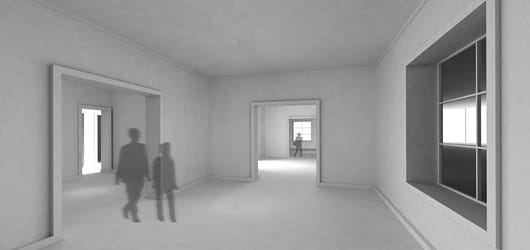
Following in the tradition of the house museum and the private collection (and in contrast to the Classical Gallery), the Villa Gallery provides space to display art in an intimate, domestic setting.

image

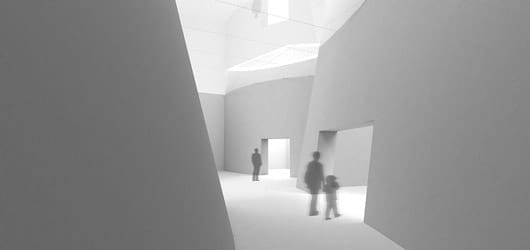
The unusual forms of the Shaped Gallery provide a foil with which—and against which—exhibitions and artworks can interact, similar to the spiral gallery of the Solomon R. Guggenheim Museum in New York.

image

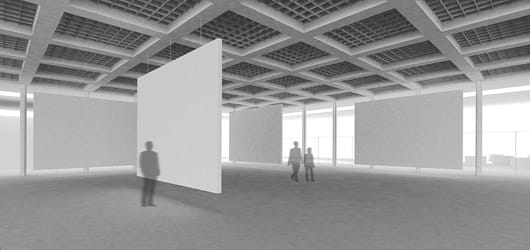
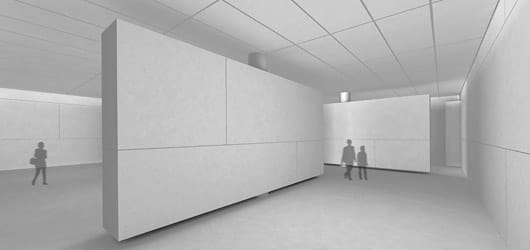
The Universal Gallery is one of three “Reconfigurable Galleries” in the array, utilizing a system of ceiling-mounted, movable panels for conventional art display. The ceiling grid is designed to hang large, heavy pieces of art as well.

image

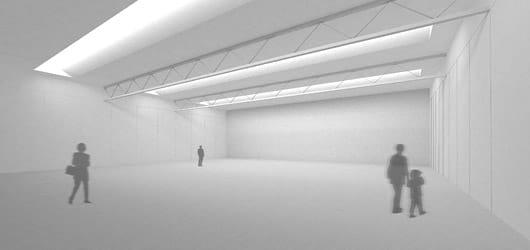
The White Box Gallery provides a dedicated space that can accommodate large contemporary works of art. In the event that an even larger gallery is needed, the panelized side walls of the White Box Gallery can be easily stored within the installation room. This opens the White Box to the adjoining Universal Gallery and Accordion Gallery to create a contiguous 1,540 m² space—equivalent to the largest gallery spaces at many of the world’s leading museums. If desired, roll-down shutter doors open one side of the gallery entirely to the public ring.

image

The Accordion Gallery—the second of three “Reconfigurable Galleries”—is equipped with walls which can be moved laterally to create spaces of differing widths, a classical enfilade, or a large open room.

image

The third “Reconfigurable Gallery” is the Rotating Gallery, whose four walls can easily swivel to allow for rapid rearrangement.

image

By creating a flexible array of distinct gallery types and surrounding them with a ring of public circulation, Yin Yang asserts a unique, performance-driven presence in Bjørvika while still deferring to the new Opera’s iconographic power.

image

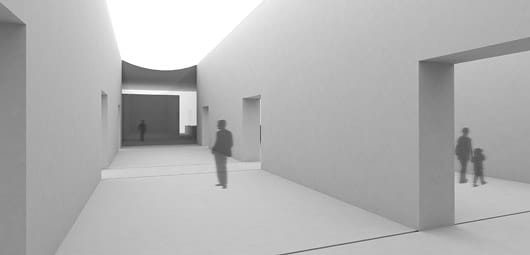
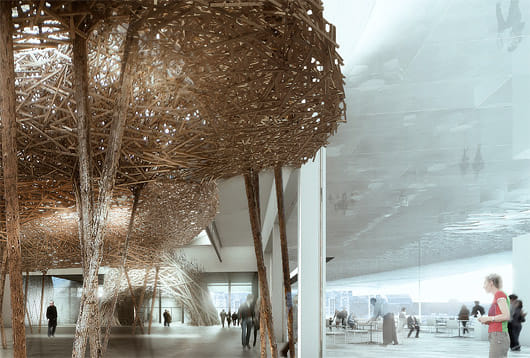
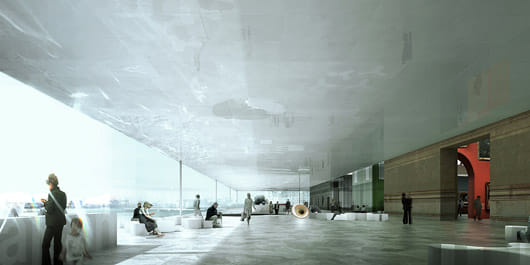
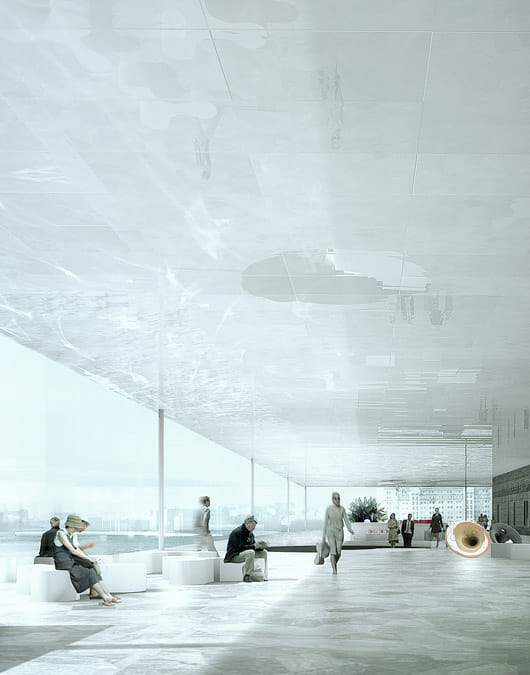
In the spirit of the Louisiana Museum of Modern Art in Humlebæk, Denmark, the public ring provides moments of repose with views to the fjord and city, and spaces adjacent to the galleries for the display of less sensitive artworks.

image

Close up of the lobby ring

image

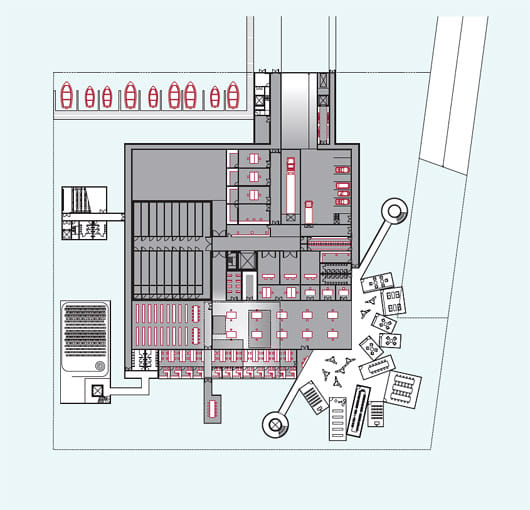
Ground Level

image

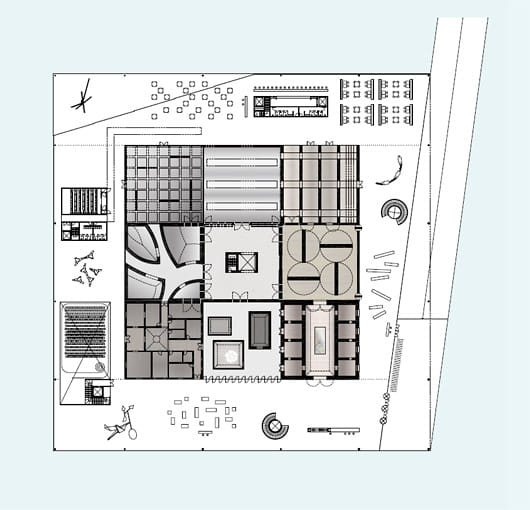
Level 1

image

Transition from the lobby ring to the galleries

image

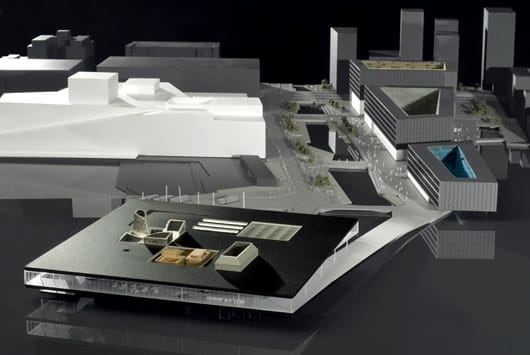
Overall Model Shot

image

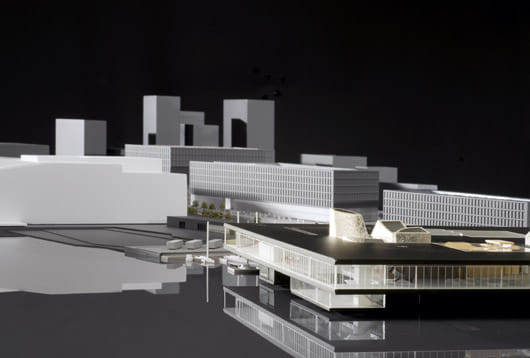
Model View to Commons

image

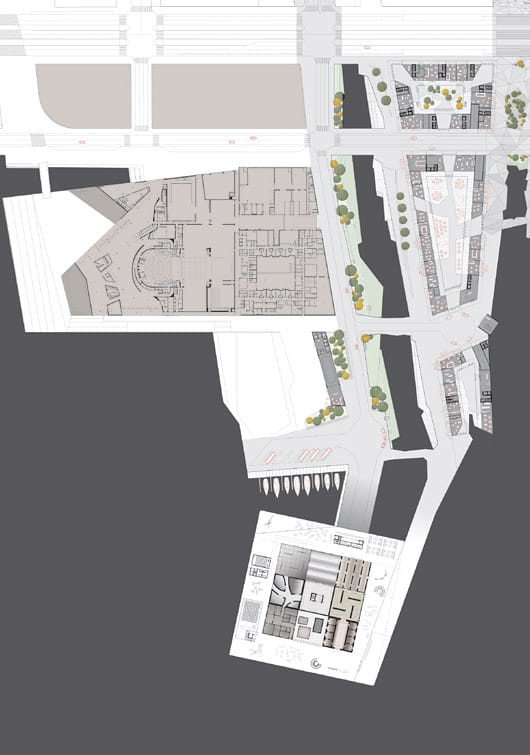
Munch Area Master Plan

image

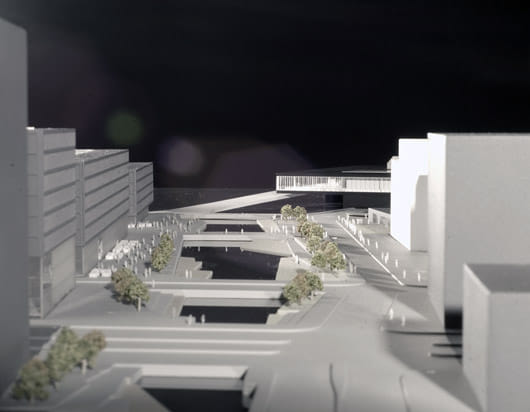
Similar to the proposed design of the Munch Museum, the three courtyard buildings use strategy—not signature form—to make a lasting, positive mark on their environs. Seemingly just three, simple, contemporary versions of Oslo’s urban fabric stepping down toward the water, they harbor secret gardens that stitch together the Aker River Commons and the Station Commons.

image

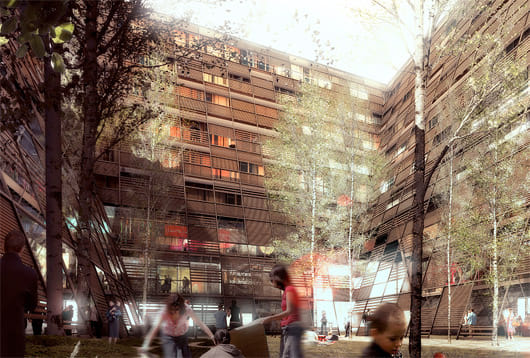
Each garden is distinct, aligned to the program of its container. The housing block contains a forest; the business center contains a piazza; and the hotel block contains a rustic seafront. Coincidentally, their contents also reference Oslo’s expression, “The blue and the green and the city in between.” The courtyard of the housing block contains a forest.

Images: REX

Related

usa ● stenersen ● rex ● oslo ● norway ● new york ● museum ● munch ● europe

Share

  • Follow

    0 Comments

  • Comment as :

REX's Proposal for the Munch Area Competition in Oslo

Northwestern University selects 12-firm longlist to design new engineering building

New architecture and design competitions: Exploring 130 Years of American Design, Christo & Jeanne-Claude Center, 13 White Houses, and La Pyramide

Micro-architecture honored in latest Tiny House Architecture Competition

World’s most beautiful restaurants of 2026 chosen by Prix Versailles

Sponsored Post by Buildner

Design a wine tasting room in Italy! Valli Wine Tasting Room is launched!

10 can't-miss architecture & design events to see this June in London, Los Angeles, Chicago, San Francisco, Detroit, San Diego, Porto, and Barcelona

Sponsored Post by Buildner

Museum of Emotions / Edition #8 FINAL registration deadline is approaching!

Seven global projects make AR Public Awards shortlist 2026

Sign up for Bustler's Email Newsletters

Sponsored Post by Buildner

Design a slow-living restaurant in Portugal! Portugal Long Table Restaurant is launched!

World's best tall buildings honored at the CVU 2026 Award of Excellence

Sponsored Post by TWOPAGES

Final call: TWOPAGES X Design Contest 2026 submissions close June 5

Kengo Kuma & Paul Raff win Alberta national park visitor center competition with landscape-focused design

2026 Moira Gemmill and MJ Long prizes announced by W Awards

New architecture and design competitions: Kinderspace, Stewardson Keefe LeBrun Travel Grant, SMALL PROJECT BIG IMPACT, and Garden of University House, Bucharest

The Century of Gehry: New retrospective explores the late architect's work & collaborations

Next page » Loading

REX's Proposal for the Munch Area Competition in Oslo

By Bustler Editors|

Friday, Apr 3, 2009

Share

Related

usa ● stenersen ● rex ● oslo ● norway ● new york ● museum ● munch ● europe

Last week, Bustler reported on the winners of the international competition for the new Munch Area in Oslo’s waterfront neighborhood Bjørvika. The proposal “Yin Yang” by New York-based architecture firm REX won the second prize in this competition (together with the proposal “Girls on the Bridge” by Christ & Gantenbein, Switzerland and Lie Øyen Arkitekter, Norway).

Here’s a closer look at REX’s concept for “Yin Yang”:

image

2nd prize winner in Oslo: the proposal “Yin Yang” by REX

MUNCH MUSEUM AND STENERSEN MUSEUM COLLECTIONS
Oslo, Norway

CLIENT HAV Eiendom, Oslo Kommune
PROGRAM Art museum housing the Munch and Stenersen Collections, self-produced exhibitions, and travelling exhibitions
AREA 16,585 m² (178,520 sf)
PROJECT COST NA
STATUS Limited competition, second prize, 2009
ARCHITECT REX
KEY PERSONNEL Lee Altman, Haviland Argo, Gabrielle Brainard, Keith Burns, Alex Diez, Jeffrey Franklin, Javier Haddad, David Menicovich, Joshua Prince-Ramus, Jacob Reidel
CONSULTANTS José Miguel Iribas, Lord, Magnusson Klemencic, Transsolar

image

Daytime Rendering

image

Nighttime Rendering

Oslo recently celebrated the opening of its world-acclaimed Opera House, an important step in the city’s commitment to developing Bjørvika and to unifying Oslo’s eastern and western centres. With four more significant projects under development within the district—Oslo Central Station, the Barcode, the Deichman Axis and the Munch Area—Oslo must be wary of overwhelming Bjørvika with too many strong visual landmarks. Such a constellation would undermine the Opera’s iconographic power, and dilute the identity of the city as a whole.

image

The skylight and glass floor in the Munch Studios Gallery allow natural light into the administration rooms and the painting, paper, and sculpture studios.

image

To best complement the Opera, the Munch Museum should forge a new kind of iconography—one based on innovative building performance, not signature form—to command a significant place within Oslo’s mental landscape. Where the Opera is strong, REX’s “Yin Yang” proposal for the new Munch Museum is strategic, establishing itself as a worthy counterpart by radically addressing two cardinal challenges facing contemporary museum design.

image

Challenge 1: The new Munch Museum demands its galleries to be extremely flexible. They must accommodate all types of artistic idioms, to grow or shrink in accord with the number and size of temporary exhibitions, to be intimate or majestic, sky-lit or blacked out, permeable or soundproof. Contemporary museum flexibility is typically conceived as generic white boxes—a blank slate—in which any exhibition format can be constructed. In practice however, as artistic media grow more diverse and museum operational budgets become more limited, a blank slate becomes constrictive: museums can not afford to endlessly transform their generic galleries. The result is not freedom, but imprisonment within a white box.

Strategy 1: By embracing a new form of gallery flexibility, REX’s proposal for the new Munch Museum avoids this trap. Yin Yang offers complete flexibility—without increasing operational costs—by providing built-in tools. The galleries are arranged into an array of eight, distinct typologies, each with its own proportions, materiality, lighting, circulation and form of flexibility. While a museum with a single gallery type requires great expense to transform itself, the array’s range of galleries guarantees curatorial freedom regardless of budgetary constraints. It can accommodate a spectrum of curatorial visions and can be reconfigured, both with no future additional cost.

image

Manifested as a flexible array of distinct gallery types surrounded by a ring of public circulation, Yin Yang asserts a unique, performance-driven presence in Bjørvika while still deferring to the new Opera’s iconic power.

Challenge 2: The new Munch Museum requires a flexible circulation sequence capable of individually or simultaneously presenting the museum’s own collections, self-produced exhibitions and travelling exhibitions. The classic museum procession is a lobby that begins and ends a linear loop of galleries. This compulsory circulation causes major curatorial and operational problems for the institutions it organizes: they must use all their galleries at once and cannot easily subdivide their space for simultaneous shows. Institutions with this sequence have to continuously “feed the beast,” exhibiting blockbuster after blockbuster, and must support staffs capable of managing shows this size.

Strategy 2: The REX proposal for the new Munch Museum wraps all un-ticketed spaces into a public “ring” around the galleries. Rather than imposing a fixed procession on curators and patrons, this organization provides independent access to each gallery, or a procession through any plausible combination or permutation of galleries. The public ring—including shops, lecture hall, auditorium, café, restaurant, education spaces and sponsors lounges—doubles as the main circulation for the galleries, fostering new, dynamic relationships between the two and increasing area efficiency.
image

The walls of the Classical Gallery’s central hall are designed high enough to exhibit monumental works, such as Munch’s The Sun, Alma Mater, and The Human Mountain. Similarly, its floor is designed to display Munch’s delicate, oversized sketches that are too fragile to mount on stretchers. The Classical Gallery is closest to the main entrance, and if desired, can serve as the entrée to Munch’s work.

image

Three pavilions are based upon Munch’s studios at Ekely, Norway, and both the interiors and exteriors of the pavilions can be used for art display. One pavilion is open to the sky to simulate Munch’s outdoor painting studio. The glass floor around the pavilions provides sunlight to the administration rooms and the painting, paper, and sculpture studios below.

image

Following in the tradition of the house museum and the private collection (and in contrast to the Classical Gallery), the Villa Gallery provides space to display art in an intimate, domestic setting.

image

The unusual forms of the Shaped Gallery provide a foil with which—and against which—exhibitions and artworks can interact, similar to the spiral gallery of the Solomon R. Guggenheim Museum in New York.

image

The Universal Gallery is one of three “Reconfigurable Galleries” in the array, utilizing a system of ceiling-mounted, movable panels for conventional art display. The ceiling grid is designed to hang large, heavy pieces of art as well.

image

The White Box Gallery provides a dedicated space that can accommodate large contemporary works of art. In the event that an even larger gallery is needed, the panelized side walls of the White Box Gallery can be easily stored within the installation room. This opens the White Box to the adjoining Universal Gallery and Accordion Gallery to create a contiguous 1,540 m² space—equivalent to the largest gallery spaces at many of the world’s leading museums. If desired, roll-down shutter doors open one side of the gallery entirely to the public ring.

image

The Accordion Gallery—the second of three “Reconfigurable Galleries”—is equipped with walls which can be moved laterally to create spaces of differing widths, a classical enfilade, or a large open room.

image

The third “Reconfigurable Gallery” is the Rotating Gallery, whose four walls can easily swivel to allow for rapid rearrangement.

image

By creating a flexible array of distinct gallery types and surrounding them with a ring of public circulation, Yin Yang asserts a unique, performance-driven presence in Bjørvika while still deferring to the new Opera’s iconographic power.
image

In the spirit of the Louisiana Museum of Modern Art in Humlebæk, Denmark, the public ring provides moments of repose with views to the fjord and city, and spaces adjacent to the galleries for the display of less sensitive artworks.

image

Close up of the lobby ring

image

Ground Level

image

Level 1

image

Transition from the lobby ring to the galleries

image

Overall Model Shot

image

Model View to Commons

image

Munch Area Master Plan

image

Similar to the proposed design of the Munch Museum, the three courtyard buildings use strategy—not signature form—to make a lasting, positive mark on their environs. Seemingly just three, simple, contemporary versions of Oslo’s urban fabric stepping down toward the water, they harbor secret gardens that stitch together the Aker River Commons and the Station Commons.

image

Each garden is distinct, aligned to the program of its container. The housing block contains a forest; the business center contains a piazza; and the hotel block contains a rustic seafront. Coincidentally, their contents also reference Oslo’s expression, “The blue and the green and the city in between.” The courtyard of the housing block contains a forest.

Images: REX

Share

  • Follow

    0 Comments

  • Comment as :

Archinect JobsArchinect Jobs

The Archinect Job Board attracts the world's top architectural design talents.

VIEW ALL JOBS POST A JOB

Architect / Urban Designer

Office for the Next Environment (OFTN)

Architect / Urban Designer

New York, NY, US

Senior Project Architect

Breland – Harper

Senior Project Architect

Los Angeles, CA, US

Architect

mani colaku architects

Architect

New York, NY, US

Project Architect

Lang Architecture

Project Architect

New York, NY, US

Project Designer (3 to 5 years)

Swift Lee Office

Project Designer (3 to 5 years)

Los Angeles, CA, US

Architectural Designer

Build Block Inc.

Architectural Designer

Los Angeles, CA, US

Architect 10+

Standard Architects

Architect 10+

Long Island City, NY, US

Junior Architect / Architectural Designer

S20M

Junior Architect / Architectural Designer

New York, NY, US

Project Architect

Arrowstreet

Project Architect

Boston, MA, US

Architectural Designer II

Studio AR&D Architects

Architectural Designer II

Los Angeles, CA, US

Next page » Loading