• Login / Join
  • About
  • •
  • Contact
  • •
  • Advertising
bustler logo
bustler logo
  • News
  • Competitions
  • Events
  • Bustler is powered by Archinect
  • Sign up for Bustler's Email Newsletters

  • Follow these Bustler feeds:

  • Search

    Search in

  • Submit

    What are you submitting?

    News Pitch
    Competition
    Event
  • Login / Join
  • News|Competitions|Events
  • Search
    | Submit
    | Follow
  • Search in

    What are you submitting?

    News Pitch
    Competition
    Event

    Follow these Bustler feeds:

  • About|Contact|Advertising
  • Login / Join

National Museum of Afghanistan Entry by Matteo Cainer Architects

By Bustler Editors|

Tuesday, Oct 16, 2012

"Timeless Cube", entry for the National Museum of Afghanistan competition by Matteo Cainer Architects (Image: Matteo Cainer Architects)

Bustler recently published the winning projects of the National Museum of Afghanistan competition. Here is another museum entry we just received, the proposal "Timeless Cube" by Paris/London-based firm Matteo Cainer Architects.

Project Description from the Architects:

The construction of the Afghan museum celebrates the richness of Afghanistan’s cultural heritage and the spirit of its peoples. In a nation devastated by war, the wealth of its cultural background and the spirit of its peoples are embodied here. In spite of the years of conflict and turmoil, the underlying strengths of the country remain intact, embedded in the earth and rising from it.

Aerial approach (Image: Matteo Cainer Architects)

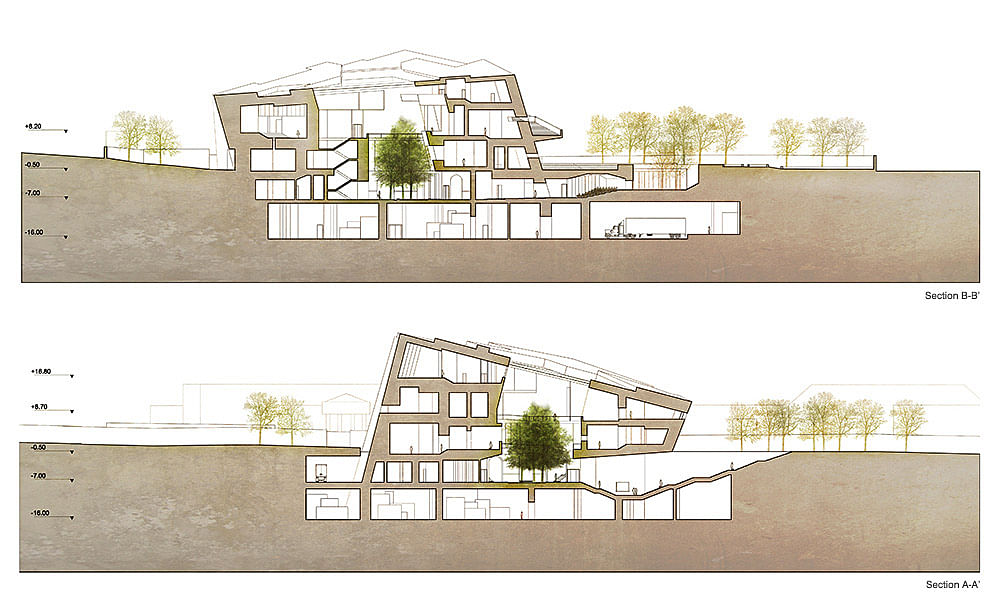
The new National Museum of Afghanistan awakens the nation’s cultural heritage through powerful symbolic references, where physical fragments and traces inform us of its past. This concept is well illustrated in the ‘negative spaces’ of the artist and sculptor Rachel Whiteread that highlight the memory of an object, rendering the invisible visible through a reversal of solid and void. Here this ‘absent presence’ is found in the day-lit foyer, a tranquil and serene space filled with water and greenery. Entering the main hall, each visitor defines their own experience of the museum, ascending the monumental stairs from the foyer at its heart, aware of the depth of knowledge expressed in the deep recesses of its masonry walls. 

Ground approach (Image: Matteo Cainer Architects)

If the façade acts as a reflection of our society today, then the monolithic walls embody our history and culture. As if hewn from solid stone, the galleries bring to mind the very origins of space and knowledge. Each of the country’s eight significant historic periods is represented in a dedicated space designed to house representative artefacts. A perambulation through this sequence of spaces unfolds a voyage of learning and discovery. Carved ramps and stairs overlook the foyer with the sequence of galleries unfolding in an intriguing and complex geometry. 

The new museum’s 56 metre square cube represents the significance of 7 and 8 in Islamic culture. There are seven verses in the Koran, here representing rebirth, and eight principal galleries in the program, the indeterminate open sky acting as a metaphor for the future.

Main entrance (Image: Matteo Cainer Architects)

The site geometries and composition define the garden setting with a series of water features designed to refresh the air during the summer months. The orientation and planning of the museum introduces cool, shady areas for outdoor promenades, and the landscaping strategy enhances on-site bio-diversity and shaded meeting areas. The museum's gardens respond to the intense climate of Kabul and include native grasses and indigenous plants. Landscaping includes a stepped garden with covered seating areas and additional dedicated spaces for the museum's educational programs, including tours, garden lectures and outdoor performances.

Interior foyer (Image: Matteo Cainer Architects)

A sustainable environmental concept determined the orientation, layout and design of the building envelope. The exposed concrete envelope introduces the required thermal mass, and the natural/displacement ventilation and highly efficient lighting systems reduces the overall energy consumption and provides a passive internal environment. Above the main foyer, digitally controlled external sunshades respond to protect the interior from the intense solar gain, reducing cooling loads internally. The orientation and inclination of the building allows controlled daylight internally with the potential for solar harvesting technology and a renewable energy supply. Internal heating and cooling is achieved through boreholes/earth tubes or crypt cooling, allowing air to circulate through large diameter underground pipes that discharge internal heat build-up via a stack. Materials are generally specified to be sourced and fabricated locally. 

Interior foyer (Image: Matteo Cainer Architects)

Efficient use is made of the rainfall and humidity in the winter months. The soft landscape acts as a filter to collect and store rainwater for irrigation and grey water use and the fragmented form of the envelope acts as a natural purifier that provides potable water for the complex.

A future extension to the museum is considered in the concept design and planning, so that additional storage areas and communicating spaces can be successfully added. An twinned volume extension to the existing building is envisaged, with visitors following a mirrored circulation route, descending through the galleries from above.

Bird's eye view, south (Image: Matteo Cainer Architects)

The Timeless Cube embodies the strength, pride and traditions of the Afghan people, providing visitors with better understanding of the country. The new landmark will be a stage for debate and reconciliation through an educational program that creatively engages people of all ages in traditional and non-traditional learning. The history, identity and traditions of its peoples will provide the bedrock for future generations to understand the culture of their forefathers and a unity in the region. 

Function diagram (Image: Matteo Cainer Architects)

Project Details:

Location: Kabul, Afghanistan
Client: Islamic Republic of Afghanistan/Ministry of Information and Culture
Program: Master planning, National Museum Complex
Area: 4,25 hectars/ 17,126 sqm Museum complex
Status of Project: Competition Entry
Architects: Matteo Cainer Architects Ltd

Find more plans and diagrams in the image gallery below.

Related

national museum of afghanistan ● museum ● middle east ● matteo cainer architects ● kabul ● afghanistan

Share

  • Follow

    0 Comments

  • Comment as :

National Museum of Afghanistan Entry by Matteo Cainer Architects

New architecture and design competitions: Exploring 130 Years of American Design, Christo & Jeanne-Claude Center, 13 White Houses, and La Pyramide

Micro-architecture honored in latest Tiny House Architecture Competition

World’s most beautiful restaurants of 2026 chosen by Prix Versailles

Sponsored Post by Buildner

Design a wine tasting room in Italy! Valli Wine Tasting Room is launched!

10 can't-miss architecture & design events to see this June in London, Los Angeles, Chicago, San Francisco, Detroit, San Diego, Porto, and Barcelona

Sponsored Post by Buildner

Museum of Emotions / Edition #8 FINAL registration deadline is approaching!

Seven global projects make AR Public Awards shortlist 2026

Sponsored Post by Buildner

Design a slow-living restaurant in Portugal! Portugal Long Table Restaurant is launched!

Sign up for Bustler's Email Newsletters

World's best tall buildings honored at the CVU 2026 Award of Excellence

Sponsored Post by TWOPAGES

Final call: TWOPAGES X Design Contest 2026 submissions close June 5

Kengo Kuma & Paul Raff win Alberta national park visitor center competition with landscape-focused design

2026 Moira Gemmill and MJ Long prizes announced by W Awards

New architecture and design competitions: Kinderspace, Stewardson Keefe LeBrun Travel Grant, SMALL PROJECT BIG IMPACT, and Garden of University House, Bucharest

The Century of Gehry: New retrospective explores the late architect's work & collaborations

Sponsored Post by Buildner

Rome Rain Rooms FINAL registration deadline is in 5 DAYS!

Next page » Loading

National Museum of Afghanistan Entry by Matteo Cainer Architects

By Bustler Editors|

Tuesday, Oct 16, 2012

Share

"Timeless Cube", entry for the National Museum of Afghanistan competition by Matteo Cainer Architects (Image: Matteo Cainer Architects)

Related

national museum of afghanistan ● museum ● middle east ● matteo cainer architects ● kabul ● afghanistan

Bustler recently published the winning projects of the National Museum of Afghanistan competition. Here is another museum entry we just received, the proposal "Timeless Cube" by Paris/London-based firm Matteo Cainer Architects.

Project Description from the Architects:

The construction of the Afghan museum celebrates the richness of Afghanistan’s cultural heritage and the spirit of its peoples. In a nation devastated by war, the wealth of its cultural background and the spirit of its peoples are embodied here. In spite of the years of conflict and turmoil, the underlying strengths of the country remain intact, embedded in the earth and rising from it.

Aerial approach (Image: Matteo Cainer Architects)

The new National Museum of Afghanistan awakens the nation’s cultural heritage through powerful symbolic references, where physical fragments and traces inform us of its past. This concept is well illustrated in the ‘negative spaces’ of the artist and sculptor Rachel Whiteread that highlight the memory of an object, rendering the invisible visible through a reversal of solid and void. Here this ‘absent presence’ is found in the day-lit foyer, a tranquil and serene space filled with water and greenery. Entering the main hall, each visitor defines their own experience of the museum, ascending the monumental stairs from the foyer at its heart, aware of the depth of knowledge expressed in the deep recesses of its masonry walls. 

Ground approach (Image: Matteo Cainer Architects)

If the façade acts as a reflection of our society today, then the monolithic walls embody our history and culture. As if hewn from solid stone, the galleries bring to mind the very origins of space and knowledge. Each of the country’s eight significant historic periods is represented in a dedicated space designed to house representative artefacts. A perambulation through this sequence of spaces unfolds a voyage of learning and discovery. Carved ramps and stairs overlook the foyer with the sequence of galleries unfolding in an intriguing and complex geometry. 

The new museum’s 56 metre square cube represents the significance of 7 and 8 in Islamic culture. There are seven verses in the Koran, here representing rebirth, and eight principal galleries in the program, the indeterminate open sky acting as a metaphor for the future.

Main entrance (Image: Matteo Cainer Architects)

The site geometries and composition define the garden setting with a series of water features designed to refresh the air during the summer months. The orientation and planning of the museum introduces cool, shady areas for outdoor promenades, and the landscaping strategy enhances on-site bio-diversity and shaded meeting areas. The museum's gardens respond to the intense climate of Kabul and include native grasses and indigenous plants. Landscaping includes a stepped garden with covered seating areas and additional dedicated spaces for the museum's educational programs, including tours, garden lectures and outdoor performances.

Interior foyer (Image: Matteo Cainer Architects)

A sustainable environmental concept determined the orientation, layout and design of the building envelope. The exposed concrete envelope introduces the required thermal mass, and the natural/displacement ventilation and highly efficient lighting systems reduces the overall energy consumption and provides a passive internal environment. Above the main foyer, digitally controlled external sunshades respond to protect the interior from the intense solar gain, reducing cooling loads internally. The orientation and inclination of the building allows controlled daylight internally with the potential for solar harvesting technology and a renewable energy supply. Internal heating and cooling is achieved through boreholes/earth tubes or crypt cooling, allowing air to circulate through large diameter underground pipes that discharge internal heat build-up via a stack. Materials are generally specified to be sourced and fabricated locally. 

Interior foyer (Image: Matteo Cainer Architects)

Efficient use is made of the rainfall and humidity in the winter months. The soft landscape acts as a filter to collect and store rainwater for irrigation and grey water use and the fragmented form of the envelope acts as a natural purifier that provides potable water for the complex.

A future extension to the museum is considered in the concept design and planning, so that additional storage areas and communicating spaces can be successfully added. An twinned volume extension to the existing building is envisaged, with visitors following a mirrored circulation route, descending through the galleries from above.

Bird's eye view, south (Image: Matteo Cainer Architects)

The Timeless Cube embodies the strength, pride and traditions of the Afghan people, providing visitors with better understanding of the country. The new landmark will be a stage for debate and reconciliation through an educational program that creatively engages people of all ages in traditional and non-traditional learning. The history, identity and traditions of its peoples will provide the bedrock for future generations to understand the culture of their forefathers and a unity in the region. 

Function diagram (Image: Matteo Cainer Architects)

Project Details:

Location: Kabul, Afghanistan
Client: Islamic Republic of Afghanistan/Ministry of Information and Culture
Program: Master planning, National Museum Complex
Area: 4,25 hectars/ 17,126 sqm Museum complex
Status of Project: Competition Entry
Architects: Matteo Cainer Architects Ltd

Find more plans and diagrams in the image gallery below.

Share

  • Follow

    0 Comments

  • Comment as :

Archinect JobsArchinect Jobs

The Archinect Job Board attracts the world's top architectural design talents.

VIEW ALL JOBS POST A JOB

Graduate Architect

RATIO Design

Graduate Architect

Chicago, IL, US

Intermediate Architect

FROM Architecture DPC

Intermediate Architect

New York, NY, US

Senior Architectural Project Manager (Systems Driven, Human-Centric) (Hourly)

Local Parti Architecture, PC

Senior Architectural Project Manager (Systems Driven, Human-Centric) (Hourly)

New York, NY, US

Project Architect

Westside Design

Project Architect

Santa Monica, CA, US

Office Assistant / Studio Coordinator

Beinfield Architecture PC

Office Assistant / Studio Coordinator

Norwalk, CT, US

Intermediate Designer - 3+ Years Experience (NY)

Cass Calder Smith

Intermediate Designer - 3+ Years Experience (NY)

New York, NY, US

Intermediate Architectural Designer

David Smotrich & Partners LLP

Intermediate Architectural Designer

New York, NY, US

Architectural Job Captain

Christopher Courts Inc.

Architectural Job Captain

Los Angeles, CA, US

Project Designer / Job Captain

Solutions Architecture Corp

Project Designer / Job Captain

Verona, NJ, US

Junior Architect

PRDG architecture + design

Junior Architect

New York, NY, US

Next page » Loading