• Login / Join
  • About
  • •
  • Contact
  • •
  • Advertising
bustler logo
bustler logo
  • News
  • Competitions
  • Events
  • Bustler is powered by Archinect
  • Sign up for Bustler's Email Newsletters

  • Follow these Bustler feeds:

  • Search

    Search in

  • Submit

    What are you submitting?

    News Pitch
    Competition
    Event
  • Login / Join
  • News|Competitions|Events
  • Search
    | Submit
    | Follow
  • Search in

    What are you submitting?

    News Pitch
    Competition
    Event

    Follow these Bustler feeds:

  • About|Contact|Advertising
  • Login / Join

Robin Hood Gardens Design Competition: The Results

By Bustler Editors|

Friday, Jun 27, 2008

Via Building Design

The top entries in BD and the Architecture Foundation’s ideas competition for Robin Hood Gardens show that inspired refurbishment of the estate can give it a new vibrancy while reaching the required density levels.

Tower Hamlets Council, which owns the estate, together with English Partnerships, propose to demolish the estate to make way for 3,000 new homes. This is on the grounds that not only are the Smithsons-designed blocks past saving, but residents also voted for demolition, although refurbishment has since been costed as the cheaper option.

Zoran Radivojevic’s winning scheme in our ideas competition shows how the buildings’ powerful urban form can easily withstand some quite radical intervention. And this idea — that the buildings can act as a fulcrum for further development — was a theme that ran through a number of the entries.
image
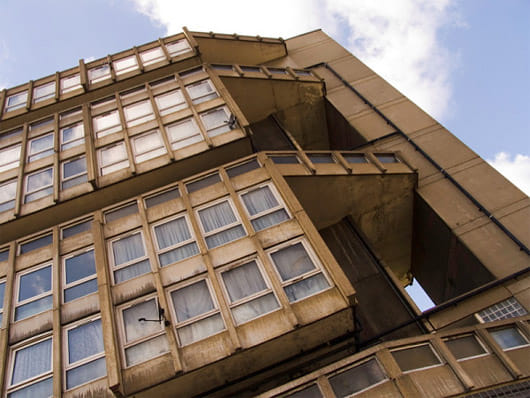
The blocks of Robin Hood Gardens today

But the contest raised other issues, namely that 20th century buildings are far more capable of sustaining radical intervention than those of the 19th and 20th centuries.

While many of the architects treated the two blocks with reverence, the more successful entries in the judges’ view were less nervous about cutting through the blocks to make them more permeable, or hanging additional structure off the facades to animate them and make the occupancy of the blocks more readable.

The competition also disapproves the claim by Tower Hamlets Council and English Partnerships that the buildings have to be demolished in order to achieve the required density levels.

A number of proposals added dwellings ranged east-west at the northern end of the site, or added housing to close both ends of the site and create more of a courtyard, minimising overlooking and maximising security.

One of the most obvious problems of the existing blocks is the failure of the Smithsons’ “streets in the sky”. The balconies are too narrow, and a number of entries proposed making them wider and greener — more hedges than streets.

Almost all the entries preserved the central green space, while the most convincing recognised that its function, as a kind of a green lung for the estate, should be allowed to spread or percolate through new residential blocks.

Finally, the entries makes a convincing argument that the estate’s problems are nothing to do with the architecture but are down to a lack of vision by its owners. This is why the judges liked the proposal to move the buildings to west London, putting it in an environment where, watched over by Goldfinger’s Trellick Tower, the equally iconic Robin Hood immediately feels more at home.


Winner: Zoran Radivojevic Cazenove Architects

image

The buildings are treated as giant carcasses that allow parts of the structure to be removed and new, lighter structures to be added. These extensions could house work studios or retail space. Some flats are also removed and the hollows used either as public space or let out as business units. Circulation is via a new set of externally attached ramps and stairwells.


Second place: Bruce Newlands Kraft Architecture & Mike Hyatt Landscape Architects

image

An engineered timber skin envelops one side of the existing blocks, providing more generous terrace space. It also extends upwards, creating an extra two storeys of community space on the roof. There are a total of 2,500 homes, a mix of high-density, low-rise housing, together with low-rise commercial and community facilities.


Third place: Ben Addy Moxon Architects

image

The architect wants to have as little impact as possible on the Smithsons’ masterplan, maintaining the green space and turning existing thoroughfares into tree-lined avenues. The concrete acoustic barrier on the eastern side is removed to open up the streetscape with retail units, cafés and market stalls. New medium- and low-rise blocks have planted facades and window boxes.


The Runners-up are:

Sabah Ashiq

image

The scheme focuses on creating better pedestrian access through the site and removing the boundary wall so the estate is no longer so isolated. The blocks are renovated, and glass and voids are used to reflect the new spatial qualities. Extra one- and two-bedroom flats are added to the blocks.


Tommaso Passalacqua Brre Architects with Baires Raffaelli, Elio Rava and Carlos Acostaf

image

An “equipment wall” is plugged onto the Smithsons’ building, “parasite” houses are built on the roof and a block of capsule houses is added to one end of the site to reach the required density.


Tom Jefferies Maccreanor Lavington

image

The architect proposes moving the blocks to west London to a site more receptive to its uncompromising architectural language. By placing it next to Goldfinger’s Trellick Tower, the original dialogue between RHG and the nearby listed grade II listed Balfron Tower is restated and strengthened. The vacant site would then become the subject of an international housing competition.


Carsten Czaja LIVFE Design Agency, Berlin

image

The buildings are wrapped in a glass screen. The approach to the Blackwall Tunnel is covered to allow for 350 new units, seven floors in height. A further 560 units are provided in freestanding towers at the eastern end of the site.


Mark NG and Jimmy Hung Make

image

The buildings are given an instant face-lift by being repaired and painted, in a manner similar to London’s Brunswick Centre. Trees are used around the site to create an acoustic barrier, while the existing green space becomes a leisure ground, complete with ferris wheel. A new retail promenade is located at the site’s eastern end, leading to a high-density residential development.


Harry Dobbs Harry Dobbs Design

image


Matteo Cainer Fletcher Priest Architects

image

The architect decided that the estate’s main flaw is the lack of community and interactive spaces, and that its regeneration should be guided by community needs. New spaces inserted as bubbles within the main frame give additional meeting spaces and facilities. There are proposals to create a series of new pathways across the site, which would be intersected by extra recreational space.


The Judging Panel:
Simon Smithson
Peter Cook
Rowan Moore, Architecture Foundation director
Amanda Baillieu, BD editor
BD columnist Paul Morrell
Roger Zogolovitch, architect/developer

For more images and detailed descriptions of the winning projects, see here.

Related

winner ● united kingdom ● robinhood gardens ● results ● refurbishment ● reconstruction ● preservation ● london ● europe ● concrete ● i would like to change things in my garden..it is not too small..but i want to design it myself...i

Share

  • Follow

    0 Comments

  • Comment as :

Robin Hood Gardens Design Competition: The Results

Northwestern University selects 12-firm longlist to design new engineering building

New architecture and design competitions: Exploring 130 Years of American Design, Christo & Jeanne-Claude Center, 13 White Houses, and La Pyramide

Micro-architecture honored in latest Tiny House Architecture Competition

World’s most beautiful restaurants of 2026 chosen by Prix Versailles

Sponsored Post by Buildner

Design a wine tasting room in Italy! Valli Wine Tasting Room is launched!

10 can't-miss architecture & design events to see this June in London, Los Angeles, Chicago, San Francisco, Detroit, San Diego, Porto, and Barcelona

Sponsored Post by Buildner

Museum of Emotions / Edition #8 FINAL registration deadline is approaching!

Seven global projects make AR Public Awards shortlist 2026

Sign up for Bustler's Email Newsletters

Sponsored Post by Buildner

Design a slow-living restaurant in Portugal! Portugal Long Table Restaurant is launched!

World's best tall buildings honored at the CVU 2026 Award of Excellence

Sponsored Post by TWOPAGES

Final call: TWOPAGES X Design Contest 2026 submissions close June 5

Kengo Kuma & Paul Raff win Alberta national park visitor center competition with landscape-focused design

2026 Moira Gemmill and MJ Long prizes announced by W Awards

New architecture and design competitions: Kinderspace, Stewardson Keefe LeBrun Travel Grant, SMALL PROJECT BIG IMPACT, and Garden of University House, Bucharest

The Century of Gehry: New retrospective explores the late architect's work & collaborations

Next page » Loading

Robin Hood Gardens Design Competition: The Results

By Bustler Editors|

Friday, Jun 27, 2008

Share

Related

winner ● united kingdom ● robinhood gardens ● results ● refurbishment ● reconstruction ● preservation ● london ● europe ● concrete ● i would like to change things in my garden..it is not too small..but i want to design it myself...i

Via Building Design

The top entries in BD and the Architecture Foundation’s ideas competition for Robin Hood Gardens show that inspired refurbishment of the estate can give it a new vibrancy while reaching the required density levels.

Tower Hamlets Council, which owns the estate, together with English Partnerships, propose to demolish the estate to make way for 3,000 new homes. This is on the grounds that not only are the Smithsons-designed blocks past saving, but residents also voted for demolition, although refurbishment has since been costed as the cheaper option.

Zoran Radivojevic’s winning scheme in our ideas competition shows how the buildings’ powerful urban form can easily withstand some quite radical intervention. And this idea — that the buildings can act as a fulcrum for further development — was a theme that ran through a number of the entries.

image
The blocks of Robin Hood Gardens today

But the contest raised other issues, namely that 20th century buildings are far more capable of sustaining radical intervention than those of the 19th and 20th centuries.

While many of the architects treated the two blocks with reverence, the more successful entries in the judges’ view were less nervous about cutting through the blocks to make them more permeable, or hanging additional structure off the facades to animate them and make the occupancy of the blocks more readable.

The competition also disapproves the claim by Tower Hamlets Council and English Partnerships that the buildings have to be demolished in order to achieve the required density levels.

A number of proposals added dwellings ranged east-west at the northern end of the site, or added housing to close both ends of the site and create more of a courtyard, minimising overlooking and maximising security.

One of the most obvious problems of the existing blocks is the failure of the Smithsons’ “streets in the sky”. The balconies are too narrow, and a number of entries proposed making them wider and greener — more hedges than streets.

Almost all the entries preserved the central green space, while the most convincing recognised that its function, as a kind of a green lung for the estate, should be allowed to spread or percolate through new residential blocks.

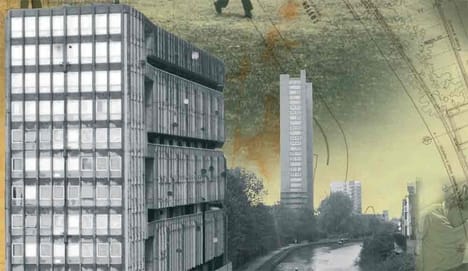
Finally, the entries makes a convincing argument that the estate’s problems are nothing to do with the architecture but are down to a lack of vision by its owners. This is why the judges liked the proposal to move the buildings to west London, putting it in an environment where, watched over by Goldfinger’s Trellick Tower, the equally iconic Robin Hood immediately feels more at home.


Winner: Zoran Radivojevic Cazenove Architects

image

The buildings are treated as giant carcasses that allow parts of the structure to be removed and new, lighter structures to be added. These extensions could house work studios or retail space. Some flats are also removed and the hollows used either as public space or let out as business units. Circulation is via a new set of externally attached ramps and stairwells.


Second place: Bruce Newlands Kraft Architecture & Mike Hyatt Landscape Architects
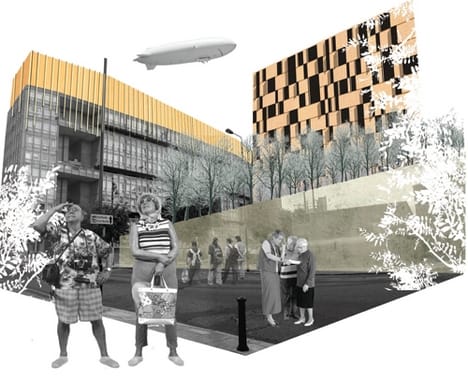
image

An engineered timber skin envelops one side of the existing blocks, providing more generous terrace space. It also extends upwards, creating an extra two storeys of community space on the roof. There are a total of 2,500 homes, a mix of high-density, low-rise housing, together with low-rise commercial and community facilities.


Third place: Ben Addy Moxon Architects
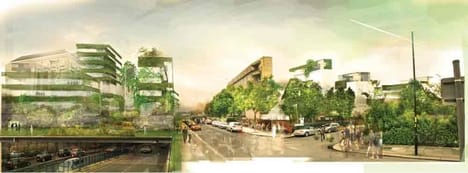
image

The architect wants to have as little impact as possible on the Smithsons’ masterplan, maintaining the green space and turning existing thoroughfares into tree-lined avenues. The concrete acoustic barrier on the eastern side is removed to open up the streetscape with retail units, cafés and market stalls. New medium- and low-rise blocks have planted facades and window boxes.


The Runners-up are:

Sabah Ashiq
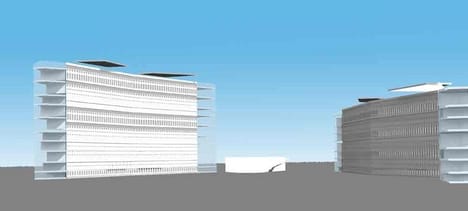
image

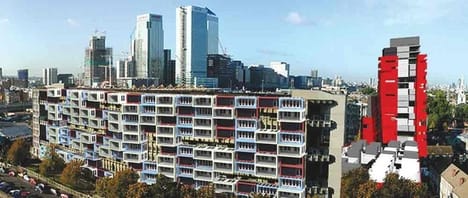
The scheme focuses on creating better pedestrian access through the site and removing the boundary wall so the estate is no longer so isolated. The blocks are renovated, and glass and voids are used to reflect the new spatial qualities. Extra one- and two-bedroom flats are added to the blocks.


Tommaso Passalacqua Brre Architects with Baires Raffaelli, Elio Rava and Carlos Acostaf
image

An “equipment wall” is plugged onto the Smithsons’ building, “parasite” houses are built on the roof and a block of capsule houses is added to one end of the site to reach the required density.


Tom Jefferies Maccreanor Lavington
image

The architect proposes moving the blocks to west London to a site more receptive to its uncompromising architectural language. By placing it next to Goldfinger’s Trellick Tower, the original dialogue between RHG and the nearby listed grade II listed Balfron Tower is restated and strengthened. The vacant site would then become the subject of an international housing competition.


Carsten Czaja LIVFE Design Agency, Berlin
image

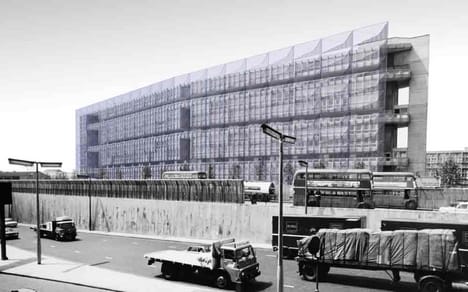
The buildings are wrapped in a glass screen. The approach to the Blackwall Tunnel is covered to allow for 350 new units, seven floors in height. A further 560 units are provided in freestanding towers at the eastern end of the site.


Mark NG and Jimmy Hung Make
image

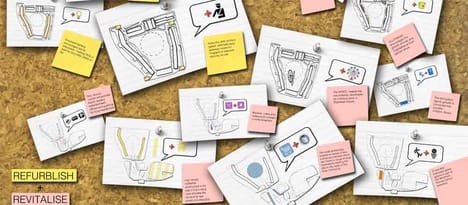
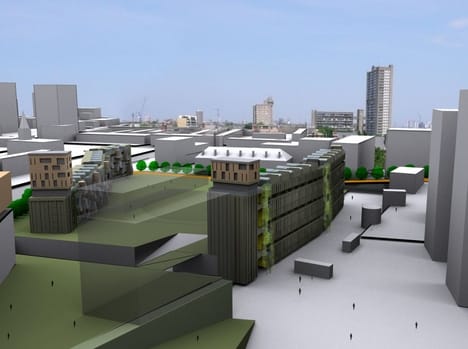
The buildings are given an instant face-lift by being repaired and painted, in a manner similar to London’s Brunswick Centre. Trees are used around the site to create an acoustic barrier, while the existing green space becomes a leisure ground, complete with ferris wheel. A new retail promenade is located at the site’s eastern end, leading to a high-density residential development.


Harry Dobbs Harry Dobbs Design
image


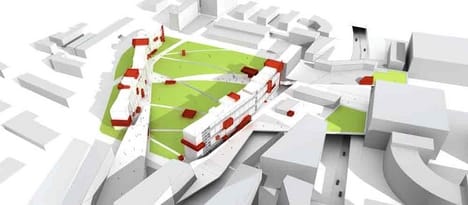
Matteo Cainer Fletcher Priest Architects
image

The architect decided that the estate’s main flaw is the lack of community and interactive spaces, and that its regeneration should be guided by community needs. New spaces inserted as bubbles within the main frame give additional meeting spaces and facilities. There are proposals to create a series of new pathways across the site, which would be intersected by extra recreational space.


The Judging Panel:
Simon Smithson
Peter Cook
Rowan Moore, Architecture Foundation director
Amanda Baillieu, BD editor
BD columnist Paul Morrell
Roger Zogolovitch, architect/developer

For more images and detailed descriptions of the winning projects, see here.

Share

  • Follow

    0 Comments

  • Comment as :

Archinect JobsArchinect Jobs

The Archinect Job Board attracts the world's top architectural design talents.

VIEW ALL JOBS POST A JOB

Architect 10+

Standard Architects

Architect 10+

Long Island City, NY, US

Architectural Designer

jones | haydu

Architectural Designer

San Francisco, CA, US

Project Architect/ Designer

Nandinee Phookan Architect, P.C.

Project Architect/ Designer

New York, NY, US

Marketing and Architectural Assistant

AGENCIE / Architecture & Engineering

Marketing and Architectural Assistant

New York, NY, US

Project Architect

BuildingWork

Project Architect

Seattle, WA, US

Senior Interior Architect/ Designer

Silverstone Group

Senior Interior Architect/ Designer

Washington, DC, US

Senior Architectural Project Manager (Systems Driven, Human-Centric) (Hourly)

Local Parti Architecture, PC

Senior Architectural Project Manager (Systems Driven, Human-Centric) (Hourly)

New York, NY, US

Project Designer (3-5 years)

Edmonds + Lee Architects

Project Designer (3-5 years)

San Francisco, CA, US

Senior Hospitality FF&E Designer

bonetti/kozerski architecture DPC

Senior Hospitality FF&E Designer

New York, NY, US

Architectural Designer, Residential

Roman and Williams Buildings and Interiors

Architectural Designer, Residential

New York, NY, US

Next page » Loading