• Login / Join
  • About
  • •
  • Contact
  • •
  • Advertising
bustler logo
bustler logo
  • News
  • Competitions
  • Events
  • Bustler is powered by Archinect
  • Sign up for Bustler's Email Newsletters

  • Follow these Bustler feeds:

  • Search

    Search in

  • Submit

    What are you submitting?

    News Pitch
    Competition
    Event
  • Login / Join
  • News|Competitions|Events
  • Search
    | Submit
    | Follow
  • Search in

    What are you submitting?

    News Pitch
    Competition
    Event

    Follow these Bustler feeds:

  • About|Contact|Advertising
  • Login / Join

Competition-Winning Silk Road Map Evolution by OFL Architecture

By Bustler Editors|

Wednesday, Oct 6, 2010

Singapore

Rome-based practice OFL architecture has shared with us their project Silk Road Map Evolution that just won them the First Prize in the international competition "New Silk Road Map". The competition was organized by New Italian Blood and was open to Italian and Chinese professionals and students.

New Silk Road Map invited participants to develop innovative ideas-projects, material or immaterial, for the recovery, reinterpretation, updating and reconfiguration of the collective image of the “Silk Road” (soon to become a UNESCO World Heritage Site). The Silk Road is an extraordinary network of commercial, cultural and religious paths measuring some 15,000 km in length. For over 2,000 years, it constituted the only connection between Eastern and Western civilisations.

The OFL architecture design team comprised Francesco Lipari, Vanessa Todaro, Andrea Debilio and Alejandro Liu Cheng as parametric design consultant.

OFL architecture's competition-winning entry Silk Road Map Evolution

Project Description:

SRME. Silk Road Map Evolution is a project born out of the will to revive and regenerate the current layout of the silk road. This is to be accomplished by means of a social, economic, political and architectonic redevelopment of the historic stretch of the road that once belonged to Marco Polo.

The project deeply integrates infrastructure with architecture and by means of a new railway system functioning on gravitational platforms follows the trail from Venice to Xian, Shanghai and Tokyo, extending its "arms" to create new infrastructures, commercial services and residences. 

A wiry MOTOR CITY extends itself to help out urban realities and struggling economies. The (linearly) diffused city runs into other micro-cities in such a way that the greater entity hooks onto the smaller ones to help them survive and, like an economic pump, extends life from the greater nodes to the smaller and poorer extremities. The 15,000 km of the silk road shall be broken up by bionic towers which will represent the centers of new urban sprawls. The new silk road line will also serve as the GENERATOR of other paths that will branch off of the main course of the road to develop a larger economic armature.

Elevation from Venice to Tokyo

The studio driven towards the development of the SRME was created following an attentive analysis of the actual condition of the city on a global level. The common problem of large contemporary cities is that of congestion of circulation. This is a natural consequence of demographic expansion, a phenomenon that can be defined as explosive considering the exponential trend that manifested in the 20th century. The "classic" urban structure of cities developed concentrically around a central nucleus is no longer capable of resolving the problematic issues of traffic and pollution. As a result, the model of an ideal city will evolve, placing emphasis on MOBILITY and creating an environment in which displacements are reduced to a minimum and sustainable means of transport are implemented. The key issues of the innovative project of mobility are therefore the growing mechanization of displacements and the abandon of personal vehicles.

Iceberg

SRME offers a response to problems of mobility by sustaining a new model of urbanization that goes beyond urbanism itself. This is developed along an axis of indefinite length, comprised of a vital artery that in turn gives life to minor urban organisms. 

LINEARITY AND THREE-DIMENSIONALITY are the driving forces of this cultural and technical venture for cities of the future. Following this new model which can be categorized within SPATIAL URBANISM, the city will no longer be thought of as an isolated organism. It will instead be integrated with others along a system of ligaments that creates a real and proper URBAN INFRASTRUCTURE in which circulation exists both horizontally and vertically.

Competition board

Silk Road Map Evolution will become a global city for the future, made up of extra long tunnels and highly sustainable and habitable towers of various forms. These small livable worlds will be organized in vertical and circular skyscrapers whose forms will be dictated by their internal functions and by their relationship with the railway system and the natural world. The fundamental goal of this innovative project of the spatial city is that of reducing to a minimum the percentage of soil disrupted for construction and urban structures. This also addresses the problems of architectonic development in large metropolises as well as overpopulation and increasing demographics of existing cities. Marginal suburbs and peripheral cities which cause great social problems will disappear. 

Competition board

From an architectonic and urban point of view, SRME is made up of two urban, ecological integrated systems. The first element, that of the towers, is composed of three different types of skyscrapers which will rise to a median height of 400 meters. The second element, that of the railway system, is made up of the main path of the silk road as well as a new line of commercial and public transport with trains that travel on polarized gravitational fields uniting the Orient with the Occident. The external skin of the entire project is composed of an innovative system made up of a cement based on titanium dioxide. This significantly reduces atmospheric disturbance and thanks to a particular synthetic chlorophyl generates a photocatalytic reaction that produces clean air for a quantity equal to 500 liters of oxygen a day for every 200 square meters of surface. An unprecedented energy system is also placed on the inside of the train tracks. This is composed of various piezoelectric panels integrated into the tracks which capture energy created by waves of pressure resulting from train traffic and transform it into electricity.

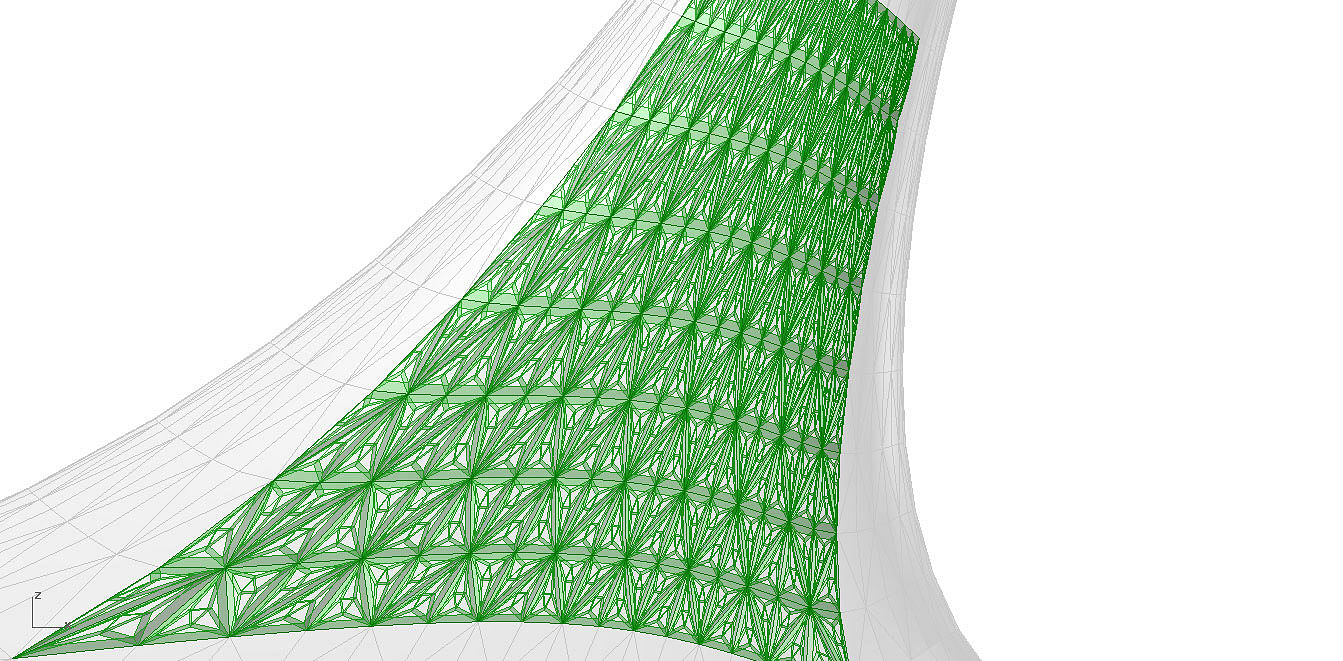
Grasshopper Process Skin 1
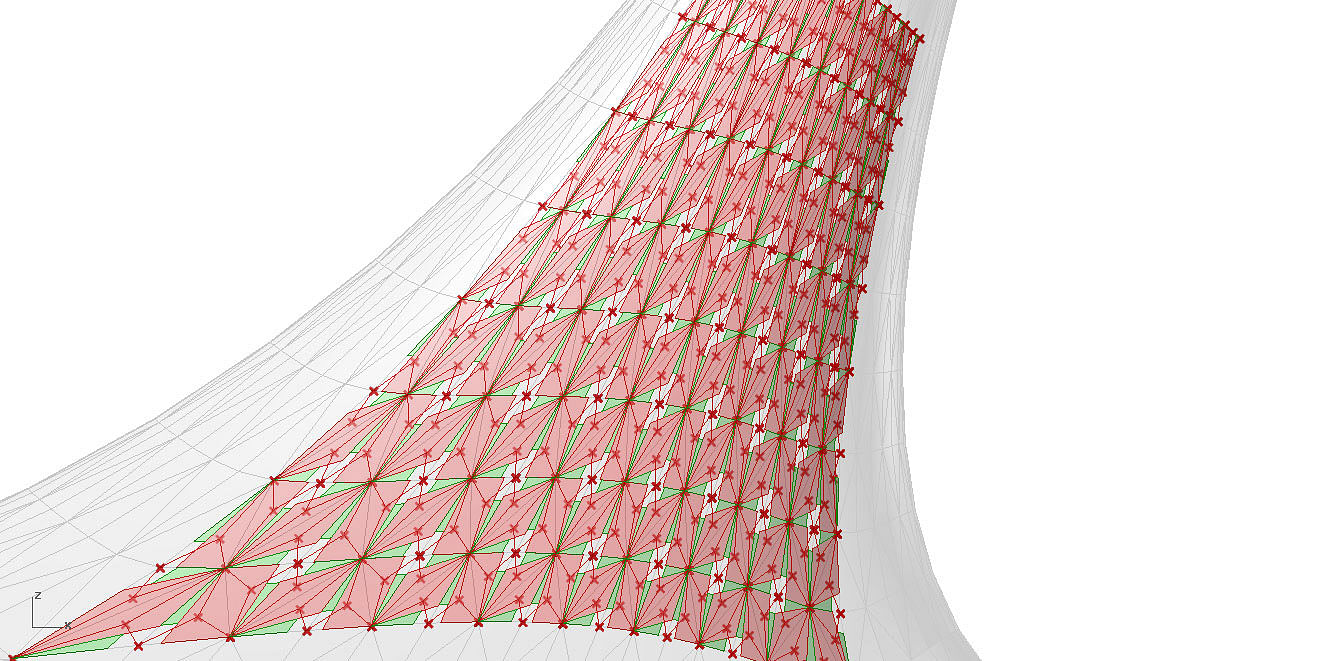
Grasshopper Process Skin 2
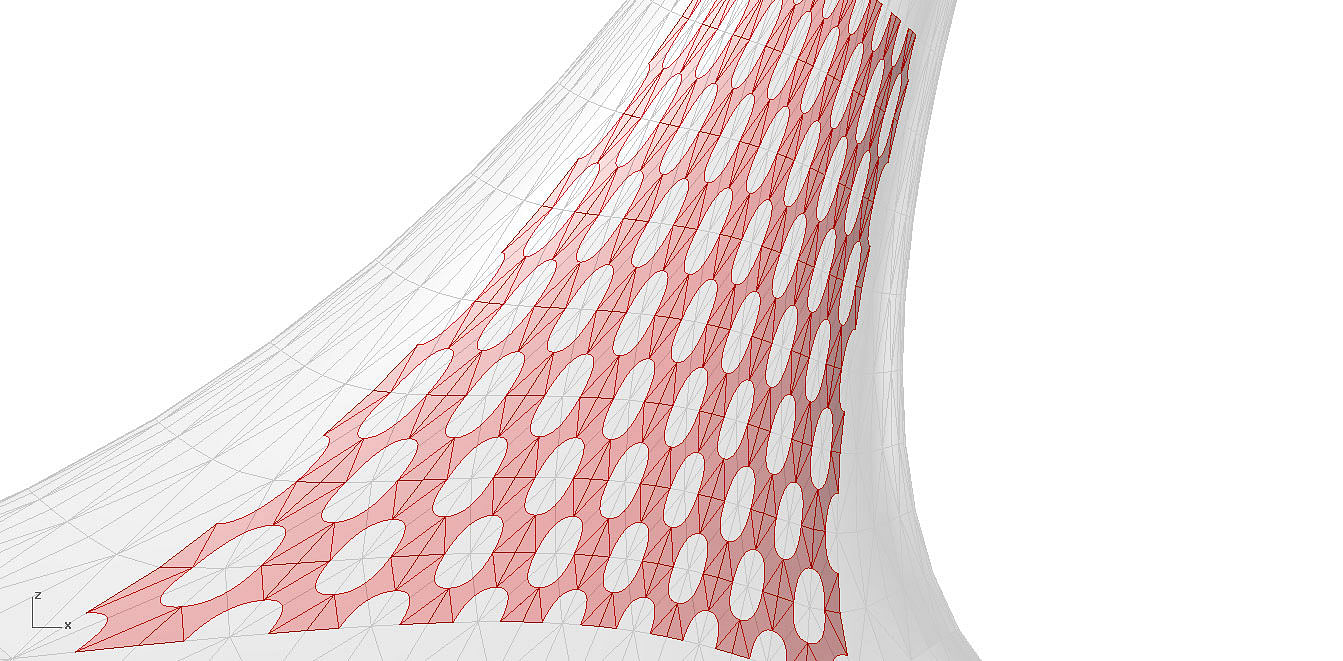
Grasshopper Process Skin 3
Grasshopper Process Skin 4
Grasshopper Process Skin 5
Grasshopper Process Skin 6

Related

silk road ● ofl architecture ● new silk road map ● new italian blood ● italy ● europe ● china ● asia

Share

  • Follow

    0 Comments

  • Comment as :

Competition-Winning Silk Road Map Evolution by OFL Architecture

Northwestern University selects 12-firm longlist to design new engineering building

New architecture and design competitions: Exploring 130 Years of American Design, Christo & Jeanne-Claude Center, 13 White Houses, and La Pyramide

Micro-architecture honored in latest Tiny House Architecture Competition

World’s most beautiful restaurants of 2026 chosen by Prix Versailles

Sponsored Post by Buildner

Design a wine tasting room in Italy! Valli Wine Tasting Room is launched!

10 can't-miss architecture & design events to see this June in London, Los Angeles, Chicago, San Francisco, Detroit, San Diego, Porto, and Barcelona

Sponsored Post by Buildner

Museum of Emotions / Edition #8 FINAL registration deadline is approaching!

Seven global projects make AR Public Awards shortlist 2026

Sign up for Bustler's Email Newsletters

Sponsored Post by Buildner

Design a slow-living restaurant in Portugal! Portugal Long Table Restaurant is launched!

World's best tall buildings honored at the CVU 2026 Award of Excellence

Sponsored Post by TWOPAGES

Final call: TWOPAGES X Design Contest 2026 submissions close June 5

Kengo Kuma & Paul Raff win Alberta national park visitor center competition with landscape-focused design

2026 Moira Gemmill and MJ Long prizes announced by W Awards

New architecture and design competitions: Kinderspace, Stewardson Keefe LeBrun Travel Grant, SMALL PROJECT BIG IMPACT, and Garden of University House, Bucharest

The Century of Gehry: New retrospective explores the late architect's work & collaborations

Next page » Loading

Competition-Winning Silk Road Map Evolution by OFL Architecture

By Bustler Editors|

Wednesday, Oct 6, 2010

Share

Singapore

Related

silk road ● ofl architecture ● new silk road map ● new italian blood ● italy ● europe ● china ● asia

Rome-based practice OFL architecture has shared with us their project Silk Road Map Evolution that just won them the First Prize in the international competition "New Silk Road Map". The competition was organized by New Italian Blood and was open to Italian and Chinese professionals and students.

New Silk Road Map invited participants to develop innovative ideas-projects, material or immaterial, for the recovery, reinterpretation, updating and reconfiguration of the collective image of the “Silk Road” (soon to become a UNESCO World Heritage Site). The Silk Road is an extraordinary network of commercial, cultural and religious paths measuring some 15,000 km in length. For over 2,000 years, it constituted the only connection between Eastern and Western civilisations.

The OFL architecture design team comprised Francesco Lipari, Vanessa Todaro, Andrea Debilio and Alejandro Liu Cheng as parametric design consultant.

OFL architecture's competition-winning entry Silk Road Map Evolution

Project Description:

SRME. Silk Road Map Evolution is a project born out of the will to revive and regenerate the current layout of the silk road. This is to be accomplished by means of a social, economic, political and architectonic redevelopment of the historic stretch of the road that once belonged to Marco Polo.

The project deeply integrates infrastructure with architecture and by means of a new railway system functioning on gravitational platforms follows the trail from Venice to Xian, Shanghai and Tokyo, extending its "arms" to create new infrastructures, commercial services and residences. 

A wiry MOTOR CITY extends itself to help out urban realities and struggling economies. The (linearly) diffused city runs into other micro-cities in such a way that the greater entity hooks onto the smaller ones to help them survive and, like an economic pump, extends life from the greater nodes to the smaller and poorer extremities. The 15,000 km of the silk road shall be broken up by bionic towers which will represent the centers of new urban sprawls. The new silk road line will also serve as the GENERATOR of other paths that will branch off of the main course of the road to develop a larger economic armature.

Elevation from Venice to Tokyo

The studio driven towards the development of the SRME was created following an attentive analysis of the actual condition of the city on a global level. The common problem of large contemporary cities is that of congestion of circulation. This is a natural consequence of demographic expansion, a phenomenon that can be defined as explosive considering the exponential trend that manifested in the 20th century. The "classic" urban structure of cities developed concentrically around a central nucleus is no longer capable of resolving the problematic issues of traffic and pollution. As a result, the model of an ideal city will evolve, placing emphasis on MOBILITY and creating an environment in which displacements are reduced to a minimum and sustainable means of transport are implemented. The key issues of the innovative project of mobility are therefore the growing mechanization of displacements and the abandon of personal vehicles.

Iceberg

SRME offers a response to problems of mobility by sustaining a new model of urbanization that goes beyond urbanism itself. This is developed along an axis of indefinite length, comprised of a vital artery that in turn gives life to minor urban organisms. 

LINEARITY AND THREE-DIMENSIONALITY are the driving forces of this cultural and technical venture for cities of the future. Following this new model which can be categorized within SPATIAL URBANISM, the city will no longer be thought of as an isolated organism. It will instead be integrated with others along a system of ligaments that creates a real and proper URBAN INFRASTRUCTURE in which circulation exists both horizontally and vertically.

Competition board

Silk Road Map Evolution will become a global city for the future, made up of extra long tunnels and highly sustainable and habitable towers of various forms. These small livable worlds will be organized in vertical and circular skyscrapers whose forms will be dictated by their internal functions and by their relationship with the railway system and the natural world. The fundamental goal of this innovative project of the spatial city is that of reducing to a minimum the percentage of soil disrupted for construction and urban structures. This also addresses the problems of architectonic development in large metropolises as well as overpopulation and increasing demographics of existing cities. Marginal suburbs and peripheral cities which cause great social problems will disappear. 

Competition board

From an architectonic and urban point of view, SRME is made up of two urban, ecological integrated systems. The first element, that of the towers, is composed of three different types of skyscrapers which will rise to a median height of 400 meters. The second element, that of the railway system, is made up of the main path of the silk road as well as a new line of commercial and public transport with trains that travel on polarized gravitational fields uniting the Orient with the Occident. The external skin of the entire project is composed of an innovative system made up of a cement based on titanium dioxide. This significantly reduces atmospheric disturbance and thanks to a particular synthetic chlorophyl generates a photocatalytic reaction that produces clean air for a quantity equal to 500 liters of oxygen a day for every 200 square meters of surface. An unprecedented energy system is also placed on the inside of the train tracks. This is composed of various piezoelectric panels integrated into the tracks which capture energy created by waves of pressure resulting from train traffic and transform it into electricity.
Grasshopper Process Skin 1
Grasshopper Process Skin 2
Grasshopper Process Skin 3
Grasshopper Process Skin 4
Grasshopper Process Skin 5
Grasshopper Process Skin 6

Share

  • Follow

    0 Comments

  • Comment as :

Archinect JobsArchinect Jobs

The Archinect Job Board attracts the world's top architectural design talents.

VIEW ALL JOBS POST A JOB

Intermediate Architect

IMC Architecture

Intermediate Architect

Brooklyn, NY, US

Junior to Intermediate Architect

Totum

Junior to Intermediate Architect

Sherman Oaks, CA, US

Project Manager

VanderHorn Architects

Project Manager

Greenwich, CT, US

Interior Project Manager

HLW International LLP

Interior Project Manager

New York, NY, US

Architect 10+

Standard Architects

Architect 10+

Long Island City, NY, US

Associate - Interior Designer

FitzGerald Associates Architects

Associate - Interior Designer

Chicago, IL, US

Junior Architect

PRDG architecture + design

Junior Architect

New York, NY, US

Architectural Designer

Build Block Inc.

Architectural Designer

Los Angeles, CA, US

Project Architect

Lang Architecture

Project Architect

New York, NY, US

Architectural Designer II

Studio AR&D Architects

Architectural Designer II

Los Angeles, CA, US

Next page » Loading