• Login / Join
  • About
  • •
  • Contact
  • •
  • Advertising
bustler logo
bustler logo
  • News
  • Competitions
  • Events
  • Bustler is powered by Archinect
  • Sign up for Bustler's Email Newsletters

  • Follow these Bustler feeds:

  • Search

    Search in

  • Submit

    What are you submitting?

    News Pitch
    Competition
    Event
  • Login / Join
  • News|Competitions|Events
  • Search
    | Submit
    | Follow
  • Search in

    What are you submitting?

    News Pitch
    Competition
    Event

    Follow these Bustler feeds:

  • About|Contact|Advertising
  • Login / Join

Swiss Clockwork Embassy in Yaoundé, Cameroon

By Bustler Editors|

Friday, May 18, 2012
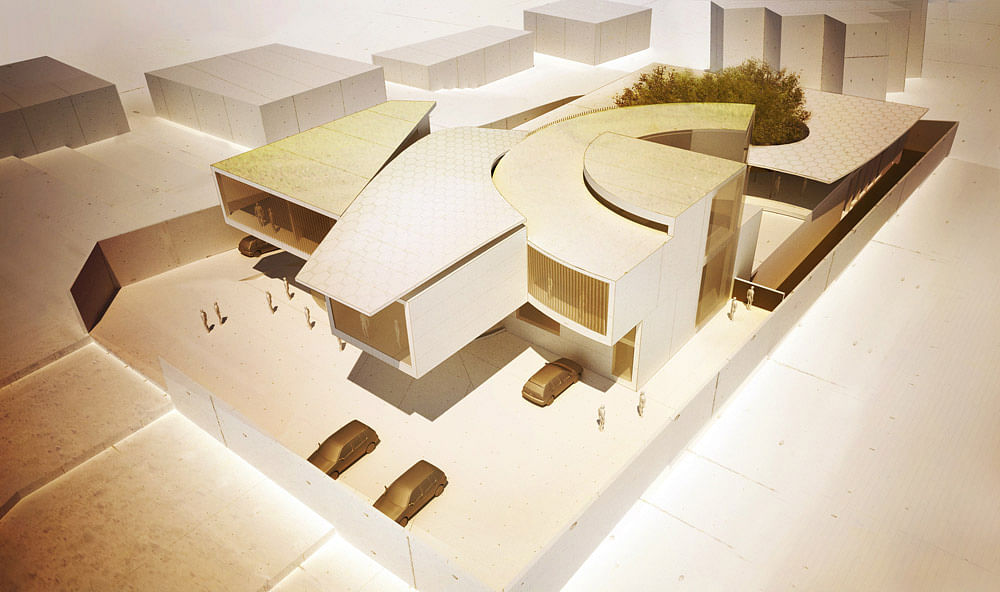
Swiss Clockwork Embassy in Yaoundé, Cameroon by Matteo Cainer Architects Ltd (Image: Matteo Cainer Architects Ltd)

London/Paris-based practice Matteo Cainer Architects Ltd has sent us its competition entry for the new Swiss embassy building in Yaoundé, the capital city of Cameroon, West Africa. The design is a play on the precision of Swiss clockwork mechanism and traditional Cameroon Musgum housing.

Project Description from the Architects:

The design of the new Swiss Embassy in Yaoundé pays tribute to its renewed presence in the Cameroon and a respect for the uniqueness of the site. The resulting proposal is an elegant ensemble that encapsulates the identity and self-image of the Swiss people and their values. As a result the core concepts that guide this proposal are an expression of Swiss traditional know-how, and an understanding of what the Embassy can represent and achieve.
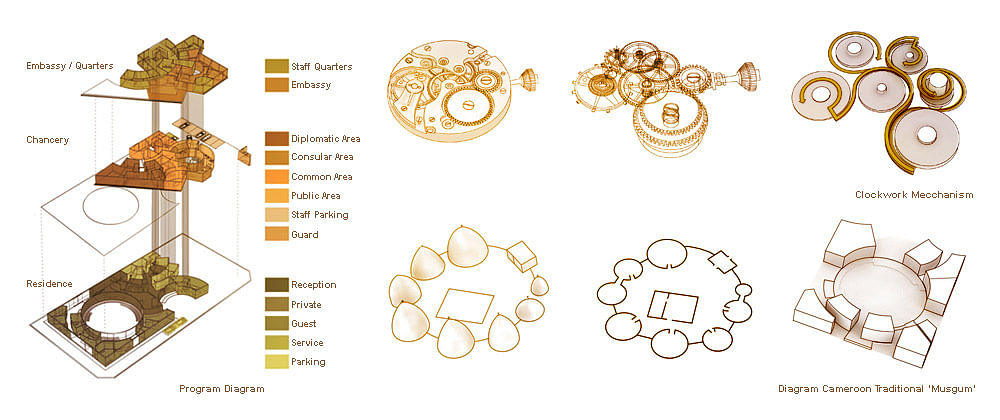
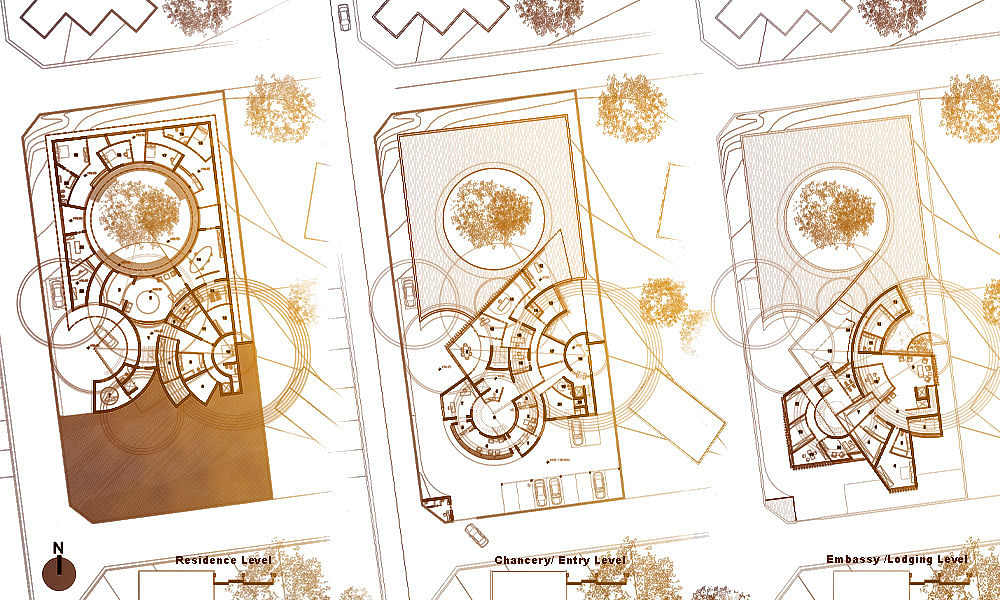
Image: Matteo Cainer Architects Ltd

The qualities of a Swiss timepiece offer an interesting metaphor for a building with a complex and symbolic role. Not only does the mechanism and synchronised movement resolve the complexity and secure requirements of the Embassy itself, but it can also represent the underlying beauty of a pragmatic and essential artefact.
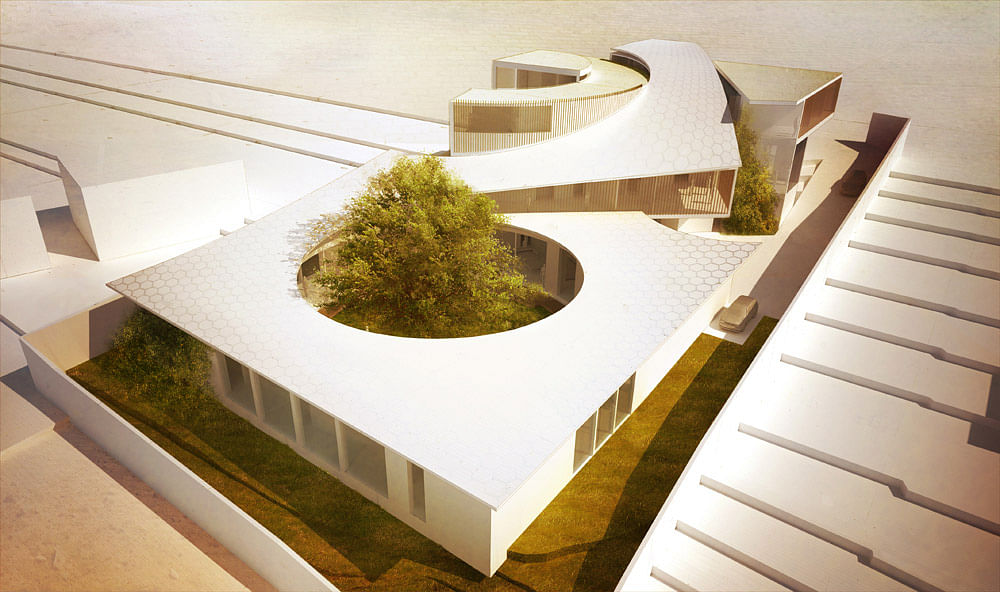
Image: Matteo Cainer Architects Ltd

The three principal components that make up the Embassy complex, the Chancellery, the Ambassador’s residence and the staff quarters, are conceived as separate elements, and as the components of a timepiece each is expressed at its own scale. These principal elements are each informed and enriched by their own language and references. The Ambassador’s residence takes its form from the traditional Cameroon ‘Musgum’ house with living spaces arranged around a central space, in this case a circular court.  This arrangement provides visual and physical protection from the outside, retaining privacy for the Ambassador and his family, with a controlled environment within.  This carefully structured interior landscape and private garden becomes the conceptual heart of the residence and a tranquil oasis for informal social gatherings. The spatial and programmatic organization of the project is conceived so that the Embassy’s public entrance and interior space present an ambience of calm and assurance, with a functional arrangement that exudes precision in detail and movement. Public and private functions within the building are set apart from each other, with public services located on the ground floor and private Embassy functions on the floor above. The Ambassador’s office has been strategically placed at the centre of the proposal, as its symbolic beating heart.
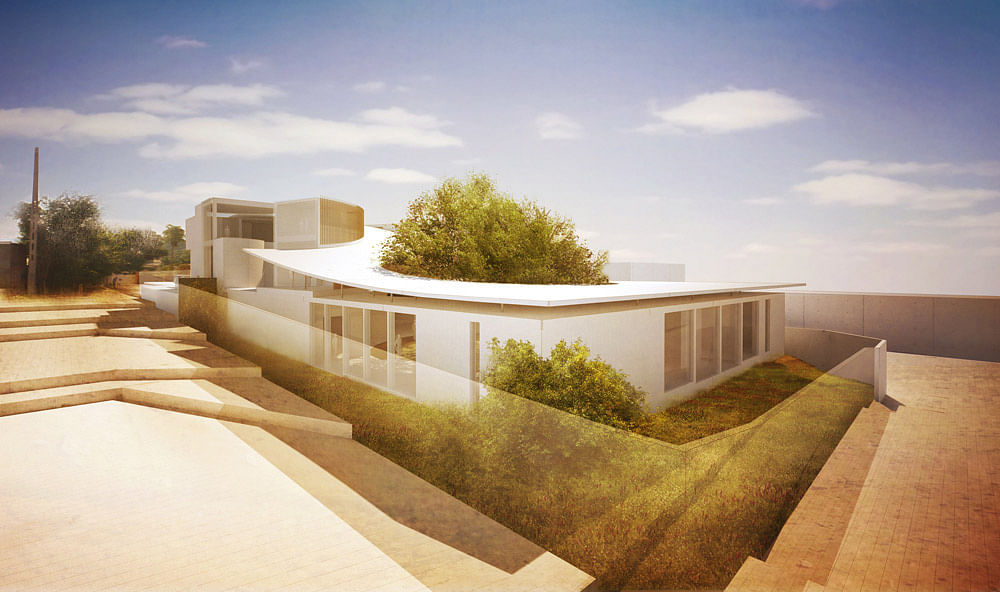
Image: Matteo Cainer Architects Ltd

Achieving a sustainable design was key to the process, from an innovative selection of engineered building components to the building’s orientation. Digitally controlled external sunshades manufactured in Switzerland respond to and protect the interiors from the intense heat/solar gain and the resulting energy savings to provide cooling.  The exposed concrete structure provides the thermal mass to reduce peak-period cooling demands and highly efficient lighting systems and a strongly insulated building skin reduce the overall energy consumption. A low maintenance “sedum” green roof over the Chancellery provides considerable energy savings, while the roof-mounted solar panels generate green electricity to reduce energy requirements for the heating of water. The installation of photovoltaic panels contributes to the Embassy’s annual power requirement. Internal heating and cooling will be effectively achieved by boreholes/earth tubes or crypt cooling, allowing air to circulate through large diameter underground pipes, with internal heat build-up by circulating air and discharging via a stack. The proposal makes efficient use of the intense rainfall and humidity in this region. The roof over the Residency is suspended over a ventilated void to keep the roof dry. The rainwater collected from the Chancery roof is stored and used for irrigation and grey water purposes. Rainwater collected from the garden is naturally purified and stored as potable water for the entire complex.
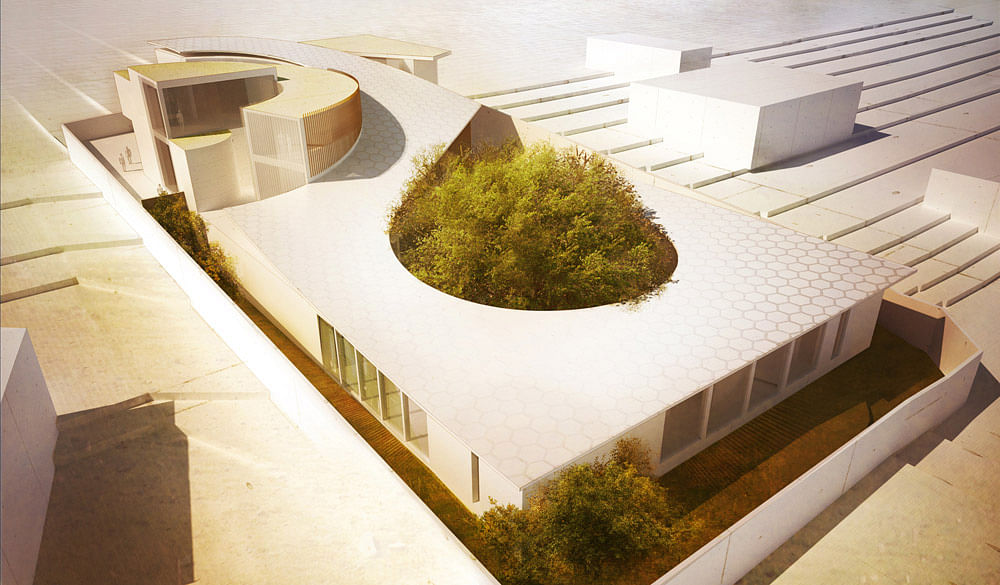
Image: Matteo Cainer Architects Ltd

The calm external simplicity of the proposal conceals an inner complexity. The layered and interconnecting spaces are developed from the concept diagrams of the time-piece mechanism. The passing of time is represented by the constantly changing patterns of shadows that are cast across the internal wall and floor surfaces. The interconnecting internal spaces, clad in natural materials, retain the complex fascination that lies within the casing of a timepiece. Constructed according to Swiss “Minergie Standards,” the new Embassy will be an exemplar of efficient and sustainable energy, learning from and integrating the qualities of the Cameroonian and Swiss people and their cultures.
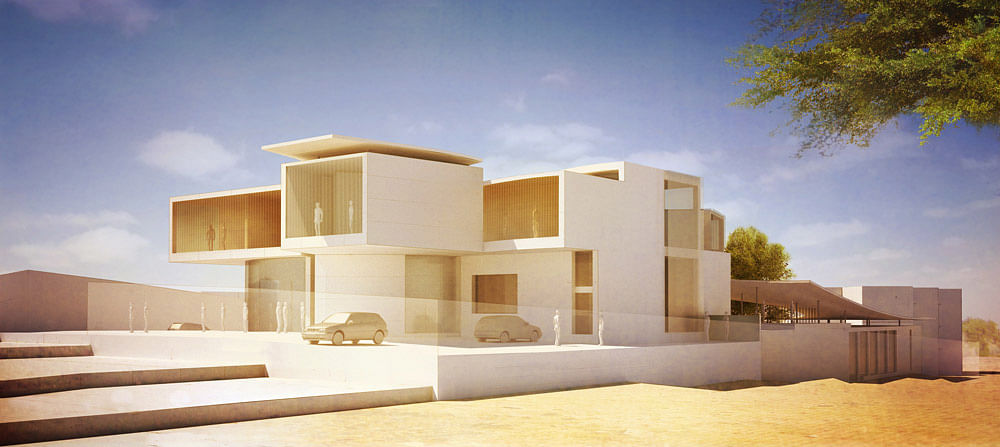
Image: Matteo Cainer Architects Ltd

Project Details:

Location: Yaoundé, Cameroon
Use: Swiss Embassy, Ambassador Residence and Staff quarters
Client: Swiss Confederation, OFCL
Design: Matteo Cainer Architects Ltd

Related

yaoundé ● switzerland ● swiss ● matteo cainer architects ltd ● embassy ● clockwork ● cameroon ● africa

Share

  • Follow

    0 Comments

  • Comment as :

Swiss Clockwork Embassy in Yaoundé, Cameroon

Over $500,000 awarded to architectural discourse projects by Graham Foundation

Best in urban planning recognized at AIA Regional & Urban Design Award 2026

Sponsored Post by Buildner

Re:Form - New Life for Old Spaces / Edition #3 advance registration deadline is approaching!

New architecture and design competitions: IDEAS Awards, UIA-HYP CUP International Student Competition, Vancouver Tall Challenge, and Memorial to the Sixth Extinction

Best small projects chosen at AIA Small Project Award 2026

10 standout sustainable projects honored at AIA COTE Top Ten Award 2026

Best residential architecture of 2026 honored at AIA Housing Award

Best new interiors of 2026 chosen at AIA Interior Architecture Awards

Sign up for Bustler's Email Newsletters

Best global architecture honored at RIBA International Awards 2026

World’s most beautiful airports of 2026 chosen by Prix Versailles

New architecture and design competitions: Brick in Architecture Awards, Study Architecture Student Showcase, N.Y.C. Groceries, and New York High Falls Riverfront Market

SmithGroup’s ‘pioneering’ Philip Merrill Environmental Center wins AIA Twenty-five Year Award

Sponsored Post by Buildner

Museum of Emotions / Edition #8 FINAL registration deadline is in 5 DAYS!

Here are the winners of the 2026 AIA Architecture Awards

40 emerging architects and designers under 40 from Europe honored

Next page » Loading

Swiss Clockwork Embassy in Yaoundé, Cameroon

By Bustler Editors|

Friday, May 18, 2012

Share

Swiss Clockwork Embassy in Yaoundé, Cameroon by Matteo Cainer Architects Ltd (Image: Matteo Cainer Architects Ltd)

Related

yaoundé ● switzerland ● swiss ● matteo cainer architects ltd ● embassy ● clockwork ● cameroon ● africa

London/Paris-based practice Matteo Cainer Architects Ltd has sent us its competition entry for the new Swiss embassy building in Yaoundé, the capital city of Cameroon, West Africa. The design is a play on the precision of Swiss clockwork mechanism and traditional Cameroon Musgum housing.

Project Description from the Architects:

The design of the new Swiss Embassy in Yaoundé pays tribute to its renewed presence in the Cameroon and a respect for the uniqueness of the site. The resulting proposal is an elegant ensemble that encapsulates the identity and self-image of the Swiss people and their values. As a result the core concepts that guide this proposal are an expression of Swiss traditional know-how, and an understanding of what the Embassy can represent and achieve.

Image: Matteo Cainer Architects Ltd

The qualities of a Swiss timepiece offer an interesting metaphor for a building with a complex and symbolic role. Not only does the mechanism and synchronised movement resolve the complexity and secure requirements of the Embassy itself, but it can also represent the underlying beauty of a pragmatic and essential artefact.

Image: Matteo Cainer Architects Ltd

The three principal components that make up the Embassy complex, the Chancellery, the Ambassador’s residence and the staff quarters, are conceived as separate elements, and as the components of a timepiece each is expressed at its own scale. These principal elements are each informed and enriched by their own language and references. The Ambassador’s residence takes its form from the traditional Cameroon ‘Musgum’ house with living spaces arranged around a central space, in this case a circular court.  This arrangement provides visual and physical protection from the outside, retaining privacy for the Ambassador and his family, with a controlled environment within.  This carefully structured interior landscape and private garden becomes the conceptual heart of the residence and a tranquil oasis for informal social gatherings. The spatial and programmatic organization of the project is conceived so that the Embassy’s public entrance and interior space present an ambience of calm and assurance, with a functional arrangement that exudes precision in detail and movement. Public and private functions within the building are set apart from each other, with public services located on the ground floor and private Embassy functions on the floor above. The Ambassador’s office has been strategically placed at the centre of the proposal, as its symbolic beating heart.

Image: Matteo Cainer Architects Ltd

Achieving a sustainable design was key to the process, from an innovative selection of engineered building components to the building’s orientation. Digitally controlled external sunshades manufactured in Switzerland respond to and protect the interiors from the intense heat/solar gain and the resulting energy savings to provide cooling.  The exposed concrete structure provides the thermal mass to reduce peak-period cooling demands and highly efficient lighting systems and a strongly insulated building skin reduce the overall energy consumption. A low maintenance “sedum” green roof over the Chancellery provides considerable energy savings, while the roof-mounted solar panels generate green electricity to reduce energy requirements for the heating of water. The installation of photovoltaic panels contributes to the Embassy’s annual power requirement. Internal heating and cooling will be effectively achieved by boreholes/earth tubes or crypt cooling, allowing air to circulate through large diameter underground pipes, with internal heat build-up by circulating air and discharging via a stack. The proposal makes efficient use of the intense rainfall and humidity in this region. The roof over the Residency is suspended over a ventilated void to keep the roof dry. The rainwater collected from the Chancery roof is stored and used for irrigation and grey water purposes. Rainwater collected from the garden is naturally purified and stored as potable water for the entire complex.

Image: Matteo Cainer Architects Ltd

The calm external simplicity of the proposal conceals an inner complexity. The layered and interconnecting spaces are developed from the concept diagrams of the time-piece mechanism. The passing of time is represented by the constantly changing patterns of shadows that are cast across the internal wall and floor surfaces. The interconnecting internal spaces, clad in natural materials, retain the complex fascination that lies within the casing of a timepiece. Constructed according to Swiss “Minergie Standards,” the new Embassy will be an exemplar of efficient and sustainable energy, learning from and integrating the qualities of the Cameroonian and Swiss people and their cultures.

Image: Matteo Cainer Architects Ltd

Project Details:

Location: Yaoundé, Cameroon
Use: Swiss Embassy, Ambassador Residence and Staff quarters
Client: Swiss Confederation, OFCL
Design: Matteo Cainer Architects Ltd

Share

  • Follow

    0 Comments

  • Comment as :

Archinect JobsArchinect Jobs

The Archinect Job Board attracts the world's top architectural design talents.

VIEW ALL JOBS POST A JOB

Computational Design Expert Leaders

Urban A&O

Computational Design Expert Leaders

New York, NY, US

Project Manager/Designer

BOTO Design Architects

Project Manager/Designer

Santa Monica, CA, US

Marketing + Communications Specialist

Trahan Architects

Marketing + Communications Specialist

New York, NY, US

Interior Architect / Interior Designer

Annum Architects (formerly Ann Beha Architects)

Interior Architect / Interior Designer

Boston, MA, US

Interior Design Project Manager

DAHLIN Architecture | Planning | Interiors

Interior Design Project Manager

Bellevue, WA, US

Architect / Architectural Designer (3-5 years experience)

Resolution: 4 Architecture

Architect / Architectural Designer (3-5 years experience)

New York, NY, US

Intermediate Designer

Rafael Viñoly Architects

Intermediate Designer

New York, NY, US

Project Manager

The Brooklyn Studio

Project Manager

Brooklyn, NY, US

Architect / Project Architect - Remote (U.S. Based)

Joseph David Associates

Architect / Project Architect - Remote (U.S. Based)

Job Captain / Designer

Heather Young Architects

Job Captain / Designer

Palo Alto, CA, US

Next page » Loading