The Guggenheim Void has been Contemplated: Public Submission Winners Announced
Posted: Wednesday, June 02, 2010 | ↓ 13 comments
Share/Save:    Bookmark on Bustler Save this  &  Email this


Five winners have been announced in Guggenheim's open call for submissions to reimagine the museum's rotunda. This public event followed the highly publicized invitational and exhibition hosted by the NYC museum from February to April of this year.

Contemplating the Void curators Nancy Spector, Deputy Director and Chief Curator, and David Van Der Leer, Assistant Curator for Architecture and Design, have selected the following five winning submissions.

image

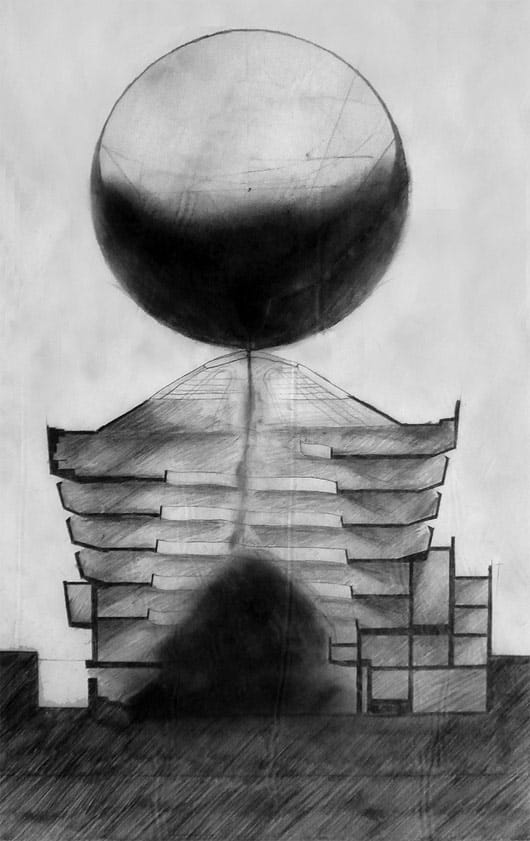
The Buried Void
Noel Turgeon
St. Paul, Minnesota

In The Buried Void, a stream of sand falls continuously from the oculus at the top of the Guggenheim into the museum and collects on the rotunda floor. For fifty years the sand will gradually fill the void, stopping on October 21, 2059 (the 100th anniversary of the Guggenheim) when it will have filled the space completely. Until then, guests in the building will be encouraged to experience and actively participate in this measure of time: as the physical objects in their lives become obsolete, visitors are encouraged to place them into museum-provided capsules and throw them into the sand. During the centennial celebration of the Guggenheim the rotunda will be excavated and the contents will be displayed in an evolutionary retrospective of forgotten things from the first half of the 21st century. The inspiration for this intervention comes from two sources: the first is wondering what will be forgotten by the future and how it could be remembered, the second is a desire to trace the passage of time through the physical means of space and objects.


image

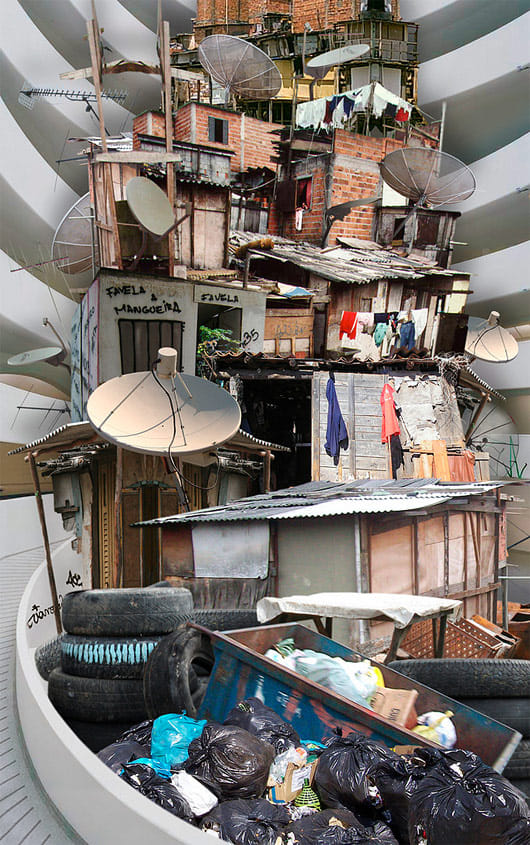
Favelart
Lucio Carvalho
Sao Paulo, Brazil

Favelart was inspired by Brazil where, if the culture does not reach out to parts that are in poverty, then poverty will, in turn, invade the culture.


image

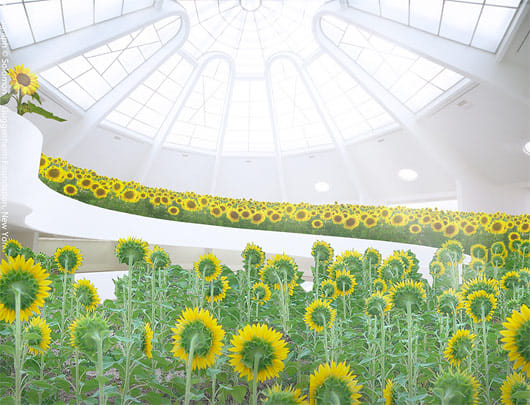
Sunflowers
David Andrew Tasman
New York, New York

Sunflowers proposes the installation of a field of sunflowers on the upper level of the rotunda. For the past 50 years, the Guggenheim has helped to bring art into life as well as the reverse. By bringing the outside in, the typical relationship between building and landscape is inverted, making the natural available for contemplation in a way that is normally reserved for works of art. The inspiration for this intervention came from an interest in popular culture and using contrasting juxtapositions as away to invoke the sublime.


image

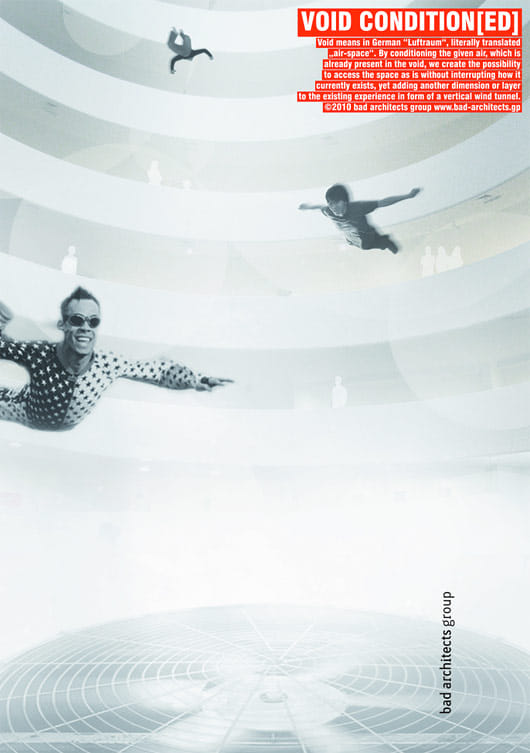
VOID CONDITION(ED)
Bad Architects Group (Paul Burgstaller/Ursula Faix
Innsbruck, Austria

VOID CONDITION(ED) was inspired by the German word for “void” (luftraum), which literally translates to “air space,” and the idea to change the space completely by changing it as little as possible.
 By conditioning the air already present in the void, one can access the space without interrupting how it currently exists, while simultaneously adding another dimension or layer to the existing experience in form of a vertical wind tunnel.


image

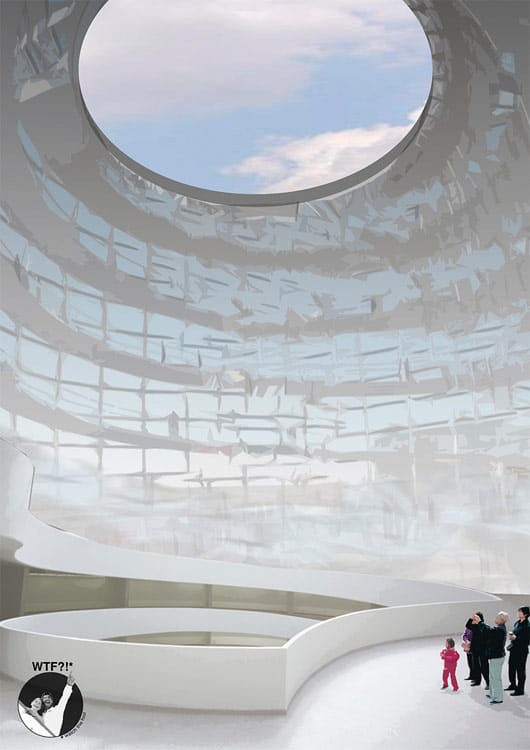
WTF?! (watch the fool)
Bruny Yan You Fu
Rennes, France

WTF?! (watch the fool) tries to give a geometrical response to "contemplating the void." The inspiration for this intervention was drawn from a story about the famous architect, Tadao Ando. When Ando was young, the roof of his house collapsed and left a big hole. This was when Ando came to realize that "contemplating the void" is also feeling the space, feeling the beauty of something invisible. Inspiration was also drawn from the Pantheon of Hadrien in Rome.


Share/Save:    Bookmark on Bustler Save this  &  Email this

Saved by: AP

Comments:
Daniel Georges
Saturday, June 05, 2010
I would like to say congratulations to the five winners. All their submissions deserve to be picked. But I feel the need to get a message across, mainly to the Guggenheim. I wouldn't have even considered writing this if there wasn't a striking opposition between my submission for this contest here:
http://www.flickr.com/photos/49611141@N02/4607073345/
and one of the five winners entitled: "Sunflowers".
http://www.flickr.com/photos/50037637@N06/4607606324/

I find the "Sunflowers" submission to be an elegant one, a pleasant installation idea indeed. But with a core slogan of "bringing the outside in", I'm left to assume that the curators of this competition have decidedly turned the blind eye towards all the current environment deterioration issues and ecological disasters striking almost everywhere on the planet. Romanticizing about sunflower fields when the entirety of an ecosystem in the US itself is at the verge of extinction is by all means irrelevant and borders the untactful.

Are museums meant to be immune to the turbulent realities of the outside, safeguarding a level of art chic?
What happened that turned museums from cultural institutions to corporate entities selling fake dreams like a Hollywood machine?

If iconic places like the Guggenheim Rotunda are exploited continuously as mere containers of introvert art, it only means that curators are reducing them to construction feats good for selling architecture books at the museum's boutique. They have indeed a far bigger potential.

Finally, I reassert my full respect to the "Sunflowers" submission creators, and congratulations to all the winners. Of course, I thank the Guggenheim nonetheless for giving everyone this invaluable opportunity to design an intervention inside the Rotunda. It was both a pleasure and an honor.

T
Canada
Saturday, June 05, 2010
Great art is not social criticism but rather a poetic experience that effects a change in the beholder's existential condition. If you want to raise consciousness for ecology there are other fora.

Daniel Georges
Saturday, June 05, 2010
It's surreal to hear voices against the idea that Art could have a higher purpose at critical roundabouts, than to please the eye of an unimaginative mind, craving originality in someone else's work.
The majority of humanity's Art is related, inspired or directly influenced by historical events. Ecology today is the main contemporary event unless you missed school, or your kids are.
If some want contemporary artists to live in bubbles waiting for that existential bolt to strike them in the forehead in order to produce irrelevant art, that is the last of my concern even if it arouses my pity. I am raising the Architectural question of the immense communicative potential that iconic buildings like the Guggenheim have and that is sadly not used.
This is an architecture and design site, "poetic existential conditions" belong to another forum indeed. Apparently an ecology-allergic one, if anything like that exists anyhow.

Elly
Saturday, June 05, 2010
The problem with that project you compared above to the sunflowers is that it just is not very good. It's a one-liner.

Daniel Georges
Sunday, June 06, 2010
Good or bad, exhilarating or appalling is not the issue here.
I respect, but strongly doubt one could see in a bed of sunflowers a multi-dimensional work of art. It's by all means nice. Period.
If we accept the "one-liner Art" tag (which is very interesting btw, thank you Elly), such a direct art should have its legitimate appearance every now and then in museums, especially at times of crisis and major social events.

We know as well as museums and curators that the masses want to stand puzzled in front of confusing art, lost in cross interpretations, generating in the process a mystical value oiling the financial wheel of the business.
We all love this game and enjoy being its victims sometimes. But for the sake of exploring a new purpose for these iconic art containers and serving a higher global cause, there should be room for something else too, a communication-driven type of art.

Between a one-liner of "Let's picture endless sunflower fields" and a one-liner of "We're all drowning in oil", the Guggenheim curators have chosen already. Weird timing.

Daniel Georges
Sunday, June 06, 2010
Good or bad, exhilarating or appalling is not the issue here.
I respect, but strongly doubt one could see in a bed of sunflowers a multi-dimensional work of art. It's by all means nice. Period.
If we accept the "one-liner Art" tag (which is very interesting btw, thank you Elly), such a direct art should have its legitimate appearance every now and then in museums, especially at times of crisis and major social events.

We know as well as museums and curators that the masses want to stand puzzled in front of confusing art, lost in cross interpretations, generating in the process a mystical value oiling the financial wheel of the business.
We all love this game and enjoy being its victims sometimes. But for the sake of exploring a new purpose for these iconic art containers and serving a higher global cause, there should be room for something else too, a communication-driven type of art.

Between the one-liner of "Let's picture endless sunflower fields" and the one-liner of "We're all drowning in oil", the Guggenheim curators have chosen already. Weird timing.

Daniel Georges
Sunday, June 06, 2010
Good or bad, exhilarating or appalling is not the issue here.
I respect, but strongly doubt one could see in a bed of sunflowers a multi-dimensional work of art. It's by all means nice. Period.
If we accept the "one-liner Art" tag (which is very interesting btw, thank you Elly), such a direct art should have its legitimate appearance every now and then in museums, especially at times of crisis and major social events.

We know as well as museums and curators that the masses want to stand puzzled in front of confusing art, lost in cross interpretations, generating in the process a mystical value oiling the financial wheel of the business.
We all love this game and enjoy being its victims sometimes. But for the sake of exploring a new purpose for these iconic art containers and serving a higher global cause, there should be room for something else too, a communication-driven type of art.

Between the one-liner of "Let's picture endless sunflower fields" and the one-liner of "We're all drowning in oil", the Guggenheim curators have chosen already. Weird timing. It's just hard to smell sunflowers nowadays.

Lim
Singapore
Sunday, June 06, 2010
Amazing !

g
toronto
Monday, June 07, 2010
The sunflowers one is very very bad. It's a terrible one liner. There are good ones..

Daniel Georges your submission is not bad but definitely not top 5. The scope of it is too small and specific and temporal...it's an at the moment, in the moment issue.


Your submission is very similar to Favelart in terms of the think models and process. However, Favelart is more universal and it's scope is bigger...speaking about an always present, perpetual CULTURAL condition. Also, there's a timescale associated with Favelart. YOUR void is filled almost instantly..it's not as sensitive.

The best entry, however, is "The Buried Void". It is not a one liner and it is complex. The idea itself/narrative is intriguing, there is a time scale associated with it AND there is a feedback loop. There's at least 3 things going on in this project and they all correlate.

g
Monday, June 07, 2010
Daniel Georges,

To your credit, though both projects are 1 liners, i'd pick yours over the sunflowers. Neither are really my cup of tea.

AC
over there
Monday, June 07, 2010
Daniel Georges (and others),

I agree with the one-liner quality of some of these entries. I have a feeling that they are a result of the nature of this kind of competition.

Yes, the sunflowers is a 'nice' response, and the oily pelicans are an instant-specific response. I agree with g in that it's similar to Favelart, whose entry does take on a broader issue. Daniel Georges' entry is visually impactful, but could be equally impactful on a billboard or t-shirt. It doesn't address the site in a meaningful way. I think with a little more consideration in this respect and the entry could have been quite successful.

Daniel Georges
Wednesday, June 09, 2010
I agree with g, Favelart is quite similar in its approach, especially that it strives to bring inside the walls of the museum a life condition, a reality that gets transformed
into an artistic intervention. And yes, it does have a more lasting cultural aspect.
As for the site-specific issue AC raised, my submission is just negating the striking whiteness of the Rotunda (the whole Guggenheim is white inside/outside) that seems to add to the impression that museums are cocooned away from global calamities.
Between the 5 winners I also believe Favelart is the best...

Daniel Georges
Wednesday, June 09, 2010
Btw, thanks to all who shared their comments!
Great feedback from all!

Name:
Email:
Location:
URL:
Comment:
Remember my personal information
Notify me of follow-up comments?

Prove you're not a spammer by answering the following question:
What is the 4th to last letter in the english alphabet?


Featured Competitions:
image
Register/Submit: Jun 2
image
Register: Jul 1 / Submit: Jul 15
image
Register/Submit: Jun 11
image
Register/Submit: May 31
image
Register/Submit: Nov 1
image
Register/Submit: Jul 1
image
Register/Submit: Aug 16

Search News by Keyword:
Advertisement