• Login / Join
  • About
  • •
  • Contact
  • •
  • Advertising
bustler logo
bustler logo
  • News
  • Competitions
  • Events
  • Bustler is powered by Archinect
  • Sign up for Bustler's Email Newsletters

  • Follow these Bustler feeds:

  • Search

    Search in

  • Submit

    What are you submitting?

    News Pitch
    Competition
    Event
  • Login / Join
  • News|Competitions|Events
  • Search
    | Submit
    | Follow
  • Search in

    What are you submitting?

    News Pitch
    Competition
    Event

    Follow these Bustler feeds:

  • About|Contact|Advertising
  • Login / Join

Transforming Tate Modern: Green Scheme for Herzog & de Meuron's Redesign

By Bustler Editors|

Friday, Jul 18, 2008

Tate Director, Nicholas Serota, and leading architect Jacques Herzog of Herzog & de Meuron, today revealed the revised plans for the new development of Tate Modern.

In response to a revised brief and consultation with artists and curators, the architects have refined designs to create a dramatic new museum for the 21st century. At the heart of the updated plans are the unique oil tanks of the former power station which will be retained as raw spaces for art and from which the new building will rise. In the previous scheme the oil tanks were occupied by an auditorium and other facilities.
image
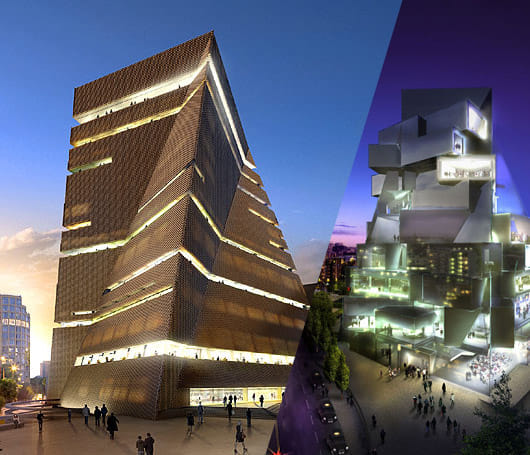
Before/After: Herzog & de Meuron’s latest redesign (left) and the previous design (right)

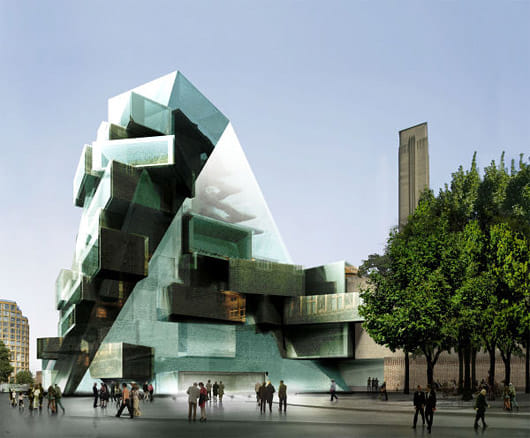
These revisions have been shaped by a desire to integrate the new building both with the existing building and the local environment. The oil tanks lead directly into the Turbine Hall and these interconnecting spaces will become the foundation of the new Tate Modern. This closer relationship between the buildings is expressed in the façade, which uses brick in a radical new way by creating a perforated brick screen through which was the building will glow at night. The building is more compact than in the previous scheme which built up of stacked boxes and the configuration is more flexible to allow for future changes in the program.

The revised building also sets new benchmarks for museums and galleries in the UK for both sustainability and energy use. By exploiting heat emitted from EDFE’s relocated transformers and employing passive design principles wherever practicable the scheme will use 40% less energy, and 35% less carbon than building regulations demand.

The scheme includes more varied spaces for Tate’s growing Collection and better facilities for the gallery’s popular learning programs. The new building rises 65 meters above ground in 11 levels and will add an additional 21,500 sq meters to Tate Modern’s existing 35,000 sq meters. A sweeping ceremonial route rises up through the floors providing a connecting path through the galleries and offering stunning views over London.
image
The first design of the Tate Modern expansion had to be revised

A new north/south route through the building will link Southwark to the City of London and will be open 12 hours a day. Two new public spaces will be created – a southern square modeled as a city piazza with the potential for special commissions and performance, and new gardens to the west designed for families and children.
Two oil tanks will be dedicated to installation, display, performance and film. In addition a further two large ‘as found’ gallery spaces will be used for artists’ commissions and other projects. The project includes a new flexible exhibition space with 6m high ceilings, clusters of top-lit galleries suitable for larger works and groups of more intimate galleries designed for small-scale works. There will also be a dedicated Children’s Gallery and photography and works on paper galleries.
Overall the project will also address some of the strains on the current building. The gallery was originally designed for 2 million visitors. With current visitor numbers exceeding 5 million, there is serious overcrowding particularly at weekends. Changes in contemporary art practice mean that different kinds of spaces are required and additional space is needed so works can be brought out of storage and shown on a more permanent basis. Since 2000, there have been 2 million participants in Tate Modern’s learning programs and existing spaces are operating at capacity.
The project is due to be completed in 2012 at estimated cost of £215 million at 2012 prices. To date Tate has received £50 million from Government, £7 million from the London Development Agency and £13 million from the private sector towards the overall costs. 

Related

europe ● london ● united kingdom ● tate modern ● herzog & de meuron ● redesign ● update

Share

  • Follow

    0 Comments

  • Comment as :

Transforming Tate Modern: Green Scheme for Herzog & de Meuron's Redesign

Northwestern University selects 12-firm longlist to design new engineering building

New architecture and design competitions: Exploring 130 Years of American Design, Christo & Jeanne-Claude Center, 13 White Houses, and La Pyramide

Micro-architecture honored in latest Tiny House Architecture Competition

World’s most beautiful restaurants of 2026 chosen by Prix Versailles

Sponsored Post by Buildner

Design a wine tasting room in Italy! Valli Wine Tasting Room is launched!

10 can't-miss architecture & design events to see this June in London, Los Angeles, Chicago, San Francisco, Detroit, San Diego, Porto, and Barcelona

Sponsored Post by Buildner

Museum of Emotions / Edition #8 FINAL registration deadline is approaching!

Seven global projects make AR Public Awards shortlist 2026

Sign up for Bustler's Email Newsletters

Sponsored Post by Buildner

Design a slow-living restaurant in Portugal! Portugal Long Table Restaurant is launched!

World's best tall buildings honored at the CVU 2026 Award of Excellence

Sponsored Post by TWOPAGES

Final call: TWOPAGES X Design Contest 2026 submissions close June 5

Kengo Kuma & Paul Raff win Alberta national park visitor center competition with landscape-focused design

2026 Moira Gemmill and MJ Long prizes announced by W Awards

New architecture and design competitions: Kinderspace, Stewardson Keefe LeBrun Travel Grant, SMALL PROJECT BIG IMPACT, and Garden of University House, Bucharest

The Century of Gehry: New retrospective explores the late architect's work & collaborations

Next page » Loading

Transforming Tate Modern: Green Scheme for Herzog & de Meuron's Redesign

By Bustler Editors|

Friday, Jul 18, 2008

Share

Related

europe ● london ● united kingdom ● tate modern ● herzog & de meuron ● redesign ● update

Tate Director, Nicholas Serota, and leading architect Jacques Herzog of Herzog & de Meuron, today revealed the revised plans for the new development of Tate Modern.

In response to a revised brief and consultation with artists and curators, the architects have refined designs to create a dramatic new museum for the 21st century. At the heart of the updated plans are the unique oil tanks of the former power station which will be retained as raw spaces for art and from which the new building will rise. In the previous scheme the oil tanks were occupied by an auditorium and other facilities.

image
Before/After: Herzog & de Meuron’s latest redesign (left) and the previous design (right)

These revisions have been shaped by a desire to integrate the new building both with the existing building and the local environment. The oil tanks lead directly into the Turbine Hall and these interconnecting spaces will become the foundation of the new Tate Modern. This closer relationship between the buildings is expressed in the façade, which uses brick in a radical new way by creating a perforated brick screen through which was the building will glow at night. The building is more compact than in the previous scheme which built up of stacked boxes and the configuration is more flexible to allow for future changes in the program.

The revised building also sets new benchmarks for museums and galleries in the UK for both sustainability and energy use. By exploiting heat emitted from EDFE’s relocated transformers and employing passive design principles wherever practicable the scheme will use 40% less energy, and 35% less carbon than building regulations demand.

The scheme includes more varied spaces for Tate’s growing Collection and better facilities for the gallery’s popular learning programs. The new building rises 65 meters above ground in 11 levels and will add an additional 21,500 sq meters to Tate Modern’s existing 35,000 sq meters. A sweeping ceremonial route rises up through the floors providing a connecting path through the galleries and offering stunning views over London.
image
The first design of the Tate Modern expansion had to be revised

A new north/south route through the building will link Southwark to the City of London and will be open 12 hours a day. Two new public spaces will be created – a southern square modeled as a city piazza with the potential for special commissions and performance, and new gardens to the west designed for families and children.
Two oil tanks will be dedicated to installation, display, performance and film. In addition a further two large ‘as found’ gallery spaces will be used for artists’ commissions and other projects. The project includes a new flexible exhibition space with 6m high ceilings, clusters of top-lit galleries suitable for larger works and groups of more intimate galleries designed for small-scale works. There will also be a dedicated Children’s Gallery and photography and works on paper galleries.
Overall the project will also address some of the strains on the current building. The gallery was originally designed for 2 million visitors. With current visitor numbers exceeding 5 million, there is serious overcrowding particularly at weekends. Changes in contemporary art practice mean that different kinds of spaces are required and additional space is needed so works can be brought out of storage and shown on a more permanent basis. Since 2000, there have been 2 million participants in Tate Modern’s learning programs and existing spaces are operating at capacity.
The project is due to be completed in 2012 at estimated cost of £215 million at 2012 prices. To date Tate has received £50 million from Government, £7 million from the London Development Agency and £13 million from the private sector towards the overall costs. 

Share

  • Follow

    0 Comments

  • Comment as :

Archinect JobsArchinect Jobs

The Archinect Job Board attracts the world's top architectural design talents.

VIEW ALL JOBS POST A JOB

Design Architect

JLK Architects

Design Architect

Chicago, IL, US

Architect / Urban Designer

Office for the Next Environment (OFTN)

Architect / Urban Designer

New York, NY, US

Job Captain

Studio AR&D Architects

Job Captain

Los Angeles, CA, US

Architecture Project Manager

RDH Architecture + Interior Design

Architecture Project Manager

Las Vegas, NV, US

Intermediate Architect

IMC Architecture

Intermediate Architect

Brooklyn, NY, US

Office Assistant / Studio Coordinator

Beinfield Architecture PC

Office Assistant / Studio Coordinator

Norwalk, CT, US

Interior Designer, 5+ Years Experience

Cass Calder Smith

Interior Designer, 5+ Years Experience

San Francisco, CA, US

Architectural Designer II

Studio AR&D Architects

Architectural Designer II

Los Angeles, CA, US

Project Designer / Job Captain

Solutions Architecture Corp

Project Designer / Job Captain

Verona, NJ, US

Project Architect/ Designer

Nandinee Phookan Architect, P.C.

Project Architect/ Designer

New York, NY, US

Next page » Loading