• Login / Join
  • About
  • •
  • Contact
  • •
  • Advertising
bustler logo
bustler logo
  • News
  • Competitions
  • Events
  • Bustler is powered by Archinect
  • Sign up for Bustler's Email Newsletters

  • Follow these Bustler feeds:

  • Search

    Search in

  • Submit

    What are you submitting?

    News Pitch
    Competition
    Event
  • Login / Join
  • News|Competitions|Events
  • Search
    | Submit
    | Follow
  • Search in

    What are you submitting?

    News Pitch
    Competition
    Event

    Follow these Bustler feeds:

  • About|Contact|Advertising
  • Login / Join

Winners of Borderless: Designing Future ASEAN Borders

By Bustler Editors|

Thursday, May 2, 2013
First Prize: "Floating Border Project"

Winning design schemes have just been announced in the international competition Borderless: Designing Future ASEAN Borders. The competition brings attention to the spaces along the borders of the 10 members of ASEAN, the Association of Southeast Asian Nations, with the aim of improving their existing conditions. The jury selected three winning designs and three honorable mentions out of 200 submissions from over 30 countries.

While there has been much discussion about achieving a "borderless" condition among ASEAN nations through economic and legislative initiatives, currently, the actual border spaces themselves have been neglected and are lagging behind these developments.

For many people inhabiting these areas, the border remains a place of division and uncertainty. Outdated infrastructure affects their sense of security and livelihood. Socio-economic and cultural differences lead to misunderstandings and inequalities. In some areas, borders have become spaces of conflict and dispute.

“In order to achieve "borderless", we must understand the space of the borders themselves,” said jury member Luke Yeung.

The competition was seeking solutions that can demonstrate how architecture can re-define the future of ASEAN borders. By focusing on local border sites, specific cultural, social and ecological issues had to be addressed while engaging in larger spatial and institutional scales.

The competition jury was composed of:

  • Vo Trong Nghia, Takashi Niwa, Masaaki Iwamoto, Vo Trong Nghia Architects, Vietnam
  • Takaharu Tezuka, Tezuka Architects, Japan
  • Boonserm Premthada, Bangkok Project Company, Thailand
  • Ary Indra, Rafael David, Johansen Yap, Aboday, Indonesia
  • Luke Yeung, Jariyawadee Lekawatana, Architectkidd, Thailand

Following are the three winning concepts and three honorable mentions.

First Prize: "Floating Border Project"
Hélène Grialou (France)
Sebastien Gafari (France)

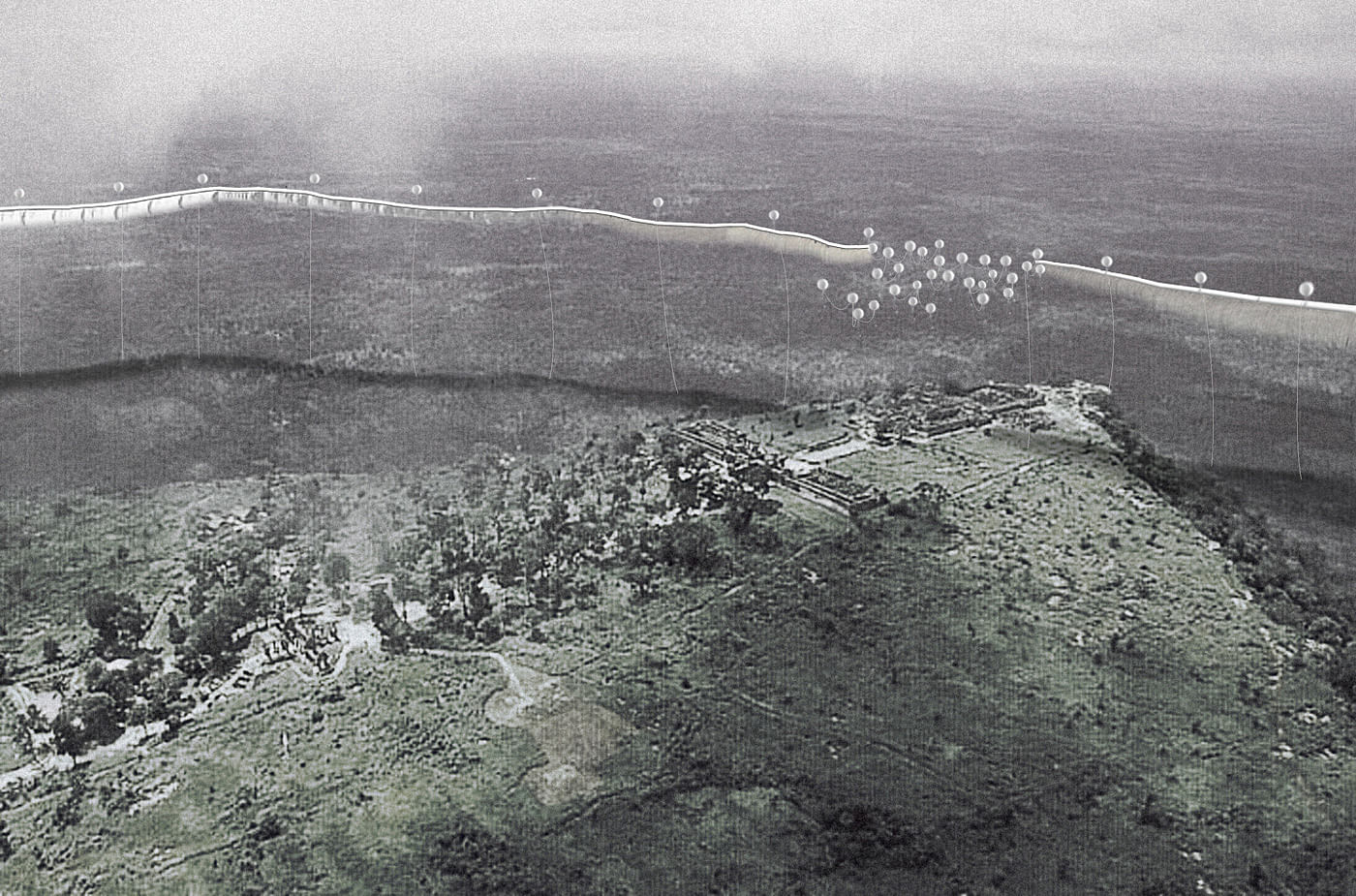
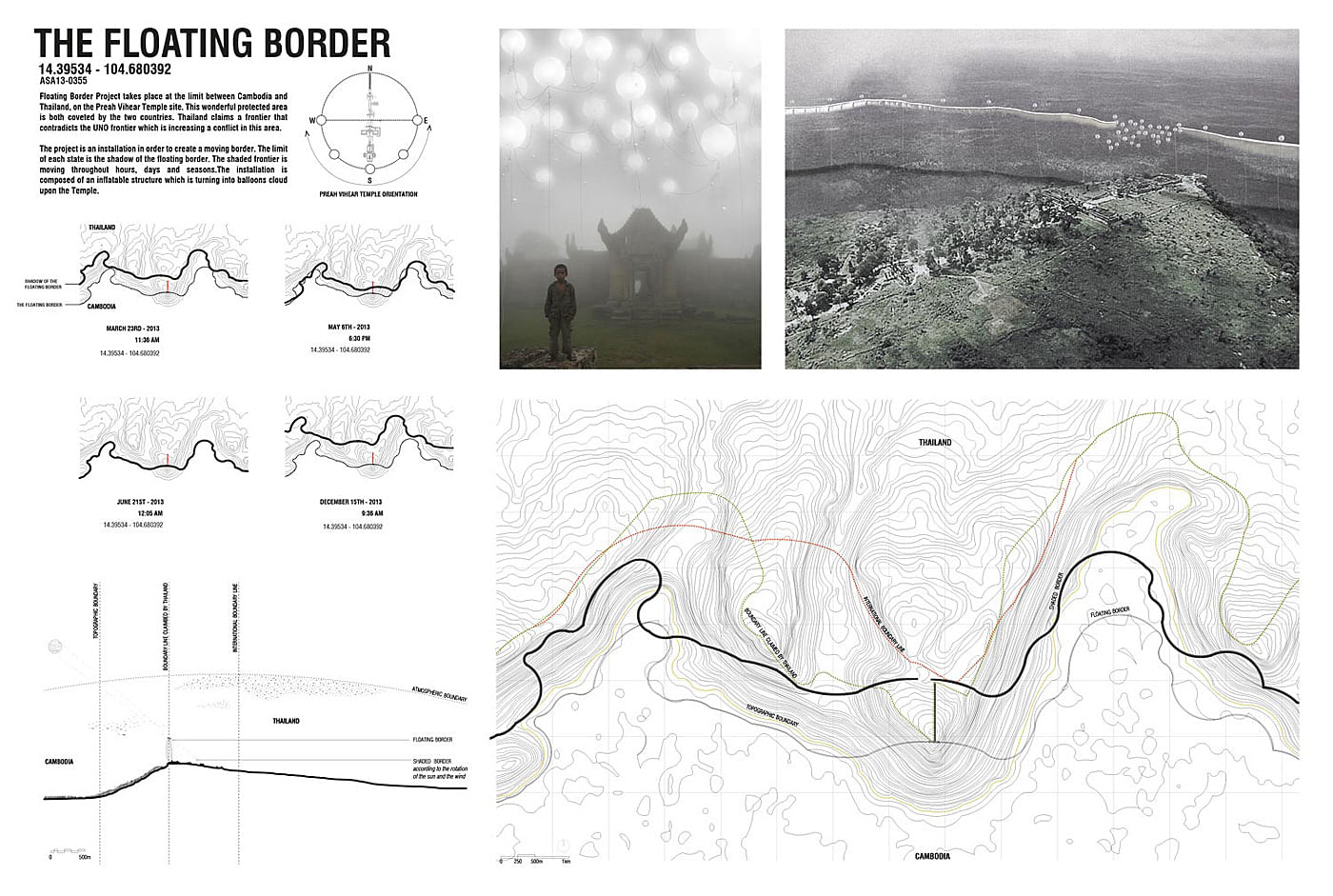
The Floating Border Project takes place at the limit between Cambodia and Thailand, on the Preah Vihear Temple site. This UNESCO World Heritage protected area is coveted by the two countries. The border area is currently in dispute and each country has presented their claims along the border area to the International Court of Justice.
First Prize: "Floating Border Project"

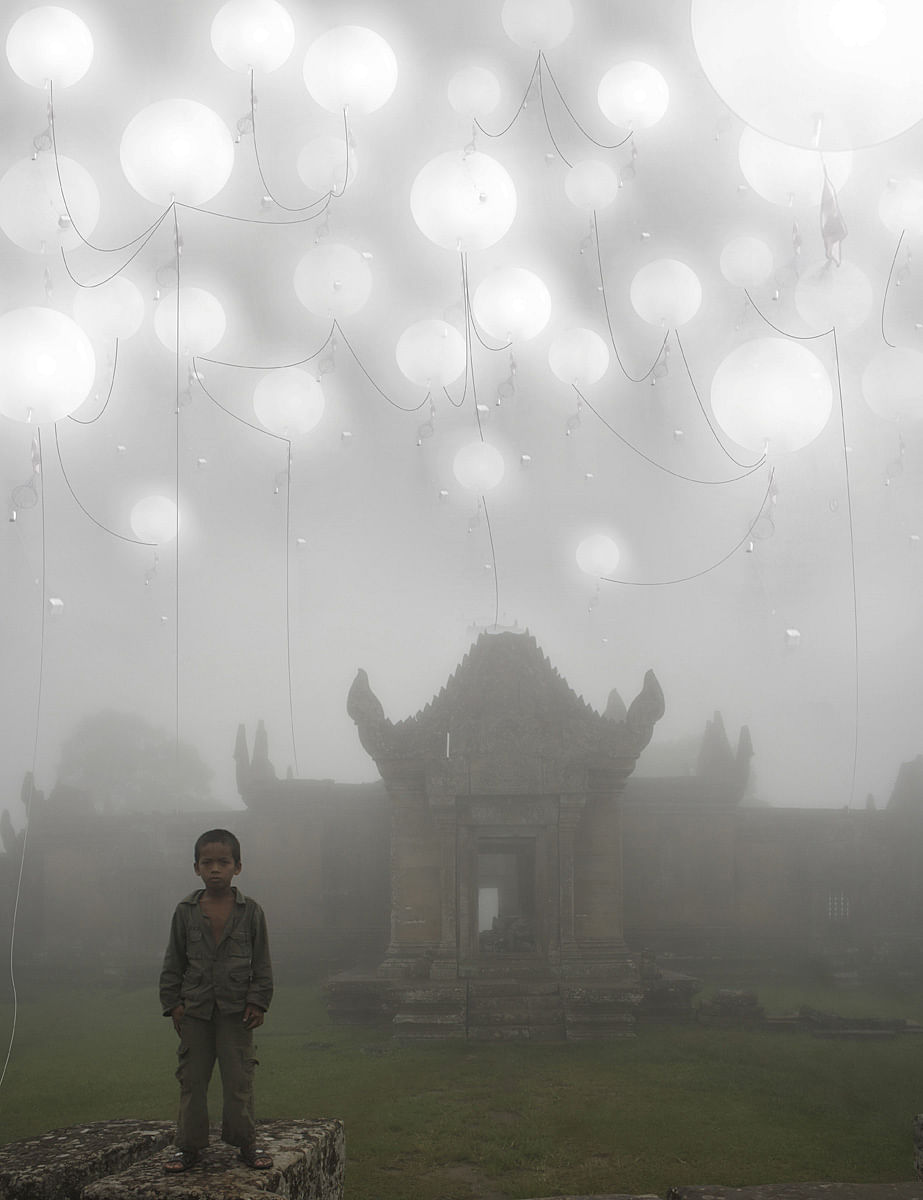
The project is an installation in order to create a moving border. The limit of each state is the shadow of the floating border. The shaded frontier is moving throughout hours, days and seasons. The installation is composed of an inflatable structure which consists of a balloon cloud upon the Temple.
First Prize: "Floating Border Project"

These balloons calculate the weather forecast, wind and luminosity. During bad weather, the limit on the ground disappears and the aerial structure lights up to become a signal seen by the both two countries.

According to Jurors Vo Trong Nghia and Masaaki Iwamoto, this was a "poetic proposal. The entrant successfully created an ambiguous and phenomenal borderline with the help of solar orbit. The proposal challenges us to understand the condition of "borderless" without relying on any programmatic and ideological solution."

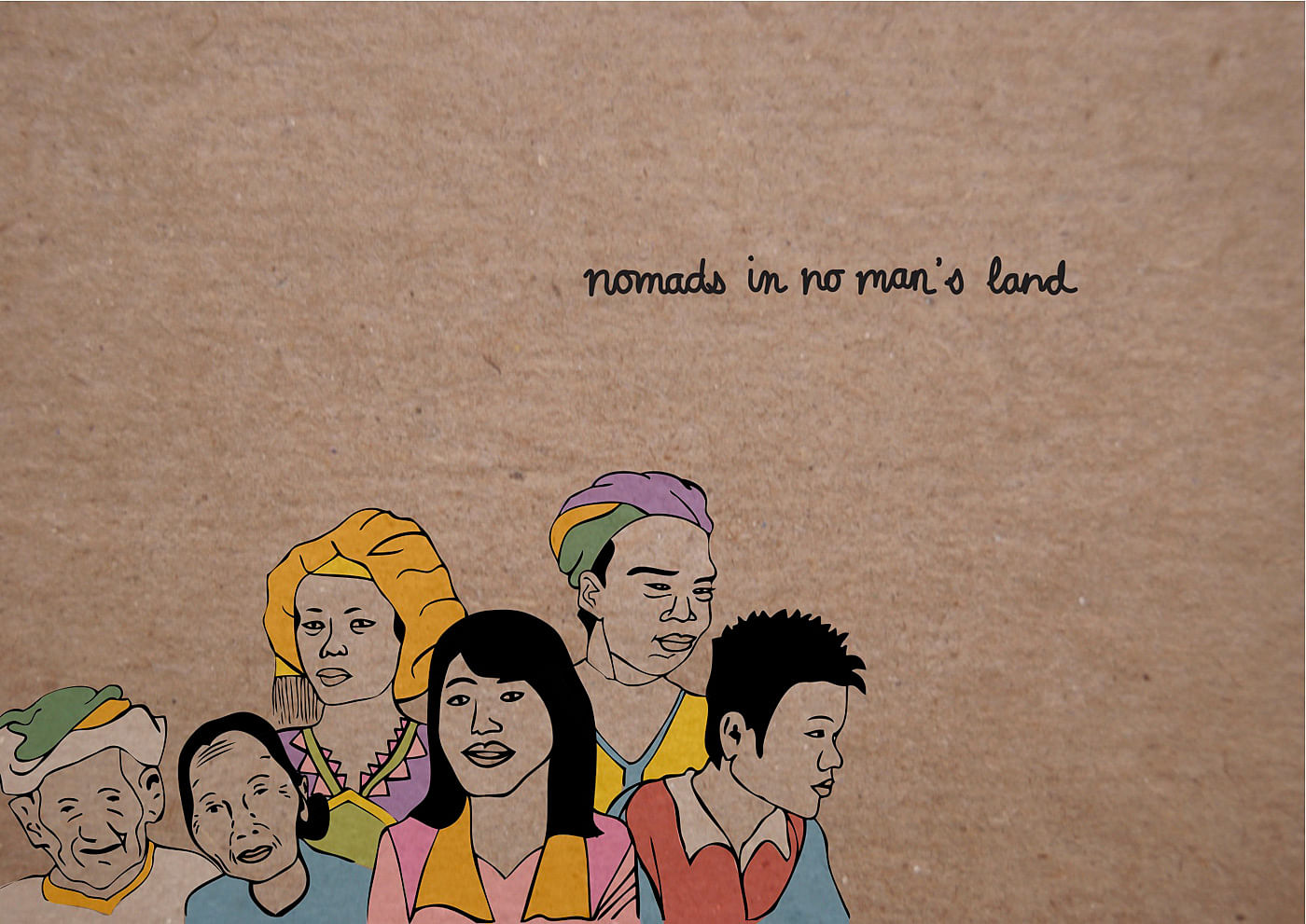
Second Prize: "Nomads in No Man's Land"
Laura van Santen (The Netherlands)

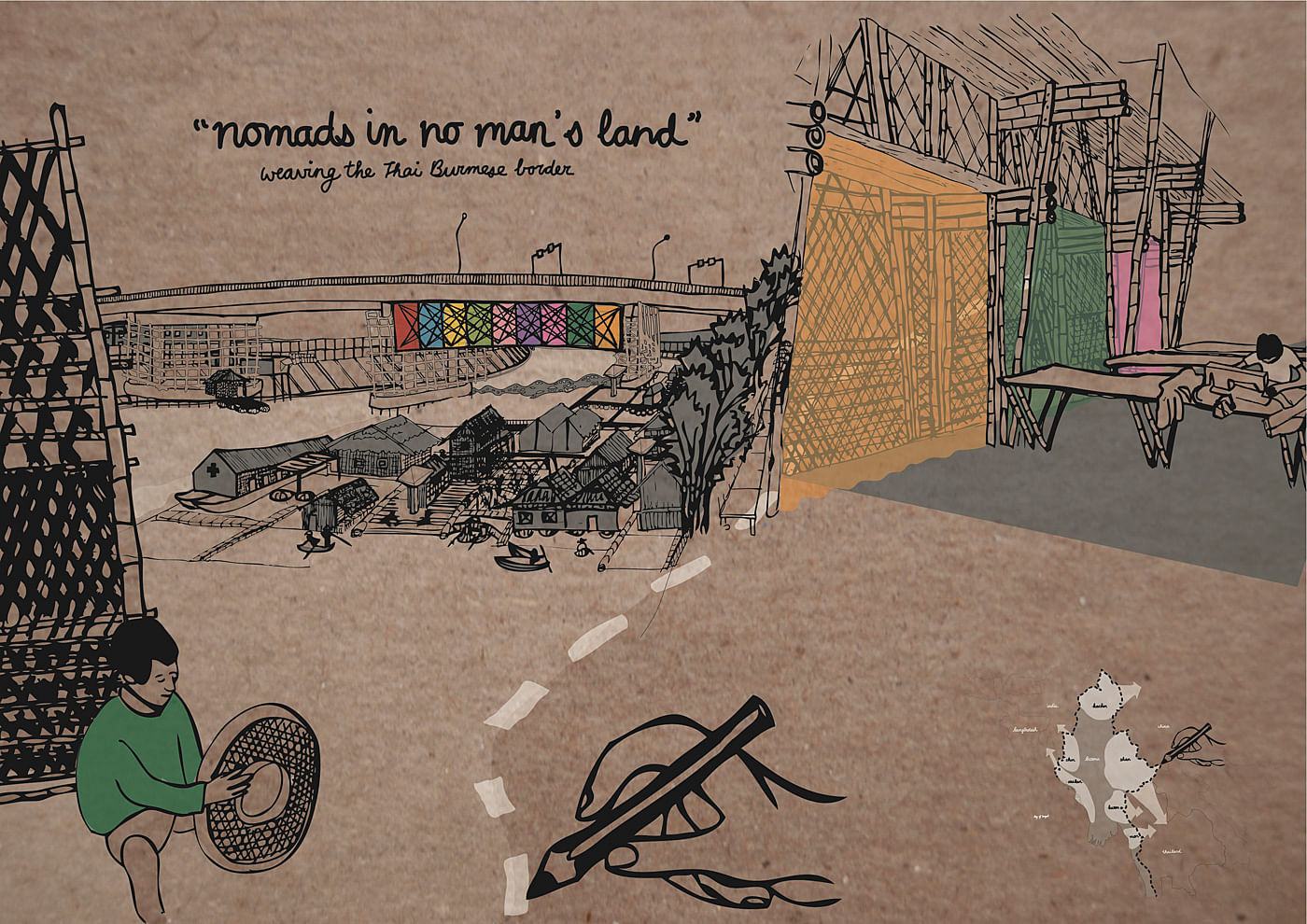
There is a Burmese saying, "difficult to move forward, difficult to move back". The border area between Burma and Thailand is defined by the interweaving of formal and formal flows, spaces, activity, and services.
Second Prize: "Nomads in No Man's Land"

How can we design for large communities that are collectively on the move, to better economical, political, social or environmental circumstances residing permanently in temporary locations?
Second Prize: "Nomads in No Man's Land"

The main potential lies in the possibility for refugees to inhabit in-between space. The economic catalyst for such a settlement would be a garment factory housed in a parasitic bamboo structure suspended under the existing 'friendship' bridge.

Second Prize: "Nomads in No Man's Land"

This allows Burmese migrants to work and live in unconstrained spatial circumstances with optimization of humanitarian aid. An extraterritorial settlement will form on the river that represents the border between the two countries, built up of renewable and recycled materials.

Project video: "Nomads in No Man's Land"

According to Juror Luke Yeung, "what begins as a community-based approach transforms into a greater treatise on architecture and society. The issues presented (borders, livelihoods, infrastructure) are far-reaching yet brought together and connected by a moving and intimate narrative."

Third Prize: "The Temple and the Portico"
Ludovico Centis (Italy)
Yoichi Iwamoto (Japan / Italy)

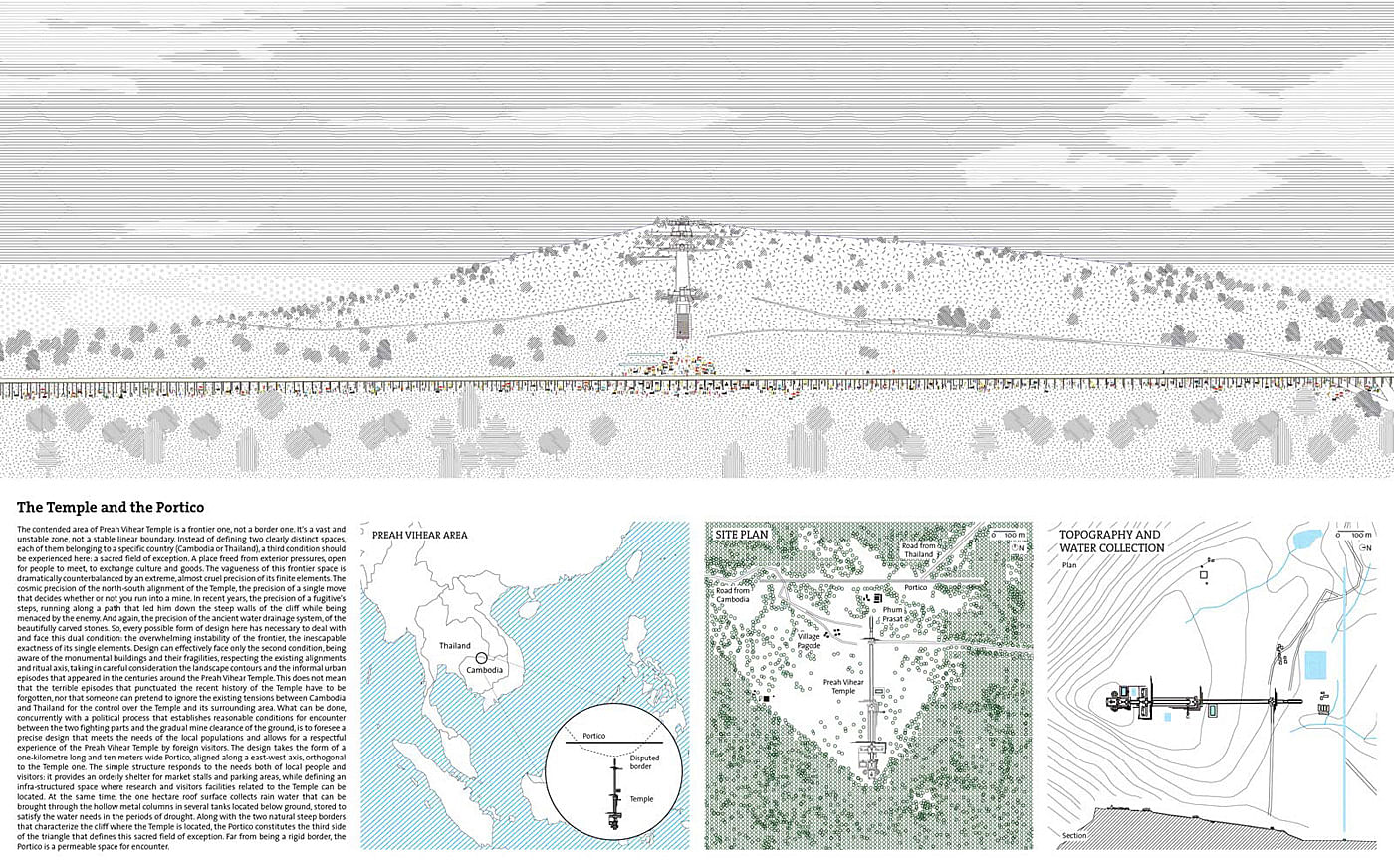
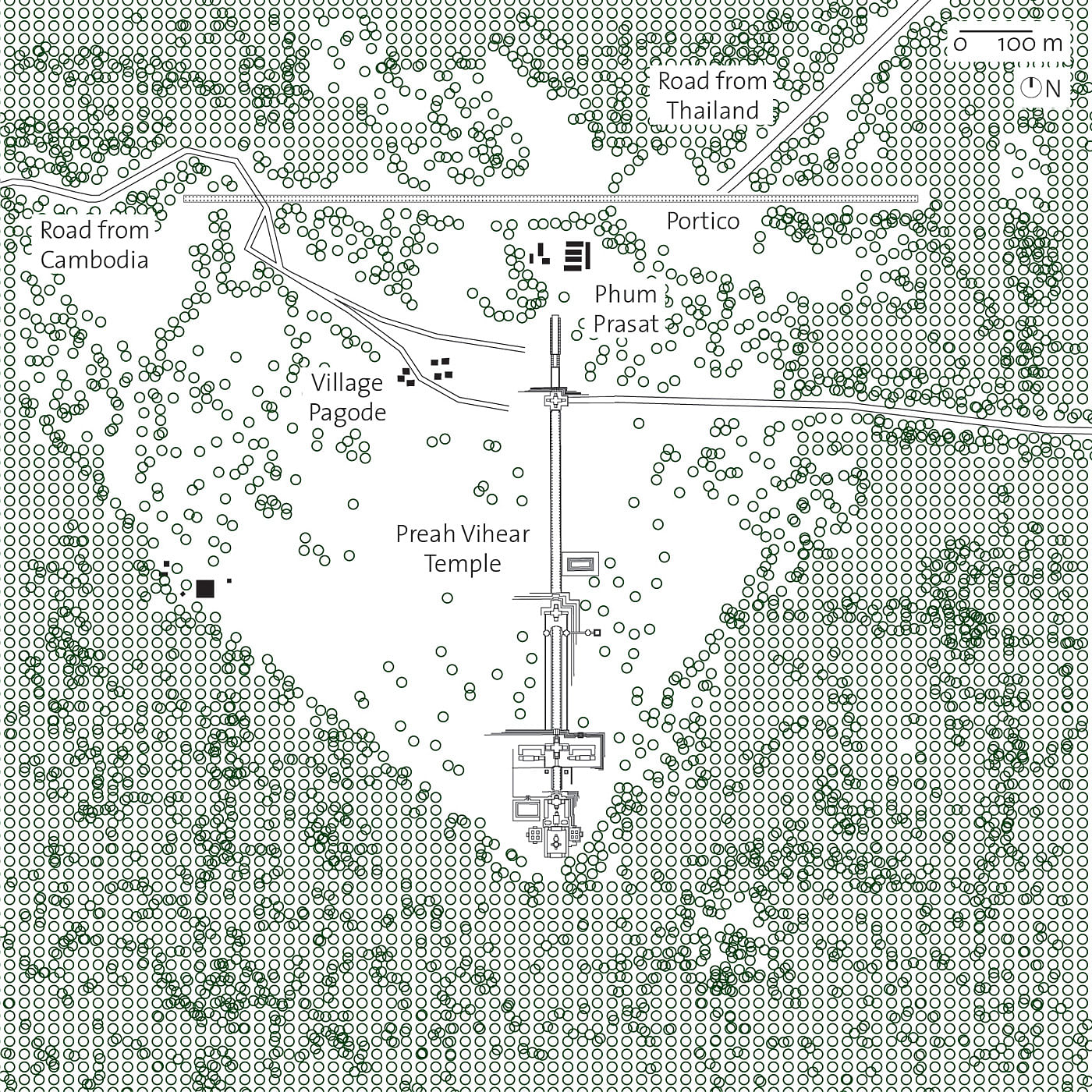
The contended area of Preah Vihear Temple is a frontier one, not a border one. It's a vast and unstable zone, not a stable linear boundary. Instead of defining two clearly distinct spaces, each of them belonging to a specific country (Cambodia or Thailand), a third condition should be experienced here: a sacred field of exception. A place freed from exterior pressures, open for people to meet, to exchange culture and goods. The vagueness of this frontier space is dramatically counterbalanced by an extreme, almost cruel precision of its finite elements.
Third Prize: "The Temple and the Portico"

The simple proposed structure responds to the needs both of local people and visitors: it provides an orderly shelter for market stalls and parking areas, while defining an infra-structured space where research and visitors facilities related to the Temple can be located.
Third Prize: "The Temple and the Portico"

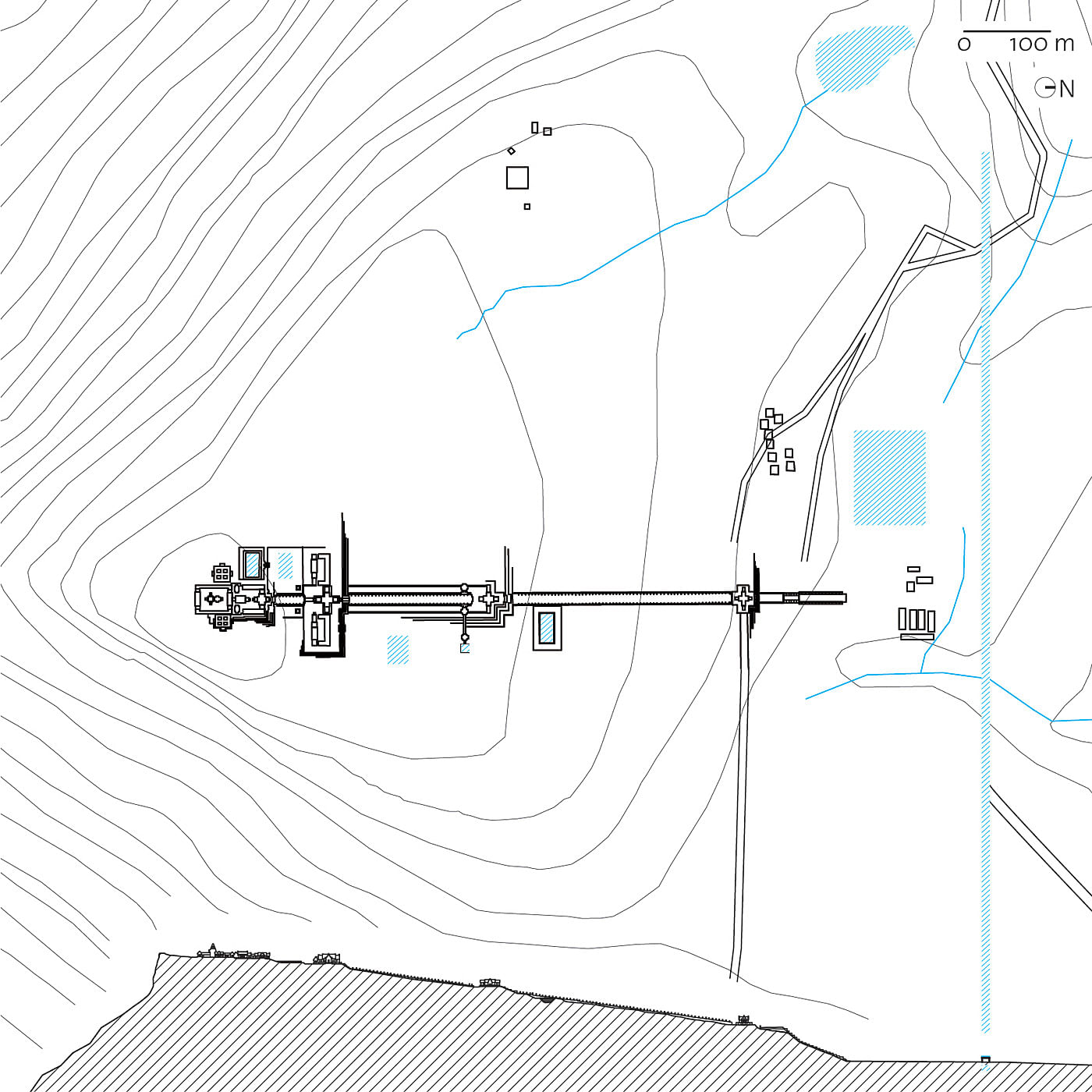
At the same time, the one hectare roof surface collects rain water that can be brought through the hollow metal columns in several tanks located below ground, stored to satisfy the water needs in the periods of drought. Along with the two natural steep borders that characterize the cliff where the Temple is located, the Portico constitutes the third side of the triangle that defines this sacred field of exception. Far from being a rigid border, the Portico is a permeable space for encounter.
Third Prize: "The Temple and the Portico"

Vo Trong Nghia and Masaaki Iwamoto comment: "The entrant successfully recognizes this temple between Cambodia and Thailand as a shared entity beyond history and nationality. The idea of creating "a sacred field of exception" by inserting linear object into curved borderline and organizing the program as a linear object, is also persuasive."

Honorable Mention 1: "Shared Border and Shared Culture"
Nam Sang Hyun (South Korea)
Choi Young Jun (South Korea)
Ju Myeong Hyeon (South Korea)

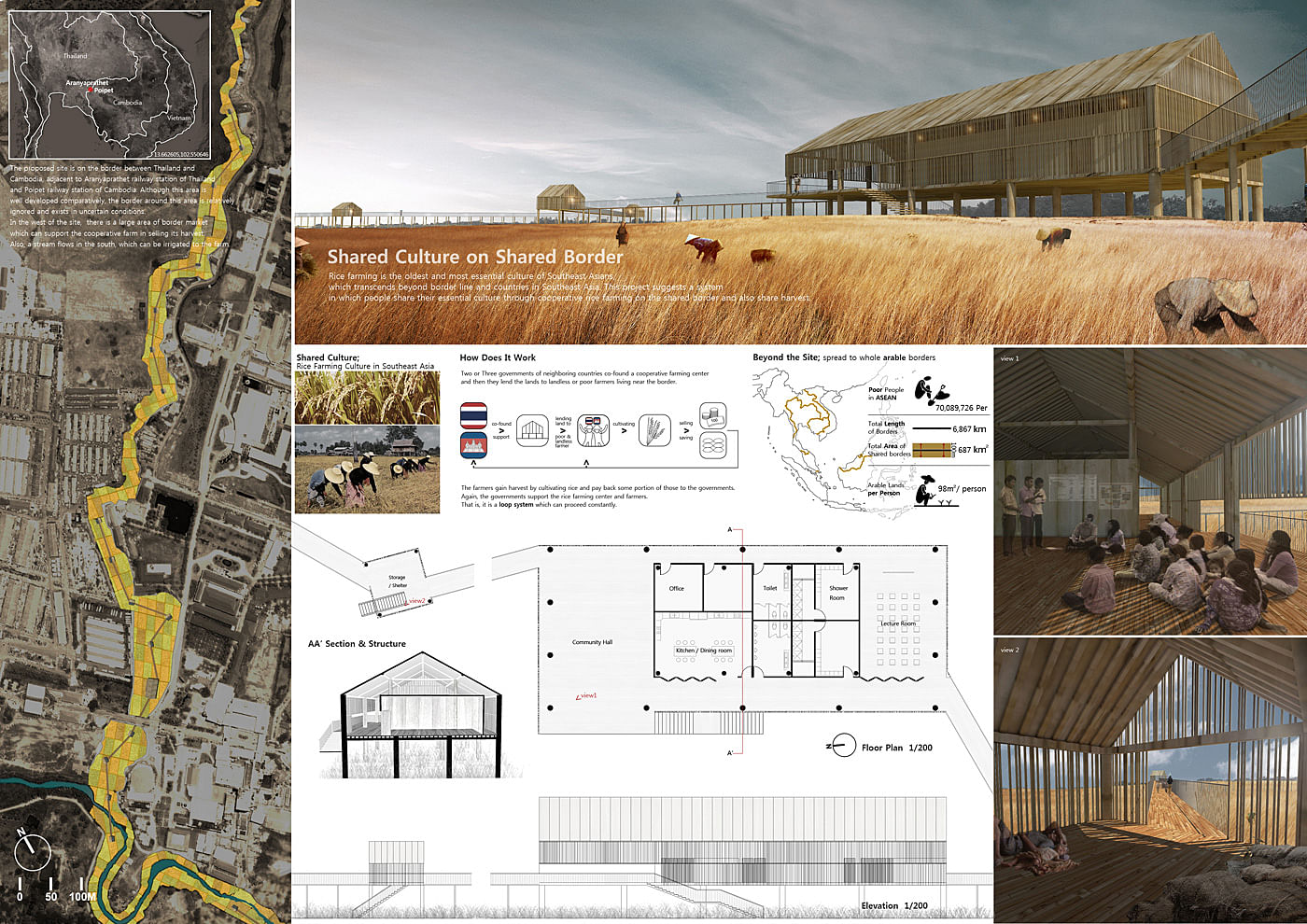
Rice farming is the oldest and most essential culture for Southeast Asians, and transcends beyond border lines and countries. It is practiced not by individuals but by communities based on cooperation. This project suggests a system in which people share their essential culture through cooperative rice farming on the shared border.
Honorable Mention 1: "Shared Border and Shared Culture"

The proposed architecture consists of 3 parts: a main building, small storage and shelters, and bridges unifying the whole architecture. The main building has a program of training farmers to improve agricultural knowledge and technique. Also it has a space for various events held by the farmers from different countries in order to activate the community. Other programs such as small kitchen, dining room, toilets, shower room and offices also provide support. Small buildings standing along the rice fields function as storage for farming tools, equipment and harvest. Finally, the bridges integrate the entire structure while also functioning as passages for the workers.

Traditionally, Southeast Asian architecture has characteristics based on the tropical and monsoon climate. The walls that create architecture usually do not create distinct separation from natural ventilation and light, thus erasing borders between outside and inside. The proposed architectural design applies common characteristics of Southeast Asian architecture in order to respect and embrace the whole context of Southeast Asia. These characteristics have an effect on blurring the visual borders by the structures.

According to Juror Takashi Niwa: "Agriculture is one of the most important topics for every country, so this proposal could be a good model of development in Asia. The ideas have possibility that the border could be a center for agricultural education between two countries. As agricultural work requires collaboration, this proposal succeeds in connecting each people from two sides closely and realizing development with a peaceful activity."

Honorable Mention 2: "Moving Bridge"
Ilman Harun (Indonesia)
Ho Phuong Thanh (Vietnam)
Cheng Wei Chung (Taiwan)

South-East Asian countries are composed by natural elements such as seas and rivers. Mekong, one of the most important river in this area, serves as a natural border along 5 ASEAN countries (Myanmar, Laos, Thailand, Cambodia and Vietnam).
Honorable Mention 2: "Moving Bridge"

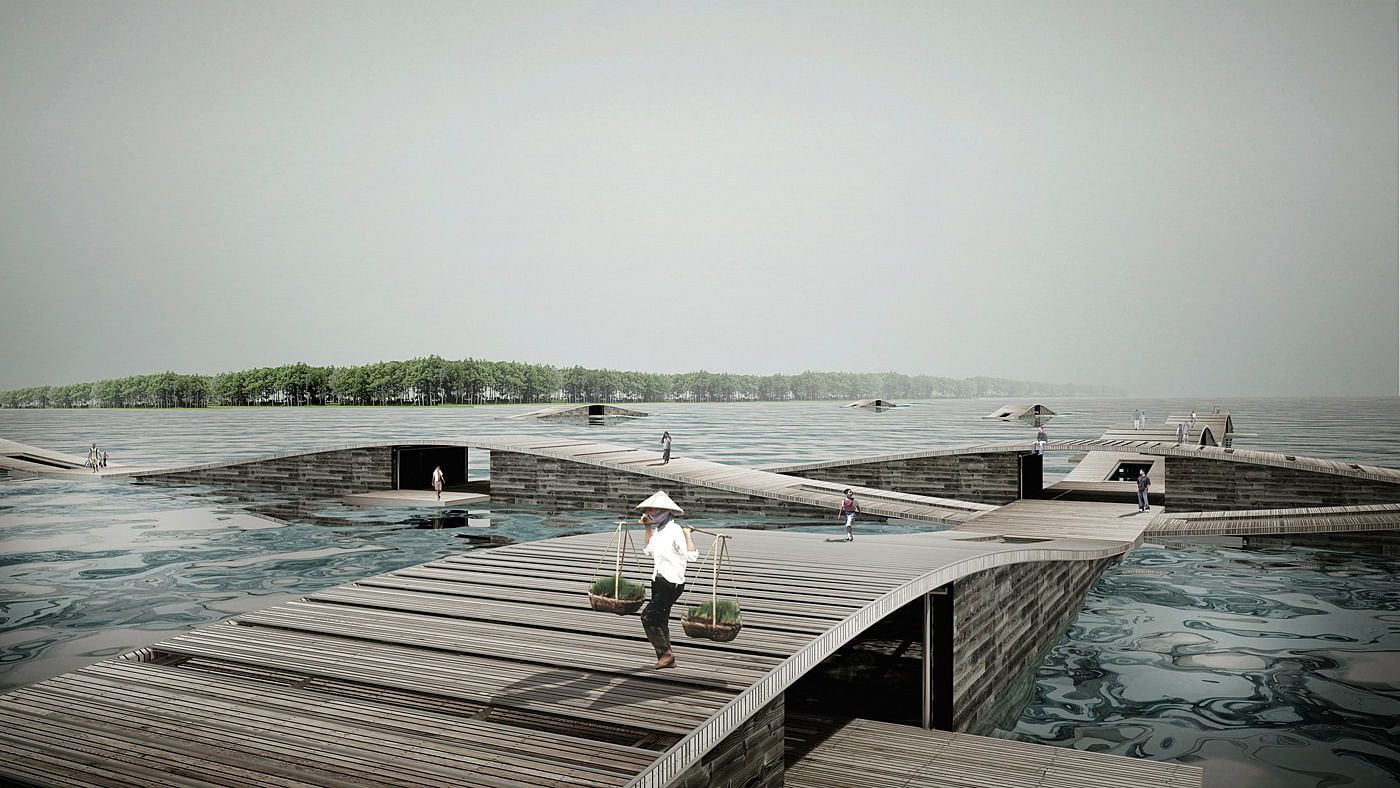
The approach aims to inspire and at the same time conserve and reinterpret existing public spaces on the water, such as water markets, which not only provide economic activities but also possess traditional heritage.

The proposal builds on the traditional wooden boat, as a movable object as well as being familiar construction for local people. Boat construction can also be used in a modular way, and has possibilities to re-use, expand, grow and adapt to different riverbank conditions.

Project video: "Moving Bridge"

This new interpretation of boats has curved shapes that connect each other with combinations to form bridges providing continuous space and movement. People are free to choose their circulation on the roof as pathways and below there are exhibition functions and spaces.

The intimate feeling inside and spacious feeling outside support the process of new spatial relation and cooperation. As people move from inside to outside, the experience and the feeling changes dramatically from being intimate (local space) to being free (global space. Inspired by spacious views and the feeling of different smells, sounds and winds from the river, people will have new ways and perspectives to see their homeland as well as the neighboring country’s land.

Juror Boonserm Premthada comments: "This proposal succeeds in expressing the relationship of the river and transportation, and transforming it to be a connection for people along the water's surface."

Honorable Mention 3: "Series of Thresholds"
Saran Chaiyasuta (Thailand)

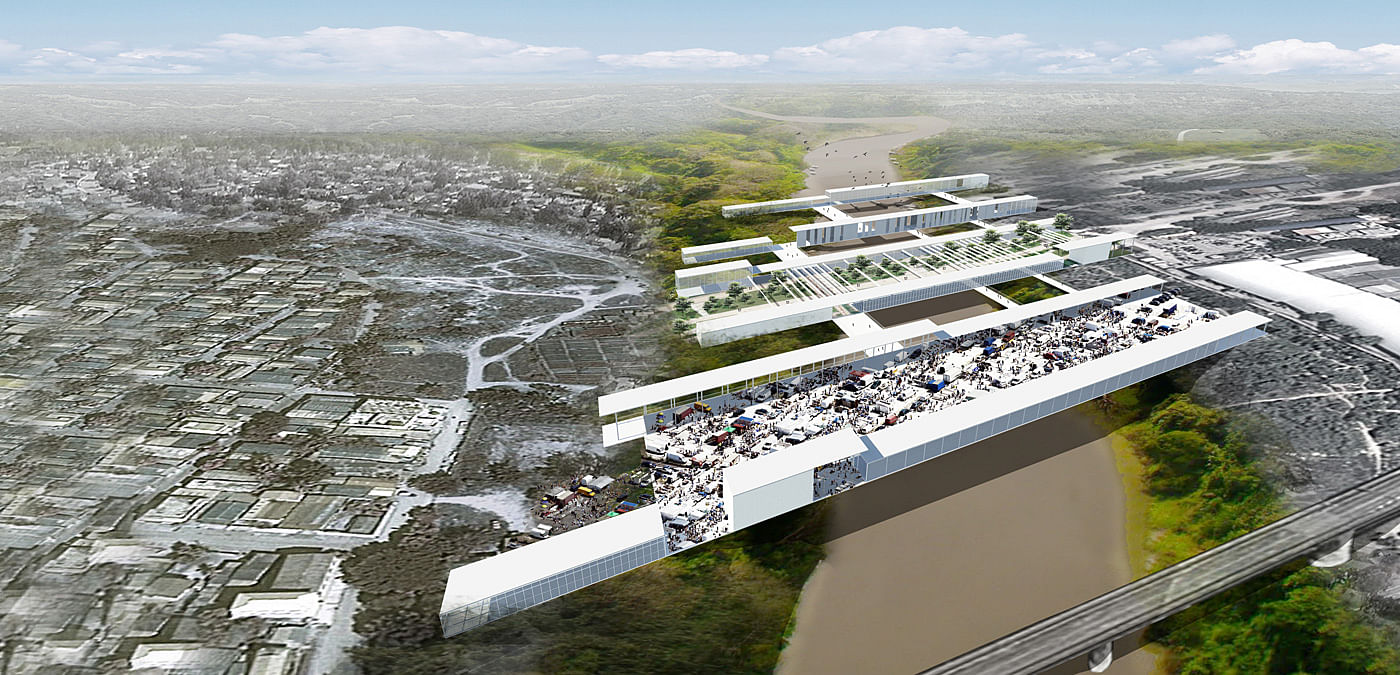
The borderline between Myawaddy, Myanmar and Mae Sot, Thailand along Moei River is an obvious natural boundary that cuts through city soil and people. But if we look beyond the concept of line and investigate the separation as a land or area, we can understand and redefine the meaning of situation in different layers.
Honorable Mention 3: "Series of Thresholds"

The goal of this proposal is not to read architecture as construction elements - column, slab, window, etc. - but to read them as tools to form and craft space - enclosed/opened, distribution/clustered, high-dense/low-dense, and solid/transparent. Secondly, architecture is a subject, in the way we focus on the performance of architecture and its effects - public, private, connected, disconnected, etc. In other words, the objective is to create what will happen in architecture.

Project video: "Series of Thresholds"

The use of the relationship between these two angles of reading architecture will be by instruments to shape space in order to accommodate activities by determining numbers of different conditions. The relationship between each conditional space is constituted by sequence of conditions themselves and together this creates a series of boundaries as thresholds of transition and connection, creating new experiences, the experience of borderless society.

Juror Boonserm Premthada comments: "There is a strong research in this project along with expressing physical and concrete notions of architecture to create new living spaces."

All images courtesy of Borderless Competition. To see more design entries and project videos, visit the competition's Facebook page.

Related

southeast asia ● borderless competition ● border ● asia ● asean

Share

  • Follow

    0 Comments

  • Comment as :

Winners of Borderless: Designing Future ASEAN Borders

Eight innovative timber projects honored at 2026 Wood in Architecture Awards

Beautiful brick architecture honored at BRICK AWARD 26

Over $500,000 awarded to architectural discourse projects by Graham Foundation

Best in urban planning recognized at AIA Regional & Urban Design Award 2026

Sponsored Post by Buildner

Re:Form - New Life for Old Spaces / Edition #3 advance registration deadline is approaching!

New architecture and design competitions: IDEAS Awards, UIA-HYP CUP International Student Competition, Vancouver Tall Challenge, and Memorial to the Sixth Extinction

Best small projects chosen at AIA Small Project Award 2026

10 standout sustainable projects honored at AIA COTE Top Ten Award 2026

Sign up for Bustler's Email Newsletters

Best residential architecture of 2026 honored at AIA Housing Award

Best new interiors of 2026 chosen at AIA Interior Architecture Awards

Best global architecture honored at RIBA International Awards 2026

World’s most beautiful airports of 2026 chosen by Prix Versailles

New architecture and design competitions: Brick in Architecture Awards, Study Architecture Student Showcase, N.Y.C. Groceries, and New York High Falls Riverfront Market

SmithGroup’s ‘pioneering’ Philip Merrill Environmental Center wins AIA Twenty-five Year Award

Sponsored Post by Buildner

Museum of Emotions / Edition #8 FINAL registration deadline is in 5 DAYS!

Next page » Loading

Winners of Borderless: Designing Future ASEAN Borders

By Bustler Editors|

Thursday, May 2, 2013

Share

First Prize: "Floating Border Project"

Related

southeast asia ● borderless competition ● border ● asia ● asean

Winning design schemes have just been announced in the international competition Borderless: Designing Future ASEAN Borders. The competition brings attention to the spaces along the borders of the 10 members of ASEAN, the Association of Southeast Asian Nations, with the aim of improving their existing conditions. The jury selected three winning designs and three honorable mentions out of 200 submissions from over 30 countries.

While there has been much discussion about achieving a "borderless" condition among ASEAN nations through economic and legislative initiatives, currently, the actual border spaces themselves have been neglected and are lagging behind these developments.

For many people inhabiting these areas, the border remains a place of division and uncertainty. Outdated infrastructure affects their sense of security and livelihood. Socio-economic and cultural differences lead to misunderstandings and inequalities. In some areas, borders have become spaces of conflict and dispute.

“In order to achieve "borderless", we must understand the space of the borders themselves,” said jury member Luke Yeung.

The competition was seeking solutions that can demonstrate how architecture can re-define the future of ASEAN borders. By focusing on local border sites, specific cultural, social and ecological issues had to be addressed while engaging in larger spatial and institutional scales.

The competition jury was composed of:

  • Vo Trong Nghia, Takashi Niwa, Masaaki Iwamoto, Vo Trong Nghia Architects, Vietnam
  • Takaharu Tezuka, Tezuka Architects, Japan
  • Boonserm Premthada, Bangkok Project Company, Thailand
  • Ary Indra, Rafael David, Johansen Yap, Aboday, Indonesia
  • Luke Yeung, Jariyawadee Lekawatana, Architectkidd, Thailand

Following are the three winning concepts and three honorable mentions.

First Prize: "Floating Border Project"
Hélène Grialou (France)
Sebastien Gafari (France)

The Floating Border Project takes place at the limit between Cambodia and Thailand, on the Preah Vihear Temple site. This UNESCO World Heritage protected area is coveted by the two countries. The border area is currently in dispute and each country has presented their claims along the border area to the International Court of Justice.

First Prize: "Floating Border Project"

The project is an installation in order to create a moving border. The limit of each state is the shadow of the floating border. The shaded frontier is moving throughout hours, days and seasons. The installation is composed of an inflatable structure which consists of a balloon cloud upon the Temple.

First Prize: "Floating Border Project"

These balloons calculate the weather forecast, wind and luminosity. During bad weather, the limit on the ground disappears and the aerial structure lights up to become a signal seen by the both two countries.

According to Jurors Vo Trong Nghia and Masaaki Iwamoto, this was a "poetic proposal. The entrant successfully created an ambiguous and phenomenal borderline with the help of solar orbit. The proposal challenges us to understand the condition of "borderless" without relying on any programmatic and ideological solution."

Second Prize: "Nomads in No Man's Land"
Laura van Santen (The Netherlands)

There is a Burmese saying, "difficult to move forward, difficult to move back". The border area between Burma and Thailand is defined by the interweaving of formal and formal flows, spaces, activity, and services.

Second Prize: "Nomads in No Man's Land"

How can we design for large communities that are collectively on the move, to better economical, political, social or environmental circumstances residing permanently in temporary locations?

Second Prize: "Nomads in No Man's Land"

The main potential lies in the possibility for refugees to inhabit in-between space. The economic catalyst for such a settlement would be a garment factory housed in a parasitic bamboo structure suspended under the existing 'friendship' bridge.

Second Prize: "Nomads in No Man's Land"

This allows Burmese migrants to work and live in unconstrained spatial circumstances with optimization of humanitarian aid. An extraterritorial settlement will form on the river that represents the border between the two countries, built up of renewable and recycled materials.

Project video: "Nomads in No Man's Land"

According to Juror Luke Yeung, "what begins as a community-based approach transforms into a greater treatise on architecture and society. The issues presented (borders, livelihoods, infrastructure) are far-reaching yet brought together and connected by a moving and intimate narrative."

Third Prize: "The Temple and the Portico"
Ludovico Centis (Italy)
Yoichi Iwamoto (Japan / Italy)

The contended area of Preah Vihear Temple is a frontier one, not a border one. It's a vast and unstable zone, not a stable linear boundary. Instead of defining two clearly distinct spaces, each of them belonging to a specific country (Cambodia or Thailand), a third condition should be experienced here: a sacred field of exception. A place freed from exterior pressures, open for people to meet, to exchange culture and goods. The vagueness of this frontier space is dramatically counterbalanced by an extreme, almost cruel precision of its finite elements.

Third Prize: "The Temple and the Portico"

The simple proposed structure responds to the needs both of local people and visitors: it provides an orderly shelter for market stalls and parking areas, while defining an infra-structured space where research and visitors facilities related to the Temple can be located.

Third Prize: "The Temple and the Portico"

At the same time, the one hectare roof surface collects rain water that can be brought through the hollow metal columns in several tanks located below ground, stored to satisfy the water needs in the periods of drought. Along with the two natural steep borders that characterize the cliff where the Temple is located, the Portico constitutes the third side of the triangle that defines this sacred field of exception. Far from being a rigid border, the Portico is a permeable space for encounter.

Third Prize: "The Temple and the Portico"

Vo Trong Nghia and Masaaki Iwamoto comment: "The entrant successfully recognizes this temple between Cambodia and Thailand as a shared entity beyond history and nationality. The idea of creating "a sacred field of exception" by inserting linear object into curved borderline and organizing the program as a linear object, is also persuasive."

Honorable Mention 1: "Shared Border and Shared Culture"
Nam Sang Hyun (South Korea)
Choi Young Jun (South Korea)
Ju Myeong Hyeon (South Korea)

Rice farming is the oldest and most essential culture for Southeast Asians, and transcends beyond border lines and countries. It is practiced not by individuals but by communities based on cooperation. This project suggests a system in which people share their essential culture through cooperative rice farming on the shared border.

Honorable Mention 1: "Shared Border and Shared Culture"

The proposed architecture consists of 3 parts: a main building, small storage and shelters, and bridges unifying the whole architecture. The main building has a program of training farmers to improve agricultural knowledge and technique. Also it has a space for various events held by the farmers from different countries in order to activate the community. Other programs such as small kitchen, dining room, toilets, shower room and offices also provide support. Small buildings standing along the rice fields function as storage for farming tools, equipment and harvest. Finally, the bridges integrate the entire structure while also functioning as passages for the workers.

Traditionally, Southeast Asian architecture has characteristics based on the tropical and monsoon climate. The walls that create architecture usually do not create distinct separation from natural ventilation and light, thus erasing borders between outside and inside. The proposed architectural design applies common characteristics of Southeast Asian architecture in order to respect and embrace the whole context of Southeast Asia. These characteristics have an effect on blurring the visual borders by the structures.

According to Juror Takashi Niwa: "Agriculture is one of the most important topics for every country, so this proposal could be a good model of development in Asia. The ideas have possibility that the border could be a center for agricultural education between two countries. As agricultural work requires collaboration, this proposal succeeds in connecting each people from two sides closely and realizing development with a peaceful activity."

Honorable Mention 2: "Moving Bridge"
Ilman Harun (Indonesia)
Ho Phuong Thanh (Vietnam)
Cheng Wei Chung (Taiwan)

South-East Asian countries are composed by natural elements such as seas and rivers. Mekong, one of the most important river in this area, serves as a natural border along 5 ASEAN countries (Myanmar, Laos, Thailand, Cambodia and Vietnam).

Honorable Mention 2: "Moving Bridge"

The approach aims to inspire and at the same time conserve and reinterpret existing public spaces on the water, such as water markets, which not only provide economic activities but also possess traditional heritage.

The proposal builds on the traditional wooden boat, as a movable object as well as being familiar construction for local people. Boat construction can also be used in a modular way, and has possibilities to re-use, expand, grow and adapt to different riverbank conditions.

Project video: "Moving Bridge"

This new interpretation of boats has curved shapes that connect each other with combinations to form bridges providing continuous space and movement. People are free to choose their circulation on the roof as pathways and below there are exhibition functions and spaces.

The intimate feeling inside and spacious feeling outside support the process of new spatial relation and cooperation. As people move from inside to outside, the experience and the feeling changes dramatically from being intimate (local space) to being free (global space. Inspired by spacious views and the feeling of different smells, sounds and winds from the river, people will have new ways and perspectives to see their homeland as well as the neighboring country’s land.

Juror Boonserm Premthada comments: "This proposal succeeds in expressing the relationship of the river and transportation, and transforming it to be a connection for people along the water's surface."

Honorable Mention 3: "Series of Thresholds"
Saran Chaiyasuta (Thailand)

The borderline between Myawaddy, Myanmar and Mae Sot, Thailand along Moei River is an obvious natural boundary that cuts through city soil and people. But if we look beyond the concept of line and investigate the separation as a land or area, we can understand and redefine the meaning of situation in different layers.

Honorable Mention 3: "Series of Thresholds"

The goal of this proposal is not to read architecture as construction elements - column, slab, window, etc. - but to read them as tools to form and craft space - enclosed/opened, distribution/clustered, high-dense/low-dense, and solid/transparent. Secondly, architecture is a subject, in the way we focus on the performance of architecture and its effects - public, private, connected, disconnected, etc. In other words, the objective is to create what will happen in architecture.

Project video: "Series of Thresholds"

The use of the relationship between these two angles of reading architecture will be by instruments to shape space in order to accommodate activities by determining numbers of different conditions. The relationship between each conditional space is constituted by sequence of conditions themselves and together this creates a series of boundaries as thresholds of transition and connection, creating new experiences, the experience of borderless society.

Juror Boonserm Premthada comments: "There is a strong research in this project along with expressing physical and concrete notions of architecture to create new living spaces."

All images courtesy of Borderless Competition. To see more design entries and project videos, visit the competition's Facebook page.

Share

  • Follow

    0 Comments

  • Comment as :

Archinect JobsArchinect Jobs

The Archinect Job Board attracts the world's top architectural design talents.

VIEW ALL JOBS POST A JOB

Architect

Joe Serrins Studio

Architect

New York, NY, US

Architect/Project Manager - Commercial

DAHLIN Architecture | Planning | Interiors

Architect/Project Manager - Commercial

Pleasanton, CA, US

Interior Designer

Fowlkes Studio

Interior Designer

Washington, DC, US

Marketing Manager

PBDW Architects

Marketing Manager

New York, NY, US

Executive Assistant & Office Manager To Principal

Danny Forster & Architecture

Executive Assistant & Office Manager To Principal

New York, NY, US

Intermediate Architect

GF55 Architects

Intermediate Architect

New York, NY, US

Project Manager - Planning

DAHLIN Architecture | Planning | Interiors

Project Manager - Planning

Pleasanton, CA, US

Senior Designer / Architect

NardiHaus

Senior Designer / Architect

Pasadena, CA, US

Project Designer / Job Captain

Kadre Architects, Inc

Project Designer / Job Captain

Los Angeles, CA, US

Designer (Level 3)

KPMB

Designer (Level 3)

Cambridge, MA, US

Next page » Loading