• Login / Join
  • About
  • •
  • Contact
  • •
  • Advertising
bustler logo
bustler logo
  • News
  • Competitions
  • Events
  • Bustler is powered by Archinect
  • Sign up for Bustler's Email Newsletters

  • Follow these Bustler feeds:

  • Search

    Search in

  • Submit

    What are you submitting?

    News Pitch
    Competition
    Event
  • Login / Join
  • News|Competitions|Events
  • Search
    | Submit
    | Follow
  • Search in

    What are you submitting?

    News Pitch
    Competition
    Event

    Follow these Bustler feeds:

  • About|Contact|Advertising
  • Login / Join

Winners of Regional Holcim Awards "Africa Middle East" Announced in Marrakech

By Bustler Editors|

Thursday, Nov 20, 2008

Marrakech / Morocco – November 13, 2008 – The winners of the second Holcim Awards for Sustainable Construction from across region Africa Middle East were announced at a ceremony in Marrakech. Total prize money of USD 270,000 was presented to eleven projects that illustrated the broad scope for applying sustainable construction approaches to the built environment across public and private architecture, urban planning, and environmental remediation.

The Swiss-based Holcim Foundation for Sustainable Construction conducts the competition in parallel across five regions of the world. Almost 5,000 projects from 90 countries entered the competition which aims to promote sustainable responses from the building and construction industry to technological, environmental, socioeconomic and cultural issues. The ceremony in Marrakech featured a diverse and international group of project teams and demonstrated that sustainable construction is truly of global concern.

Revitalization of the Fez River in Morocco wins Gold Award
A remediation and urban development scheme for the river precinct in Fez, Morocco received the top prize of USD 100,000 and the Holcim Awards Gold 2008 trophy for combining a comprehensive socio-cultural and economic program within the core environmental remediation initiative. The landscape design by Moroccan architect Aziza Chaouni and American-resident Japanese planner Takako Tajima includes water quality improvement, remediation of contaminated sites, creation of open spaces and the enhancement of existing resources for economic development.
image

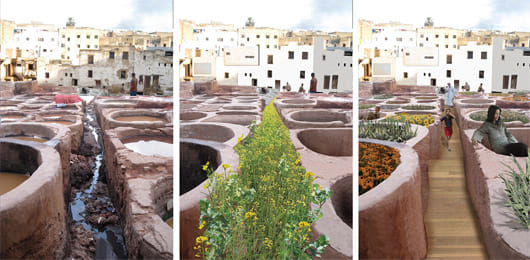
Gold: River remediation and urban development scheme, Fez, Morocco: Chouarra tanneries pit restoration and path remediation.

image

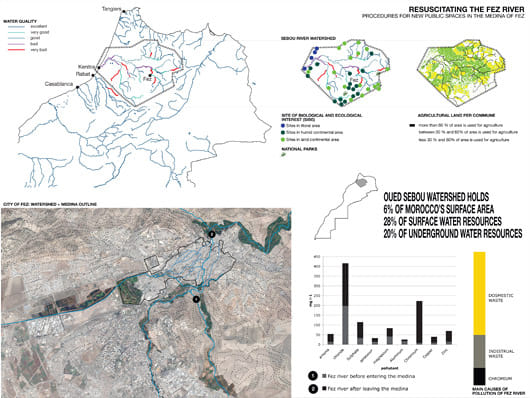
Gold: River remediation and urban development scheme, Fez, Morocco: Sebou River watershed and water quality.

image

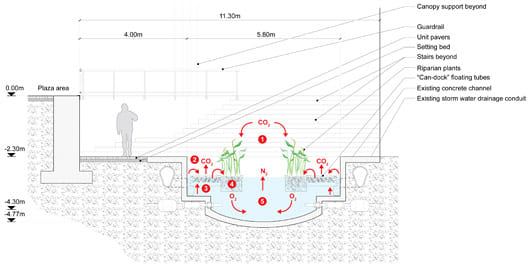
Gold: River remediation and urban development scheme, Fez, Morocco: Detail section of restorer.

Head of Jury and acclaimed architect Joe Addo, praised the approach of coupling environmental remediation with a comprehensive socio-cultural and economic program. “While mitigating the threats of pollution and declining water supply to this historic lifeline traversing the medina of Fez, community-supported programs such as a leather craft center, recreation facilities, water-cleaning wetlands and botanical gardens will restore vitality to the city in a truly sustainable way,” he said.

School and orphans home in Uganda receives Silver Award
The Holcim Awards Silver was presented to the low-cost Mukwano Home in Rakai, Uganda created by Japanese architect Koji Tsutsui. The new homes reflect local social traditions and habits, provide shelter and offer health care, education spaces and leisure facilities. The long-term goal of the project is to provide the children with basic building skills and a chance of future work, and to develop effective social and contextual impact by providing a solid community for children orphaned by the impact of HIV/AIDS.

image

Silver: Low-cost school and home for HIV orphans, Rakai, Uganda: Expanding Mukwano Village.

image

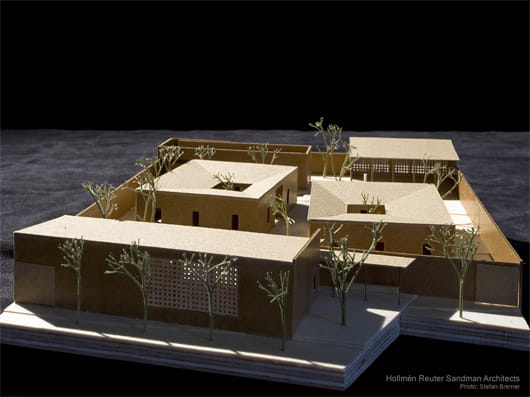
Silver: Low-cost school and home for HIV orphans, Rakai, Uganda: Center courtyard of the Mukwano Home: basic huts gather and become the home with connecting canopies. The huts surround an existing tree in the center court.

Bronze Award for Lighthouse Tower in the United Arab Emirates
The submission by UAE-resident South African architect Shaun Killa for the iconic, 400m tall Lighthouse Tower in Dubai, United Arab Emirates (UAE) was commended for demonstrating in a convincing manner that high-rise buildings also have significant potential to be designed and constructed to meet sustainability targets. The 53-story building incorporates passive cooling, optimizes use of daylight through a responsive façade, and will include wind turbines and photo-voltaic panels to generate most of the energy needs of the building – and is therefore projected to achieve energy savings of around 50% compared to a conventional office tower.

image

Bronze: Lighthouse tower with low-carbon footprint, Dubai, UAE: DIFC Lighthouse: a functional, physical and metaphorical beacon for future low-carbon, sustainable and environmentally responsive design.

image

Bronze: Lighthouse tower with low-carbon footprint, Dubai, UAE: Wind engineering.

Acknowledgement prizes for projects in South Africa, Tanzania, and the UAE
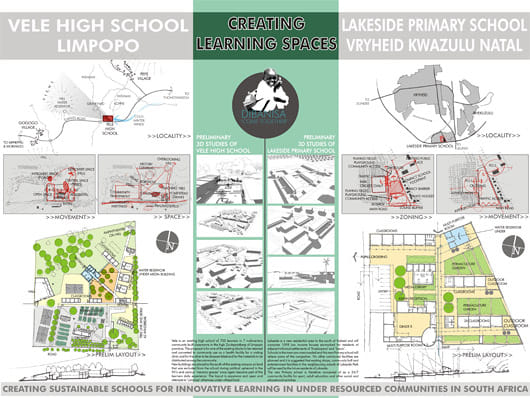
Five submissions, three from South Africa and one each from Tanzania and the UAE received Acknowledgement prizes for their approaches to housing, infrastructure, and urban planning. An integrated theater and orphanage compound in Moshi, Tanzania and a mixed-used responsive urban planning strategy for the Xeritown development in Dubai, UAE were selected in addition to three projects from South Africa: a school infrastructure project in Vele and Vryheid, a stabilized earth visitors’ center in the Mapungubwe National Park and a low-impact environmentally-responsive private home in Cape Town.

image

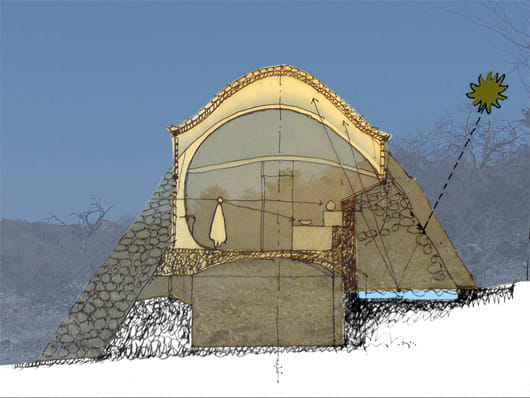
Acknowledgement: Low-impact environmentally-responsive house, Cape Town, South Africa: A house that breathes.

image

Acknowledgement: School infrastructure from local resources, Vele and Vryheid, South Africa: Vele High School & Lakeside Primary School represent the first phase in the program. Site analyses and design responses are presented.

image

Acknowledgement: Stabilized earth visitors’ center, Mapungubwe National Park, South Africa: Pools reflect sun and cool air.

image

Acknowledgement: TunaHAKI integrated theater and orphanage, Moshi, Tanzania: South view of the orphanage.

image

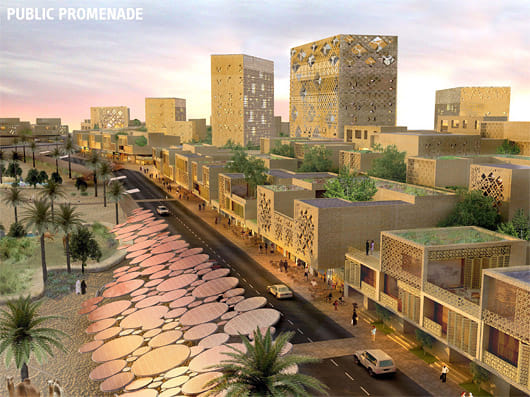
Acknowledgement: Xeritown responsive urban planning strategy, Dubai, UAE: Active urban edge: architecture, infrastructure and landscape come together defining a space of intensified urban life.

“Next Generation” prizes for project visions
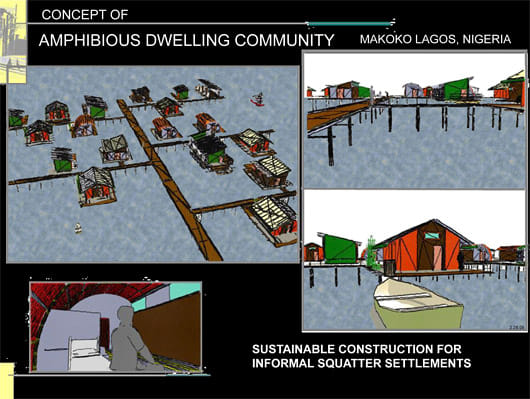
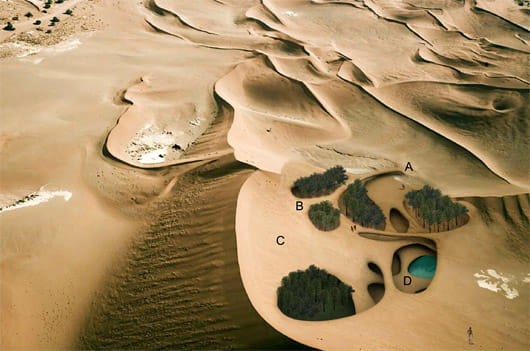
For the first time, the Holcim Awards competition included a category for the visions of young architects and designers. Two innovative projects from Nigeria were both awarded equal First prize in the “Next Generation” category. A concept for amphibious dwellings which use low-lying and flood prone areas in informal settlements of Lagos to provide safe housing close to residents’ source of income by American-resident Nigerian architect Akinlabi Afolayan was selected for its fresh approach to improving squatter settlements. In addition, the First-prize-winning dune anti-desertification architecture created by Swedish architect Magnus Larsson received the top accolade for applying cutting-edge biotechnology to stop desert encroachment in Sokoto. A waterfront sustainable development project for Mombasa, Kenya by local architects Maranga Njoroge and Benedette Nthale also received a “Next Generation” prize and was applauded for its holistic intervention in the commercial development of a prime beach area.

image

“Next Generation” 1st prize: Amphibious dwellings in informal settlements, Lagos, Nigeria: Amphibious dwellings enabling sustainable growth of community like Makoko: an alternative to “slum-clearance programs”.

image

“Next Generation” 1st prize: Dune anti-desertification architecture, Sokoto, Nigeria: Final render of the scheme.

image

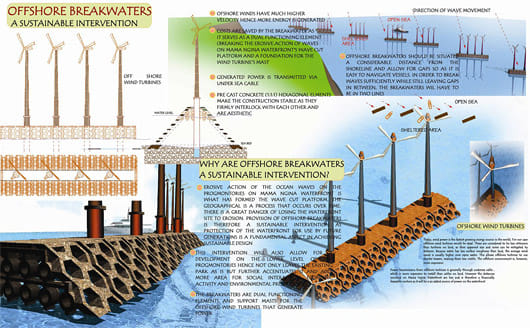
“Next Generation” 3rd prize: Waterfront sustainable development concept, Mombasa, Kenya: Offshore breakwaters: a sustainable invention.

Independent jury of international experts in architecture and sustainability
Competition submissions for projects in region Africa Middle East were evaluated by an independent jury hosted by the University of the Witwatersrand, Johannesburg: Joe Addo (Head of jury, Ghana), Rachid Benmokhtar Benabdellah (Morocco), Dominique Drouet (Morocco), Daniel Irurah (South Africa), Nina Maritz (Namibia), Amer Moustafa (UAE), Hans-Rudolf Schalcher (Switzerland), Holger Wallbaum (Switzerland), and Eyal Weizman (Israel) used the “target issues” for sustainable construction developed by the Holcim Foundation to evaluate submissions. The “target issues” address the triple bottom line of economic, environmental, and social factors together with architectural quality and the potential to apply the innovation in other locations.

International series of five ceremonies
The prizes for region Africa Middle East were conferred at the awards ceremony held in Marrakech, attended by more than 320 representatives of government, business, architecture and related disciplines from 24 countries. Chairman of Holcim and of the Advisory Board of the Holcim Foundation, Rolf Soiron, welcomed all. On behalf of Moroccan Minister of Housing and City Planning, Ahmed Taoufiq Hejira, General Director of architecture and urban planning, Abderrahmane Chorfi, provided a keynote address which emphasized the important role of the built environment of achieving sustainable development.

The Marrakech event was the fourth of five ceremonies. The results for Europe, North America and Latin America have also been announced, and the results for Asia Pacific are still to be celebrated in New Delhi. Gold, silver and bronze prize winners from each region automatically qualify for the global Holcim Awards competition. The projects will be further evaluated by a global jury and the winners proclaimed in Switzerland in 2009.

The Holcim Awards is an international competition of the Holcim Foundation which seeks innovative, future-oriented and tangible sustainable construction projects and offers prize money of USD 2 million per three-year competition cycle. The competition is run in cooperation with renowned partner universities: The University of the Witwatersrand, South Africa; Swiss Federal Institute of Technology (ETH Zurich), Switzerland; Massachusetts Institute of Technology (MIT), USA; Tongji University, China; Universidad Iberoamericana, Mexico; and the Universidade de São Paulo, Brazil.

The Holcim Foundation is supported by Holcim Ltd and its Group companies in more than 70 countries, but is independent of its commercial interests. Holcim is one of the world’s leading producers of cement and aggregates, and was recently named “Leader of the Industry” in the Dow Jones Sustainability Index for the fourth year in succession.

Images: Holcim Foundation

Related

africa ● award ● dubai ● holcim ● international ● middle east ● prize ● regional ● south africa ● sustainable ● uae ● winners ● morocco

Share

  • Follow

    0 Comments

  • Comment as :

Winners of Regional Holcim Awards "Africa Middle East" Announced in Marrakech

Northwestern University selects 12-firm longlist to design new engineering building

New architecture and design competitions: Exploring 130 Years of American Design, Christo & Jeanne-Claude Center, 13 White Houses, and La Pyramide

Micro-architecture honored in latest Tiny House Architecture Competition

World’s most beautiful restaurants of 2026 chosen by Prix Versailles

Sponsored Post by Buildner

Design a wine tasting room in Italy! Valli Wine Tasting Room is launched!

10 can't-miss architecture & design events to see this June in London, Los Angeles, Chicago, San Francisco, Detroit, San Diego, Porto, and Barcelona

Sponsored Post by Buildner

Museum of Emotions / Edition #8 FINAL registration deadline is approaching!

Seven global projects make AR Public Awards shortlist 2026

Sign up for Bustler's Email Newsletters

Sponsored Post by Buildner

Design a slow-living restaurant in Portugal! Portugal Long Table Restaurant is launched!

World's best tall buildings honored at the CVU 2026 Award of Excellence

Sponsored Post by TWOPAGES

Final call: TWOPAGES X Design Contest 2026 submissions close June 5

Kengo Kuma & Paul Raff win Alberta national park visitor center competition with landscape-focused design

2026 Moira Gemmill and MJ Long prizes announced by W Awards

New architecture and design competitions: Kinderspace, Stewardson Keefe LeBrun Travel Grant, SMALL PROJECT BIG IMPACT, and Garden of University House, Bucharest

The Century of Gehry: New retrospective explores the late architect's work & collaborations

Next page » Loading

Winners of Regional Holcim Awards "Africa Middle East" Announced in Marrakech

By Bustler Editors|

Thursday, Nov 20, 2008

Share

Related

africa ● award ● dubai ● holcim ● international ● middle east ● prize ● regional ● south africa ● sustainable ● uae ● winners ● morocco

Marrakech / Morocco – November 13, 2008 – The winners of the second Holcim Awards for Sustainable Construction from across region Africa Middle East were announced at a ceremony in Marrakech. Total prize money of USD 270,000 was presented to eleven projects that illustrated the broad scope for applying sustainable construction approaches to the built environment across public and private architecture, urban planning, and environmental remediation.

The Swiss-based Holcim Foundation for Sustainable Construction conducts the competition in parallel across five regions of the world. Almost 5,000 projects from 90 countries entered the competition which aims to promote sustainable responses from the building and construction industry to technological, environmental, socioeconomic and cultural issues. The ceremony in Marrakech featured a diverse and international group of project teams and demonstrated that sustainable construction is truly of global concern.

Revitalization of the Fez River in Morocco wins Gold Award
A remediation and urban development scheme for the river precinct in Fez, Morocco received the top prize of USD 100,000 and the Holcim Awards Gold 2008 trophy for combining a comprehensive socio-cultural and economic program within the core environmental remediation initiative. The landscape design by Moroccan architect Aziza Chaouni and American-resident Japanese planner Takako Tajima includes water quality improvement, remediation of contaminated sites, creation of open spaces and the enhancement of existing resources for economic development.
image

Gold: River remediation and urban development scheme, Fez, Morocco: Chouarra tanneries pit restoration and path remediation.

image

Gold: River remediation and urban development scheme, Fez, Morocco: Sebou River watershed and water quality.

image

Gold: River remediation and urban development scheme, Fez, Morocco: Detail section of restorer.

Head of Jury and acclaimed architect Joe Addo, praised the approach of coupling environmental remediation with a comprehensive socio-cultural and economic program. “While mitigating the threats of pollution and declining water supply to this historic lifeline traversing the medina of Fez, community-supported programs such as a leather craft center, recreation facilities, water-cleaning wetlands and botanical gardens will restore vitality to the city in a truly sustainable way,” he said.

School and orphans home in Uganda receives Silver Award
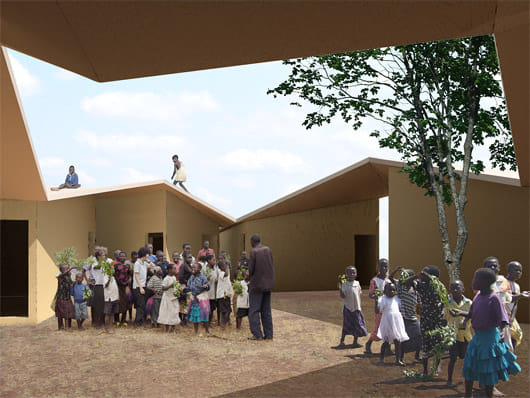
The Holcim Awards Silver was presented to the low-cost Mukwano Home in Rakai, Uganda created by Japanese architect Koji Tsutsui. The new homes reflect local social traditions and habits, provide shelter and offer health care, education spaces and leisure facilities. The long-term goal of the project is to provide the children with basic building skills and a chance of future work, and to develop effective social and contextual impact by providing a solid community for children orphaned by the impact of HIV/AIDS.
image

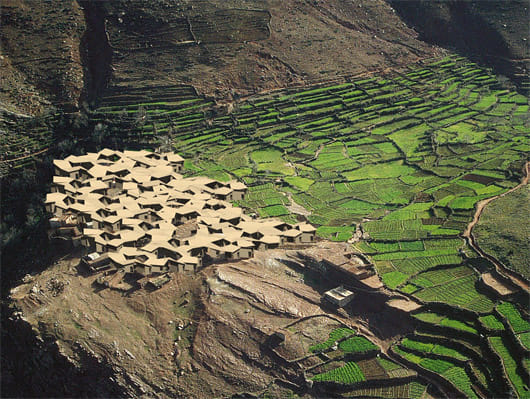
Silver: Low-cost school and home for HIV orphans, Rakai, Uganda: Expanding Mukwano Village.

image

Silver: Low-cost school and home for HIV orphans, Rakai, Uganda: Center courtyard of the Mukwano Home: basic huts gather and become the home with connecting canopies. The huts surround an existing tree in the center court.

Bronze Award for Lighthouse Tower in the United Arab Emirates
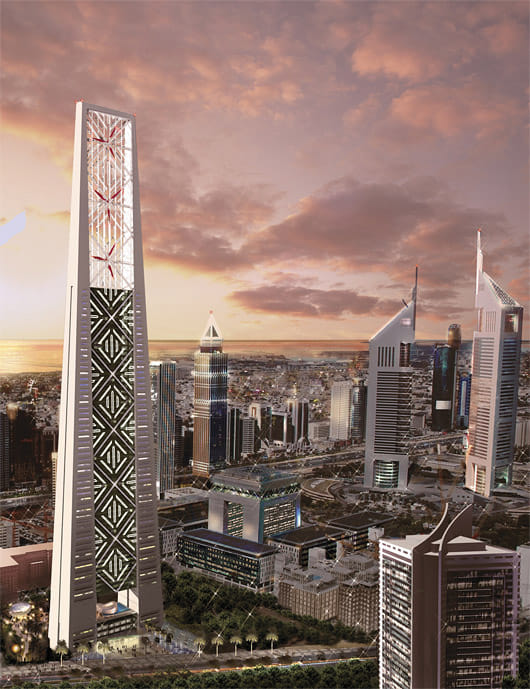
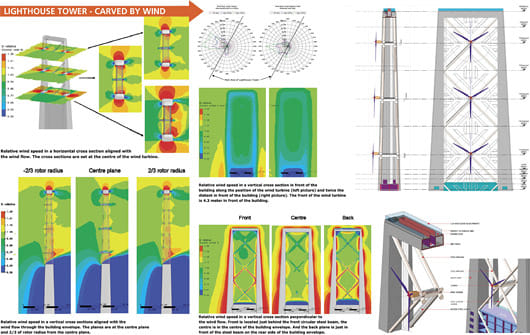
The submission by UAE-resident South African architect Shaun Killa for the iconic, 400m tall Lighthouse Tower in Dubai, United Arab Emirates (UAE) was commended for demonstrating in a convincing manner that high-rise buildings also have significant potential to be designed and constructed to meet sustainability targets. The 53-story building incorporates passive cooling, optimizes use of daylight through a responsive façade, and will include wind turbines and photo-voltaic panels to generate most of the energy needs of the building – and is therefore projected to achieve energy savings of around 50% compared to a conventional office tower.
image

Bronze: Lighthouse tower with low-carbon footprint, Dubai, UAE: DIFC Lighthouse: a functional, physical and metaphorical beacon for future low-carbon, sustainable and environmentally responsive design.

image

Bronze: Lighthouse tower with low-carbon footprint, Dubai, UAE: Wind engineering.

Acknowledgement prizes for projects in South Africa, Tanzania, and the UAE
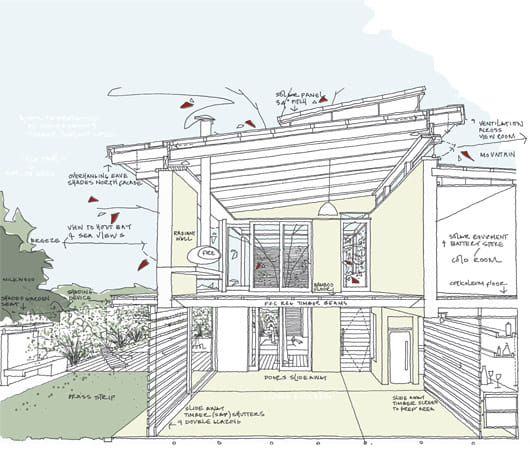
Five submissions, three from South Africa and one each from Tanzania and the UAE received Acknowledgement prizes for their approaches to housing, infrastructure, and urban planning. An integrated theater and orphanage compound in Moshi, Tanzania and a mixed-used responsive urban planning strategy for the Xeritown development in Dubai, UAE were selected in addition to three projects from South Africa: a school infrastructure project in Vele and Vryheid, a stabilized earth visitors’ center in the Mapungubwe National Park and a low-impact environmentally-responsive private home in Cape Town.
image

Acknowledgement: Low-impact environmentally-responsive house, Cape Town, South Africa: A house that breathes.

image

Acknowledgement: School infrastructure from local resources, Vele and Vryheid, South Africa: Vele High School & Lakeside Primary School represent the first phase in the program. Site analyses and design responses are presented.

image

Acknowledgement: Stabilized earth visitors’ center, Mapungubwe National Park, South Africa: Pools reflect sun and cool air.

image

Acknowledgement: TunaHAKI integrated theater and orphanage, Moshi, Tanzania: South view of the orphanage.

image

Acknowledgement: Xeritown responsive urban planning strategy, Dubai, UAE: Active urban edge: architecture, infrastructure and landscape come together defining a space of intensified urban life.

“Next Generation” prizes for project visions
For the first time, the Holcim Awards competition included a category for the visions of young architects and designers. Two innovative projects from Nigeria were both awarded equal First prize in the “Next Generation” category. A concept for amphibious dwellings which use low-lying and flood prone areas in informal settlements of Lagos to provide safe housing close to residents’ source of income by American-resident Nigerian architect Akinlabi Afolayan was selected for its fresh approach to improving squatter settlements. In addition, the First-prize-winning dune anti-desertification architecture created by Swedish architect Magnus Larsson received the top accolade for applying cutting-edge biotechnology to stop desert encroachment in Sokoto. A waterfront sustainable development project for Mombasa, Kenya by local architects Maranga Njoroge and Benedette Nthale also received a “Next Generation” prize and was applauded for its holistic intervention in the commercial development of a prime beach area.
image

“Next Generation” 1st prize: Amphibious dwellings in informal settlements, Lagos, Nigeria: Amphibious dwellings enabling sustainable growth of community like Makoko: an alternative to “slum-clearance programs”.

image

“Next Generation” 1st prize: Dune anti-desertification architecture, Sokoto, Nigeria: Final render of the scheme.

image

“Next Generation” 3rd prize: Waterfront sustainable development concept, Mombasa, Kenya: Offshore breakwaters: a sustainable invention.

Independent jury of international experts in architecture and sustainability
Competition submissions for projects in region Africa Middle East were evaluated by an independent jury hosted by the University of the Witwatersrand, Johannesburg: Joe Addo (Head of jury, Ghana), Rachid Benmokhtar Benabdellah (Morocco), Dominique Drouet (Morocco), Daniel Irurah (South Africa), Nina Maritz (Namibia), Amer Moustafa (UAE), Hans-Rudolf Schalcher (Switzerland), Holger Wallbaum (Switzerland), and Eyal Weizman (Israel) used the “target issues” for sustainable construction developed by the Holcim Foundation to evaluate submissions. The “target issues” address the triple bottom line of economic, environmental, and social factors together with architectural quality and the potential to apply the innovation in other locations.

International series of five ceremonies
The prizes for region Africa Middle East were conferred at the awards ceremony held in Marrakech, attended by more than 320 representatives of government, business, architecture and related disciplines from 24 countries. Chairman of Holcim and of the Advisory Board of the Holcim Foundation, Rolf Soiron, welcomed all. On behalf of Moroccan Minister of Housing and City Planning, Ahmed Taoufiq Hejira, General Director of architecture and urban planning, Abderrahmane Chorfi, provided a keynote address which emphasized the important role of the built environment of achieving sustainable development.

The Marrakech event was the fourth of five ceremonies. The results for Europe, North America and Latin America have also been announced, and the results for Asia Pacific are still to be celebrated in New Delhi. Gold, silver and bronze prize winners from each region automatically qualify for the global Holcim Awards competition. The projects will be further evaluated by a global jury and the winners proclaimed in Switzerland in 2009.

The Holcim Awards is an international competition of the Holcim Foundation which seeks innovative, future-oriented and tangible sustainable construction projects and offers prize money of USD 2 million per three-year competition cycle. The competition is run in cooperation with renowned partner universities: The University of the Witwatersrand, South Africa; Swiss Federal Institute of Technology (ETH Zurich), Switzerland; Massachusetts Institute of Technology (MIT), USA; Tongji University, China; Universidad Iberoamericana, Mexico; and the Universidade de São Paulo, Brazil.

The Holcim Foundation is supported by Holcim Ltd and its Group companies in more than 70 countries, but is independent of its commercial interests. Holcim is one of the world’s leading producers of cement and aggregates, and was recently named “Leader of the Industry” in the Dow Jones Sustainability Index for the fourth year in succession.

Images: Holcim Foundation

Share

  • Follow

    0 Comments

  • Comment as :

Archinect JobsArchinect Jobs

The Archinect Job Board attracts the world's top architectural design talents.

VIEW ALL JOBS POST A JOB

Project Designer / Job Captain

Solutions Architecture Corp

Project Designer / Job Captain

Verona, NJ, US

Project Architect/Interior Designer

IMC Architecture

Project Architect/Interior Designer

Brooklyn, NY, US

Project Manager / Project Architect (5–10 Years’ Experience)

Millan Architect / Studio Inc.

Project Manager / Project Architect (5–10 Years’ Experience)

Venice, CA, US

Architectural Designer (3-5 Years) - Commercial & Hospitality Focus

Pfeffer Torode Architecture

Architectural Designer (3-5 Years) - Commercial & Hospitality Focus

Nashville, TN, US

Architect 10+

Standard Architects

Architect 10+

Long Island City, NY, US

Senior Project Architect

IMC Architecture

Senior Project Architect

Brooklyn, NY, US

Project Architect

Westside Design

Project Architect

Santa Monica, CA, US

Architect / Urban Designer

Office for the Next Environment (OFTN)

Architect / Urban Designer

New York, NY, US

Marketing Coordinator

Blair + Mui Dowd Architects

Marketing Coordinator

New York, NY, US

Junior Architect

PRDG architecture + design

Junior Architect

New York, NY, US

Next page » Loading