• Login / Join
  • About
  • •
  • Contact
  • •
  • Advertising
bustler logo
bustler logo
  • News
  • Competitions
  • Events
  • Bustler is powered by Archinect
  • Sign up for Bustler's Email Newsletters

  • Follow these Bustler feeds:

  • Search

    Search in

  • Submit

    What are you submitting?

    News Pitch
    Competition
    Event
  • Login / Join
  • News|Competitions|Events
  • Search
    | Submit
    | Follow
  • Search in

    What are you submitting?

    News Pitch
    Competition
    Event

    Follow these Bustler feeds:

  • About|Contact|Advertising
  • Login / Join

Xi’an World Horticultural Expo, 2nd Place Entry by Serie Architects

By Bustler Editors|

Sunday, Mar 29, 2009
image

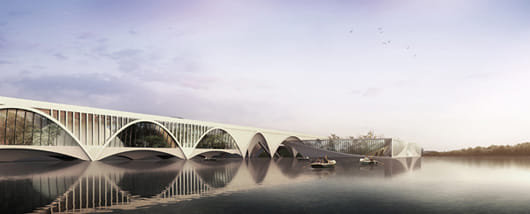
Last week we reported on Plasma Studio’s winning entry to the Xi’an World Horticultural Expo.  Today we present the 2nd place entry by Serie Architects.
image

Competition 2nd Prize
Building Type: Green House and Expo Building
Location:  Chan-Ba Ecological District, Xian, China.

Learning from Xian
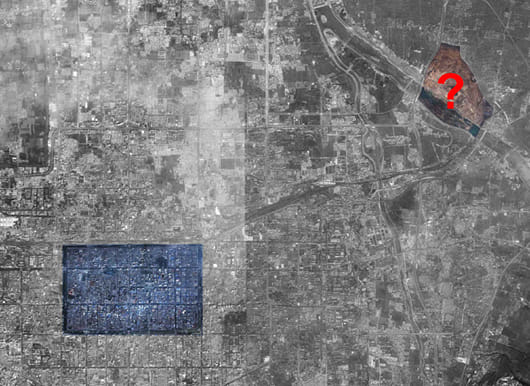
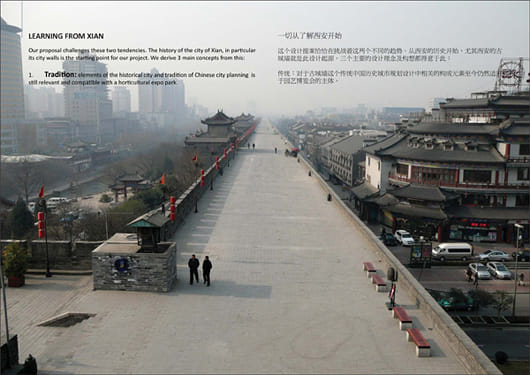
It is often assumed that the idea of the city is contradictory to the idea of landscape and nature. Thus more often than not, for landscape architecture projects worldwide today, we witness the endless proliferation of architecture that literally looks like landscape. Our proposal challenges these two tendencies. The history of the city of Xian, in particular its city walls is the starting point for our project. We derive 3 main concepts from this:

  • Tradition: elements of the historical city and tradition of Chinese city planning is still relevant and compatible with a horticultural expo park.
  • Clarity: a simple, clear and legible architectural structure can act as a powerful organizational element for an expanded territory many times its scale.
  • Contrast: when architecture’s pure form and geometry stands in contrast to landscape and nature, without altering the latter, the contrasting beauty between the two is mutually reinforced.     
image

Five Climates Crossing
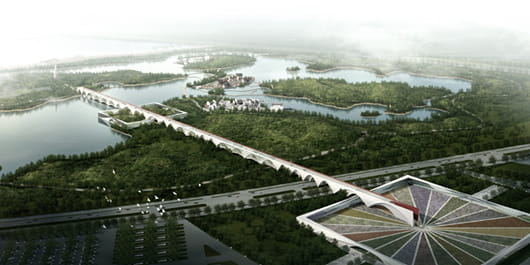
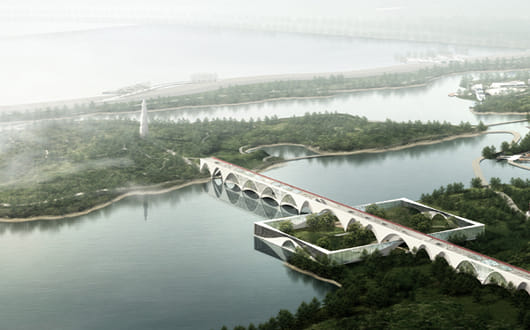
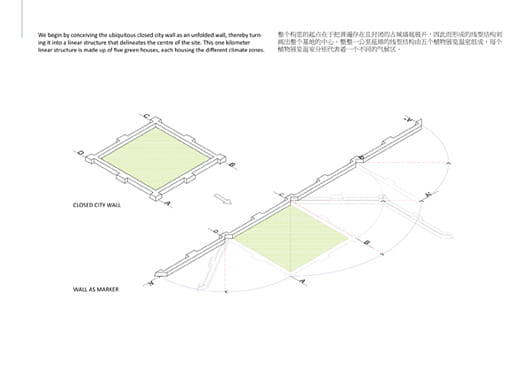
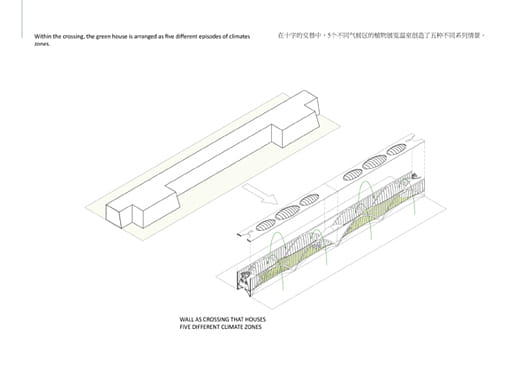
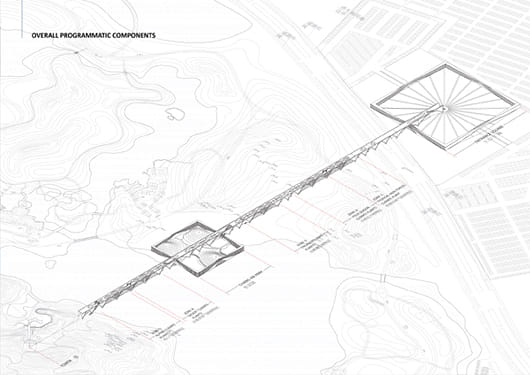
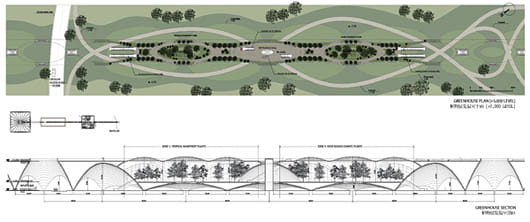
We propose a strong, simple and clear architectural artifact as a main organizing element for the master plan. We begin by re-conceiving the ubiquitous closed city wall as an unfolded wall, turning it into a linear structure that delineates the centre of the site. This one kilometer linear structure is made up of five green houses, each housing the different climate zones. Like the Xian City Wall, this new structure, we name the Five Climates Crossing will mark the centre of the park and simultaneously act as a connector, linking the Entrance Square on the north, Chang’an Park in the middle and the viewing tower on the south. Within the crossing, the green house is arranged linearly as five different episodes of climates zones, allowing visitors to move sequentially from one green house to another whilst maintaining visual connection to the outside.
image

image

Entrance Square
The northern tip of the Five Climate Crossing marks the centre of the Entrance Square. We propose a square measuring 210m by 210m. The square is planned to be a flexible open space for both horticultural exhibitions and opening ceremonies. The centre of the square is marked by a flight of steps leading up to the Five Climates Crossing and is the lowest point in the square, creating a very gentle amphitheatre configuration. Radiating pavement lines focuses the circulation and attention to the entrance steps and centre of the square. At the same time, these radiating lines slices up the square to a pie chart like horticultural plots, creating a fan like configuration for exhibitions.
image

image

Chang’an Park
We propose Chang’an Park as a square that frames three small peaks and part of the lake in the middle of the park. The three green peaks framed by the perimeter block houses the Chang’an Concert Hall and 2 large exhibition halls. VIP lounges, restaurants, shops, ticketing and reception foyers are housed along the perimeter block. The foyer and principal views for the concert hall faces the lake and becomes an important principal façade for the lake view viewed from the south and east direction.
image

image

Developmental Options and Construction
Depending on the available funding and time, the crossing can be realized in different lengths and different segments without fundamentally compromising the design concept and intention. The one kilometre long Five Climates Crossing is made up of only four repeating module. This allows off-site pre-fabrication construction, where different modules can be mass produced rapidly.


Client: Xian International Horticultural Exposition 2011 Xian
Gross Floor Area: 20,000 sqm
Site Area:  418 Ha
Date: Concept Design – January 2009
Status: Competition 2nd Prize

Credits:
Serie Architects London
Unit 4L Leroy House
436 Essex Road
London N1 4EA
[t]: 0207 22 600 22
[e]: [email protected]
[w]: www.serie.co.uk

Serie Architects Beijing
Room 504
No.1 Jianwai Soho
Beijing 100022
China
[t]: +86 10 58696548

Design Team: Chris Lee, Kapil Gupta, Bolam Lee, Martin Jameson, Stephie Sun

About Serie Architects

SERIE is an international practice based in London, Mumbai and Beijing working in the diverse fields of architecture, urbanism and design. The practice is interested in the evolution and mutation of building types in cities today and the projection of these forms of intelligence into spatial solutions. Working typologically, or in our terms, thinking and exploring in series – harnessing the cumulative intelligence of building types – is key to the work of Serie. The practice consistently attempts to push the boundaries of its architectural and master planning projects worldwide.
The practice has completed among others, the award winning Jewel Tech factory, Blue Frog Acoustic Lounge and Studios, Thanks Boutique, and the Leo Burnett HQ in Mumbai, India. Current projects include Bohacky Residential development in Bratislava, an office complex and two schools in Mumbai. Nearing completion is the Tote banqueting hall, restaurant and bar in Mumbai.

The practice is constantly informed through the research conducted in the Architectural Association School of Architecture, London where the practice’s principal, Christopher Lee has held the position of Diploma Unit Master since 2002 with Diploma Unit 6. Chris Lee explores the issues that lie at the intersection between architecture and urbanism with particular focus on developing new relevant types for today’s urban environments. He is also currently conducting his doctoral research on the same topic in the Berlage Institute Rotterdam. Kapil Gupta is a director at the Urban Design Research Institute, Mumbai, which is currently leading a series of research projects on the city.

Christopher Lee lectures widely and has delivered guest-lectures in Tsinghua University Beijing, Central Academy of Fine Arts Beijing, Beijing Institute of Architectural Design,  UIA Conference Kuala Lumpur, Chinese University of Hong Kong, School or Architecture & Planning Chennai, Barbican London, Urban Design Research Institute Mumbai, Bezalel Dept. of Architecture Israel, Goldsmith College, University of Arts London and Asia@AA Forum London. With his unit, Dip 6 he represented the AA at the 2006 Venice Biennale and recently co-authored Typological Formations: Renewable Building Types and the City.

The works of the practice has been published in AD (UK), A+U [Japan], ArchArchitecture+ (UAE), Architectural Record (US), Wallpaper (UK), Egg Magazine (Taiwan), Monitor (Russia), Interiors and Design (Russia), Archiworld, Tatlin, Space and a host on magazines in India like Indian Architect & Builder, A+D, Space, Time & Architecture, Home Review, Inside Outside and Better Interiors. Chris Lee has also been featured in Japan Architect and regularly in the AA files (UK).

Related

china ● master plan ● xi'an ● 2nd place ● serie architects ● hoticulture

Share

  • Follow

    0 Comments

  • Comment as :

Xi’an World Horticultural Expo, 2nd Place Entry by Serie Architects

Northwestern University selects 12-firm longlist to design new engineering building

New architecture and design competitions: Exploring 130 Years of American Design, Christo & Jeanne-Claude Center, 13 White Houses, and La Pyramide

Micro-architecture honored in latest Tiny House Architecture Competition

World’s most beautiful restaurants of 2026 chosen by Prix Versailles

Sponsored Post by Buildner

Design a wine tasting room in Italy! Valli Wine Tasting Room is launched!

10 can't-miss architecture & design events to see this June in London, Los Angeles, Chicago, San Francisco, Detroit, San Diego, Porto, and Barcelona

Sponsored Post by Buildner

Museum of Emotions / Edition #8 FINAL registration deadline is approaching!

Seven global projects make AR Public Awards shortlist 2026

Sign up for Bustler's Email Newsletters

Sponsored Post by Buildner

Design a slow-living restaurant in Portugal! Portugal Long Table Restaurant is launched!

World's best tall buildings honored at the CVU 2026 Award of Excellence

Sponsored Post by TWOPAGES

Final call: TWOPAGES X Design Contest 2026 submissions close June 5

Kengo Kuma & Paul Raff win Alberta national park visitor center competition with landscape-focused design

2026 Moira Gemmill and MJ Long prizes announced by W Awards

New architecture and design competitions: Kinderspace, Stewardson Keefe LeBrun Travel Grant, SMALL PROJECT BIG IMPACT, and Garden of University House, Bucharest

The Century of Gehry: New retrospective explores the late architect's work & collaborations

Next page » Loading

Xi’an World Horticultural Expo, 2nd Place Entry by Serie Architects

By Bustler Editors|

Sunday, Mar 29, 2009

Share

Related

china ● master plan ● xi'an ● 2nd place ● serie architects ● hoticulture

image

Last week we reported on Plasma Studio’s winning entry to the Xi’an World Horticultural Expo.  Today we present the 2nd place entry by Serie Architects.

image

Competition 2nd Prize
Building Type: Green House and Expo Building
Location:  Chan-Ba Ecological District, Xian, China.

Learning from Xian
It is often assumed that the idea of the city is contradictory to the idea of landscape and nature. Thus more often than not, for landscape architecture projects worldwide today, we witness the endless proliferation of architecture that literally looks like landscape. Our proposal challenges these two tendencies. The history of the city of Xian, in particular its city walls is the starting point for our project. We derive 3 main concepts from this:

  • Tradition: elements of the historical city and tradition of Chinese city planning is still relevant and compatible with a horticultural expo park.
  • Clarity: a simple, clear and legible architectural structure can act as a powerful organizational element for an expanded territory many times its scale.
  • Contrast: when architecture’s pure form and geometry stands in contrast to landscape and nature, without altering the latter, the contrasting beauty between the two is mutually reinforced.     

image

Five Climates Crossing
We propose a strong, simple and clear architectural artifact as a main organizing element for the master plan. We begin by re-conceiving the ubiquitous closed city wall as an unfolded wall, turning it into a linear structure that delineates the centre of the site. This one kilometer linear structure is made up of five green houses, each housing the different climate zones. Like the Xian City Wall, this new structure, we name the Five Climates Crossing will mark the centre of the park and simultaneously act as a connector, linking the Entrance Square on the north, Chang’an Park in the middle and the viewing tower on the south. Within the crossing, the green house is arranged linearly as five different episodes of climates zones, allowing visitors to move sequentially from one green house to another whilst maintaining visual connection to the outside.

image

image

Entrance Square
The northern tip of the Five Climate Crossing marks the centre of the Entrance Square. We propose a square measuring 210m by 210m. The square is planned to be a flexible open space for both horticultural exhibitions and opening ceremonies. The centre of the square is marked by a flight of steps leading up to the Five Climates Crossing and is the lowest point in the square, creating a very gentle amphitheatre configuration. Radiating pavement lines focuses the circulation and attention to the entrance steps and centre of the square. At the same time, these radiating lines slices up the square to a pie chart like horticultural plots, creating a fan like configuration for exhibitions.

image

image

Chang’an Park
We propose Chang’an Park as a square that frames three small peaks and part of the lake in the middle of the park. The three green peaks framed by the perimeter block houses the Chang’an Concert Hall and 2 large exhibition halls. VIP lounges, restaurants, shops, ticketing and reception foyers are housed along the perimeter block. The foyer and principal views for the concert hall faces the lake and becomes an important principal façade for the lake view viewed from the south and east direction.

image

image

Developmental Options and Construction
Depending on the available funding and time, the crossing can be realized in different lengths and different segments without fundamentally compromising the design concept and intention. The one kilometre long Five Climates Crossing is made up of only four repeating module. This allows off-site pre-fabrication construction, where different modules can be mass produced rapidly.


Client: Xian International Horticultural Exposition 2011 Xian
Gross Floor Area: 20,000 sqm
Site Area:  418 Ha
Date: Concept Design – January 2009
Status: Competition 2nd Prize

Credits:
Serie Architects London
Unit 4L Leroy House
436 Essex Road
London N1 4EA
[t]: 0207 22 600 22
[e]: [email protected]
[w]: www.serie.co.uk

Serie Architects Beijing
Room 504
No.1 Jianwai Soho
Beijing 100022
China
[t]: +86 10 58696548

Design Team: Chris Lee, Kapil Gupta, Bolam Lee, Martin Jameson, Stephie Sun

About Serie Architects

SERIE is an international practice based in London, Mumbai and Beijing working in the diverse fields of architecture, urbanism and design. The practice is interested in the evolution and mutation of building types in cities today and the projection of these forms of intelligence into spatial solutions. Working typologically, or in our terms, thinking and exploring in series – harnessing the cumulative intelligence of building types – is key to the work of Serie. The practice consistently attempts to push the boundaries of its architectural and master planning projects worldwide.
The practice has completed among others, the award winning Jewel Tech factory, Blue Frog Acoustic Lounge and Studios, Thanks Boutique, and the Leo Burnett HQ in Mumbai, India. Current projects include Bohacky Residential development in Bratislava, an office complex and two schools in Mumbai. Nearing completion is the Tote banqueting hall, restaurant and bar in Mumbai.

The practice is constantly informed through the research conducted in the Architectural Association School of Architecture, London where the practice’s principal, Christopher Lee has held the position of Diploma Unit Master since 2002 with Diploma Unit 6. Chris Lee explores the issues that lie at the intersection between architecture and urbanism with particular focus on developing new relevant types for today’s urban environments. He is also currently conducting his doctoral research on the same topic in the Berlage Institute Rotterdam. Kapil Gupta is a director at the Urban Design Research Institute, Mumbai, which is currently leading a series of research projects on the city.

Christopher Lee lectures widely and has delivered guest-lectures in Tsinghua University Beijing, Central Academy of Fine Arts Beijing, Beijing Institute of Architectural Design,  UIA Conference Kuala Lumpur, Chinese University of Hong Kong, School or Architecture & Planning Chennai, Barbican London, Urban Design Research Institute Mumbai, Bezalel Dept. of Architecture Israel, Goldsmith College, University of Arts London and Asia@AA Forum London. With his unit, Dip 6 he represented the AA at the 2006 Venice Biennale and recently co-authored Typological Formations: Renewable Building Types and the City.

The works of the practice has been published in AD (UK), A+U [Japan], ArchArchitecture+ (UAE), Architectural Record (US), Wallpaper (UK), Egg Magazine (Taiwan), Monitor (Russia), Interiors and Design (Russia), Archiworld, Tatlin, Space and a host on magazines in India like Indian Architect & Builder, A+D, Space, Time & Architecture, Home Review, Inside Outside and Better Interiors. Chris Lee has also been featured in Japan Architect and regularly in the AA files (UK).

Share

  • Follow

    0 Comments

  • Comment as :

Archinect JobsArchinect Jobs

The Archinect Job Board attracts the world's top architectural design talents.

VIEW ALL JOBS POST A JOB

Junior to Intermediate Architect

Totum

Junior to Intermediate Architect

Sherman Oaks, CA, US

Project Designer (3-5 years)

Edmonds + Lee Architects

Project Designer (3-5 years)

San Francisco, CA, US

Architectural Designer, Residential

Roman and Williams Buildings and Interiors

Architectural Designer, Residential

New York, NY, US

Project Architect/Job Captain

HLW International LLP

Project Architect/Job Captain

West Palm Beach, FL, US

Project Architect LA & NYC

Montalba Architects, Inc.

Project Architect LA & NYC

Los Angeles, CA, US

Junior Architect / Architectural Designer

S20M

Junior Architect / Architectural Designer

New York, NY, US

Architectural Associate/Junior Architect

Goldstone Architecture

Architectural Associate/Junior Architect

Bennington, VT, US

Junior Designer

OLIVER FREUNDLICH DESIGN

Junior Designer

New York, NY, US

Project Architect

BuildingWork

Project Architect

Seattle, WA, US

Interior Designer | Education & Institutional Work

Berliner Architects

Interior Designer | Education & Institutional Work

Culver City, CA, US

Next page » Loading