• Login / Join
  • About
  • •
  • Contact
  • •
  • Advertising
bustler logo
bustler logo
  • News
  • Competitions
  • Events
  • Bustler is powered by Archinect
  • Sign up for Bustler's Email Newsletters

  • Follow these Bustler feeds:

  • Search

    Search in

  • Submit

    What are you submitting?

    News Pitch
    Competition
    Event
  • Login / Join
  • News|Competitions|Events
  • Search
    | Submit
    | Follow
  • Search in

    What are you submitting?

    News Pitch
    Competition
    Event

    Follow these Bustler feeds:

  • About|Contact|Advertising
  • Login / Join

Details of Young & Ayata's first-prize "Vessel Collective" for the Bauhaus Museum Dessau

By Bustler Editors|

Friday, Sep 11, 2015
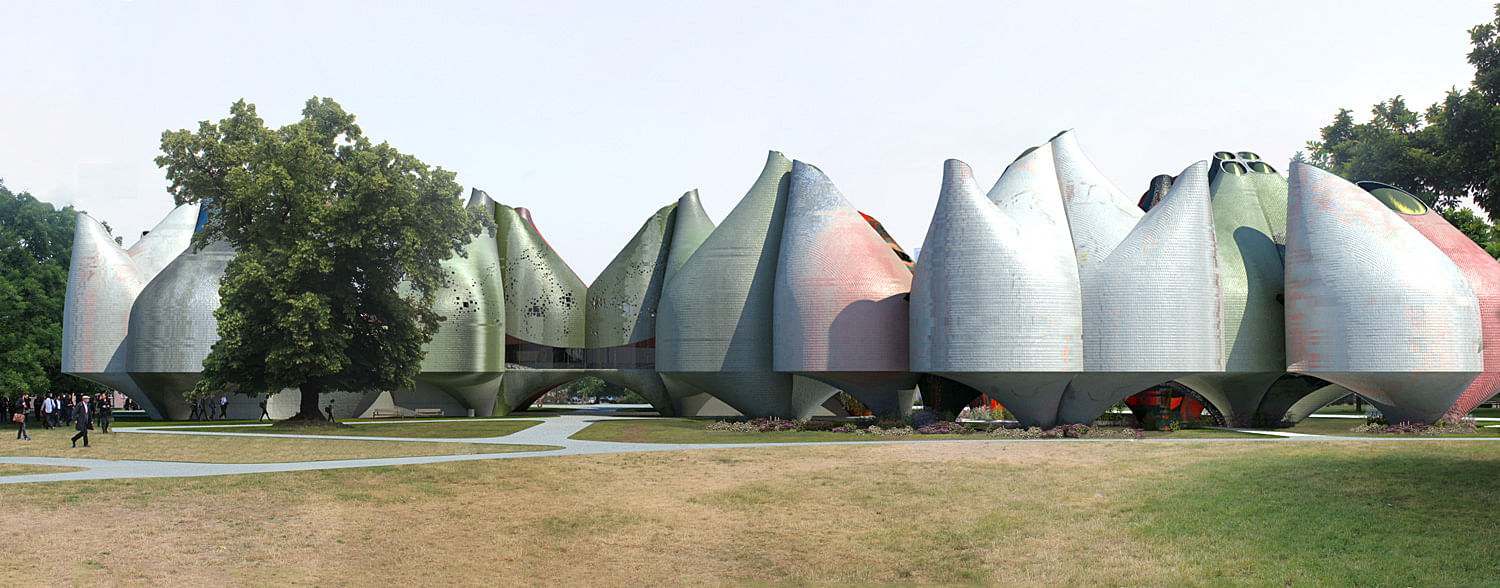
Young & Ayata: Vessel Collective Bauhaus Museum.

Earlier this week, New York-based Young & Ayata had one of the two first-prize proposals for the Bauhaus Museum competition in Dessau, Germany. The Bauhaus Dessau Foundation launched the open international competition intending to construct a museum in Dessau's City Park, in time to mark the 100th anniversary of the Bauhaus in 2019. The jury will determine which first-prize winner will construct the museum.

Founded in 2008, Young & Ayata continues to rise in the contemporary architecture scene. In recent years, they won in the 2014 Architectural League Prize and participated in exhibitions like "Treatise: Why Write Alone?" at the Graham Foundation earlier this year.

Check out their Bauhaus Museum proposal "Vessel Collective" right below.

"Vessel Collective: The legacy of the Bauhaus is defined in large part by a multiplicity of identities and tensions which contribute to its continuing vitality nearly a century after its founding. It would be a reduction of the complexity of the Bauhaus to divide it cleanly into a technical side and an expressive side, yet technical and expressive factors were often in conflict and in conversation throughout its history. The tension between these two motivations-- and specifically the shape that tension took at the Bauhaus-- continues to influence art, architecture, and design today. 

Our design of a museum for the Bauhaus Dessau is strongly informed by such productive tension--in this case, the tension between a desire for a modular repeatable system of organization, provided by a grid, and the exploration of sensation found in color and material experimentation. These two factors were central to many of the Bauhaus explorations as well, from figural glitches in Gunta Stölzl's textile wall hangings to the intuitively interrupted striations of Paul Klee's figurations, from the luminous mechanical index of László Moholy-Nagy's photograms to the grossly comic automatons of Oskar Schlemmer's dramatic costumes."
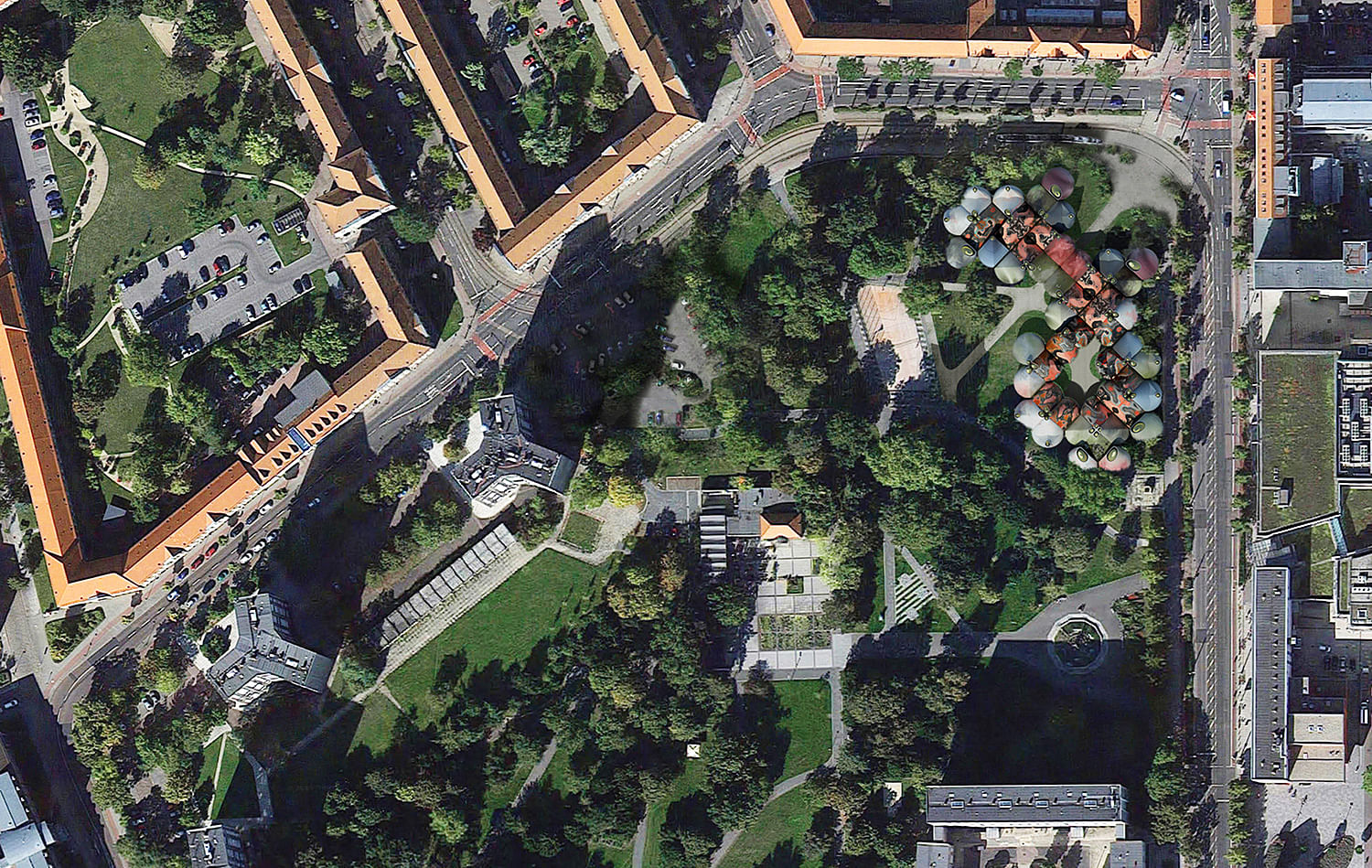
Young & Ayata: Vessel Collective Bauhaus Museum - Aerial view.

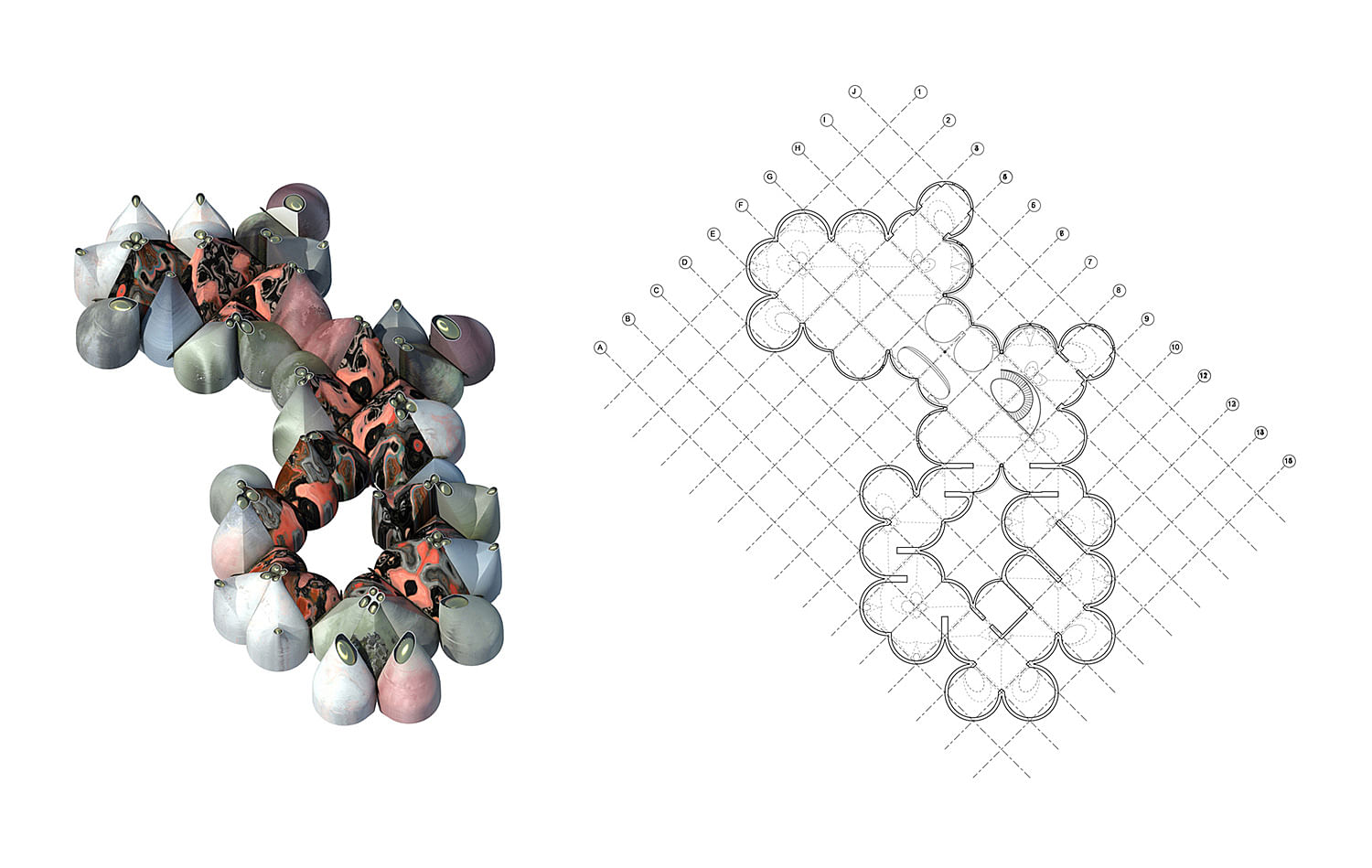
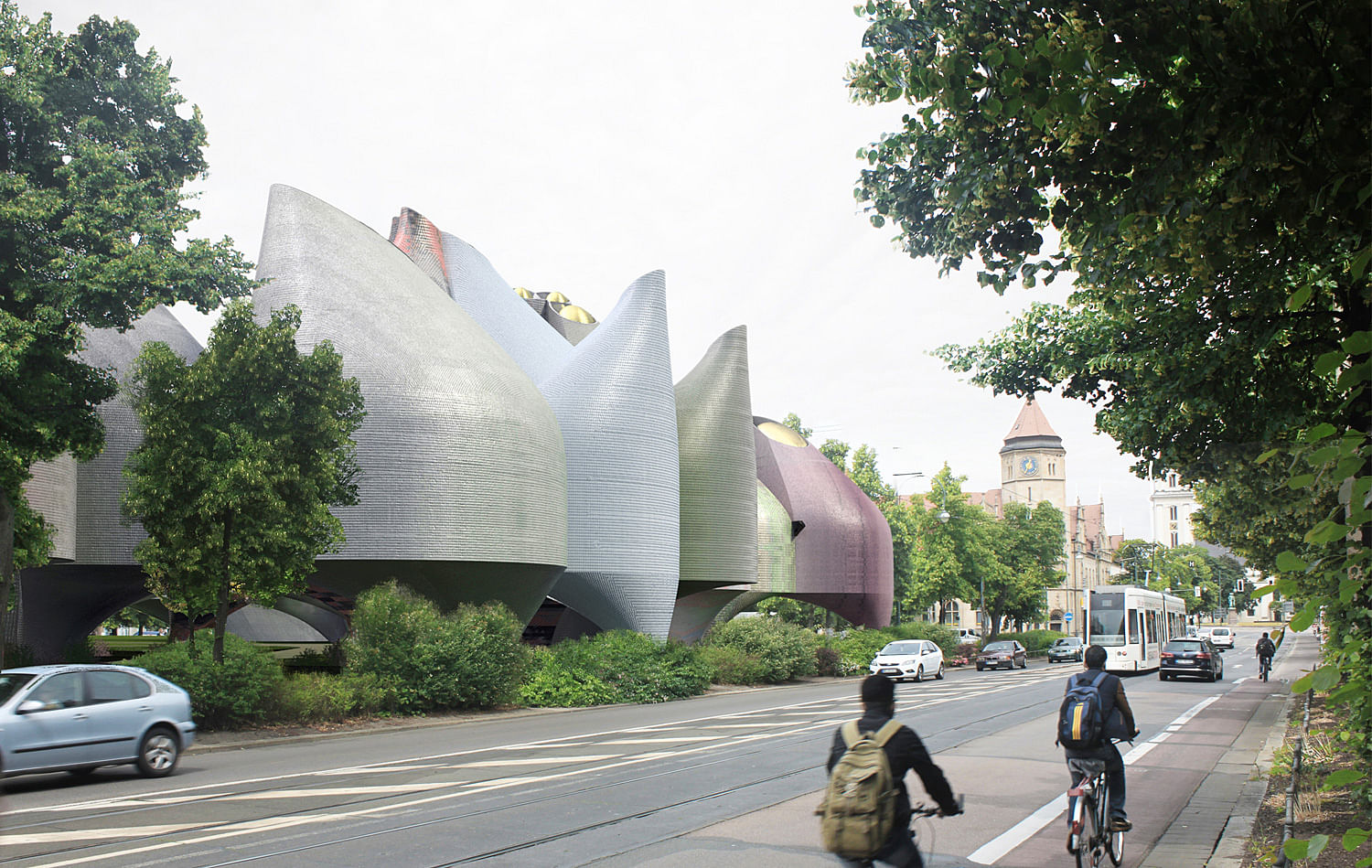
"Our proposal for the Bauhaus Museum Dessau acknowledges these tensions through the design of a building as a collection of individual masses aggregated serially through a grid. We are calling these objects "vessels" as they allude to the crafted object of a vase or volumetric container. The vessels hover above the site on trunk-like legs, creating a light touch in the park and allowing passage underneath. The bellies of the vessels swell to touch each other along the gridded matrix creating an open continuous floor plan that connects the entire museum with a single floor. These combinations allow the building to fluctuate character between a huddle of singular objects, a sinuous coil of continuity, and a matrix of gridded repetition. Each attitude is at odds with the others, a productive tension resonating through the design."
Young & Ayata: Vessel Collective Bauhaus Museum.

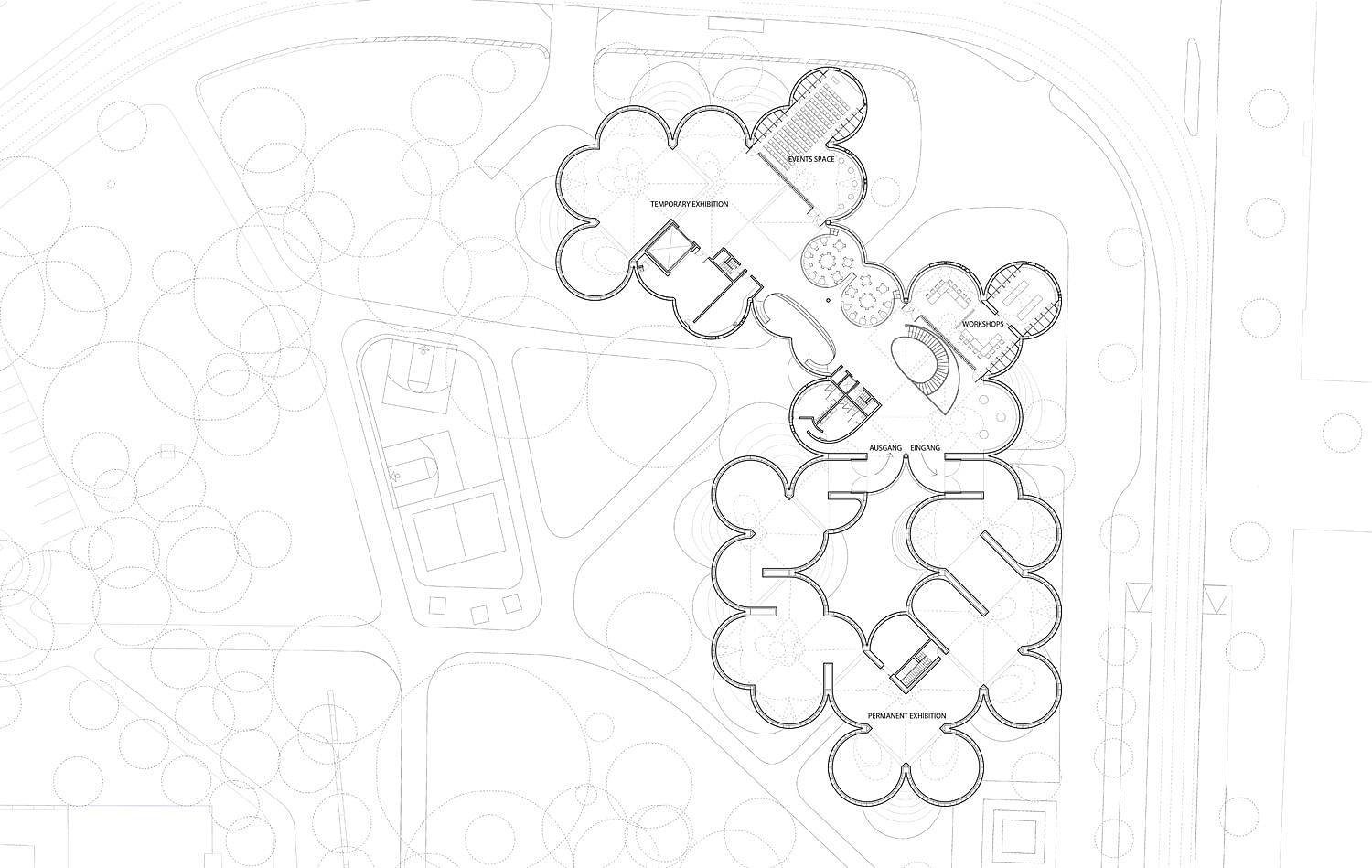
"All of the vessels are similar units built only from circles and squares, but as they collect together they rotate, mirror and fuse to create a varied figuration on the exterior and a variety of different spatial volumes on the interior. The fusion of these volumes rises toward light nozzles equipped with diffusers that bounce and block direct sunlight. These fusions vary from one to four joined vessels and change direction based on solar orientation. This presents the gallery experience as an alternation between an open flexible matrix and distinct volumes of different spatial qualities, a mash-up of the historical typologies of the enfilade and the free-plan, creating a new hybrid of exhibition possibilities.  The main level plan is divided into two wings along an axis perpendicular to the site corner. To one side is the sequence of permanent galleries devoted to the Bauhaus.

To the other side are the temporary galleries. The center of the building acts as a hub or knuckle between the gallery programs. This space opens views out to the park and to the urban street corner with cafeteria and special exhibition functions which can double as an active event space when desired. From this knuckle it is possible also to go to the education workshops or the education event space. Above this central space is a mezzanine for the offices of the museum director and staff. This space has views down to the main floor as well as views out to the park and street corner through a series of small punched openings that filter through the cones like veins of marble."
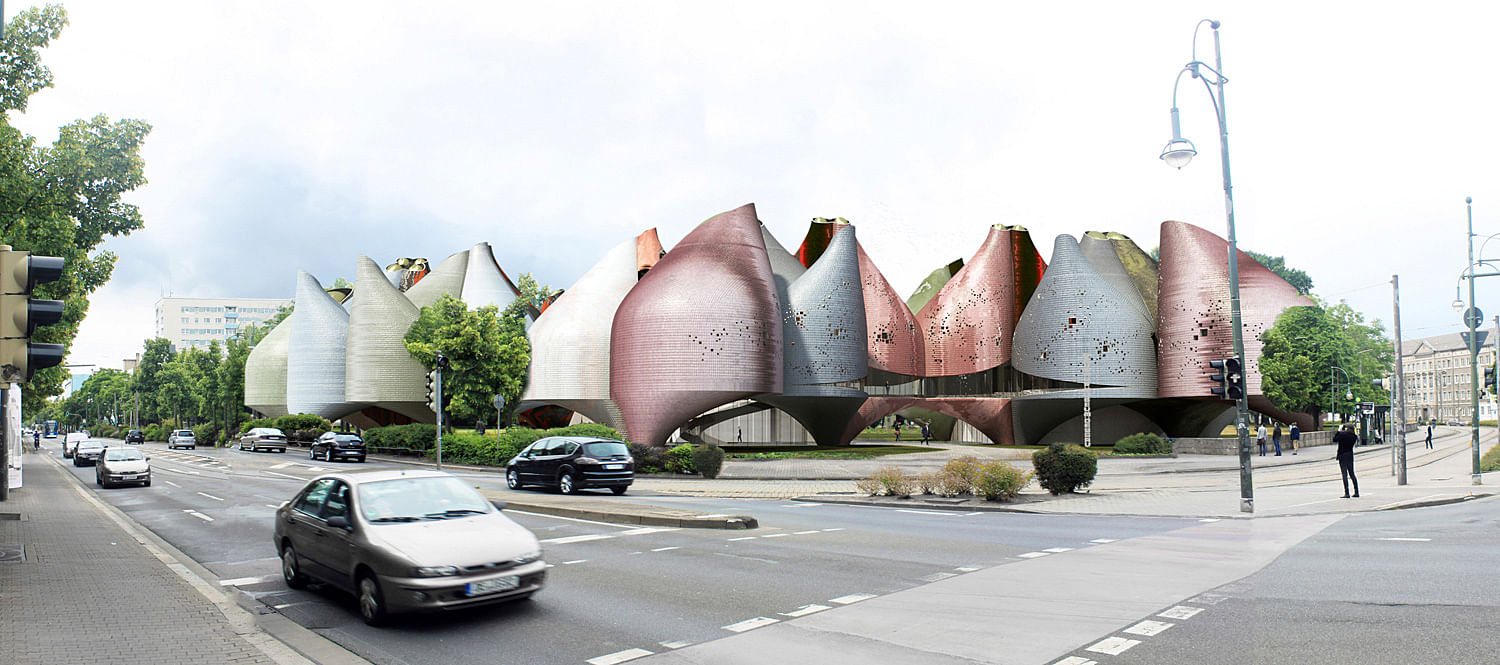
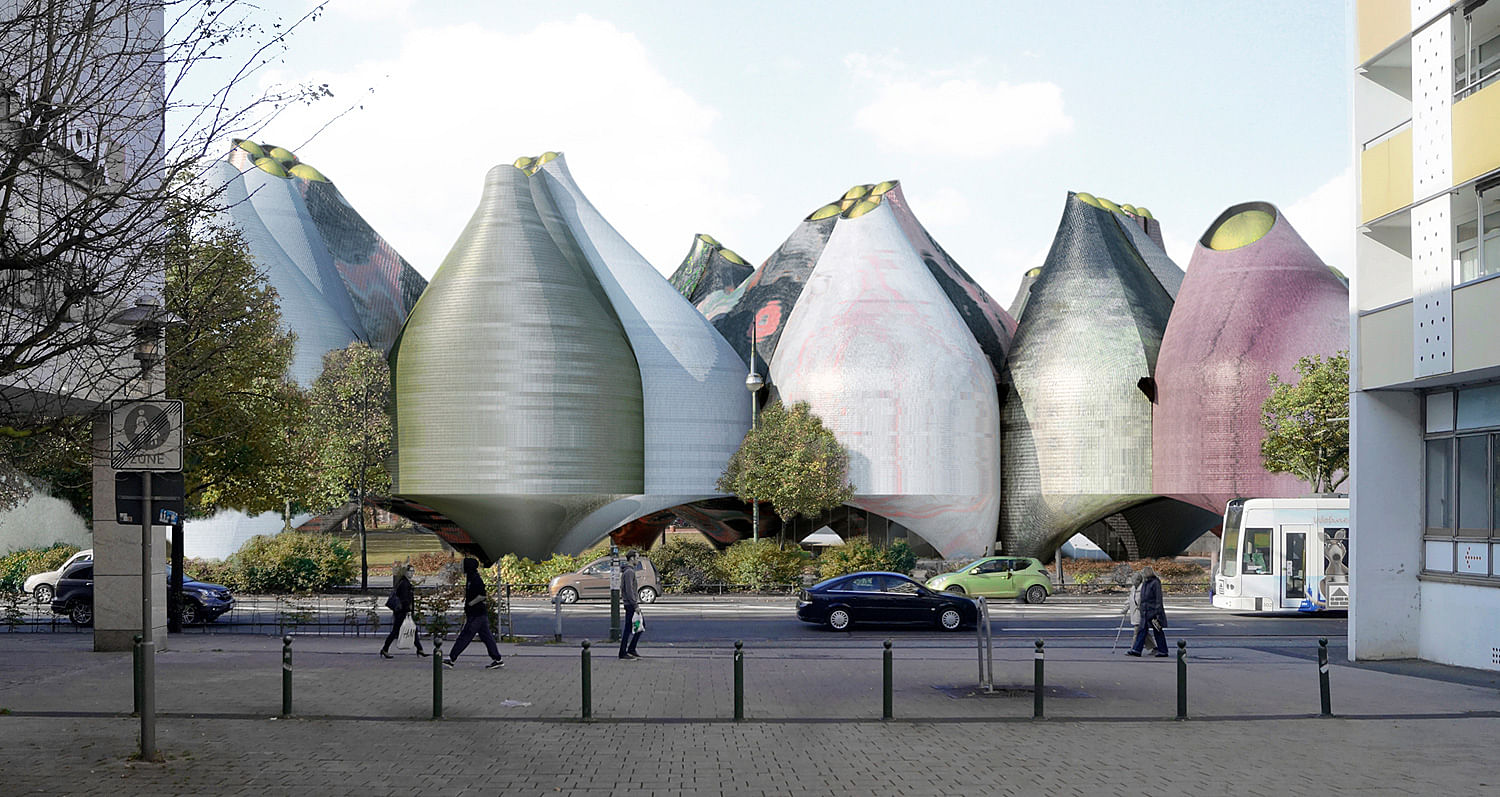
Young & Ayata: Vessel Collective Bauhaus Museum - Corner view.

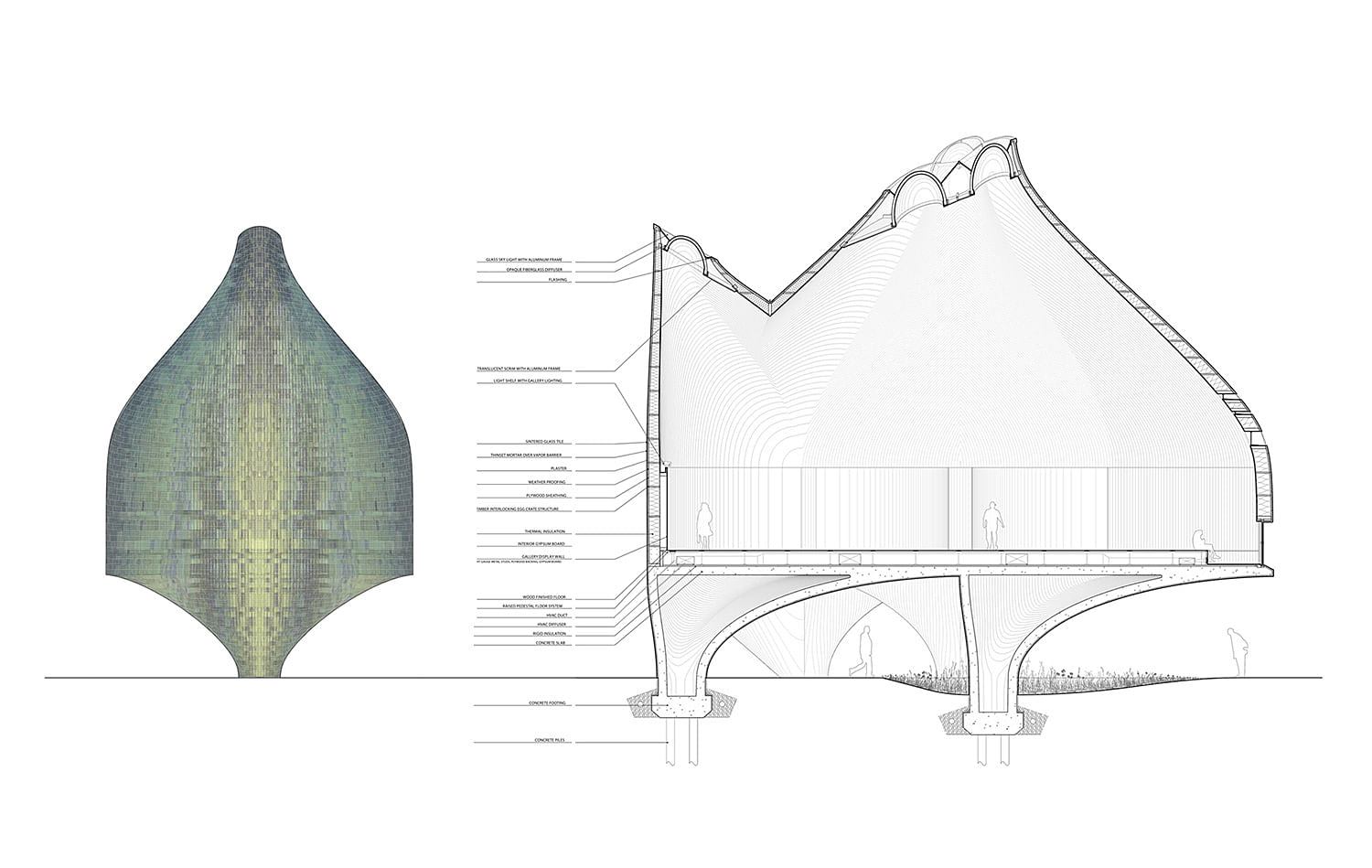
"The structure of the building has two primary systems: a single concrete slab raised on concrete legs, and a series of timber egg-crate vessel tops. The slab and legs create a stable lower level as a single system. On this table top of sorts the timber egg-crate cones rest fully on the edge of the slab and then behave as large box-beams when spanning over interior spaces. The gallery exhibition areas have apertures only high overhead, which creates greater thermal stability through a high-performance building envelope insulating each gallery on all sides. A raised floor above the slab creates a horizontal plenum continuous through the entire building containing all mechanical, electrical and plumbing services. Utilizing underfloor air displacement ventilation systems will enable maximum flexibility in the interior gallery spaces, and will be supplemented with radiant flooring in spaces near perimeter glazing."
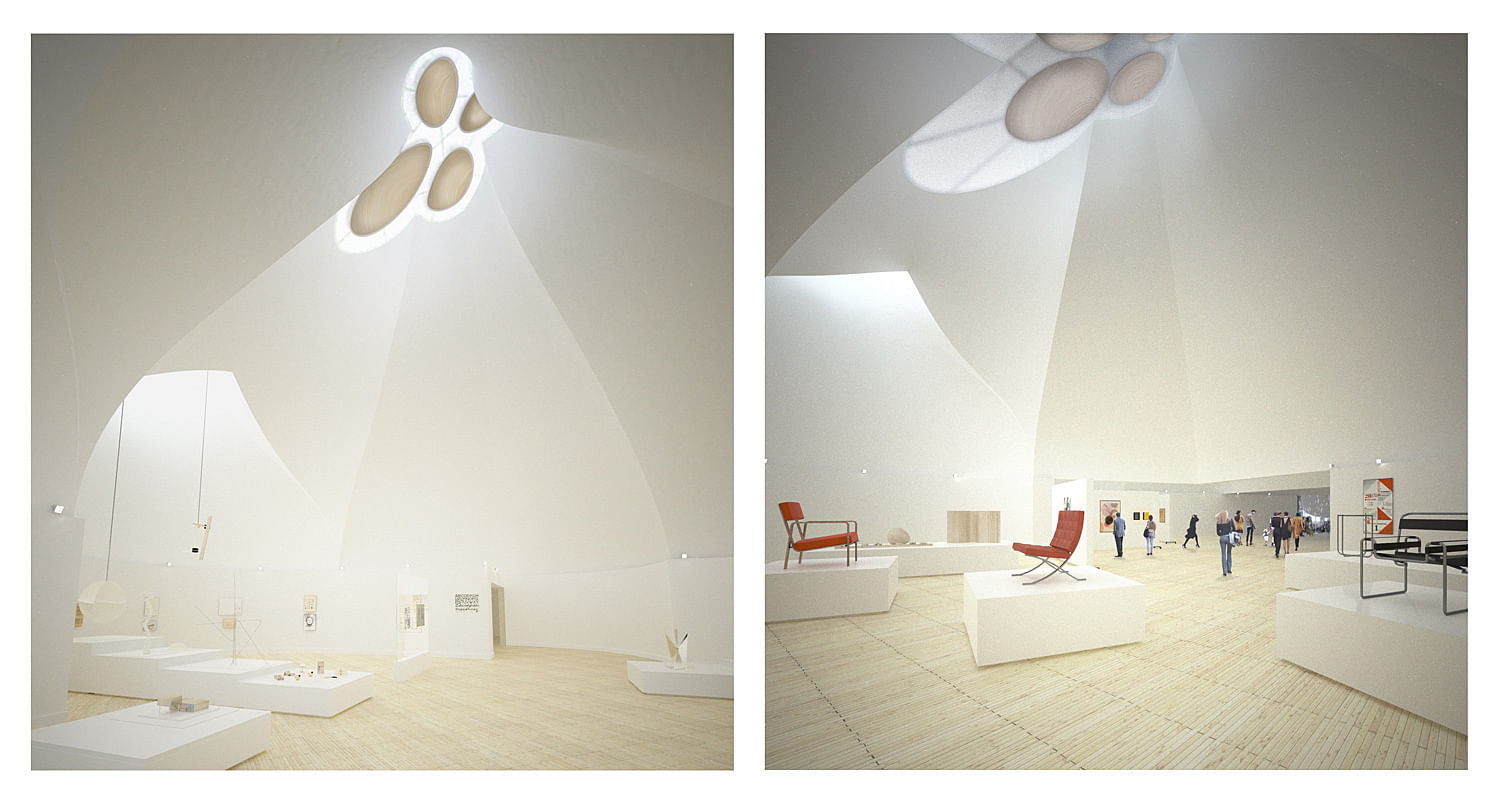
Young & Ayata: Vessel Collective Bauhaus Museum - Permanent and Temporary Galleries.

"The mechanical systems are broken into three zones: the permanent galleries, the temporary gallery, and the lobby/cafeteria/education/workshop zone, allowing the galleries to be environmentally controlled for artworks, while the other programmatic areas can be controlled as desired by activity and climatic factors. The goal of this integrated systems design is to provide the best possible interior museum environment, while reducing overall environmental impact, and providing long-term, operational cost savings."
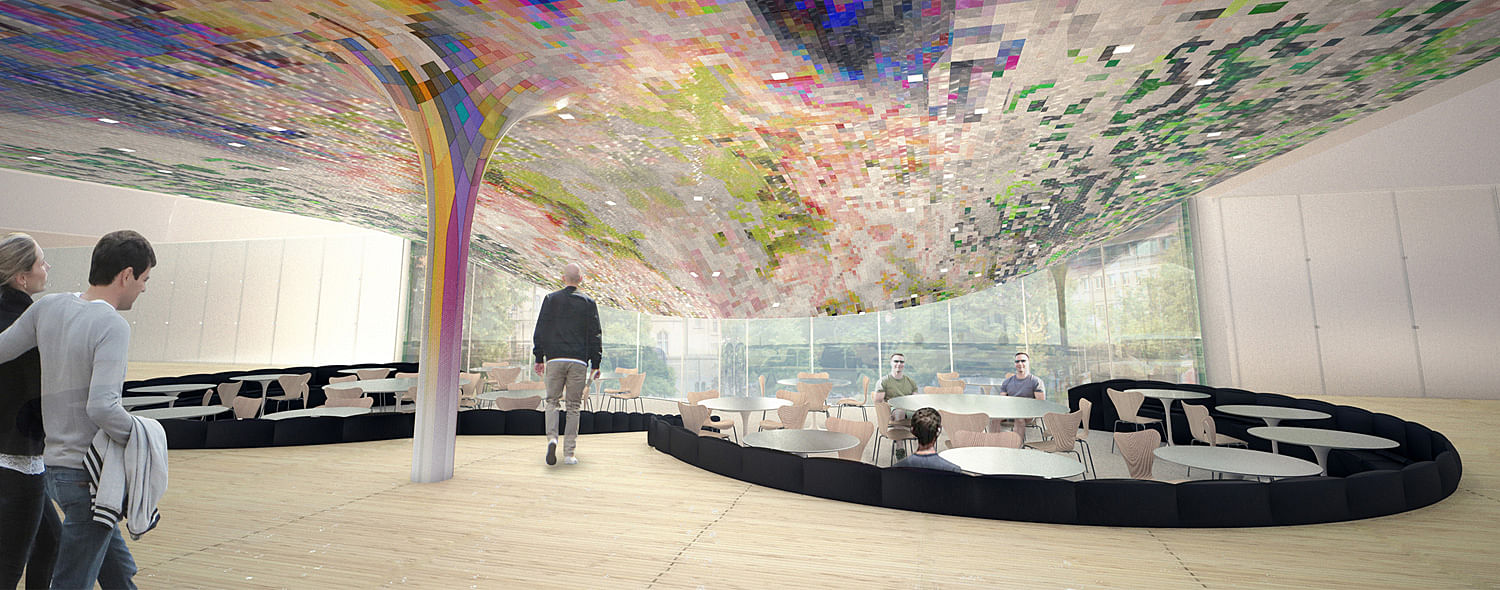
Young & Ayata: Vessel Collective Bauhaus Museum - Cafeteria.

"The exterior of the vessels is clad with small dimension sintered glass tiles made from recycled car windshields. Each vessel has a different colored pattern that helps distinguish it from its immediate neighbors. The tiles are laid out through a digital scanning of a graphic pattern, breaking and sorting color to find a matching tile per pixel; these are then robotically assembled into sub panels, which are numbered and fit together to cover the surfaces. The surface effect is an optical fusion into an apparent solidity as a single vessel. This cladding can be considered an update on the relations between craft and technology prevalent within Bauhaus ideology. The digital scan breaks the surface into a modular grid reminiscent of Bauhaus graphic and textile designs. The robotic layout uses cutting-edge technology to translate these patterns into material systems. The patterns thus use a digital 'material' mediation, a glitch, to then derive a visual glitch apparent in the aesthetics of the textile-like tile surface."
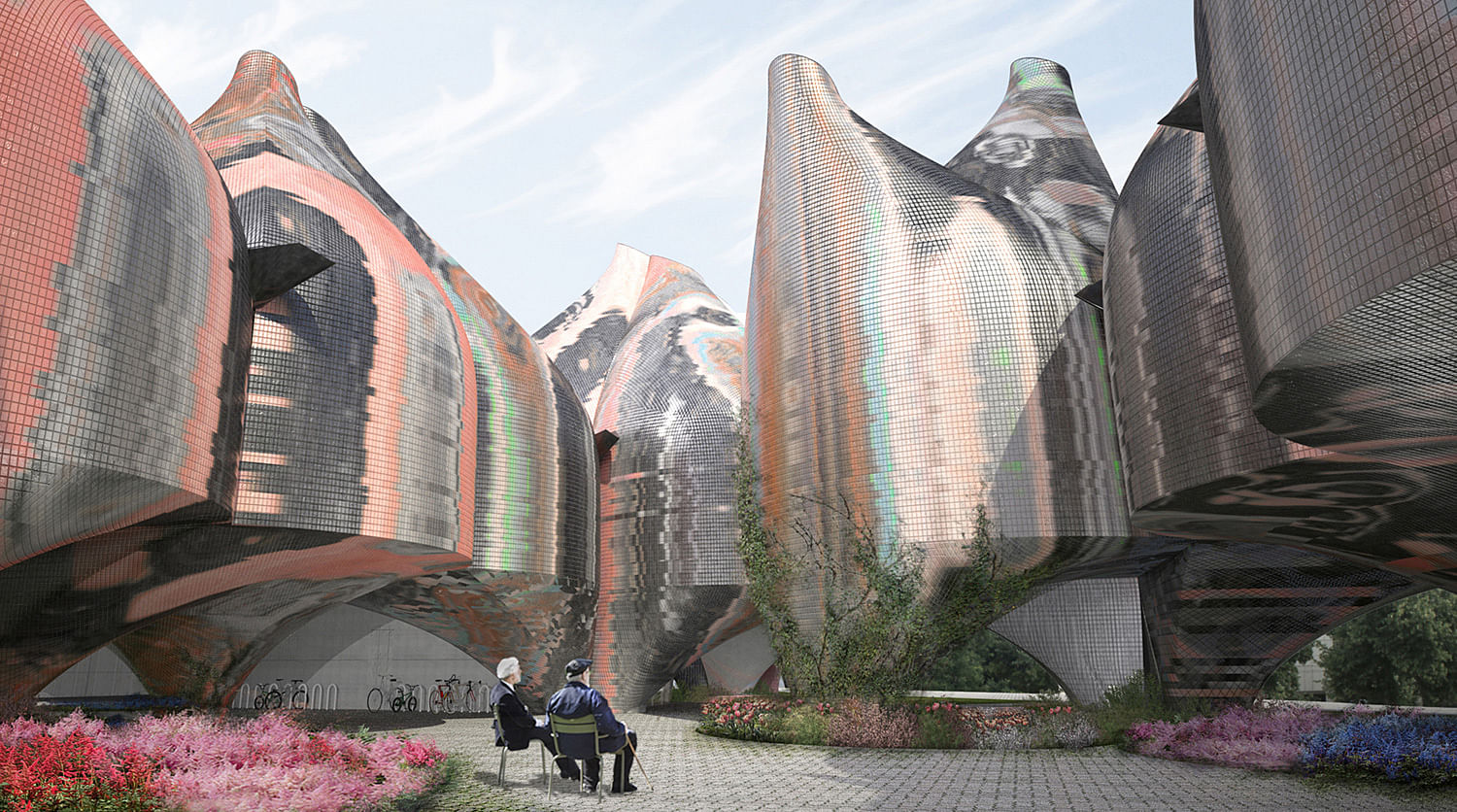
Young & Ayata: Vessel Collective Bauhaus Museum - Courtyard.

"The entire building sits lightly in the park, each concrete leg resting only on a series of piles that minimize the intrusion to the site ground. This site strategy allows visitors to pass visually and physically under the museum into the tree canopy of the park beyond. Each leg meets the ground with a slight depression that is landscaped with overflowing bushels of indigenous shade tolerant flowering vegetation. These wildflower beds spill blushes of color out into the courtyard and towards the park heightening the apparent lightness of the building's relation with the ground. The main building entry foyer lies to one side of a primary axial pathway connecting the corner of Friedrichstraβe and Kavalierstraβe to the park interior. This ground level entry foyer also opens onto a sculpture court in the center of the permanent gallery wing, its surface continuous with the surface of the park. Opposite the main entry foyer is the shop and logistics programs."
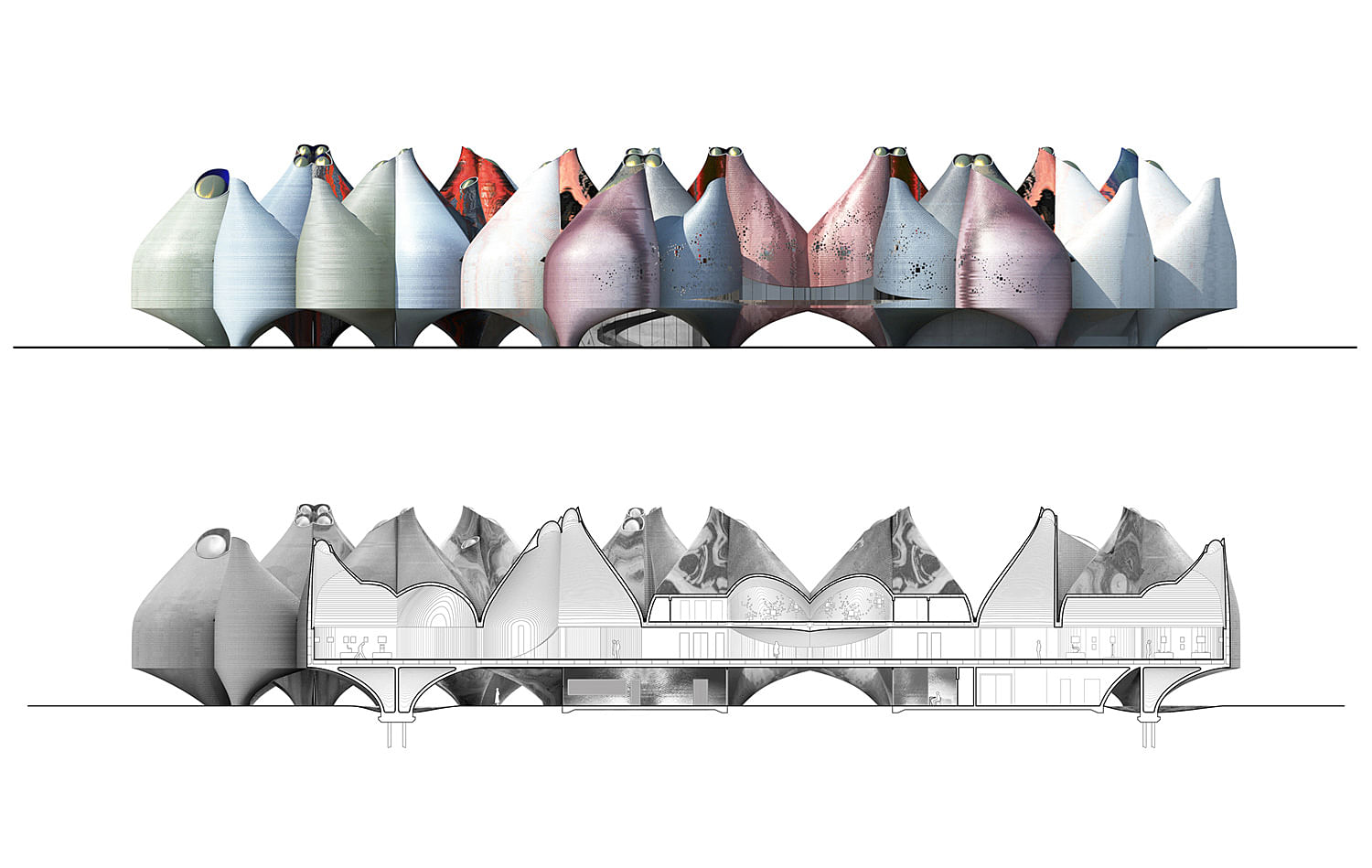
Young & Ayata: Vessel Collective Bauhaus Museum - Elevation + Section.

"A matrix or an object, repeated module or singular figures, technological or primitive: our proposal for the Bauhaus Museum Dessau fluctuates between these pairs in an unresolved tension. This lack of resolution reflects the multiplicity of understandings of the Bauhaus as a school, a collective body, an ideology, a body of art work, a workshop for industry, and the fount of one of western culture's most enduring modern legacies. To reduce this collection and its history to only one aspect is to diminish the rich complexity of the Bauhaus. The alternative is to celebrate the multiplicities in tension."

All images courtesy of Young & Ayata.

More project images in the thumbnail gallery below.
Related

museums ● germany ● dessau ● bauhaus museum dessau ● bauhaus museum ● bauhaus dessau foundation ● bauhaus ● young & ayata

Share

  • Follow

    0 Comments

  • Comment as :

Details of Young & Ayata's first-prize "Vessel Collective" for the Bauhaus Museum Dessau

Eight innovative timber projects honored at 2026 Wood in Architecture Awards

Beautiful brick architecture honored at BRICK AWARD 26

Over $500,000 awarded to architectural discourse projects by Graham Foundation

Best in urban planning recognized at AIA Regional & Urban Design Award 2026

Sponsored Post by Buildner

Re:Form - New Life for Old Spaces / Edition #3 advance registration deadline is approaching!

New architecture and design competitions: IDEAS Awards, UIA-HYP CUP International Student Competition, Vancouver Tall Challenge, and Memorial to the Sixth Extinction

Best small projects chosen at AIA Small Project Award 2026

10 standout sustainable projects honored at AIA COTE Top Ten Award 2026

Sign up for Bustler's Email Newsletters

Best residential architecture of 2026 honored at AIA Housing Award

Best new interiors of 2026 chosen at AIA Interior Architecture Awards

Best global architecture honored at RIBA International Awards 2026

World’s most beautiful airports of 2026 chosen by Prix Versailles

New architecture and design competitions: Brick in Architecture Awards, Study Architecture Student Showcase, N.Y.C. Groceries, and New York High Falls Riverfront Market

SmithGroup’s ‘pioneering’ Philip Merrill Environmental Center wins AIA Twenty-five Year Award

Sponsored Post by Buildner

Museum of Emotions / Edition #8 FINAL registration deadline is in 5 DAYS!

Next page » Loading

Details of Young & Ayata's first-prize "Vessel Collective" for the Bauhaus Museum Dessau

By Bustler Editors|

Friday, Sep 11, 2015

Share

Young & Ayata: Vessel Collective Bauhaus Museum.

Related

museums ● germany ● dessau ● bauhaus museum dessau ● bauhaus museum ● bauhaus dessau foundation ● bauhaus ● young & ayata

Earlier this week, New York-based Young & Ayata had one of the two first-prize proposals for the Bauhaus Museum competition in Dessau, Germany. The Bauhaus Dessau Foundation launched the open international competition intending to construct a museum in Dessau's City Park, in time to mark the 100th anniversary of the Bauhaus in 2019. The jury will determine which first-prize winner will construct the museum.

Founded in 2008, Young & Ayata continues to rise in the contemporary architecture scene. In recent years, they won in the 2014 Architectural League Prize and participated in exhibitions like "Treatise: Why Write Alone?" at the Graham Foundation earlier this year.

Check out their Bauhaus Museum proposal "Vessel Collective" right below.

"Vessel Collective: The legacy of the Bauhaus is defined in large part by a multiplicity of identities and tensions which contribute to its continuing vitality nearly a century after its founding. It would be a reduction of the complexity of the Bauhaus to divide it cleanly into a technical side and an expressive side, yet technical and expressive factors were often in conflict and in conversation throughout its history. The tension between these two motivations-- and specifically the shape that tension took at the Bauhaus-- continues to influence art, architecture, and design today. 

Our design of a museum for the Bauhaus Dessau is strongly informed by such productive tension--in this case, the tension between a desire for a modular repeatable system of organization, provided by a grid, and the exploration of sensation found in color and material experimentation. These two factors were central to many of the Bauhaus explorations as well, from figural glitches in Gunta Stölzl's textile wall hangings to the intuitively interrupted striations of Paul Klee's figurations, from the luminous mechanical index of László Moholy-Nagy's photograms to the grossly comic automatons of Oskar Schlemmer's dramatic costumes."

Young & Ayata: Vessel Collective Bauhaus Museum - Aerial view.

"Our proposal for the Bauhaus Museum Dessau acknowledges these tensions through the design of a building as a collection of individual masses aggregated serially through a grid. We are calling these objects "vessels" as they allude to the crafted object of a vase or volumetric container. The vessels hover above the site on trunk-like legs, creating a light touch in the park and allowing passage underneath. The bellies of the vessels swell to touch each other along the gridded matrix creating an open continuous floor plan that connects the entire museum with a single floor. These combinations allow the building to fluctuate character between a huddle of singular objects, a sinuous coil of continuity, and a matrix of gridded repetition. Each attitude is at odds with the others, a productive tension resonating through the design."

Young & Ayata: Vessel Collective Bauhaus Museum.

"All of the vessels are similar units built only from circles and squares, but as they collect together they rotate, mirror and fuse to create a varied figuration on the exterior and a variety of different spatial volumes on the interior. The fusion of these volumes rises toward light nozzles equipped with diffusers that bounce and block direct sunlight. These fusions vary from one to four joined vessels and change direction based on solar orientation. This presents the gallery experience as an alternation between an open flexible matrix and distinct volumes of different spatial qualities, a mash-up of the historical typologies of the enfilade and the free-plan, creating a new hybrid of exhibition possibilities.  The main level plan is divided into two wings along an axis perpendicular to the site corner. To one side is the sequence of permanent galleries devoted to the Bauhaus.

To the other side are the temporary galleries. The center of the building acts as a hub or knuckle between the gallery programs. This space opens views out to the park and to the urban street corner with cafeteria and special exhibition functions which can double as an active event space when desired. From this knuckle it is possible also to go to the education workshops or the education event space. Above this central space is a mezzanine for the offices of the museum director and staff. This space has views down to the main floor as well as views out to the park and street corner through a series of small punched openings that filter through the cones like veins of marble."

Young & Ayata: Vessel Collective Bauhaus Museum - Corner view.

"The structure of the building has two primary systems: a single concrete slab raised on concrete legs, and a series of timber egg-crate vessel tops. The slab and legs create a stable lower level as a single system. On this table top of sorts the timber egg-crate cones rest fully on the edge of the slab and then behave as large box-beams when spanning over interior spaces. The gallery exhibition areas have apertures only high overhead, which creates greater thermal stability through a high-performance building envelope insulating each gallery on all sides. A raised floor above the slab creates a horizontal plenum continuous through the entire building containing all mechanical, electrical and plumbing services. Utilizing underfloor air displacement ventilation systems will enable maximum flexibility in the interior gallery spaces, and will be supplemented with radiant flooring in spaces near perimeter glazing."

Young & Ayata: Vessel Collective Bauhaus Museum - Permanent and Temporary Galleries.

"The mechanical systems are broken into three zones: the permanent galleries, the temporary gallery, and the lobby/cafeteria/education/workshop zone, allowing the galleries to be environmentally controlled for artworks, while the other programmatic areas can be controlled as desired by activity and climatic factors. The goal of this integrated systems design is to provide the best possible interior museum environment, while reducing overall environmental impact, and providing long-term, operational cost savings."

Young & Ayata: Vessel Collective Bauhaus Museum - Cafeteria.

"The exterior of the vessels is clad with small dimension sintered glass tiles made from recycled car windshields. Each vessel has a different colored pattern that helps distinguish it from its immediate neighbors. The tiles are laid out through a digital scanning of a graphic pattern, breaking and sorting color to find a matching tile per pixel; these are then robotically assembled into sub panels, which are numbered and fit together to cover the surfaces. The surface effect is an optical fusion into an apparent solidity as a single vessel. This cladding can be considered an update on the relations between craft and technology prevalent within Bauhaus ideology. The digital scan breaks the surface into a modular grid reminiscent of Bauhaus graphic and textile designs. The robotic layout uses cutting-edge technology to translate these patterns into material systems. The patterns thus use a digital 'material' mediation, a glitch, to then derive a visual glitch apparent in the aesthetics of the textile-like tile surface."

Young & Ayata: Vessel Collective Bauhaus Museum - Courtyard.

"The entire building sits lightly in the park, each concrete leg resting only on a series of piles that minimize the intrusion to the site ground. This site strategy allows visitors to pass visually and physically under the museum into the tree canopy of the park beyond. Each leg meets the ground with a slight depression that is landscaped with overflowing bushels of indigenous shade tolerant flowering vegetation. These wildflower beds spill blushes of color out into the courtyard and towards the park heightening the apparent lightness of the building's relation with the ground. The main building entry foyer lies to one side of a primary axial pathway connecting the corner of Friedrichstraβe and Kavalierstraβe to the park interior. This ground level entry foyer also opens onto a sculpture court in the center of the permanent gallery wing, its surface continuous with the surface of the park. Opposite the main entry foyer is the shop and logistics programs."

Young & Ayata: Vessel Collective Bauhaus Museum - Elevation + Section.

"A matrix or an object, repeated module or singular figures, technological or primitive: our proposal for the Bauhaus Museum Dessau fluctuates between these pairs in an unresolved tension. This lack of resolution reflects the multiplicity of understandings of the Bauhaus as a school, a collective body, an ideology, a body of art work, a workshop for industry, and the fount of one of western culture's most enduring modern legacies. To reduce this collection and its history to only one aspect is to diminish the rich complexity of the Bauhaus. The alternative is to celebrate the multiplicities in tension."

All images courtesy of Young & Ayata.

More project images in the thumbnail gallery below.
Share

  • Follow

    0 Comments

  • Comment as :

Archinect JobsArchinect Jobs

The Archinect Job Board attracts the world's top architectural design talents.

VIEW ALL JOBS POST A JOB

Architect

ThinkForm Architects

Architect

Hopewell, NJ, US

Executive Assistant & Office Manager To Principal

Danny Forster & Architecture

Executive Assistant & Office Manager To Principal

New York, NY, US

Intermediate Architect - Retail (AutoCAD-based)

O'Neil Langan Architects

Intermediate Architect - Retail (AutoCAD-based)

New York, NY, US

Architectural Design Manager for Architectural Lighting Design Firm

Castelli-Design

Architectural Design Manager for Architectural Lighting Design Firm

New York, NY, US

Digital Futures Fellow

The University of Tennessee - Knoxville

Digital Futures Fellow

Knoxville, TN, US

Job Captain

Studio AR&D Architects

Job Captain

Los Angeles, CA, US

Architectural Designer

7th Street Burger

Architectural Designer

New York, NY, US

Architect

ThinkForm Architects

Architect

Charleston, SC, US

Project Architect at High End Boutique Townhouse Firm in BK

Steering House Design and Development

Project Architect at High End Boutique Townhouse Firm in BK

Brooklyn, NY, US

Interior Designer

Megan Grehl

Interior Designer

New York, NY, US

Next page » Loading