RISK: Present Predicaments in Architecture and Urban Planning
Friday, Mar 30, 20125 PMEDT
| Taubman College, Rackham Auditorium Ann Arbor, MI
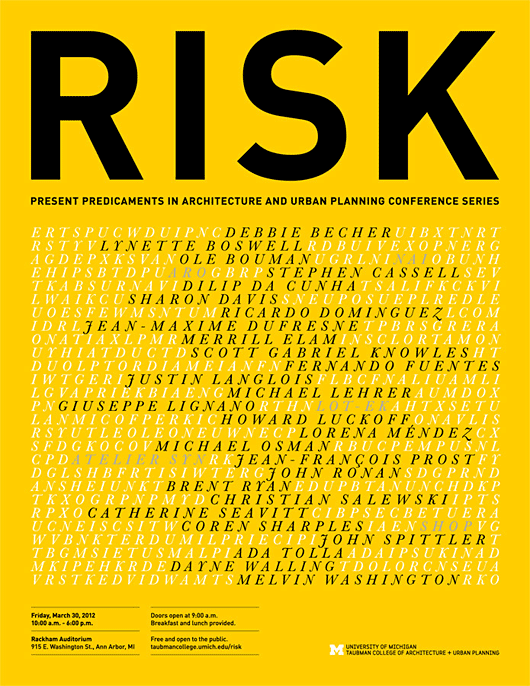 RISK, a conference that highlights present predicaments in architecture and urban planning, will explore the intersection between entrepreneurship and practice, taking risks in design, coopting strategies from other disciplines to advance architecture and planning, and in general not being afraid of change.
A dynamic group of speakers will engage the topic in 15-minute presentations, followed by a faculty response to provide a summary and commentary on the themes such as professional risk; environmental risk; risk of investing in the central city; and design as risk.
The event is free and open to the public. For more: www.taubmancollege.umich.edu/risk
10:15 AM – Panel: The Risk of Investing in the Central City
For much of the twentieth century, investing public or private dollars into any major U. S. central city was not much of a risk. In global or regional powerhouses such as New York, Seattle, or Chicago, this is still true. Yet, even in these cities, some neighborhoods or sectors may suffer major social and economic problems and thus not be as competitive as others. Some other cities pose an investment risk for almost anywhere within their borders; this is particularly true for "legacy cities," those which have lost major portions of their population and commerce over the last few decades and experience high vacancy levels. This panel will consider the spectrum of risk in public and private investment issues in such cities. It will include the "long view" of redevelopment and its historical effects on Baltimore in "risky" areas; the challenge of convincing residents in declining areas to accept the "risk" of redevelopment, as illustrated in two redevelopment areas in Philadelphia, and ways planners can overcome such skepticism; the ways that the public sector and developers have overcome challenges of investment in cities such as Detroit and Flint over the last few decades; continuing challenges of such investment and ways to overcome them while meeting goals such as sustainability and equity; and design principles that might govern future development in "legacy cities."
Speakers: Debbie Becher, Lynette Boswell, Howard Luckoff, Brent Ryan, Dayne Walling, Melvin Washington
Response by: Professor June Manning Thomas
12:00 PM – Panel: World At Risk
The panel seeks to address the interrelations of risk and the environment in a society increasingly defined in terms of heightened threats, environmental degradation, and climate change. Away from scenarios of "ecological apocalypse" and "natural disasters," both of which flirt with a naturalization of the political, the panel highlights the interrelations of nature, expertise, and power in the construction of risk and explores the agency of representation and design in the making and unmaking of such uncertain worlds.
Speakers:Stephen Cassell, Dilip da Cunha, Scott Gabriel Knowles, Michael Osman, Christian Salewski
Response by: Assistant Professor Rania Ghosn
2:15 PM – Panel: Professional Precarity
Professional risk has come to assume considerable significance for nearly everyone in today's uncertain economic climate. Unemployment statistics are regarded with the anxiety of sporting wagers, dominated by relentless speculation. Hazards abound and reactionary caution has become the status quo. Despite, or better yet, in spite of this prevailing attitude, the members of this panel have dared to operate. In a time when the notion of job security has become an outmoded concept, these individuals have endeavored to re-define industries and boldly occupy unfamiliar territory. Their respective practices have eschewed the easily codified. They have turned their backs on the purported security of conventional modes of working for what can be described as a new kind of professional risk-taking. What is this phenomenon? How does one set benchmarks and define their role within a practice for which there are no models or categories? What are the metrics of success when no one-to-one competitor exists? Is 'success' even relevant? Not only will the speakers on the panel address these (and more) pressing questions in detail, but they will also begin to speculate upon the implications of their intentionally precarious professional endeavors for the future of the industries within which they work.
Speakers: Sharon Davis, Michael Lehrer, Catherine Seavitt, Coren Sharples, John Spittler
Response by: Lecturer Teman Evans
3:45 PM – Panel: Objective Uncertainty
We live in an age of objective uncertainty, which is to say that we are objectively certain that these are precarious times. What we may be uncertain about – against a backdrop of environmental anxiety, financial crisis, and socio-cultural unhinging - is the architectural object's ability to do something about it. The stakes are high. If architecture is to re-establish a fundamental and critical relationship to existing political, economic, and cultural orders, if it is to take on a transformative agenda, then the conventional visual and formal tropes of prominence, continuity and monumentality may well need to be reconsidered. The question is, how? This panel will consider transformative design procedures – both risky and optimistic – that challenge accepted formats and redefine the parameters of architectural engagement. In trading programmatic determinacies for adaptability, finish for progression, or polish for opportunistic imperfection, does architecture expand its operating field and gain legitimacy as an instrument of change? Or is the acceptance of the architectural object's authoritative insolvencies too perilous a tactic in the contemporary environment?
Speakers: Ole Bouman, Merrill Elam, Giuseppe Lignano & Ada Tolla, John Ronan
Response by: Assistant Professor Anya Sirota
5:05 PM – Panel: Design Vulnerability
From the perspective of design research, the laboratory is a model for investigating urban scenography, interstitial space, transient icons, and the political economies which shape architecture and the city. The lab is not, in this model, the hygienic space portioned from the world to afford a distanced observation; the lab is instead a platform for embedded forms of inquiry, intervention, speculation, and experimentation. These precarious forms of practice are affirmed through design strategies that embolden our experiences of vulnerability at the level of the city, the social, and the ecological. These practices do not attempt to erase vulnerability through design but instead leverage design research and performative experimentation by collaborating with and among various vulnerabilities. The panel considers how practices of accumulating vulnerability offer new models of courage and conviction for post-heroic architecture and design.
Speakers: Ricardo Dominguez, Jean-Maxime Dufresne & Jean-François Prost, Fernando Fuentes & Lorena Méndez, Justin Langlois
Response by: Walter B. Sanders Fellow Etienne Turpin
RISK is the 2nd conference in the series representing president predicaments in architecture and urban planning. POWER was held October 2011. To watch the videos, for more: taubmancollege.umich.edu/power
RISK, a conference that highlights present predicaments in architecture and urban planning, will explore the intersection between entrepreneurship and practice, taking risks in design, coopting strategies from other disciplines to advance architecture and planning, and in general not being afraid of change.
A dynamic group of speakers will engage the topic in 15-minute presentations, followed by a faculty response to provide a summary and commentary on the themes such as professional risk; environmental risk; risk of investing in the central city; and design as risk.
The event is free and open to the public. For more: www.taubmancollege.umich.edu/risk
10:15 AM – Panel: The Risk of Investing in the Central City
For much of the twentieth century, investing public or private dollars into any major U. S. central city was not much of a risk. In global or regional powerhouses such as New York, Seattle, or Chicago, this is still true. Yet, even in these cities, some neighborhoods or sectors may suffer major social and economic problems and thus not be as competitive as others. Some other cities pose an investment risk for almost anywhere within their borders; this is particularly true for "legacy cities," those which have lost major portions of their population and commerce over the last few decades and experience high vacancy levels. This panel will consider the spectrum of risk in public and private investment issues in such cities. It will include the "long view" of redevelopment and its historical effects on Baltimore in "risky" areas; the challenge of convincing residents in declining areas to accept the "risk" of redevelopment, as illustrated in two redevelopment areas in Philadelphia, and ways planners can overcome such skepticism; the ways that the public sector and developers have overcome challenges of investment in cities such as Detroit and Flint over the last few decades; continuing challenges of such investment and ways to overcome them while meeting goals such as sustainability and equity; and design principles that might govern future development in "legacy cities."
Speakers: Debbie Becher, Lynette Boswell, Howard Luckoff, Brent Ryan, Dayne Walling, Melvin Washington
Response by: Professor June Manning Thomas
12:00 PM – Panel: World At Risk
The panel seeks to address the interrelations of risk and the environment in a society increasingly defined in terms of heightened threats, environmental degradation, and climate change. Away from scenarios of "ecological apocalypse" and "natural disasters," both of which flirt with a naturalization of the political, the panel highlights the interrelations of nature, expertise, and power in the construction of risk and explores the agency of representation and design in the making and unmaking of such uncertain worlds.
Speakers:Stephen Cassell, Dilip da Cunha, Scott Gabriel Knowles, Michael Osman, Christian Salewski
Response by: Assistant Professor Rania Ghosn
2:15 PM – Panel: Professional Precarity
Professional risk has come to assume considerable significance for nearly everyone in today's uncertain economic climate. Unemployment statistics are regarded with the anxiety of sporting wagers, dominated by relentless speculation. Hazards abound and reactionary caution has become the status quo. Despite, or better yet, in spite of this prevailing attitude, the members of this panel have dared to operate. In a time when the notion of job security has become an outmoded concept, these individuals have endeavored to re-define industries and boldly occupy unfamiliar territory. Their respective practices have eschewed the easily codified. They have turned their backs on the purported security of conventional modes of working for what can be described as a new kind of professional risk-taking. What is this phenomenon? How does one set benchmarks and define their role within a practice for which there are no models or categories? What are the metrics of success when no one-to-one competitor exists? Is 'success' even relevant? Not only will the speakers on the panel address these (and more) pressing questions in detail, but they will also begin to speculate upon the implications of their intentionally precarious professional endeavors for the future of the industries within which they work.
Speakers: Sharon Davis, Michael Lehrer, Catherine Seavitt, Coren Sharples, John Spittler
Response by: Lecturer Teman Evans
3:45 PM – Panel: Objective Uncertainty
We live in an age of objective uncertainty, which is to say that we are objectively certain that these are precarious times. What we may be uncertain about – against a backdrop of environmental anxiety, financial crisis, and socio-cultural unhinging - is the architectural object's ability to do something about it. The stakes are high. If architecture is to re-establish a fundamental and critical relationship to existing political, economic, and cultural orders, if it is to take on a transformative agenda, then the conventional visual and formal tropes of prominence, continuity and monumentality may well need to be reconsidered. The question is, how? This panel will consider transformative design procedures – both risky and optimistic – that challenge accepted formats and redefine the parameters of architectural engagement. In trading programmatic determinacies for adaptability, finish for progression, or polish for opportunistic imperfection, does architecture expand its operating field and gain legitimacy as an instrument of change? Or is the acceptance of the architectural object's authoritative insolvencies too perilous a tactic in the contemporary environment?
Speakers: Ole Bouman, Merrill Elam, Giuseppe Lignano & Ada Tolla, John Ronan
Response by: Assistant Professor Anya Sirota
5:05 PM – Panel: Design Vulnerability
From the perspective of design research, the laboratory is a model for investigating urban scenography, interstitial space, transient icons, and the political economies which shape architecture and the city. The lab is not, in this model, the hygienic space portioned from the world to afford a distanced observation; the lab is instead a platform for embedded forms of inquiry, intervention, speculation, and experimentation. These precarious forms of practice are affirmed through design strategies that embolden our experiences of vulnerability at the level of the city, the social, and the ecological. These practices do not attempt to erase vulnerability through design but instead leverage design research and performative experimentation by collaborating with and among various vulnerabilities. The panel considers how practices of accumulating vulnerability offer new models of courage and conviction for post-heroic architecture and design.
Speakers: Ricardo Dominguez, Jean-Maxime Dufresne & Jean-François Prost, Fernando Fuentes & Lorena Méndez, Justin Langlois
Response by: Walter B. Sanders Fellow Etienne Turpin
RISK is the 2nd conference in the series representing president predicaments in architecture and urban planning. POWER was held October 2011. To watch the videos, for more: taubmancollege.umich.edu/power

Share
0 Comments
Comment as :