• Login / Join
  • About
  • •
  • Contact
  • •
  • Advertising
bustler logo
bustler logo
  • News
  • Competitions
  • Events
  • Bustler is powered by Archinect
  • Sign up for Bustler's Email Newsletters

  • Follow these Bustler feeds:

  • Search

    Search in

  • Submit

    What are you submitting?

    News Pitch
    Competition
    Event
  • Login / Join
  • News|Competitions|Events
  • Search
    | Submit
    | Follow
  • Search in

    What are you submitting?

    News Pitch
    Competition
    Event

    Follow these Bustler feeds:

  • About|Contact|Advertising
  • Login / Join

AGER Group's Winning Kaohsiung Port Station Proposal

By Bustler Editors|

Wednesday, Aug 3, 2011
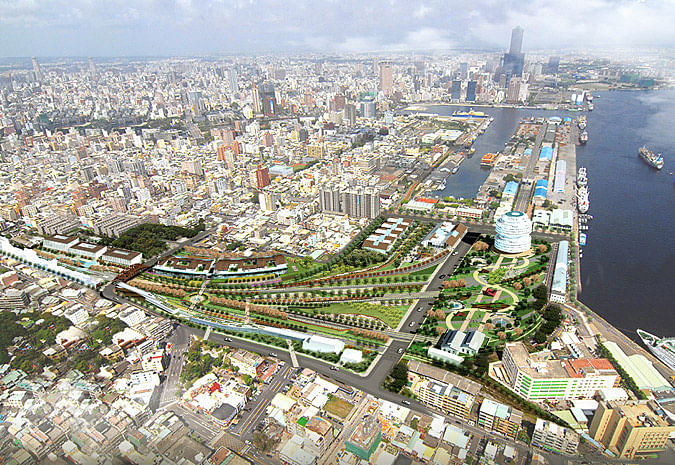
Aerial view of the competition-winning Kaohsiung Port Station concept by AGER Group (Image: AGER Group)

We recently published one of the two winning entries to the Kaohsiung Port Station Urban Design competition by De Architekten Cie. Here is now also the second of two entries that managed to win the jury's highest praise, the Excellence Award, by AGER Group’s Boston Studio. The team was led by Jessica Leete; team members included Thomas Paine, Molly Huang, Albert Chung, Winnie Lai, Shan Shan Lu, and Claire Ji Kim.

The international competition was initiated by the city government of Kaohsiung, Taiwan to transform the derelict site of the old railyards and port station from a barrier between two important areas of the city into a connective piece of the urban fabric.

Project Description by the Architects:

The 15.42 hectare site is located between the Hamasen and Yenchen historic commercial centers of the 1920’s and 40’s and at the intersection of three of Kaohsiung’s thriving neighborhoods home of the recent Maritime Music Center and Port Terminal competitions.  The competition aimed at transforming the historic rail yard and port station into a new city destination, creating a progressive model for local urban renewal.  The competition’s dual goals of cultural preservation and urban development are achieved in AGER’s proposal through a three phased development. 

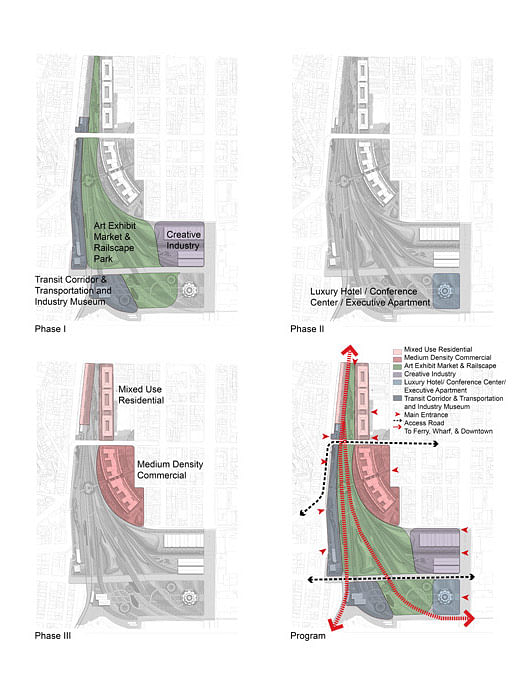
In phase one, AGER proposed three strategies to establish a new identity for the project. They include developing a transportation and industry museum, preserving key portions of the railway for public and special event use, and transforming other portions of the rail yard into an art exhibit/market and rail-scape park corridor. The corridor would be animated with outdoor sculpture, restaurants and retail in specially re-designed rail-cars, and the former sugar warehouses renovated into creative industry lofts.
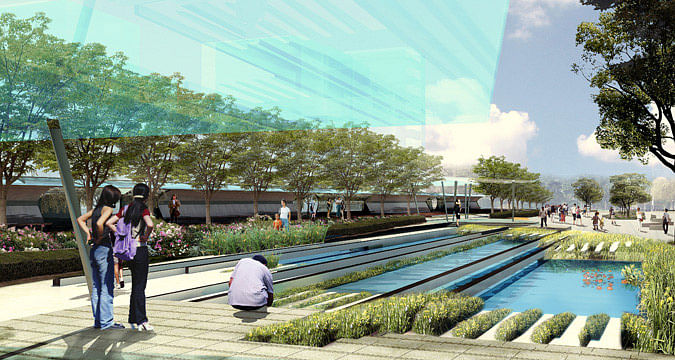
Perspective, pond (Image: AGER Group)

In phase two, an iconic luxury hotel with conference center and executive apartments to be designed by a signature architect is proposed to attract additional visitors to the rail-scape park corridor development and transportation and industry museum.  This iconic building would aim to bring additional recognition to the project and with it, investors to phase three of the project.
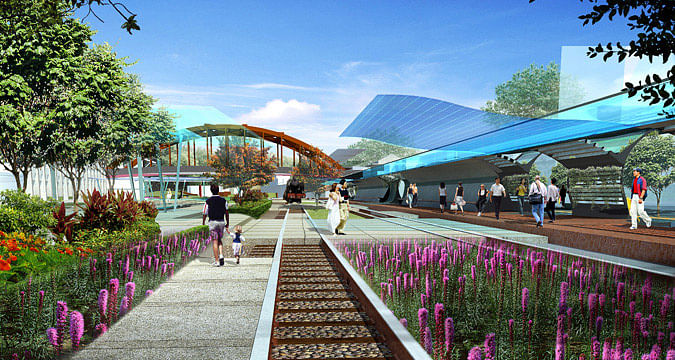
Perspective, north, rail (Image: AGER Group)

Phase three of the project, which lies at the north end of the site, is most intimately connected to the adjacent historic Hamasen urban fabric district.  Consequently, Ager proposed a series of  high-density mixed use residential buildings based on the Southeast Asian shophouse typology found in the Hamasen district and a high end commercial complex with public corridors and civic spaces that becomes the new hub to help bring together the existing neighborhoods.
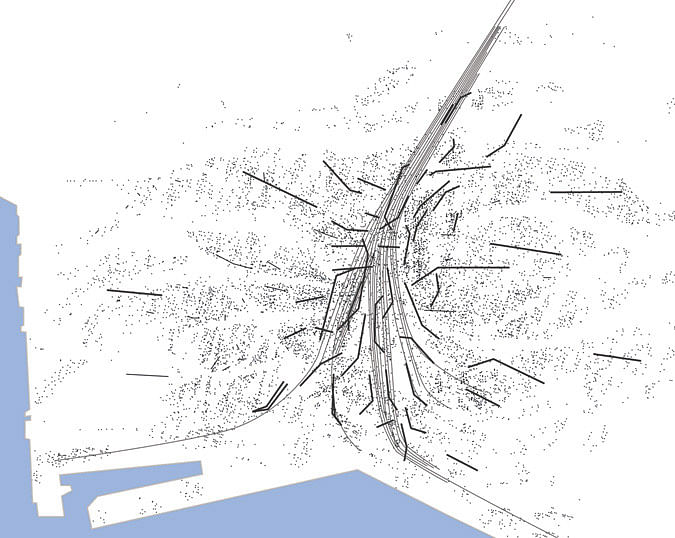
Concept diagram (Image: AGER Group)

Complimenting this three phased approach, AGER studied the economic trends of domestic consumer market growth, office and retail demand, housing demand, and the expected growth of Taiwan’s tourism industry to propose a financially feasible design.  Integrated in the study, was consideration of the brownfield soil conditions, building re-use, and disaster resilience to help form a sustainable strategy for the project over time.
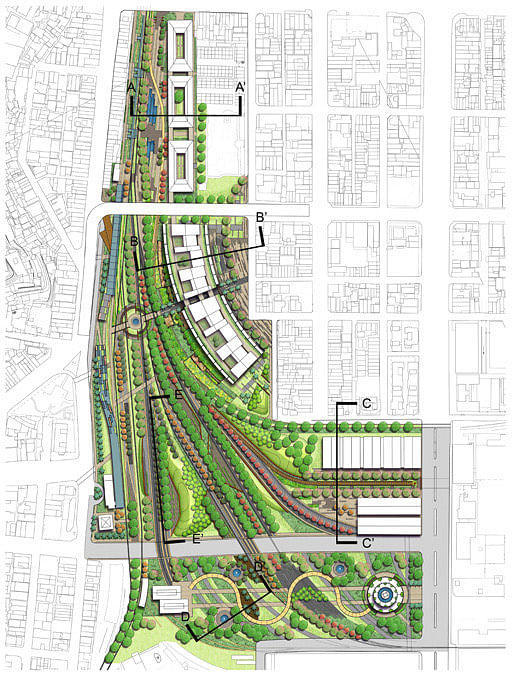
Site plan (Image: AGER Group)

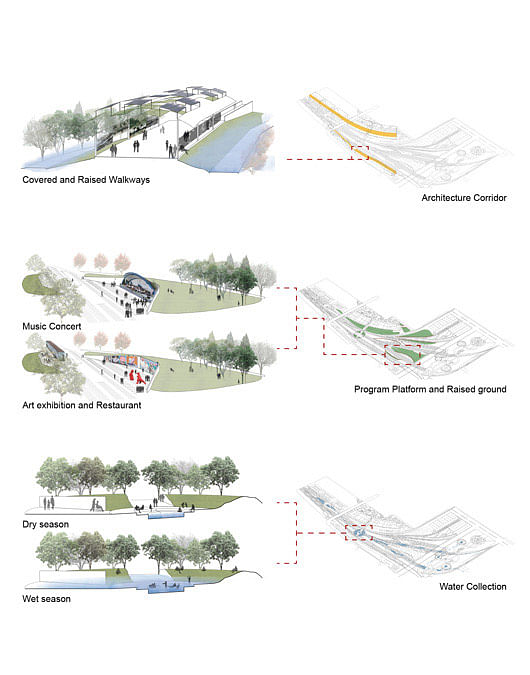
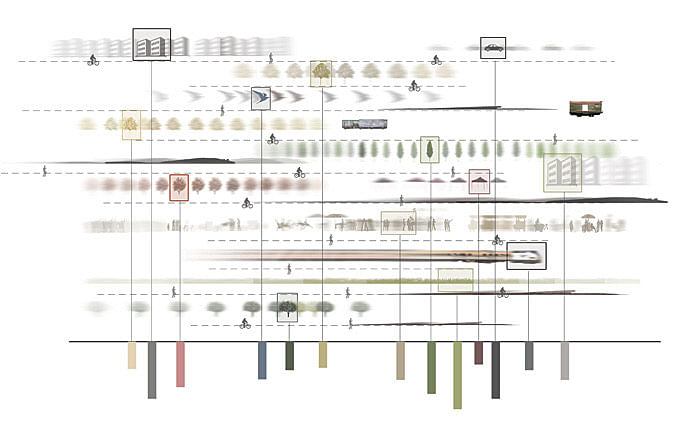
Instead of developing a final picture or finished master plan with a predetermined end result for the project, AGER’s phased strategy for the re-use of the existing rail infrastructure  used a variety of components (rail, walk, wall, ramp, plaza, building, program platform/ stage, landform, planting) to direct and capture the diverse forces and flows within the site to create flexible conditions for future events and program.  The seemless relationship between landscape, architecture, and infrastructure allows for an increased level of habitation, protected circulation, and incremental response to a variety of weather conditions.  In particular the park corridor, the central network for movement in the project, is designed to encourage communication, exchange, and thus be adaptable over time based on behaviour and performance.  It is the central stage for a series of events that are not pre-determined but rather catalyzed and amplified by the intersection of territory, varying intensities of activity and speeds of progression.  From the point of view of the visitor this is a constantly shifting layered experience coordinated with their own movement. 
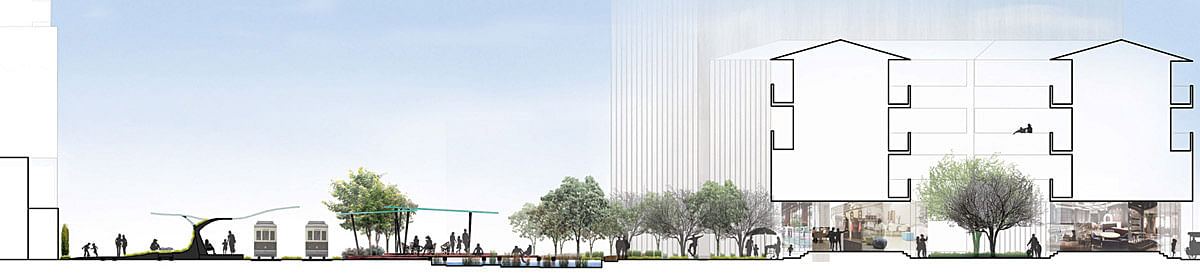
AA-section (Image: AGER Group)
CC-section (Image: AGER Group)
DD-section (Image: AGER Group)

Find more diagrams in the image gallery below.

Related

urban ● taiwan ● port ● kaohsiung ● harbor ● city ● asia ● ager group

Share

  • Follow

    0 Comments

  • Comment as :

AGER Group's Winning Kaohsiung Port Station Proposal

New architecture and design competitions: Exploring 130 Years of American Design, Christo & Jeanne-Claude Center, 13 White Houses, and La Pyramide

Micro-architecture honored in latest Tiny House Architecture Competition

World’s most beautiful restaurants of 2026 chosen by Prix Versailles

Sponsored Post by Buildner

Design a wine tasting room in Italy! Valli Wine Tasting Room is launched!

10 can't-miss architecture & design events to see this June in London, Los Angeles, Chicago, San Francisco, Detroit, San Diego, Porto, and Barcelona

Sponsored Post by Buildner

Museum of Emotions / Edition #8 FINAL registration deadline is approaching!

Seven global projects make AR Public Awards shortlist 2026

Sponsored Post by Buildner

Design a slow-living restaurant in Portugal! Portugal Long Table Restaurant is launched!

Sign up for Bustler's Email Newsletters

World's best tall buildings honored at the CVU 2026 Award of Excellence

Sponsored Post by TWOPAGES

Final call: TWOPAGES X Design Contest 2026 submissions close June 5

Kengo Kuma & Paul Raff win Alberta national park visitor center competition with landscape-focused design

2026 Moira Gemmill and MJ Long prizes announced by W Awards

New architecture and design competitions: Kinderspace, Stewardson Keefe LeBrun Travel Grant, SMALL PROJECT BIG IMPACT, and Garden of University House, Bucharest

The Century of Gehry: New retrospective explores the late architect's work & collaborations

Sponsored Post by Buildner

Rome Rain Rooms FINAL registration deadline is in 5 DAYS!

Next page » Loading

AGER Group's Winning Kaohsiung Port Station Proposal

By Bustler Editors|

Wednesday, Aug 3, 2011

Share

Aerial view of the competition-winning Kaohsiung Port Station concept by AGER Group (Image: AGER Group)

Related

urban ● taiwan ● port ● kaohsiung ● harbor ● city ● asia ● ager group

We recently published one of the two winning entries to the Kaohsiung Port Station Urban Design competition by De Architekten Cie. Here is now also the second of two entries that managed to win the jury's highest praise, the Excellence Award, by AGER Group’s Boston Studio. The team was led by Jessica Leete; team members included Thomas Paine, Molly Huang, Albert Chung, Winnie Lai, Shan Shan Lu, and Claire Ji Kim.

The international competition was initiated by the city government of Kaohsiung, Taiwan to transform the derelict site of the old railyards and port station from a barrier between two important areas of the city into a connective piece of the urban fabric.

Project Description by the Architects:

The 15.42 hectare site is located between the Hamasen and Yenchen historic commercial centers of the 1920’s and 40’s and at the intersection of three of Kaohsiung’s thriving neighborhoods home of the recent Maritime Music Center and Port Terminal competitions.  The competition aimed at transforming the historic rail yard and port station into a new city destination, creating a progressive model for local urban renewal.  The competition’s dual goals of cultural preservation and urban development are achieved in AGER’s proposal through a three phased development. 

In phase one, AGER proposed three strategies to establish a new identity for the project. They include developing a transportation and industry museum, preserving key portions of the railway for public and special event use, and transforming other portions of the rail yard into an art exhibit/market and rail-scape park corridor. The corridor would be animated with outdoor sculpture, restaurants and retail in specially re-designed rail-cars, and the former sugar warehouses renovated into creative industry lofts.

Perspective, pond (Image: AGER Group)

In phase two, an iconic luxury hotel with conference center and executive apartments to be designed by a signature architect is proposed to attract additional visitors to the rail-scape park corridor development and transportation and industry museum.  This iconic building would aim to bring additional recognition to the project and with it, investors to phase three of the project.

Perspective, north, rail (Image: AGER Group)

Phase three of the project, which lies at the north end of the site, is most intimately connected to the adjacent historic Hamasen urban fabric district.  Consequently, Ager proposed a series of  high-density mixed use residential buildings based on the Southeast Asian shophouse typology found in the Hamasen district and a high end commercial complex with public corridors and civic spaces that becomes the new hub to help bring together the existing neighborhoods.

Concept diagram (Image: AGER Group)

Complimenting this three phased approach, AGER studied the economic trends of domestic consumer market growth, office and retail demand, housing demand, and the expected growth of Taiwan’s tourism industry to propose a financially feasible design.  Integrated in the study, was consideration of the brownfield soil conditions, building re-use, and disaster resilience to help form a sustainable strategy for the project over time.

Site plan (Image: AGER Group)

Instead of developing a final picture or finished master plan with a predetermined end result for the project, AGER’s phased strategy for the re-use of the existing rail infrastructure  used a variety of components (rail, walk, wall, ramp, plaza, building, program platform/ stage, landform, planting) to direct and capture the diverse forces and flows within the site to create flexible conditions for future events and program.  The seemless relationship between landscape, architecture, and infrastructure allows for an increased level of habitation, protected circulation, and incremental response to a variety of weather conditions.  In particular the park corridor, the central network for movement in the project, is designed to encourage communication, exchange, and thus be adaptable over time based on behaviour and performance.  It is the central stage for a series of events that are not pre-determined but rather catalyzed and amplified by the intersection of territory, varying intensities of activity and speeds of progression.  From the point of view of the visitor this is a constantly shifting layered experience coordinated with their own movement. 
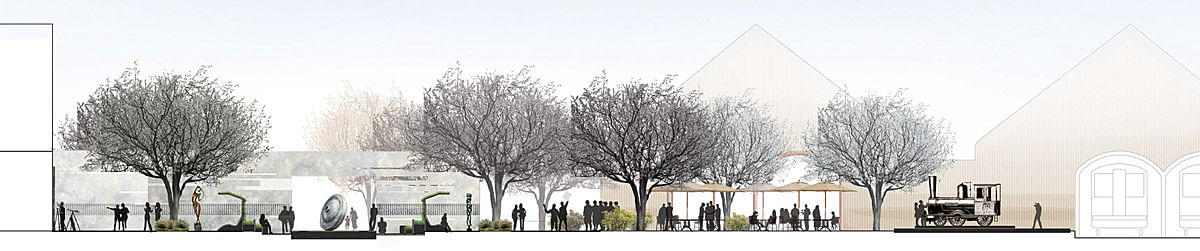
AA-section (Image: AGER Group)
CC-section (Image: AGER Group)
DD-section (Image: AGER Group)

Find more diagrams in the image gallery below.
Share

  • Follow

    0 Comments

  • Comment as :

Archinect JobsArchinect Jobs

The Archinect Job Board attracts the world's top architectural design talents.

VIEW ALL JOBS POST A JOB

Graduate Architect

RATIO Design

Graduate Architect

Chicago, IL, US

AutoCAD Drafter/Architectural Designer

Kari Whitman Interiors

AutoCAD Drafter/Architectural Designer

Boulder, CO, US

Architect / Urban Designer

Office for the Next Environment (OFTN)

Architect / Urban Designer

New York, NY, US

Architect / Project Manager

Curtis + Ginsberg Architects LLP

Architect / Project Manager

New York, NY, US

Designer

HATCH ARCHITECTURE

Designer

Los Angeles, CA, US

Project Architect

Arrowstreet

Project Architect

Boston, MA, US

Associate - Interior Designer

FitzGerald Associates Architects

Associate - Interior Designer

Chicago, IL, US

Registered Architect

Advantage Point Group, Inc.

Registered Architect

Saint Paul, MN, US

Intermediate Architect/Designer

DXA Studio

Intermediate Architect/Designer

New York, NY, US

Project Architect

Berliner Architects

Project Architect

Culver City, CA, US

Next page » Loading